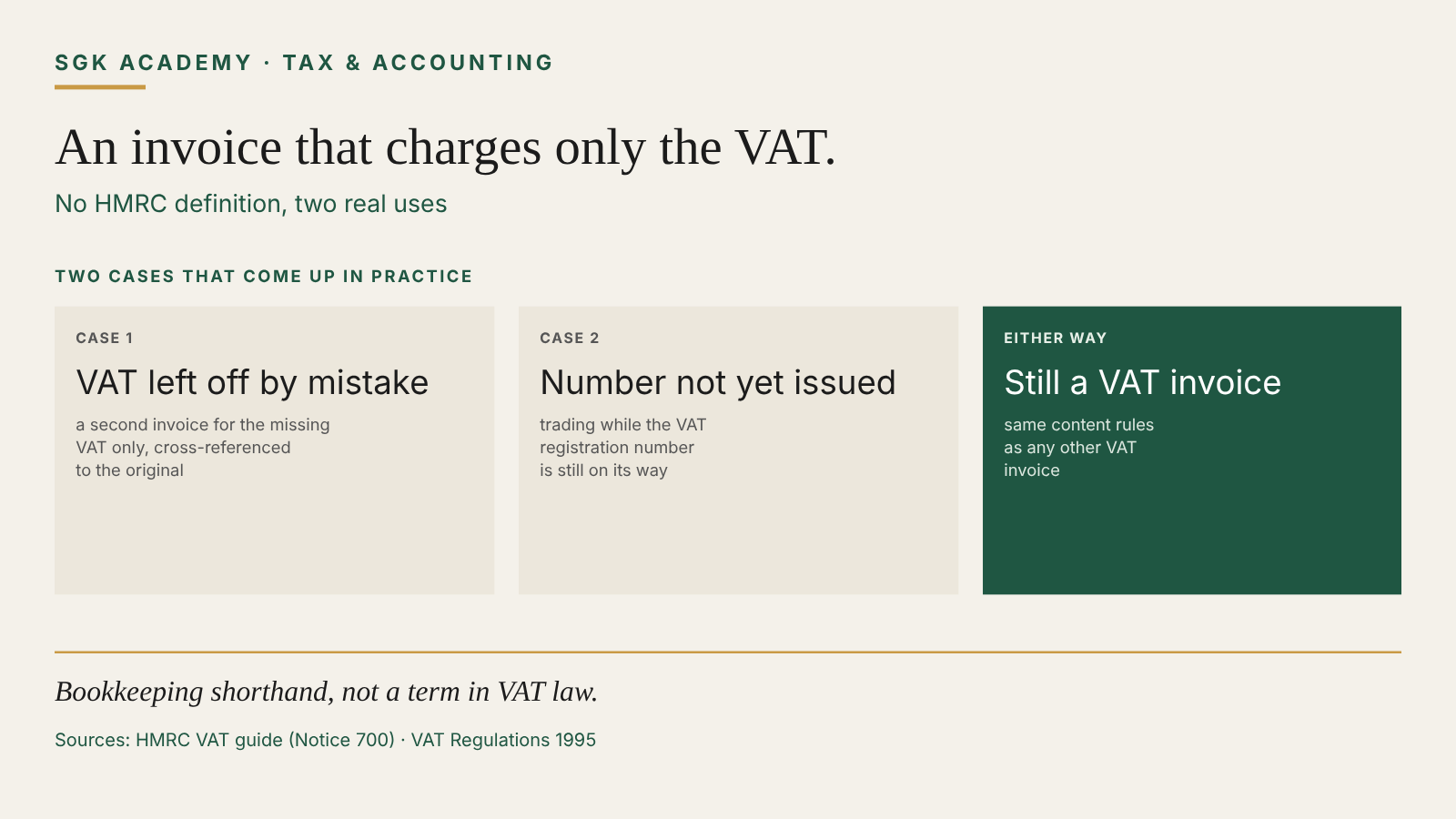
A “VAT-only invoice” is not a term HMRC defines in VAT law or in the VAT guide (Notice 700). It is bookkeeping shorthand for a document that charges VAT by itself, without a matching net value, because the net amount was already invoiced, agreed or assessed somewhere else. Two situations account for most real uses: fixing an invoice issued without VAT by mistake, and bridging the gap before a new VAT registration number arrives.
Once issued, a VAT-only invoice is still a VAT invoice in HMRC’s eyes, and it has to meet the same content rules as any other one.
The two cases that come up in practice
You left VAT off an invoice by mistake. A supply was standard-rated, the invoice went out showing only the net amount, and the error was spotted after the customer had already paid or booked it. Rather than cancel the original invoice and reissue a new one for the full gross amount, many businesses raise a second invoice for the missing VAT only, cross-referenced to the first. The net value, description and customer stay on the original document; the second one adds only the tax that should have been charged on it.
You are trading before your VAT registration number arrives. HMRC’s position is that you cannot show VAT as a separate charge, or call a document a VAT invoice, until your registration number has been confirmed. A business approved for registration but still waiting for the number has two common workarounds: raise the price to the VAT-inclusive amount with a note that a VAT invoice will follow, or invoice at the net rate and send a second, VAT-only invoice once the number is issued. HMRC expects proper VAT invoices for the intervening sales within 30 days of being told the number, which in practice means the VAT-only catch-up invoice has to go out promptly once registration is confirmed, not whenever is convenient.
A third situation, less often handled this way, is import VAT. Import VAT is assessed by UK customs on the import itself, not charged by the overseas supplier, so the supplier’s invoice normally carries no VAT at all. The VAT shows up separately, either as a C79 certificate for VAT paid at the border or on the monthly statement under postponed VAT accounting, and a customs agent or freight forwarder’s own invoice for duty and clearance fees is a different document again. Some accounting software labels these separate VAT entries “VAT-only,” but they are not VAT invoices from the original supplier and should not be treated as if they adjust a UK sales invoice.
It is still a VAT invoice
A VAT-only invoice does not get an exemption from the normal invoicing rules just because the net figure is zero. The content requirements for a full VAT invoice come from regulation 14(1) of the VAT Regulations 1995, as amended with effect from 1 October 2007, and HMRC’s manual (VATREC5010) sets out the particulars that have to appear. In practice that means a VAT-only invoice still needs:
| Element | What goes on a VAT-only invoice |
|---|---|
| Supplier details | Your business name, address and VAT registration number, exactly as on any other invoice |
| Invoice number and date | Its own sequential number and issue date, separate from the original invoice |
| Reference to the original supply | The original invoice number and date, and a description tying the VAT to that supply |
| VAT rate | The rate that applied to the underlying supply — you cannot apply a different rate on the correction than applied to the original sale |
| VAT amount | The VAT amount itself, shown as the only monetary figure for the supply |
| Customer details | The customer’s name and address, as on a full invoice |
If the gross value of the correction is £250 or less, the simplified invoice rules under regulation 16A can apply instead of the full list above, but the supplier’s VAT registration number, the VAT rate and the amount still need to appear; the simplified format is for situations where a full invoice’s detail is not practical, not an excuse to drop the VAT number.
A worked example
A design agency invoices a client £4,000 for a standard-rated project, dated 3 March. The invoice is issued without VAT by mistake and the client pays the full £4,000. The agency spots the error during its next VAT return preparation.
| Step | Figure | Note |
|---|---|---|
| Original invoice | £4,000, no VAT shown | Should have been £4,000 + £800 VAT at 20% |
| VAT-only invoice raised | £800 | References the 3 March invoice number and date |
| VAT due from the agency | £800 | Declared in box 1 of the return covering the date of supply, not the date the error was found |
| Amount still owed by the client | £800 | Unless the agency absorbs it, which is a commercial decision, not a VAT one |
The VAT due date follows the original supply, not the date the mistake was caught. If the £800 VAT-only invoice falls in a later VAT period than the original £4,000 net invoice, the output tax should still be corrected against the period of the original supply; a current-period adjustment of this size may need the error correction process in VAT Notice 700/45 rather than simply adding £800 to the next return, depending on how far back the original invoice goes and the value involved. HMRC’s self-correction limits allow a net error of £10,000 or less to go through the next return automatically (or up to £50,000 if it does not exceed 1% of the box 6 figure for that period); above that, or for a deliberate error, the business reports it on form VAT652 instead.
Before you raise one, check these
- Confirm the rate. The VAT-only invoice should use the rate that applied to the original supply (20%, 5% or 0%), never a rate chosen to make the numbers convenient.
- Cross-reference the original invoice. State its number, date and a short description so the VAT clearly attaches to a specific supply rather than floating as an unexplained charge.
- Work out whether this is a correction or a price change. An invoice that adds VAT you simply forgot is not the same as one that follows an agreed increase in price; a genuine price increase is usually handled with a debit note rather than a bare VAT-only invoice. See our guide to credit notes and VAT adjustments for the matching case where the price goes down.
- Size the correction against the error limits. If the missing VAT, combined with any other errors in the same return period, is over £10,000 (or over £50,000 and more than 1% of box 6), use the VAT652 disclosure route instead of adjusting the current return.
- Do not use one to charge VAT before registration is confirmed. Wait for the registration number; then issue proper VAT invoices for the intervening sales, normally within 30 days of being told the number.