If your business handles personal data on a computer, you almost certainly owe the UK data protection fee: £52, £78 or £3,763 a year, depending on how many people work for you and how much you turn over. The fee goes to the regulator most people still call the ICO, and it is set by regulation. Sole traders pay it too. The few exemptions apply only when everything you do with personal data falls inside a short statutory list.
This guide works through the three questions behind the searches people make about it: which tier you are in, whether you can be exempt, and what a letter about non-payment really means. It also covers the one change of 2026 that affects who you are paying, and a gap in the published penalty figures that is worth knowing about before you pay a fine at the wrong amount.
Last checked 24 November 2026.
The short answer
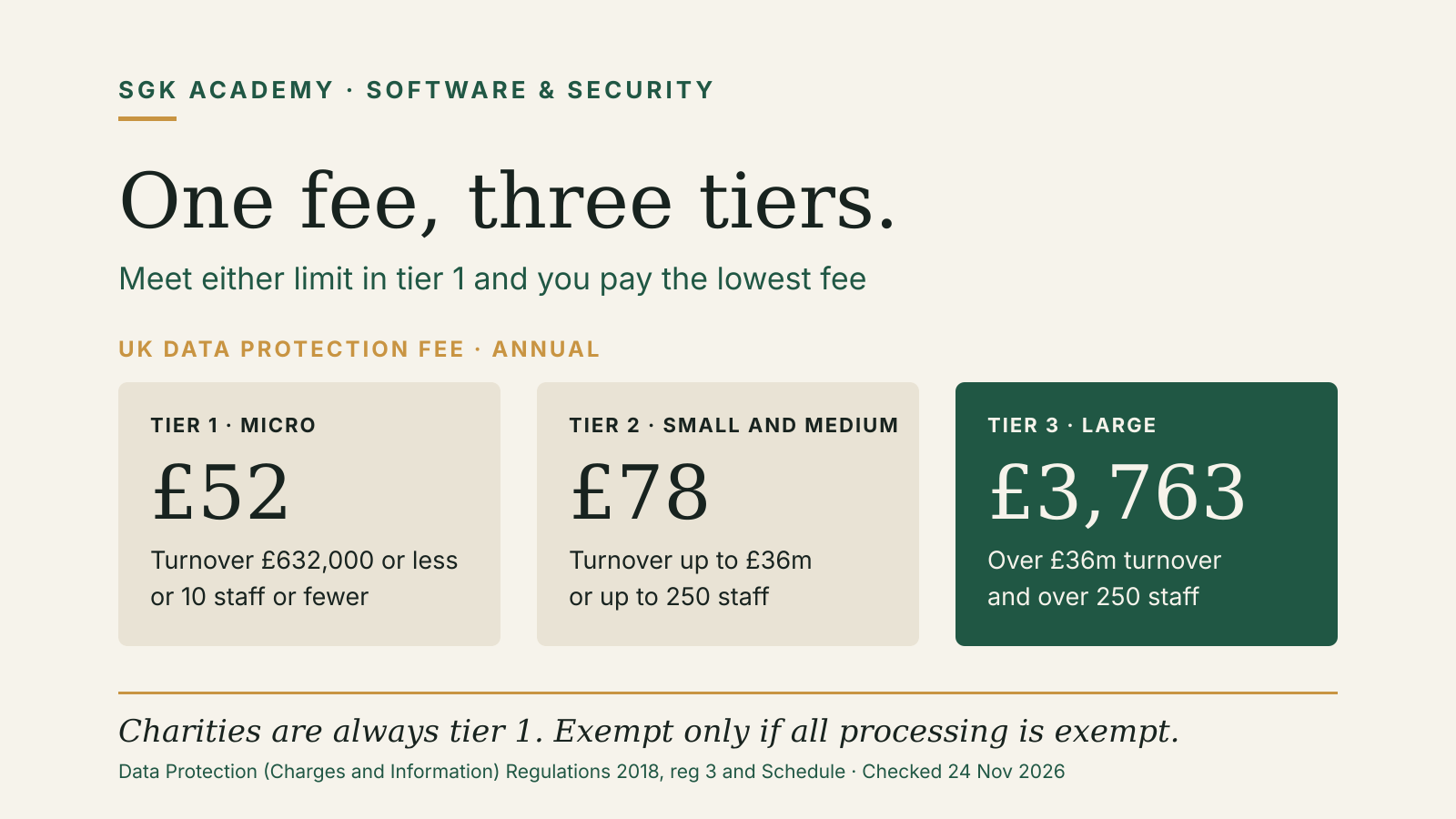
The fee is charged under the Data Protection (Charges and Information) Regulations 2018. The amounts were raised on 17 February 2025 by SI 2025/63 and have not changed since; GOV.UK’s fee page gives the same range.
| Tier | Who is in it | Annual fee | By direct debit |
|---|---|---|---|
| 1 | Turnover of £632,000 or less, or 10 staff or fewer, or a charity, or a small occupational pension scheme | £52 | £47 |
| 2 | Not tier 1, and turnover of £36 million or less, or 250 staff or fewer | £78 | £73 |
| 3 | Everyone else | £3,763 | £3,758 |
The direct debit reduction is £5 under regulation 3(5). The fee does not carry VAT, because the regulator’s FAQ says statutory fees are outside the scope of VAT.
“Or”, not “and”: how the tier test really works
Most small businesses misread tier 1. Regulation 3(2)(a) lists the conditions as alternatives: a turnover of £632,000 or less, or 10 members of staff or fewer. Meeting either one puts you in tier 1. A company with £4 million of turnover and eight employees pays £52. A one-person company with £900,000 of turnover pays £52 as well.
Tier 2 is also an “or”: turnover of £36 million or less, or 250 staff or fewer, once you are outside tier 1. So a business with 300 staff and £20 million of turnover is in tier 2. Tier 3 is reached only when you miss both limits at once, which means more than 250 staff and more than £36 million of turnover.
Worked examples. These are illustrative businesses, not real ones.
| Business | Staff | Turnover | Tier and fee |
|---|---|---|---|
| Design studio, limited company | 3 | £1.4m | 1: £52 (staff 10 or fewer) |
| Online shop, limited company | 14 | £580,000 | 1: £52 (turnover £632,000 or less) |
| Online shop, same company a year later | 14 | £700,000 | 2: £78 (neither tier 1 limit met) |
| Logistics firm | 300 | £20m | 2: £78 (turnover £36m or less) |
| Manufacturer | 300 | £50m | 3: £3,763 |
| Registered charity | 500 | £60m | 1: £52 (charities are always tier 1) |
| Company incorporated four months ago | 2 | £0 so far | 1: £52 |
The last row follows from the definition of “financial year” in regulation 1: a controller that has existed for less than 12 months uses the period of its existence. For an older company the figure comes from the most recent financial year that ended before the first day of the charge period, not from a forecast, and turnover and staff are fixed on that first day (regulation 3(4)).
How to count staff
The regulations define the staff number as an average. You count the number of people who were members of staff in each completed month of the financial year, add the monthly totals and divide by the number of months. The regulator’s guide to the fee says “members of staff” covers employees, workers, office holders and partners, that each part-timer counts as one, and that people based overseas count.
An example with a 12-month year: 8 people in each of the first three months, 9 in the next two, 12 in the next two, 13 in the next two and 14 in the last three. The monthly totals add to 134, and 134 divided by 12 is 11.2. That is above 10, so the staff route to tier 1 is closed. If turnover for the year was £580,000, the company is still tier 1 on turnover. If it was £700,000, the company is tier 2 and owes £78.
What you must give them besides the money
Regulation 2(3) requires more than payment. Within the first 21 days of each charge period you must tell the regulator your name and address, whether your staff number is up to 10, over 10 and up to 250, or over 250, whether your turnover is up to £632,000, over that and up to £36 million, or over £36 million, and whether you are a public authority. For a registered company the address is its registered office; for anyone else it is the principal place of business in the UK (regulation 2(5)).
Regulation 2(2) sets the same 21-day window for payment. The fee then covers 12 months from the renewal date, not from the date you paid, according to the FAQ, and the regulator does not treat you as covered until it receives a payment it can match to you. Put the registration reference on every payment.
Check the address on your registration against your privacy notice. The regulator’s own fee page records that its head office moved from Wilmslow to Manchester in September 2026, so a privacy notice that names the old office address for complaints is now out of date.
Are you exempt?
You are exempt only if all of your processing of personal data is exempt processing (regulation 2(1)). One non-exempt activity brings you back into the fee. Paragraph 2 of the Schedule to the Regulations lists what counts, and for a small business the relevant entries are these:
| Exempt processing (Schedule, para 2(2)) | What it covers in practice |
|---|---|
| (a) Not automated | Paper records that are not meant to be put on a computer |
| (b) Personal, family or household affairs | Your own address book, not your customers |
| (d) Staff administration | Managing staff, volunteers and contractors |
| (e) Advertising, marketing and public relations | Promoting your own goods or services |
| (f) Accounts and records | Keeping accounts and records of purchases and sales, deciding whether to accept a customer or supplier, and financial forecasts |
| (g) Not-for-profit membership bodies | Running membership or support activities |
Two reading points follow from the text. First, the list is about purposes. A business that only keeps customer and supplier accounts, runs payroll for its staff and sends marketing about its own products can fall entirely inside (d), (e) and (f). Second, the list contains no entry for recording customers on CCTV, running a customer relationship system that records support calls, or profiling users of a website, so a business doing any of those has processing outside the list and owes the fee. Paragraph 2(4) also excludes credit reference agencies from the accounts exemption.
The wording “unless all of the processing is exempt” is why the regulator’s online self-assessment exists, and it is the quickest way to get a recorded answer. The regulator’s fee page states that sole traders are covered when they use personal information, unless exempt, so working for yourself does not change the test.
A decision not to pay on grounds of exemption should be written down. Note the date, the activities you reviewed against each paragraph of the Schedule and the result of the self-assessment, and re-run it when you add a tool that records or analyses people, such as a CCTV system or an AI note-taker. The DPIA for AI tools guide covers how to review one of those before you switch it on.
What happens if you do not pay
The route to a fine is slower than most letters make it sound, and the amounts are fixed by a published document.
- The regulator sends a reminder before your previous payment expires, according to the FAQ.
- If you neither pay nor say you no longer need to, the FAQ says it can issue a notice of intent 28 days after expiry. You then have 28 days to pay or make representations.
- If nothing arrives, a monetary penalty notice can follow.
The regulator’s published fixed penalties for failing to pay the charge are £400 for tier 1, £600 for tier 2 and £4,000 for tier 3, with a reserved right to go up to £4,350 where a controller fails to supply the information needed to decide the fee or exemption, for example by ignoring the regulator.
| Tier | Annual fee | Fixed penalty | Penalty as a multiple of the fee |
|---|---|---|---|
| 1 | £52 | £400 | 7.7 times |
| 2 | £78 | £600 | 7.7 times |
| 3 | £3,763 | £4,000 | 1.1 times |
A notice of intent is not itself a fine. The regulator’s pay a penalty page says that if the letter or email is headed “Notice of intention to issue a penalty notice”, you only need to pay the annual fee by the deadline in the notice. Once paid, the records update automatically and no monetary penalty notice follows. The same page says a penalty itself is paid by BACS to the account given on the monetary penalty notice, with the registration reference included.
A discrepancy in the published ceiling
The FAQ and the penalties page both say the maximum fine is £4,350 and describe it as 150% of the top-tier fee. That is arithmetically the old top tier: 150% of £2,900 is £4,350. Section 158(3) of the Data Protection Act 2018 allows the regulator to specify a penalty up to 150% of the highest charge payable, disregarding any direct debit discount. With the top tier now at £3,763 that ceiling is £5,644.50. I did not find a published penalty document that uses it. The practical position is that £400, £600 and £4,000 are the stated amounts and £4,350 is the stated limit; a letter demanding a different figure should be checked against the regulator’s current document before payment.
Who you are paying: the Information Commission
On 30 September 2026 the Information Commission took over the functions of the Information Commissioner’s Office, under the Data (Use and Access) Act 2025, as announced by GOV.UK. GOV.UK states that the change does not alter the regulator’s role, responsibilities or powers. The consolidated text of regulation 2 on legislation.gov.uk now names the Information Commission as the body to be paid, and the GOV.UK fee page is headed “Information Commission (ICO)”. The fee amounts did not change. The regulator’s own website still uses the ICO name, and the penalties document still says “Information Commissioner”, so expect both names for a while.
Nothing in the sources I read says a business must re-register because of the new name, and a letter in either name can be genuine. Verify the sender by starting from GOV.UK rather than from a link in an email.
Is the letter genuine?
Search suggestions for this topic include “is it legit” and “scam”, and the worry is reasonable: the fee is small enough that people pay without checking. Three checks hold up against what the regulator publishes.
- Start from GOV.UK. The GOV.UK page links to the regulator’s own service. Use that route, not a payment link in a message.
- Match the wording. The regulator’s own page describes the notice it sends before any fine as one headed “Notice of intention to issue a penalty notice” and says it asks you to pay the annual fee by the deadline in the notice. The regulator’s self-assessment starts by asking whether you have had a letter or email that referenced your Companies House number, one about renewing your registration, or a notice of intention.
- Match the amount. A genuine demand for the fee is one of £52, £78 or £3,763 less any direct debit discount. A request for a sum that is not one of those three amounts is not the statutory fee.
If a payment is made to the wrong party, tell your bank promptly. The invoice fraud payment checks guide sets out what to ask for.
Questions
Do sole traders have to pay the data protection fee?
Yes, if they process personal data in their business and the processing is not wholly exempt. The regulator’s fee page names sole traders. A sole trader with few staff is normally in tier 1 at £52.
Do I pay if I only keep customer invoices and payroll?
Possibly not. Staff administration, accounts and records of sales and purchases, and marketing of your own goods are separate exemptions in paragraph 2 of the Schedule. If those are all you do with personal data, you may be exempt, and the self-assessment will record that. A website that profiles visitors or a CCTV system takes you outside them.
Is turnover or staff number used?
Either can place you in tier 1 or tier 2. Tier 1 needs turnover of £632,000 or less, or 10 staff or fewer. The test is read on the first day of the charge period using the last completed financial year.
Does the fee include VAT?
No. The regulator’s FAQ says statutory fees are outside the scope of VAT.
How long does one payment cover?
Twelve months from the renewal date, not the date of payment, and only once the regulator can match the payment to you.
What if I miss the date?
You still owe the fee. A notice of intent can follow 28 days after expiry, and the stated fixed penalties are £400, £600 or £4,000 by tier.
Do charities pay?
Yes, at tier 1, under regulation 3(2)(a)(iii), unless all their processing is exempt.
Does a data breach change the fee?
No. Breach duties are separate; see data breach reporting for small businesses. The same goes for subject access requests.
Sources
- legislation.gov.uk: Data Protection (Charges and Information) Regulations 2018, SI 2018/480; regulations 1 to 3 and the Schedule.
- legislation.gov.uk: SI 2025/63, Amendment Regulations 2025; fee increase from 17 February 2025.
- legislation.gov.uk: Data Protection Act 2018, section 158; fixed penalties and the 150% limit.
- ICO: Guide to the data protection fee; tiers, staff count and direct debit discount.
- ICO: Data protection fee FAQs; VAT, renewal, notice of intent timing and the £4,350 maximum.
- ICO: Fixed penalties for failure to pay the data protection charge; £400, £600 and £4,000.
- ICO: Pay a penalty; notice of intention and how penalties are paid.
- ICO: Data protection fee and self-assessment.
- GOV.UK: Pay the data protection fee and how much it costs.
- GOV.UK: Information Commission succeeds the ICO as UK’s data protection regulator (30 September 2026).
Sources reviewed on 24 November 2026. This guide describes the rules for UK controllers and is not legal advice; confirm your tier and any exemption with the regulator’s self-assessment or an adviser.