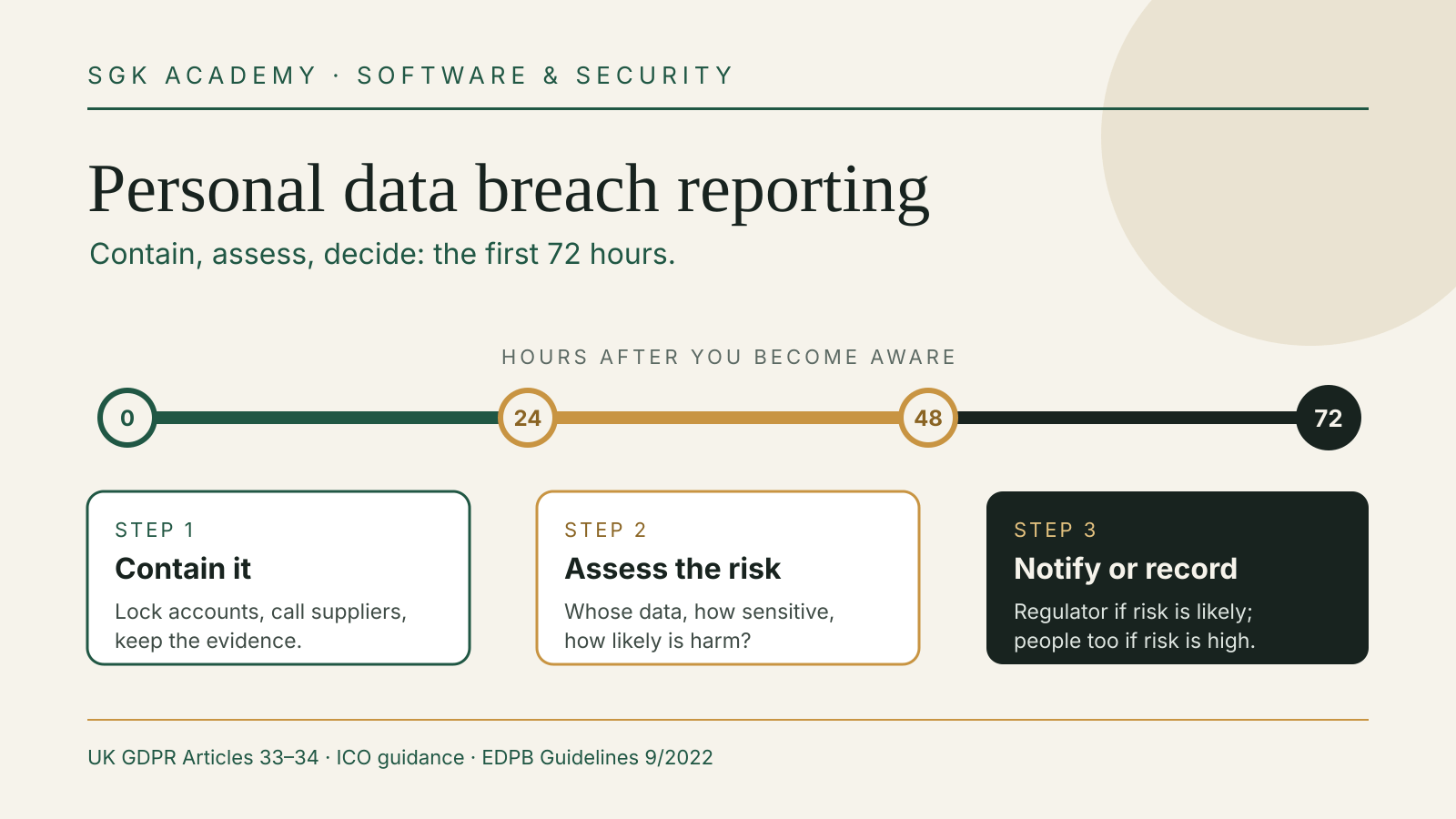
Data breach reporting for a small business usually starts with something ordinary: a laptop left on a train, an invoice run sent to the wrong client list, a supplier email saying “we have detected unauthorised access”. The legal clock does not wait for a full investigation. Under the UK GDPR and the EU GDPR, a notifiable personal data breach goes to the regulator within 72 hours of becoming aware of it, where feasible, and some breaches must also be told to the people affected.
This guide sets out what counts as a breach, when the clock starts, which authority to tell when customers live in several countries, and how to keep the record the law requires even when nothing is reported.
Source and version check: reviewed 21 October 2026 against UK GDPR Articles 33 and 34 on legislation.gov.uk, the ICO’s guide to personal data breaches and its breach reporting page, and EDPB Guidelines 9/2022 (version 2.0, adopted 28 March 2023). The ICO notes that its breach guidance is under review after the Data (Use and Access) Act 2025, so check the linked pages before relying on a detail.
What counts as a personal data breach
The ICO defines a personal data breach as a breach of security leading to the accidental or unlawful destruction, loss, alteration, unauthorised disclosure of, or access to, personal data. Intent does not matter: a mistake counts as much as an attack.
In practice that covers more than hacking. The ICO’s own list includes:
- access by an unauthorised third party;
- sending personal data to the wrong recipient;
- a lost or stolen device holding personal data;
- personal data altered without permission;
- loss of availability, such as records encrypted by ransomware or deleted without a backup.
A useful shorthand from the ICO is confidentiality, integrity and availability. If an incident affected any of the three for personal data, treat it as a possible breach and start the process below. Not every breach has to be reported, but every one has to be assessed and recorded.
When the 72 hours start
Article 33(1) of the UK GDPR says the controller must notify “without undue delay and, where feasible, not later than 72 hours after having become aware of it”. If the notification is late, it must give reasons for the delay.
“Aware” has a specific meaning. The European Data Protection Board says a controller becomes aware when it has a reasonable degree of certainty that a security incident has led to personal data being compromised. A short initial investigation to establish that is allowed, but it should start immediately. The EDPB’s examples help:
| Situation | When awareness starts |
|---|---|
| A USB stick with unencrypted personal data is lost | When you realise it is lost, even if you cannot tell whether anyone read it |
| Someone tells you they received a customer’s data by mistake and shows you | At once: you have clear evidence |
| Monitoring flags a possible intrusion, and you check and confirm data was reached | When the check confirms it |
| An attacker contacts you demanding a ransom | Once you confirm the system was attacked |
Two consequences follow for small teams. First, the clock is measured in hours, not working days, so a breach found on a Friday afternoon is due before Monday afternoon. Second, “we were still looking into it” protects you only for the brief period needed to confirm that something happened, not for the whole investigation.
The decision: report, tell people, or record only
There are three levels of response, and each has its own test.
| Likely effect on people | Tell the regulator? | Tell the individuals? | Record internally? |
|---|---|---|---|
| Unlikely to result in a risk | No | No | Yes |
| A risk is likely | Yes, within 72 hours where feasible | Not required unless the risk is high | Yes |
| A high risk is likely | Yes | Yes, without undue delay | Yes |
The ICO’s illustration: theft of a customer database that could be used for identity fraud should be reported, but the loss or alteration of a staff telephone list normally would not be. The focus is on consequences for the people whose data it is, such as fraud, financial loss, discrimination, damage to reputation or loss of confidentiality, not on embarrassment to the business.
To judge the level, look at:
- What data: contact details, bank details, identity documents, health information, passwords.
- How many people, and who: a handful of business contacts or thousands of consumers; children or vulnerable people.
- What happened to it: read by a stranger, published, merely unavailable for an hour, or deleted and restored from a backup.
- Whether it was protected: encrypted with a key that was not compromised, or in plain text.
- What you can still do: recall an email, revoke access, force password resets.
If you decide not to report, write down why. The ICO says you must be able to justify the decision, and Article 33(5) requires you to document every breach anyway.
Encryption changes the answer, not the definition
A stolen laptop with full-disk encryption is still a breach. The EDPB explains, however, that if personal data was encrypted with a state-of-the-art algorithm and the key was not compromised, the data is in principle unintelligible, so the breach is unlikely to harm individuals and may not need reporting. That is one of the strongest arguments for turning on device encryption before anything goes wrong. It also appears in Article 34(3)(a) as a reason not to tell individuals.
What the notification must contain
Article 33(3) lists the minimum content of a report to the regulator:
- the nature of the breach, including, where possible, the categories and approximate number of people and of records concerned;
- the name and contact details of the data protection officer or another contact point;
- the likely consequences of the breach;
- the measures taken or proposed to deal with it, including steps to reduce possible harm.
You do not need every answer before reporting. Article 33(4) allows information to be provided in phases “without undue further delay”. The ICO’s current position is “report early, update later”: send what you know inside 72 hours, say when you expect more, then follow up.
In the UK the report is made online. The ICO says its form takes about 30 minutes and cannot be saved and resumed, so collect the facts first. It asks what happened, when and how you found out, who is or may be affected, what you are doing about it, and who else you have told. If you are unsure whether a report is needed, the ICO publishes a self-assessment tool on the same page.
A note on the regulator’s name
On 30 September 2026 the office of the Information Commissioner was abolished and its functions passed to a new body, the Information Commission, under sections 118 and 119 of the Data (Use and Access) Act 2025. Article 33 of the UK GDPR on legislation.gov.uk now refers to “the Commission”. The ICO said in its announcement that it will continue to be known as the ICO, and the reporting route is unchanged. A notification addressed to the ICO reaches the right body.
Telling the people affected
When a breach is likely to result in a high risk to people’s rights and freedoms, Article 34 requires you to tell them without undue delay. The message must be in clear and plain language and contain at least the contact point, the likely consequences and the measures taken, the same elements as items 2 to 4 above.
The ICO adds that you should give specific advice people can act on, for example resetting a password, watching for phishing emails that use the leaked details, or checking their bank accounts.
Article 34(3) lists three cases where individual messages are not required:
- the data was protected in a way that makes it unintelligible to anyone not authorised, such as encryption;
- you have since taken measures that mean the high risk is no longer likely to materialise;
- contacting people individually would involve disproportionate effort, in which case a public communication or similar measure must inform them equally effectively.
The regulator can also require you to inform people if it considers the risk high, so do not treat these exceptions as a way of avoiding an uncomfortable email.
When a supplier has the breach
Most small businesses hold personal data in other people’s systems: accounting software, a CRM, a payroll bureau, a cloud drive. In GDPR terms you are usually the controller and the supplier is your processor.
Article 33(2) requires the processor to notify the controller without undue delay after becoming aware of a breach. The EDPB says the processor should not wait to assess the risk first; that judgment belongs to you. It also says the controller should, in principle, be considered aware once the processor has told it. In other words, your 72 hours usually start when the supplier’s notice arrives, not when you finish reading its incident page.
Three things to check now rather than during an incident:
- the data processing terms with each supplier say how and how fast they will tell you (the ICO points to the contract requirements in Article 28);
- the notification goes to a monitored address, not to a former employee;
- you know which suppliers hold which categories of personal data. Our guide to software supplier checks covers the wider review.
Customers in several countries: which regulator?
This is where cross-border founders most often get caught out, because the UK and EU regimes now run separately.
UK GDPR. If you are a UK business and the breach is notifiable under the UK GDPR, you report to the ICO.
EU GDPR, with an establishment in the EU. If the business has an establishment in an EU country and the processing is cross-border, the EDPB says you notify the lead supervisory authority, the authority for your main establishment. That is not necessarily where the affected people live or where the breach happened. The EDPB advises deciding which authority that is when you write your breach plan, and, if in doubt, notifying at least the local authority where the breach took place.
EU GDPR, without an establishment in the EU. A UK, US or other non-EU business that offers goods or services to people in the EU, or monitors their behaviour there, falls under Article 3(2) of the EU GDPR and is bound by the same notification duties. The EDPB is explicit that appointing an EU representative under Article 27 does not give you the one-stop shop. The breach has to be notified to every supervisory authority in whose member state affected individuals live.
The ICO makes the same point from the UK side: a breach affecting individuals in EEA countries engages the EU GDPR, and your breach plan should identify which European authority would be involved. The EDPB publishes contact details for all EU and EEA authorities.
| Your set-up | Affected people | Where to report a notifiable breach |
|---|---|---|
| UK company, UK customers only | UK | ICO |
| UK company, no EU establishment, customers in Ireland and Germany | UK, Ireland, Germany | ICO for UK data subjects; the Irish and German authorities for people living there |
| Company with a main establishment in one EU country, cross-border processing | Several EU countries | The lead supervisory authority, saying which other countries are affected |
The table describes the routing rules in the sources above. Whether the UK GDPR, the EU GDPR or both apply to a particular data set depends on your facts, so record the reasoning in the breach log.
Other reports you may owe
The UK GDPR process is not the only one. The ICO lists separate regimes:
- Communications service providers report personal data breaches under PECR on a separate ICO form. The ICO notes that the Data (Use and Access) Act changed that deadline from 24 hours to 72 hours.
- UK trust service providers under the eIDAS Regulation report security breaches within 24 hours.
- Operators of essential services and relevant digital service providers have separate incident-reporting duties under the NIS rules, and a NIS report does not replace a personal data breach report.
The ICO also suggests considering your insurer, the police, the National Cyber Security Centre where a malicious actor was involved, and Report Fraud (Police Scotland for organisations in Scotland) where there may be criminal intent. Many cyber insurance policies have their own notification deadlines, so read yours before you need it. Those contacts belong in your wider cyber incident response plan, which also names who leads, who contains the problem and in what order systems come back.
A worked 72-hour timeline
The following is an illustrative scenario, not a real case. A four-person UK consultancy with clients in the UK and Ireland, and no EU establishment, finds on Tuesday at 09:00 that an employee’s webmail was accessed from an unknown location over the weekend. The mailbox holds client contact details and some scanned identity documents sent for onboarding.
| Time | Action |
|---|---|
| Tue 09:00 | Incident spotted. Owner named. Password reset, sessions revoked, MFA checked. |
| Tue 11:00 | Sign-in logs reviewed; access to the mailbox confirmed. Awareness starts here: the clock now runs to Fri 11:00. |
| Tue 15:00 | Inventory: about 60 client contacts, 9 identity documents, of which 4 belong to clients living in Ireland. Forwarding rules checked and removed. |
| Wed 10:00 | Risk assessed as high for the 9 people whose identity documents were exposed, because of fraud risk; likely risk for the wider contact list. Decision recorded. |
| Wed 14:00 | ICO report filed with the facts so far, noting that the access method is still being investigated. Irish Data Protection Commission notified for the 4 Irish residents. |
| Wed 16:00 | The 9 individuals emailed in plain language, with what happened, what was exposed and what to watch for. |
| Following week | Follow-up information sent to both regulators. Breach log completed with facts, effects and remedial action. |
Note what made the timeline workable: a named owner, access to sign-in logs, and a list of what data lived in the mailbox. A small team that discovers all three during the incident loses a day.
The breach log
Article 33(5) requires the controller to document every personal data breach: the facts, its effects and the remedial action taken, in enough detail for the regulator to verify compliance. This applies to incidents you decide not to report, which is where most small businesses have gaps.
A simple log entry needs:
- date and time found, and date and time of awareness;
- what happened and how it was found;
- categories of data and approximate number of people and records;
- risk assessment and the reasoning for the decision to report or not;
- regulators and individuals notified, with dates and references;
- containment and remedial steps;
- what will change to prevent a repeat.
The ICO notes that human error is the leading cause of reported breaches and suggests training, a “check twice, send once” habit and a culture in which people report near misses. A log that records near misses as well as breaches is the cheapest way to see where those errors cluster.
Prepare before the clock starts
A breach plan for a small team fits on one page. The ICO’s own checklist asks whether you can recognise a breach, have a response plan, have allocated responsibility, and know who your supervisory authority is. Turn that into concrete preparation:
- Name an owner and a deputy who decide whether to report. Write their phone numbers somewhere that does not depend on company email.
- Map where personal data lives, including suppliers, so the “how many people, which countries” question can be answered in hours. The same map is what you search when someone makes a subject access request, which runs on its own one-month clock.
- Know your authorities. UK: the ICO. EU: the lead authority if you have an EU establishment, or the authorities of the countries where your customers live if you do not.
- Turn on encryption for laptops and phones. It can be the difference between a recordable incident and a reportable one.
- Keep access tidy. Leavers with live accounts and shared passwords are a common source of breaches. See the employee offboarding access checklist and our guide to a password manager for small business.
- Reduce the chance of impersonation. Spoofed email is a common route to account takeover and invoice fraud; DMARC for small business explains the setup.
- Consider a baseline standard. Cyber Essentials covers five technical controls that reduce the most common attacks.
- Keep a template for the regulator report and the message to individuals, with the Article 33(3) headings already in place.
What failure to report can cost
The ICO states that failing to notify a breach when required can lead to a fine of up to £8.7 million or 2% of global turnover, alongside its other corrective powers. For most small firms the more immediate cost is practical: a late or missing report makes it harder to show that the rest of the response was sound, and the regulator can still require you to tell the people affected.
Official sources
- UK GDPR Article 33: notification of a personal data breach (legislation.gov.uk)
- UK GDPR Article 34: communication of a personal data breach to the data subject (legislation.gov.uk)
- ICO: Personal data breaches, a guide
- ICO: UK GDPR data breach reporting
- ICO: Report a breach
- EDPB Guidelines 9/2022 on personal data breach notification under GDPR, version 2.0
- EDPB: members and national data protection authorities
- Data (Use and Access) Act 2025, section 118: abolition of the office of Information Commissioner
- Data (Use and Access) Act 2025, section 119: transfer of functions to the Information Commission
- The Data (Use and Access) Act 2025 (Commencement No. 9 and Transitional and Saving Provisions) Regulations 2026
- ICO: governance changes confirmed for 30 September 2026