A rolling reserve is a payment provider’s hold on a fixed percentage of every sale, with each slice paid out after a set number of days. PayPal’s own example is 10% held for 90 days: 10% of what you take on day 1 comes back on day 91, 10% of day 2 comes back on day 92, and so on. The provider keeps that money as cover for refunds and chargebacks it might otherwise have to pay out of its own pocket.
Last checked 16 November 2026 against the Stripe, PayPal and Shopify documents listed under Sources.
The part most explanations skip is the cash arithmetic. A reserve is not a fee, so it never shows up as a cost line. It shows up as money you earned but cannot spend yet, and the amount locked away depends on your sales volume, not only on the percentage. This guide shows how much a reserve ties up, how that changes through a busy season, and what to ask the provider before and after it applies one.
What a rolling reserve is, in the providers’ own words
Three payment platforms that many small online businesses use define reserves in their published terms. The wording differs, but the mechanics line up.
| Provider | What its documents say | Where it is written |
|---|---|---|
| PayPal | A rolling reserve holds “a percentage of each transaction you receive each day” and releases it “later on a scheduled basis”. Example: 10% for a 90-day rolling period. PayPal calls rolling reserves the most common type. | US User Agreement, “Holds, Limitations, and Reserves” (last updated 4 November 2026); help article “What are reserves?” |
| Stripe | Two types: a fixed reserve, where “a set percentage of funds from each new transaction is held in reserve until a specified release date”, and a rolling reserve, where the percentage is “held in reserve on a rolling basis”. | Stripe Support, “Reserves” topic and “Reserves – frequently asked questions” |
| Shopify Payments | A “percentage-based reserve” withholds a share of each transaction for a set period; a “fixed amount reserve” sets aside a specific sum for a defined duration. | Shopify Help Center, “Overview of reserves in Shopify Payments” |
Shopify does not use the word “rolling”, but its percentage-based reserve works the same way: a share of each sale is held for the reserve period and the rest is paid out as normal.
PayPal adds a third form, the minimum reserve: “a specific minimum amount of money that you’re required to keep available” in the account at all times. It can be taken all at once (PayPal calls that an upfront reserve) or built up from a percentage of sales until the minimum is reached.
Why a provider adds one
A payment provider pays you before every risk on a sale has expired. A customer can still ask for a refund, and a cardholder can still raise a chargeback. If your balance cannot cover those, the provider is left to pay. A reserve is its buffer against that.
The documents say what feeds the decision:
- PayPal lists, among other factors, how long you have been in business, how likely chargebacks are in your industry, your processing and credit history, how long you take to deliver, and your rate of returns, chargebacks, claims and disputes. Its user agreement also says the decision may be based on confidential criteria.
- Stripe says the size of a reserve “is determined based on the level of risk associated with any business” and that it assesses industry conditions, payment activity, dispute rate, refund rate and financial stability.
- Stripe’s documentation for platforms that set reserves on their own sellers names the same drivers from the other side: average order value, dispute rate, industries with long delivery times or high loss rates (it gives event ticketing, travel and lodging, furniture and construction as examples) and wider events such as supply-chain disruption.
In practice, the triggers tend to be events that widen the gap between taking money and finishing the job: pre-orders, a sudden jump in volume, long delivery lead times, a spike in disputes, or a business model the provider has not seen from you before.
How much cash a 10% rolling reserve ties up
Take an illustrative online shop that takes £2,000 a day in card payments, about £60,000 a month, every day of the week. Its provider applies PayPal’s example terms: 10% held for 90 days.
| Period | Held each day | Released each day | Reserve balance at the end |
|---|---|---|---|
| Day 1 | £200 | £0 | £200 |
| Day 30 | £200 | £0 | £6,000 |
| Day 60 | £200 | £0 | £12,000 |
| Day 90 | £200 | £0 | £18,000 |
| Day 91 onwards | £200 | £200 | £18,000 |
For the first 90 days, payouts are 10% lower than sales. From day 91 the money coming back each day equals the money being held, so payouts return to their usual size. The reserve has not gone away; it has settled at a level and stays there.
That level follows a simple formula:
Reserve balance at steady state = reserve percentage × average daily sales × holding days
Here: 10% × £2,000 × 90 = £18,000. The shop has £18,000 of its own money with the provider for as long as the reserve runs. Double the sales and the locked amount doubles. Halve the holding period and it halves.
What the shop feels is a one-off cash drain of £18,000 spread over three months, then normal cash flow with a permanent £18,000 gap. If it funds that gap with an overdraft, the cost is real even though no fee is charged. At an illustrative 10% a year on the overdraft, £18,000 costs about £1,800 a year in interest.
The same reserve through a busy season
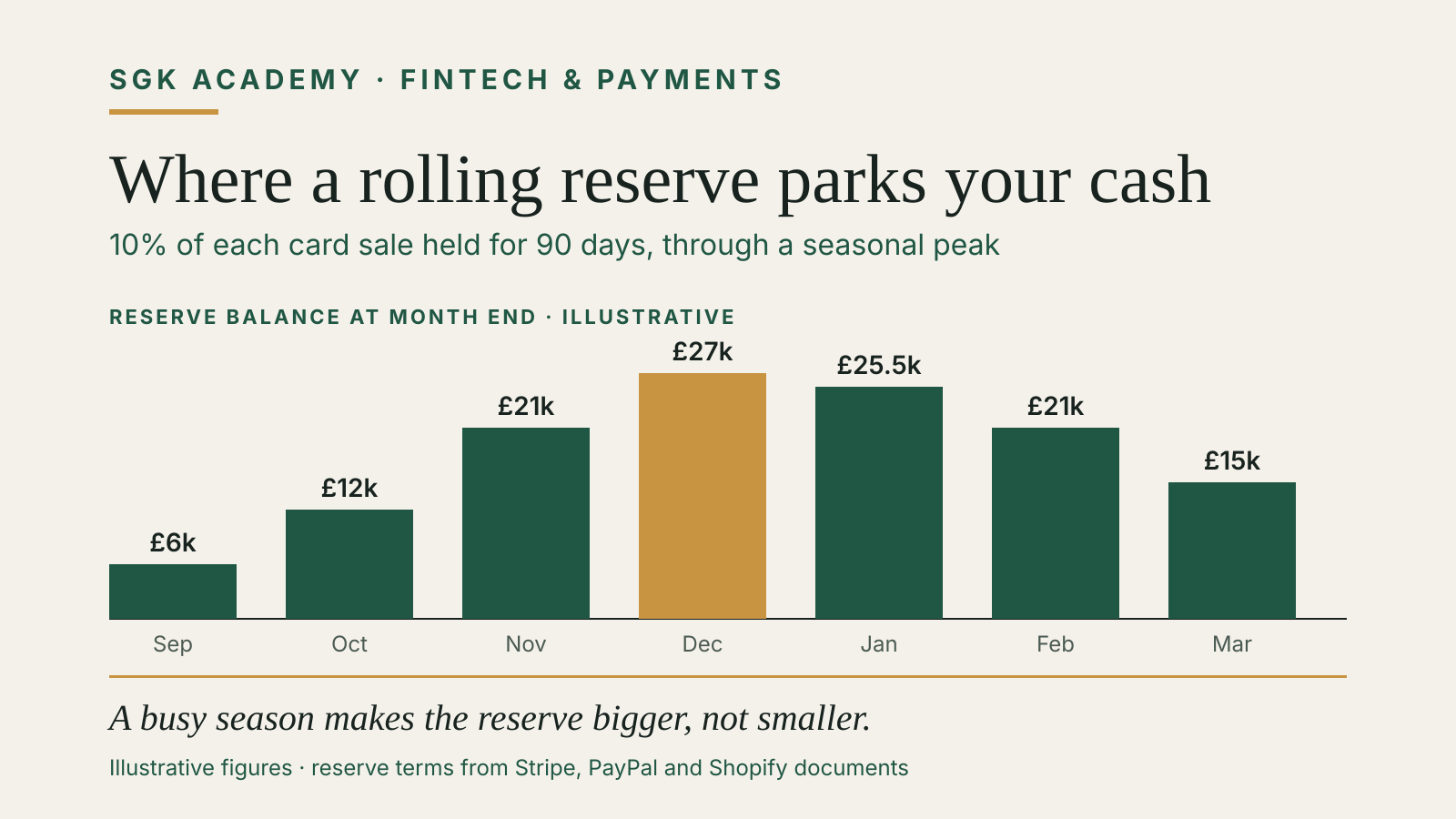
Steady sales are rare. Here is the same shop with a seasonal peak, using the same 10% held for 90 days. To keep the table readable, 90 days is treated as three calendar months, so each month’s held amount comes back three months later.
| Month | Card sales | Held (10%) | Released (from 3 months earlier) | Payout (sales − held + released) | Reserve balance at month end |
|---|---|---|---|---|---|
| September | £60,000 | £6,000 | £0 | £54,000 | £6,000 |
| October | £60,000 | £6,000 | £0 | £54,000 | £12,000 |
| November | £90,000 | £9,000 | £0 | £81,000 | £21,000 |
| December | £120,000 | £12,000 | £6,000 | £114,000 | £27,000 |
| January | £45,000 | £4,500 | £6,000 | £46,500 | £25,500 |
| February | £45,000 | £4,500 | £9,000 | £49,500 | £21,000 |
| March | £60,000 | £6,000 | £12,000 | £66,000 | £15,000 |
Fees, refunds and chargebacks are left out so the reserve’s effect stands alone. Three things stand out.
- The reserve peaks just after the peak season. At the end of December the provider holds £27,000, which is 10% of October, November and December together. That is exactly when the shop has paid for its Christmas stock and is waiting on slow January sales.
- The December money comes back in March. The £12,000 held from December sales is released at the end of the 90 days, after the quiet months it might have paid for.
- A good season makes the reserve bigger. Nothing about the business got riskier; it simply sold more, and a percentage of more is more.
For a seasonal business, a long holding period hurts more than a high percentage. A 20% reserve held for 30 days would lock up £24,000 at the end of December (20% of December’s £120,000), but it would give the December money back in January, when it is needed.
Rolling, fixed or minimum: the same shop, three ways
The same £18,000 of protection can be set up in different ways. Using the steady £2,000 a day shop:
| Reserve type | Illustrative terms | Cash locked | When it comes back |
|---|---|---|---|
| Rolling | 10% of each sale, each slice held 90 days | Builds to £18,000 by day 90, then stays there | Continuously, 90 days after each sale |
| Fixed (Stripe’s definition) | 10% of each sale until a set release date 90 days away | Builds to £18,000 by the release date | All at once on the release date |
| Minimum, upfront (PayPal’s definition) | £18,000 required in the balance from day 1 | £18,000 straight away | When the provider lowers or removes it |
| Minimum, built from sales | 25% of each sale until £18,000 is reached | Reaches £18,000 after 36 days (£500 a day) | When the provider lowers or removes it |
The fixed version is the gentlest on cash at the end, because everything comes back in one payout. It suits a one-off risk such as a batch of pre-orders or an event. Stripe’s own guidance for platforms describes fixed reserves for “temporary or date-specific” concerns and rolling reserves for ongoing risk. The upfront minimum hurts most on day 1 and is the only type with no built-in release date.
What happens to the held money
A reserve is still your money. What the documents say about its use:
- Refunds and disputes come out of it first where they can. Stripe says that when a refund or dispute arises, “its corresponding reserve will be released and used to cover the refund/dispute immediately”. Its platform documentation says refunds and disputed amounts on a transaction are taken first from the amount reserved from that transaction.
- PayPal says chargebacks and disputes are deducted from your available balance. Reserved funds show as pending.
- Release at the end of the period. Stripe says reserve funds “will be released in full at the end of the reserve period” and that it runs another credit review a few days before a reserve is due to expire. Shopify says reserved amounts are added to upcoming payouts when the reserve expires, which can take several business days.
- Changes during the reserve. PayPal says it will notify you of new terms if its risk assessment changes, and that it may lower or remove the reserve if your business improves.
- Time limits. For reserves that a platform sets on its connected sellers, Stripe’s documentation says funds cannot be reserved for longer than 180 days, and a hold releases automatically 180 days after it was created. The direct-account documents we reviewed for Stripe, PayPal and Shopify did not publish a general maximum for the provider’s own reserves, so ask for the end date in writing.
Where to see it in your account
Each provider shows reserved money separately from your available balance. Use that figure, not the payout total, when you reconcile:
- Stripe: the Balance page of the Dashboard has a reserved funds view.
- PayPal: reserved funds appear as pending in the business account.
- Shopify Payments: Finance > Payouts > Reserve lists reserve transactions, and you can export them with “Export reserve transactions”.
In the books, the reserve is money owed to you by the provider. Keep it apart from the bank balance and from customer receivables, so a cash forecast does not count it as spendable. Our 13-week cash flow forecast has a receipts section where held and released amounts fit as separate lines, and the cash runway calculator shows what the locked sum does to runway.
What to ask when a reserve is applied
Stripe and Shopify both say they explain the terms by email when they apply a reserve. Shopify says you can appeal by replying within the stated timeframe, though some reserves cannot be appealed. Before replying, get the facts you need to model it:
- Percentage and holding period. Ask for both. The steady-state formula needs both, and so does any comparison with another provider.
- Type. Rolling, fixed with a release date, or a minimum balance. The cash profile differs sharply, as the table above shows.
- Review date. Stripe says it reviews before expiry. Ask when, and what would change the outcome.
- Evidence that would lower it. Match your answer to the factors the provider names: delivery times, refund rate, dispute rate, time in business, financial position. Proof of fulfilment dates, a falling dispute rate or recent accounts address those directly.
- What triggered it. If the trigger was a one-off, such as a pre-order campaign or a single large order, ask whether a fixed reserve tied to that event could replace an open-ended rolling one.
Before you rely on a single provider, it is worth asking these questions at signup too. A cheap processing rate with a heavy reserve can cost more cash than a dearer rate with none. Our guide to card processing fees covers the fee side of that comparison.
Questions
What does rolling reserve mean?
It means a payment provider holds back a set percentage of each payment you receive and releases each held amount after a fixed number of days. With 10% for 90 days, 10% of every sale is paid out 90 days later instead of straight away.
Is a rolling reserve a fee?
No. The money is still yours and is paid out when the holding period ends, unless it is used to cover refunds or chargebacks on your sales. The cost is the cash you cannot use in the meantime.
How long does a rolling reserve last?
Each slice is held for the stated period, commonly expressed in days. The reserve itself lasts until the provider lowers or removes it. PayPal says it may do so if your business improves; Stripe says it reviews a reserve a few days before it is due to expire.
How do I calculate how much a rolling reserve holds?
Multiply the percentage by your average daily card sales and by the number of holding days. A 10% reserve held for 90 days on £2,000 a day settles at £18,000.
What is the difference between a rolling reserve and a fixed reserve?
In Stripe’s terms, both hold a percentage of each new sale. A rolling reserve pays each slice back after a set number of days; a fixed reserve holds everything until one specified release date and then pays it out together.
Does a rolling reserve have a cap?
Not by default. A rolling reserve grows with sales volume. PayPal’s minimum reserve is a fixed target amount instead of a percentage of every sale. If you want a ceiling, ask the provider whether it will agree one.