
A 13-week cash flow forecast shows when money is expected to enter and leave the bank account, one week at a time. It is short enough to update from invoices, payroll and tax dates, yet long enough to expose a funding gap before it becomes urgent.
The 13-week horizon is a practical convention, not a statutory format. A seasonal business may need a longer view alongside it. The useful part is the rolling weekly discipline: replace estimates with actual movements, move delayed receipts to their new expected week, and add a fresh week at the end.
Source check: This guide was reviewed against British Business Bank cash-flow guidance, GOV.UK VAT return deadlines and the European Commission’s OSS payment rules on 26 October 2026. Figures below are fictional and are not a forecast for any real business.
Start with the bank balance you can use
Begin with cleared cash available at the close of the previous week. Keep money that is restricted, held for clients or otherwise unavailable out of the operating balance. If an overdraft is available, show it separately rather than pretending it is cash.
The first line of the forecast should reconcile to the bank. If it does not, later weeks may look precise while starting from the wrong number.
A simple weekly structure is:
| Row | Week 1 | Week 2 | Week 3 |
|---|---|---|---|
| Opening cash | €24,000 | €20,600 | €17,100 |
| Cash received | €8,500 | €11,000 | €18,000 |
| Cash paid | €11,900 | €14,500 | €9,600 |
| Net movement | -€3,400 | -€3,500 | €8,400 |
| Closing cash | €20,600 | €17,100 | €25,500 |
Closing cash in one week becomes opening cash in the next. That link is the backbone of the model.
Put receipts in the week cash is expected
A signed contract or issued invoice is not yet cash. The British Business Bank advises placing income when the payment is expected to reach the bank account, rather than when the sale is recorded.
List receipts by source so assumptions remain visible:
- customer invoices, using realistic payment dates;
- card or marketplace payouts, after their settlement delay;
- recurring subscriptions;
- tax refunds or grants only when timing is credible;
- owner funding or loan drawdowns only after approval and conditions are clear.
For a large invoice, write the customer, invoice number, amount and assumed payment week in a notes column. If payment slips, move it. Do not leave the original date in place to protect a preferred result.
Where project work uses stages, connect the forecast to the acceptance and invoice dates in the milestone billing guide. A milestone expected in week 4 can still produce cash in week 6 if the contract allows 14 days to pay.
Schedule payments by their real due dates
Group outgoings so the person reviewing the sheet can see what is fixed, flexible or conditional. Common groups include:
- payroll, pension and contractor payments;
- rent, software and other recurring overhead;
- suppliers and inventory;
- VAT, payroll tax and income or corporation tax;
- debt repayments, fees and interest;
- equipment or one-off projects;
- owner drawings or dividends.
Use the date cash leaves the account. A cost recognised in the accounts may be paid later; depreciation is an expense but not a cash payment. Conversely, a loan repayment uses cash even though only the interest portion is normally an expense.
The invoice payment terms guide helps translate contract language into a realistic collection date. For invoices already overdue, use the dated actions in the overdue invoice reminder sequence rather than assuming immediate payment.
Add the cross-border rows
A business that sells across borders has payment dates that a domestic template can miss. Give each of these its own row rather than burying it in “other payments”:
- UK VAT returns. GOV.UK says the deadline for submitting a VAT return online is usually one calendar month and 7 days after the end of the accounting period, and that the payment must reach HMRC by the same date (GOV.UK). Put the payment in the week the money must clear, not the week you file.
- EU VAT One Stop Shop. The European Commission’s OSS guidance says the return and the payment are due by the end of the month following the tax period (European Commission). For quarterly returns that puts a payment at the end of January, April, July and October. The VAT One Stop Shop guide explains who files it.
- Processor and marketplace payouts. Enter the payout date your provider shows, net of its fees, and keep refunds and chargebacks as a separate payment row.
- Foreign-currency receipts and payments. Forecast them at a stated rate and record that rate in the assumptions column. A downside case can apply a less favourable rate to the largest items; the currency risk guide covers how to choose one.
- Income and corporate tax payments. Take the dates from the tax authority’s notices or your adviser’s schedule, then check them against the SGK deadlines tool.
VAT collected from customers is not operating cash. Showing VAT received and VAT paid as their own rows makes it easier to see how much has to be set aside for the next return.
Find the lowest cash point, not just week 13
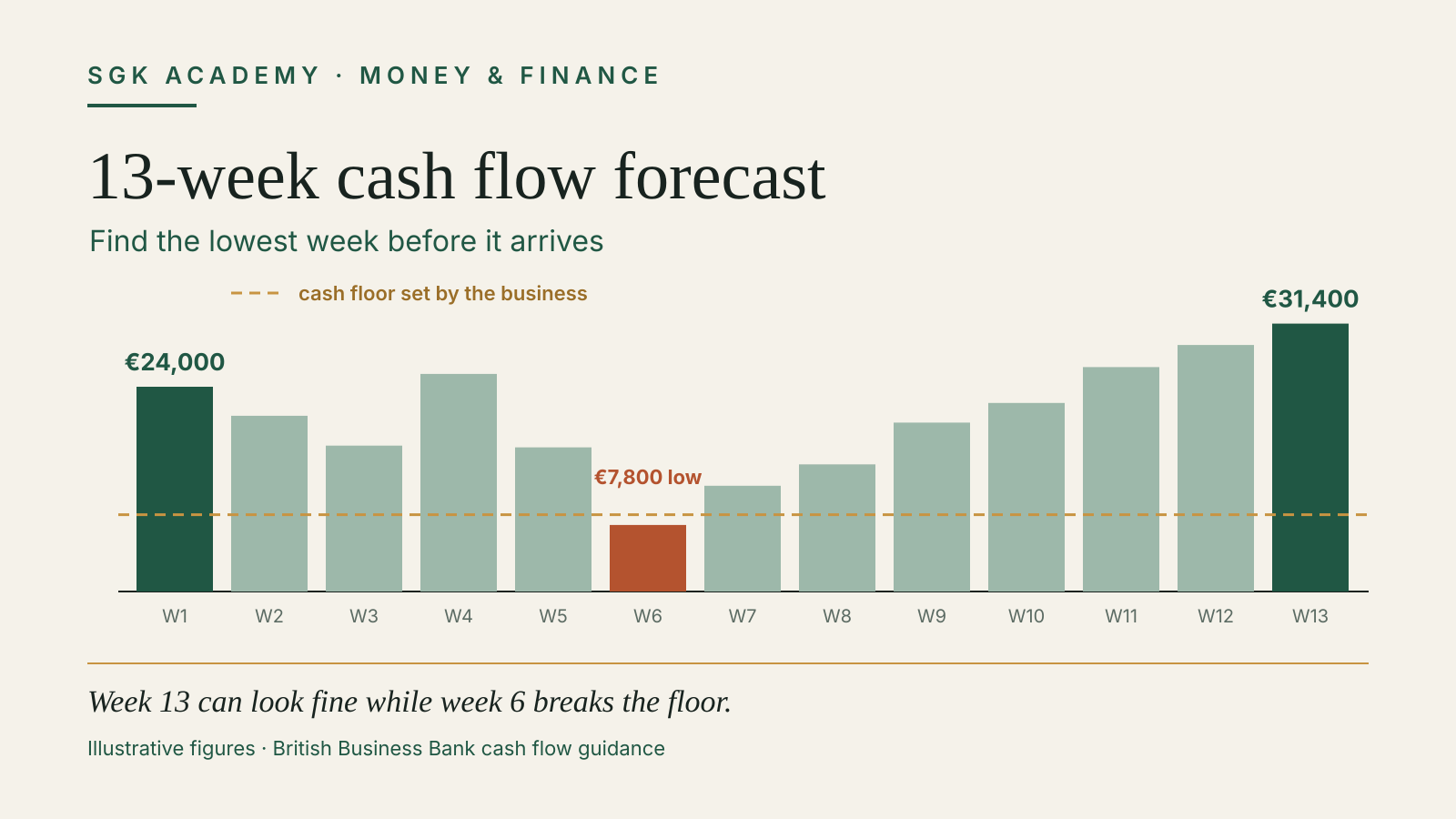
The closing balance at week 13 can look comfortable while week 6 goes below zero. Scan every column for the lowest point and the week in which it occurs.
Suppose a fictional studio starts with €24,000. Payroll and tax payments reduce cash to €7,800 in week 6. A €20,000 customer payment then lifts the week-13 balance to €31,400. The ending balance is not the immediate issue. The week-6 low point is.
Compare that low point with a cash floor set by the business. The floor might cover one payroll cycle, critical supplier payments and a margin for timing errors. It is a management choice, not a universal ratio. If owner withdrawals are what pushes the balance under the floor, our guide to paying yourself from irregular income shows how to set a fixed transfer the forecast can carry.
You can also compare the forecast with the cash runway calculator, but the two tools answer different questions. Runway uses a simplified burn-rate view. A 13-week forecast preserves the dates and uneven amounts that create a short-term squeeze.
Separate committed, likely and uncertain cash
A forecast becomes more useful when its assumptions can be challenged. Mark each large receipt or payment as one of three types:
- Committed: supported by a contract, payroll file, tax schedule or approved order.
- Likely: expected from a repeated pattern but not fixed.
- Uncertain: dependent on a sale, financing decision or unresolved dispute.
Do not total the uncertain case into the base forecast without identifying it. Instead, keep a base case and a downside case. The downside case might move the two largest customer receipts back by two weeks and increase a supplier bill by 10%.
This is not about predicting every number correctly. It shows which assumptions would change the decision.
Roll the forecast every week
Choose one update day and keep the sequence consistent:
- reconcile the opening balance to the bank;
- replace the previous week’s estimates with actual receipts and payments;
- move any late item to its new expected week;
- add new invoices, bills and approved commitments;
- investigate changes to the lowest projected balance;
- add a new week 13.
Keep a short change log. “Customer A moved from week 4 to week 6” is more useful than an unexplained shift in the total.
A forecast owned by finance but ignored by sales and operations will age quickly. The person who knows a customer has delayed approval, or that inventory must be ordered early, should feed that information into the weekly update.
Turn a forecast gap into dated actions
When the model shows a cash floor breach, work backward from the week it happens. Options may include:
- asking a customer to approve a milestone sooner;
- changing the timing of a discretionary purchase;
- agreeing a supplier schedule before the due date;
- reducing or delaying owner withdrawals;
- arranging finance before the balance is under pressure.
Each action needs an owner and date. “Improve collections” is not an action. “Morgan will call Customer A by Tuesday and confirm the disputed acceptance point” is.
Do not move taxes, wages or contracted payments in the spreadsheet unless there is a lawful, agreed change. The forecast records decisions; it does not create permission to pay late.
Common forecast errors
Using invoice dates as receipt dates. This overstates cash when customers pay on terms or late.
Netting receipts and payments. Showing only the weekly difference hides the volume and timing of the underlying movements.
Leaving overdue income in the past. If cash did not arrive, move it and document the new assumption.
Mixing tax-inclusive and tax-exclusive figures. Forecast what the bank will receive or pay and show tax separately where it helps plan the liability.
Treating available credit as cash. Keep the facility, limit, drawn amount and headroom visible as separate lines.
Never comparing estimates with actuals. Variances reveal which assumptions need better evidence.
A compact setup checklist
- Use 13 weekly columns plus an assumptions column.
- Reconcile opening cash to the bank.
- Enter receipts when they are expected to clear.
- Enter payments on their expected bank dates.
- Link each closing balance to the next opening balance.
- Highlight the lowest cash week.
- Maintain base and downside cases.
- Update on the same day each week.
- Give every remedial action an owner and deadline.



