
Milestone billing splits a project’s fee into agreed stages, with a clear trigger for each invoice. For a freelancer or small studio, it can reduce the amount of work financed before payment. The useful schedule connects deliverables, acceptance and cash dates; a list of percentages alone leaves the difficult questions unanswered.
This guide is for business-to-business service projects. It uses a fictional €6,000 assignment to show the planning decisions, not a recommended deposit rate or a contract ready for signature. Consumer work, construction, tax treatment and cancellation rights can have specific local rules. Have the terms checked for the jurisdictions and service involved.
Separate the deposit from earned milestones
An advance payment arrives before the work it is intended to fund. A milestone payment follows a defined stage or result. Both can appear in one project, but they should have different descriptions in the agreement and payment records.
Australian government guidance on preparing a contractor agreement distinguishes upfront payments, fixed-fee completion payments and progress payments. For progress payments, it recommends identifying the trigger, amount, due date and acceptable work. That is a useful planning structure; its Australian legal context should not be assumed to apply everywhere.
Avoid describing every stage as “the deposit.” If the first invoice is an advance and the second follows delivery of a review-ready draft, say so. You then have a record that explains why each amount was requested. It also makes a cancellation discussion more precise: the parties can identify the advance, work already delivered and any outstanding stage without pretending that one label determines the legal result.
Before choosing amounts, list the costs and work that occur before the first useful deliverable. A project requiring an external supplier payment at the start has a different funding profile from an assignment whose main input is the owner’s time. The schedule should address that profile, not copy a percentage from an unrelated freelancer’s website.
Write a milestone that another person can verify
“Halfway through” is difficult to verify. “The first draft is ready” is better, but still leaves room for disagreement about which draft and what it includes. A practical milestone description names the deliverable and the review standard.
For the fictional project, suppose the service is a research report. The first substantive stage could be a review-ready document containing the agreed sections, a source list and the agreed comparison table. Final delivery could include the revised document and its editable files. These descriptions are illustrative specifications, not evidence of a customer engagement.
Choose an approval contact before work begins. A freelancer can satisfy one manager and still wait while a second department decides it also needs to approve the result. Ask how the client’s internal review reaches a decision and where consolidated feedback will be recorded.
Discuss how feedback should distinguish a missing agreed item from an additional request. Fixing an omitted section and adding a new market to the research are different kinds of work. They may need different treatment in the project plan. Do not assume a line saying “two revisions included” explains what a revision may change.
Silence should not acquire a meaning by accident. If the parties want a review deadline, an escalation route or a contractual acceptance mechanism, agree it explicitly and obtain appropriate advice. Do not invent a right to treat work as accepted simply because a preferred date has passed.
Work through a €6,000 example
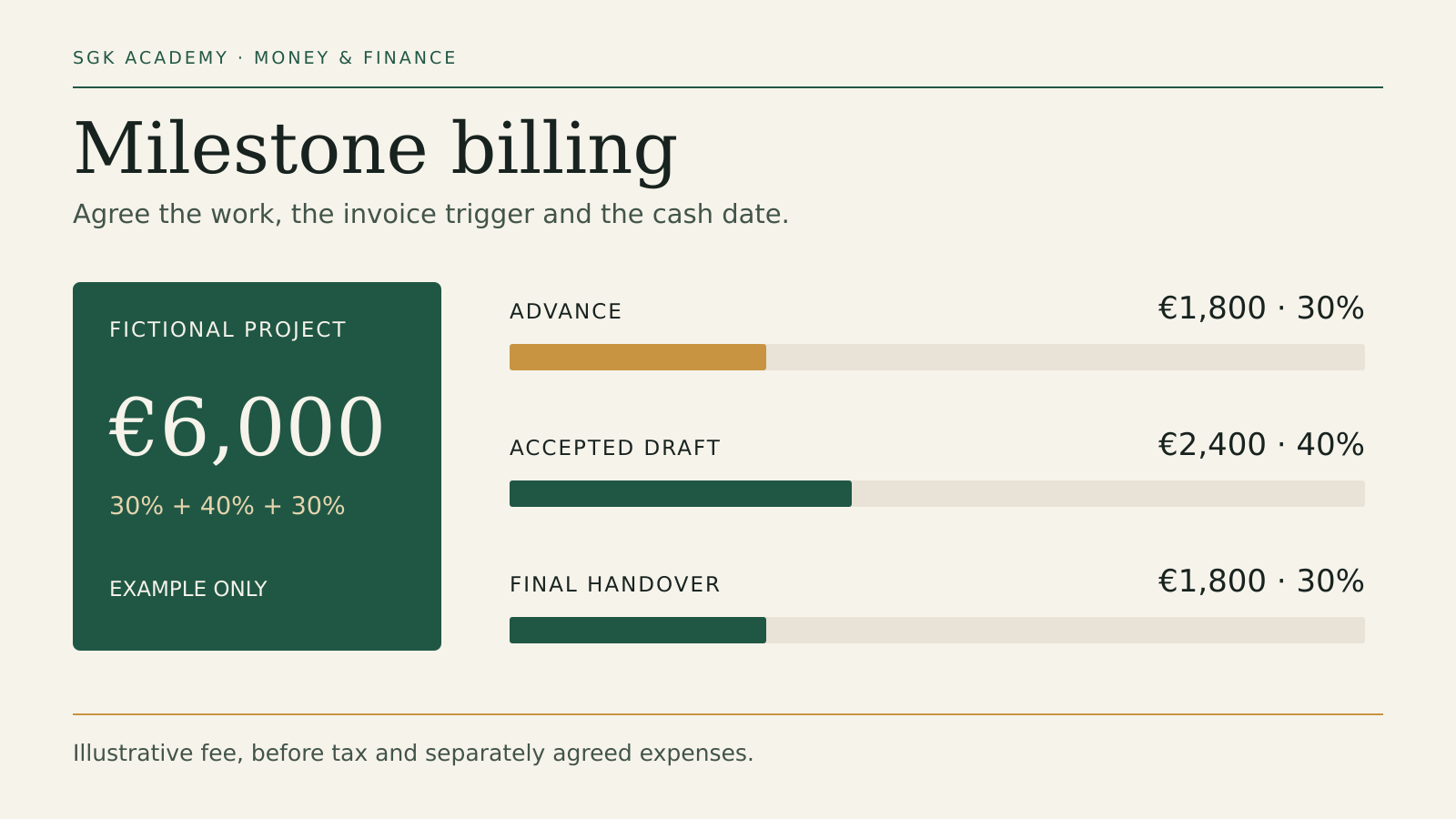
Assume a fixed fee of €6,000 before any applicable tax and separately agreed expenses. The parties choose an illustrative advance of 30%, a draft stage of 40% and a final stage of 30%. The amounts are calculations, not standard market terms.
| Stage | Proposed trigger | Share | Invoice amount |
|---|---|---|---|
| Advance | Agreement signed; before the planned start | 30% | €1,800 |
| Draft milestone | Agreed review-ready report delivered and accepted under the contract | 40% | €2,400 |
| Final milestone | Agreed revisions and final handover accepted under the contract | 30% | €1,800 |
| Total | Entire agreed scope | 100% | €6,000 |
The arithmetic is €6,000 × 0.30, €6,000 × 0.40 and €6,000 × 0.30. After the first two invoices are paid, cash received is €4,200 and the remaining project fee is €1,800. An invoice issued but not paid does not belong in the cash-received total.
The example also shows why a schedule needs more than an attractive initial percentage. If the draft stage consumes nearly all the effort, a large final balance leaves substantial payment exposure late in the project. If the client must commit significant resources before any result is visible, a large advance may be difficult for it to approve. Discuss the allocation openly rather than presenting one split as universally fair.
Keep the fee currency explicit. This example stays entirely in euros and makes no exchange-rate assumption. A cross-border agreement should identify the invoice currency and how any conversion or transfer costs are handled. SGK’s currency risk guide covers that separate budgeting problem.
Put acceptance, invoicing and payment on different dates
A delivered file, an approved stage, an issued invoice and received cash are separate events. A plan that puts them all on one day can conceal the period the business still needs to finance.
Suppose, purely for planning, that a stage is delivered on 5 November, accepted on 9 November and invoiced that day. Under an agreed 14-calendar-day term counted from that invoice date, the illustrated due date is 23 November. Do not use this example as a rule for how a real contract counts days; agree the trigger and counting method in the actual terms.
If the work is finished on 5 November but the invoice cannot be issued until acceptance, the acceptance process affects the cash forecast. If the client also needs a purchase order or a specific invoice reference, resolve that before delivery. An avoidable administrative error should not be discovered when the business is relying on the receipt.
The Australian Government’s supplier payment guide provides a concrete procurement example: a contract can allow milestone payments, while correctly rendered invoices and satisfactory delivery remain relevant to payment. That describes Australian government procurement, not a payment timetable for all customers.
For your own project, keep a forecast date and the actual receipt date. If approval slips, update the forecast instead of leaving an optimistic receipt in place. Our invoice payment terms guide explains the separate choice of the payment interval.
Check the funding gap before agreeing the split
Use a simple cash exercise alongside the delivery schedule. Suppose the fictional project requires €1,200 of supplier costs and €900 of other project cash expenses before the draft invoice is paid. Total outflow over that interval is €2,100.
If the €1,800 advance has been received, the difference is €300. The business would need at least that additional project cash over the illustrated interval, before considering any other commitments. Without the advance, the same outflows would require €2,100 before the draft receipt. These figures demonstrate timing only; they do not measure profit or the economic value of the owner’s work.
Now change one assumption. If the advance is delayed until after those expenses fall due, it provides no cash for that earlier period. A promised payment is not the same as available funding. Decide whether work may begin before the advance clears and make the operational plan match the agreed terms.
Do not spend the entire receipt merely because the bank balance has risen. The project still has future work and costs. The tax treatment and timing of advance payments depend on the applicable rules; this example does not calculate them. Keep that assessment separate from the funding arithmetic. For a UK VAT-registered business, our guide to VAT on deposits and advance payments explains when an advance creates its own tax point.
Use the cash runway calculator for a broader business buffer check. A project schedule explains one assignment, while the business may be carrying several assignments and recurring bills at once.
Keep changes from disappearing into the next milestone
A milestone becomes less useful when the scope changes but its description and price stay untouched. Before accepting an extra deliverable, record what it changes in the remaining work, review process and payment schedule.
For example, adding a second research market to the fictional report may affect the draft date and the final handover. It should not silently become part of the original €2,400 stage. Discuss a revised scope and price before doing the extra work, and retain the agreed record.
If the client changes only a contact person or delivery address, that may require an administrative update rather than a new fee. Describe the actual change instead of treating every message as either free work or a billable variation. Both parties need to understand which version of the project they are approving.
Cancellation deserves its own discussion. Identify what the agreement says about completed work, outstanding invoices, unused advances and committed external costs. Do not assume that calling a payment a “non-refundable deposit” resolves every dispute or overrides applicable law. Get advice where a cancellation provision matters materially to either party.
Make each invoice traceable to the stage
The invoice should let the client’s finance team identify the project without reconstructing the entire conversation. Use the agreed project reference, the relevant milestone description and a unique invoice number. Link the invoice in your records to delivery and acceptance evidence.
Business.gov.au’s invoicing guide explains the distinction between invoices requesting payment and receipts documenting payment. Its tax-invoice rules are Australian. For another jurisdiction, check the requirements that apply to your business rather than copying the Australian tax fields.
A useful internal record for the example would show the €2,400 draft invoice, its issue and due dates, the accepted deliverable version and the actual amount received. If only part is paid, record that receipt and the remaining balance. Do not mark the entire milestone paid because one transfer arrived.
Before sending the first invoice, check that the agreement, schedule and invoice use the same stage names. If a payment becomes overdue, use the agreed reference and outstanding amount in the reminder. Our overdue invoice reminder guide covers that next step without changing the original bargain.
Sources checked 25 October 2026: Australian Government guidance on contract preparation, invoicing and supplier payments. All project amounts and dates above are fictional worked examples. This is general business-planning information, not legal or tax advice.



