
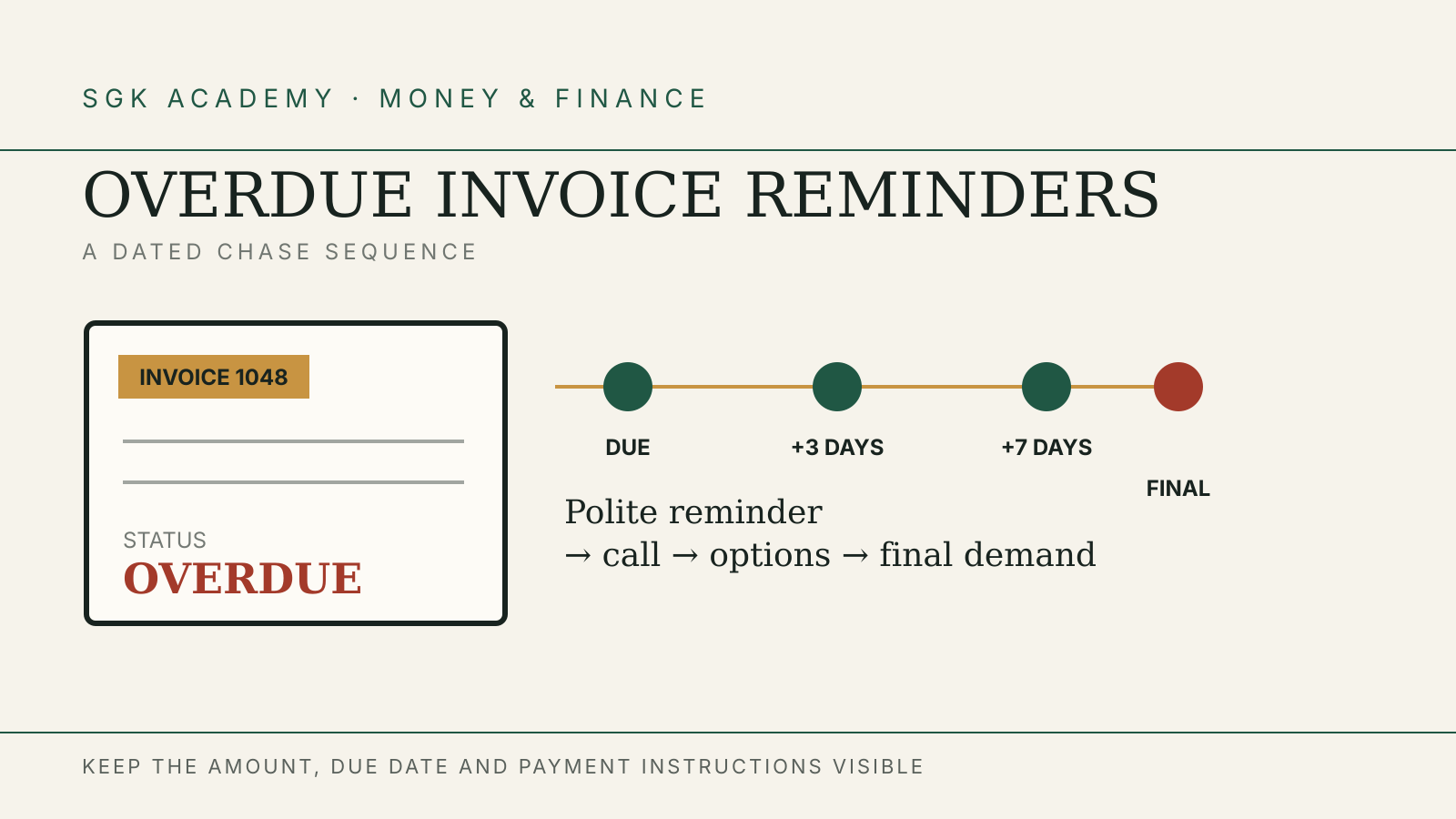
A good overdue invoice reminder removes decisions from the process. The amount, due date, payment instructions and next action stay visible, while the tone becomes firmer on a timetable you chose before the invoice was late.
This guide gives a practical sequence for UK small businesses. It is an operating routine, not a script for threatening customers. Check your contract and the governing law before adding interest, recovery costs or starting a claim.
The sequence: due date check → polite written reminder → direct contact → written payment-plan option → final demand → formal recovery decision.
Before day one: confirm the debt is actually due
Open the contract, purchase order and invoice together. Check:
- the legal customer name and billing contact;
- the invoice number, amount and currency;
- the date the payment clock started;
- the agreed term, such as net 14 or net 30;
- whether the customer disputed the work, quantity, tax or bank details;
- whether your payment instructions are current; and
- whether the invoice reached the customer’s accounts-payable system.
The UK’s Small Business Commissioner advises checking payment terms and errors before chasing. A reminder sent to the wrong entity, or based on a misunderstood due date, creates friction without moving the payment.
If the contract is silent, do not invent a deadline. Under UK late-commercial-payment rules, payment is normally late 30 days after the customer receives the invoice, or after the goods or service are delivered if that is later. Public authorities normally have 30 days; business-to-business contracts can set a longer period, commonly up to 60 days, subject to fairness rules.
Read how invoice payment terms work before you build the chase calendar.
Due date: a quiet check, not a demand
On the due date, check the bank, card processor and reconciliation queue before writing. A transfer may have arrived without the reference you expected.
If no payment appears, send a brief note that assumes an administrative delay.
Subject: Invoice 1048 due today
Hi Priya — a quick check on invoice 1048 for £2,400, due today, 24 October. I have attached it again and included the payment details below. If it is already in the payment run, please send the expected settlement date. If anything is holding approval up, tell me what you need from us.
Include the invoice, amount, due date and payment instructions. Ask for one useful fact: the planned settlement date or the specific blocker.
Do not add a long account history. The recipient should be able to forward the message internally without editing it.
Three days overdue: ask for an owner and a date
If there is no answer after a few working days, reply in the same thread and call the accounts-payable contact.
Subject: Re: Invoice 1048 — payment date
Hi Priya — invoice 1048 for £2,400 is now three days overdue. Can you confirm who owns approval and the date it will be paid? If the invoice or bank details need to be resubmitted in a different format, please send the requirement today.
Record:
- who you spoke to;
- what they said was blocking payment;
- the promised payment date;
- any document you resent; and
- the next follow-up date.
A promise without a date is not a payment plan. A date without an owner is easy to lose.
Seven days overdue: separate disputes from cash-flow problems
At one week overdue, the conversation needs a diagnosis.
If the customer disputes the work, ask them to state the disputed item and the evidence they need. Resolve the undisputed portion separately if the contract permits it.
If the customer accepts the debt but cannot pay in full, decide whether a short payment plan is commercially sensible. Put any plan in writing. It should state:
- the total balance;
- each instalment amount and date;
- the payment method and reference;
- what happens if an instalment is missed;
- whether interest or recovery costs are reserved; and
- who can agree changes.
Do not promise to waive legal rights casually. If the amount is material, use a solicitor-approved agreement.
Subject: Invoice 1048 — confirm resolution by Friday
Hi Priya — invoice 1048 remains unpaid. Please confirm by Friday whether you dispute any part of it. If not, confirm the full payment date. If a short instalment plan is needed, propose dated amounts that clear the balance.
This message offers a route to payment without pretending that “soon” is a plan.
Fourteen days overdue: send a final demand
A final demand should be factual. It is not a place for insults, public threats or claims you are not prepared to carry out.
Include:
- the creditor and debtor names;
- invoice number, amount and original due date;
- a concise history of reminders and promises;
- the final payment deadline;
- the payment route;
- any interest or recovery cost you are legally entitled to claim;
- the next step if payment is not received; and
- a contact for genuine disputes.
Subject: Final demand — invoice 1048
Invoice 1048 for £2,400 was due on 24 October and remains unpaid. Please pay the full balance by 7 November using the details below, or send a written dispute with supporting detail by that date. If neither happens, we will review formal recovery options and any interest or recovery costs available under the contract and applicable law.
Use a deadline that gives the customer a realistic opportunity to act. Do not say “legal action will start tomorrow” unless that is accurate and approved.
When UK statutory interest may apply
For qualifying UK business-to-business debts, statutory interest is generally 8 percentage points above the Bank of England base rate, unless the contract sets a different interest rate. Fixed recovery compensation is generally:
| Debt | Fixed sum |
|---|---|
| Up to £999.99 | £40 |
| £1,000 to £9,999.99 | £70 |
| £10,000 or more | £100 |
The government guidance says that if you charge interest you should send a new invoice showing it. Eligibility and calculation depend on the contract, parties and governing law. Read the full late-payment interest guide before adding a charge.
The point of mentioning interest is accuracy, not intimidation. If you are unsure whether the rules apply, get legal advice.
What to do after the final deadline
Choose deliberately among four paths.
1. Continue trading with controls
If the customer pays but does so late repeatedly, change the commercial terms. You might lower the credit limit, require a deposit, shorten payment terms or pause new work until the account is current.
2. Accept a written payment plan
Use this only when the customer acknowledges the balance and the dates are credible. Reconcile every instalment and follow up immediately if one is missed.
3. Pause work
Check the contract before suspending services or withholding deliverables. A pause can protect cash flow, but an unlawful suspension can create a new dispute.
4. Start formal recovery
Options can include a solicitor’s letter, mediation, a debt-recovery service or a court claim. Compare the debt with the likely cost, management time, evidence quality and probability of collection. Do not outsource a debt without checking how the collector communicates in your name.
If you are VAT registered and the invoice stays unpaid six months after its due date, you can usually reclaim the VAT on the unpaid part from HMRC while you keep chasing; see bad debt relief for VAT.
A simple chase log
Keep one record per invoice.
| Date | Channel | Contact | Promise or dispute | Evidence sent | Next action |
|---|---|---|---|---|---|
| Due date | AP inbox | Asked for payment date | Invoice + bank details | Call in 3 working days | |
| +3 days | Call + email | Named AP owner | Payment run Friday | Invoice | Check bank Monday |
| +7 days | Finance manager | Cash-flow issue | Plan template | Agree dates | |
| +14 days | Email/letter | Director + AP | No response | Full statement | Final deadline |
This log makes escalation consistent and preserves evidence if the matter becomes formal.
Mistakes that slow payment down
- Sending a vague “please pay” note without the amount or due date.
- Starting a new email thread for every reminder.
- Chasing before checking the bank and credit notes.
- Threatening interest or court action without checking entitlement.
- Accepting “next week” without a calendar date.
- Agreeing a payment plan only by phone.
- Continuing new work while the old balance grows.
- Changing bank details in an email without a verification process.
Invoice fraud is common. If payment details change, use a known telephone number or another established channel to verify them.
Build the sequence into your process
The best reminder is the one the business sends consistently. Add the due date and chase dates when the invoice is issued. Attach the invoice again at every stage, keep one thread, and store the promised date in the same system that reconciles payments.
Set the sequence by customer risk and relationship. A public-sector customer with a clear payment run may need a different cadence from a new client that has already missed a deposit. The structure can stay the same: verify, ask, diagnose, agree, demand, decide.



