
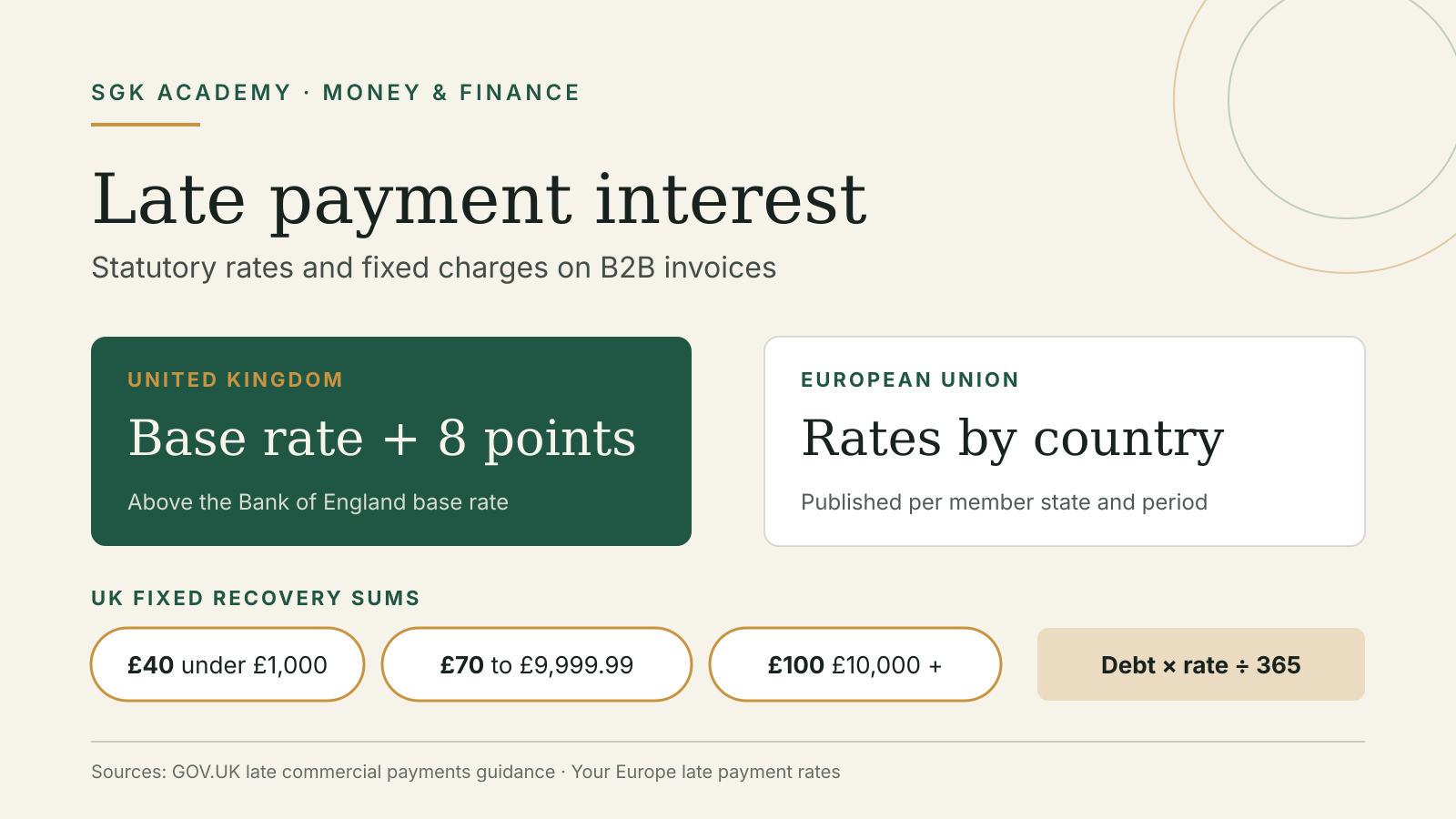
Late payment interest gives a business a formal way to price the time and work created by an overdue commercial invoice. The rules are not identical across borders: the UK uses a statutory rate tied to the Bank of England base rate, while EU countries publish their own statutory rates. In both systems, the first question is whether the debt is genuinely late under the contract and the governing law.
This guide covers business-to-business invoices and invoices owed by public authorities. Consumer debts, insolvency proceedings and damages claims follow different rules.
If the immediate problem is planning around delayed receipts rather than enforcing a debt, use the profit vs cash flow guide to map the timing gap first.
When an invoice becomes late
Start with the agreed due date. In the UK, a payment date is normally expected within 30 days for a public authority and 60 days for a business transaction. Businesses can agree a longer period, but GOV.UK says it must be fair to both sides.
If the contract does not set a due date, the UK default is 30 days after the later of:
- the customer receiving the invoice; or
- the goods being delivered or the service being provided.
The EU framework follows the same practical sequence. Interest runs from the day after the contractual due date. Without an agreed payment period, it generally becomes payable 30 calendar days after the customer receives the invoice or payment request. If receipt cannot be established, the clock starts from delivery. An invoice sent before the work is delivered does not start the clock early.
Keep evidence of delivery, acceptance and the invoice date. The cleanest calculation fails if you cannot show when payment became due.
UK statutory interest
For a UK business-to-business debt, GOV.UK describes statutory interest as 8 percentage points above the Bank of England base rate. A contractually agreed late-payment rate normally replaces the statutory rate. For contracts with public authorities, a lower contractual rate cannot be used to undercut the statutory protection.
Because the base rate can change, do not hard-code one percentage into an invoice template. Record the applicable base rate and calculation date with the debt file.
Statutory interest is a supplier’s claim against a customer. Interest that HMRC charges on late tax runs on a different rate and from a different date; our comparison of HMRC late payment interest and statutory B2B interest sets the two side by side.
The daily calculation is:
debt × annual rate ÷ 365
Then multiply the daily amount by the number of late days. GOV.UK’s worked method applies the rate to the unpaid debt and says to send a new invoice when adding interest.
Worked UK example
Assume a £4,000 invoice is 45 days late and the applicable combined statutory rate is 13% for the whole period.
- Annual interest: £4,000 × 13% = £520
- Daily interest: £520 ÷ 365 = £1.4247
- Interest for 45 days: £1.4247 × 45 = £64.11
The 13% figure is illustrative. Check the current Bank of England base rate and the GOV.UK late-payment guidance for the period you are calculating.
UK fixed recovery charges
Interest is not the only amount available. GOV.UK lists a fixed recovery sum for each late payment:
| Amount of debt | Fixed recovery charge |
|---|---|
| Up to £999.99 | £40 |
| £1,000 to £9,999.99 | £70 |
| £10,000 or more | £100 |
The charge applies once to each late payment, not once per reminder. A supplier may also claim reasonable additional recovery costs where appropriate. Keep third-party collection fees and internal recovery work separate in your records so you can explain what the fixed amount covers and what extra cost you are claiming.
For the £4,000 example, the fixed UK charge would be £70. The updated demand would therefore show £4,000 principal, £64.11 interest to the calculation date and £70 recovery compensation: £4,134.11 in total. Interest continues to change with time, so state the daily amount as well.
EU late-payment interest
EU late-payment rules cover commercial transactions between businesses, including sole traders acting professionally, and between businesses and public authorities. They do not cover consumer transactions. Insolvency and restructuring proceedings are also outside the standard process described by the EU’s Your Europe guidance.
If the contract sets a late-payment rate, use it where the governing law permits. Otherwise, the statutory rate of the relevant EU country applies. Rates differ by country and are published for defined periods. Your Europe’s table for 1 July to 31 December 2026, for example, shows different rates across member states rather than a single EU-wide percentage.
The EU guidance also provides a flat €40 recovery fee per late invoice, or the local equivalent. Some countries use higher amounts linked to the invoice value. If reasonable recovery costs exceed the flat fee, additional compensation may be claimable.
For VAT, Your Europe says interest is calculated on the gross debt including VAT, while VAT is not charged on the interest itself. Check local accounting treatment before posting the adjustment.
Which country’s law applies to a cross-border invoice?
The contract’s choice-of-law clause comes first. For a cross-border EU transaction without a stated choice, Your Europe says late-payment rules are generally governed by the law of the creditor’s habitual residence, for both goods and services.
Do not assume that an EU rule follows the customer’s address or the invoice currency. A UK supplier, an EU customer, a dollar invoice and a contract governed by another country’s law can produce a different answer from the headline table. Identify the governing law before choosing the rate or fixed charge.
If the contract is governed by a non-EU country’s law, the EU late-payment framework may not apply. Escalate the question before issuing a formal demand.
A practical calculation workflow
- Confirm that both parties acted in business, not as consumers.
- Read the contract for the due date, late-interest clause and governing law.
- Keep proof of invoice receipt, delivery and any acceptance procedure.
- Identify the first late day.
- Check the statutory rate for the correct country and period if the contract does not supply one.
- Calculate interest on the outstanding principal for the exact number of days.
- Add only the permitted fixed recovery charge and evidenced additional costs.
- Issue a clear updated invoice or demand showing principal, rate, period, daily amount and compensation.
- Stop or recalculate interest when a part-payment arrives.
- Preserve the calculation and source pages with the receivables file.
If the customer disputes the goods, delivery or amount, resolve that question rather than treating the debt as mechanically overdue. Interest rules do not turn an uncertain invoice into an admitted debt.
What to put in the payment demand
Keep the letter or email short enough to use:
- original invoice number, issue date and due date;
- unpaid principal and any part-payments;
- contractual or statutory legal basis;
- annual interest rate and the base rate or country table used;
- first and last date in the calculation;
- daily interest and interest accrued to date;
- fixed compensation and separately evidenced recovery costs;
- updated total and a new payment deadline;
- payment instructions and a contact for genuine disputes.
Avoid threatening consequences that you are not prepared or entitled to pursue. A precise calculation is more persuasive than an aggressive template.
Official sources
Reviewed 24 October 2026:



