
HMRC late payment interest and statutory interest on an overdue business invoice sound like versions of the same charge. They are not. One is charged by HM Revenue & Customs when tax is paid late. The other is a supplier’s right under commercial-debt law when a business customer pays late.
The distinction matters because the creditor, rate, start date and recovery process all change. A company can even face both at once: an unpaid customer invoice can leave it short of cash, while its own tax bill continues to accrue HMRC interest.
Reviewed against GOV.UK, the Bank of England and legislation.gov.uk on 29 October 2026. Rates and rules can change; check the linked official pages before calculating a live claim.
The short answer
| Question | HMRC late payment interest | Statutory B2B late-payment interest |
|---|---|---|
| Who charges it? | HMRC | The supplier owed money |
| What debt does it cover? | Late tax, duty or certain penalties | A qualifying commercial debt for goods or services |
| Current rate basis | Bank Rate plus 4 percentage points for the main late-payment regime from 6 April 2025 | 8 percentage points over Bank Rate as it stood on the last 30 June or 31 December |
| Rate at 29 October 2026 | 7.75% from 9 January 2026 | 11.75% for interest that started to run between 1 July and 31 December 2026 |
| Who receives the interest? | HMRC | The unpaid supplier |
| Typical start point | The tax payment due date | The day after the agreed payment date, or the statutory due date |
| Can a contract replace it? | No ordinary customer contract changes HMRC’s tax-interest rules | A substantial contractual remedy can replace statutory interest |
| Is it a penalty? | HMRC describes it as compensation for loss of use of money, not a penalty | It is interest on the commercial debt; fixed recovery compensation may also apply |
The labels are similar because both respond to late payment. The legal routes remain separate.
What HMRC late payment interest is
HMRC charges late payment interest when a person or business pays a covered tax, duty or penalty after its due date. HMRC’s Compliance Handbook describes the charge as compensation for losing the use of the money. It is simple interest: HMRC does not charge late payment interest on the interest itself.
For most late payments, interest starts on the payment due date and runs to the date the amount is paid. Special rules can move the start date or change the amount on which interest is calculated, so the generic rule is only a starting point.
The rate is linked to the Bank of England base rate. For the main late-payment regime, the margin increased to four percentage points above Bank Rate on 6 April 2025; before that it was 2.5 points. GOV.UK’s HMRC interest-rate table records the effective dates and separate tables for different taxes. Its current figure for the main taxes, including Income Tax, National Insurance, Capital Gains Tax and VAT for periods from 1 January 2023, is 7.75% from 9 January 2026. That follows the Bank of England’s cut of Bank Rate to 3.75% on 18 December 2025.
Do not copy a percentage from an old article or accounting note. Find the relevant tax and the date range in the official table. If Bank Rate changes, HMRC’s published rate usually changes from a stated later date, and a long-running debt can cross several rate periods.
What statutory interest on a late business invoice is
The Late Payment of Commercial Debts (Interest) Act 1998 inserts a right to simple interest into qualifying commercial contracts. In practical terms, a supplier may charge interest when another business or a public authority pays late for goods or services.
GOV.UK’s late commercial payments guidance gives the headline rate: eight percentage points above the Bank of England base rate for business-to-business transactions.
The reference rate does not float day by day. Article 4 of the 2002 rate order fixes it as the official dealing rate in force on 30 June, for interest that starts to run between 1 July and 31 December, or on 31 December, for interest that starts between 1 January and 30 June. Bank Rate was 3.75% on 30 June 2026, so a claim whose interest started running in the second half of 2026 uses 11.75% for its whole life, even if Bank Rate moves later.
This is not an automatic deduction made by a bank or HMRC. The supplier decides whether to claim it and normally sends a new invoice or demand showing the interest. The customer owes the supplier, not the government.
A contract may contain its own late-payment remedy. GOV.UK says statutory interest cannot be claimed where a different contractual interest rate applies. The Act also prevents a contract from excluding statutory interest unless the replacement is a substantial remedy. Public-authority contracts cannot simply use a lower rate than the statutory right.
When each clock starts
The two clocks often begin on different dates.
For HMRC interest, start with the statutory payment deadline for the specific tax. Corporation Tax, VAT, PAYE and Self Assessment do not all share one due date. A filing extension or payment plan also does not automatically mean interest has stopped; use the terms HMRC actually confirms.
For a commercial invoice, the agreed payment date is normally the relevant date. Interest starts on the following day. Where no payment date was agreed, GOV.UK says a payment generally becomes late 30 days after the later of the customer receiving the invoice or the supplier delivering the goods or service.
Public authorities normally have 30 days. Business-to-business payment terms normally must be within 60 days, although a longer period can be agreed if it is fair to both businesses.
That is why the invoice date alone is not always enough. Keep evidence of delivery, acceptance, the invoice being received and the contractual due date.
How the calculations differ
Suppose a company owes £10,000 of tax and also has a £10,000 customer invoice overdue. The numbers should be calculated independently.
For the tax debt:
- Find the HMRC rate that applied to the tax and each part of the overdue period.
- Count the days from the correct interest start date to payment.
- Apply simple interest to the unpaid amount for each rate period.
- Recalculate if part of the debt was paid during the period.
For the customer invoice:
- Confirm that the debt qualifies under the commercial-debt rules.
- Check the contract for a substantial late-payment remedy.
- Identify the relevant due date.
- Use the reference Bank Rate for that half-year plus eight percentage points.
- Calculate simple daily interest on the outstanding principal.
- Add any fixed recovery compensation only where the legal conditions are met.
A useful general formula is:
Interest = principal × annual rate × overdue days ÷ 365
GOV.UK uses the same arithmetic in its own example: £1,000 owed with a 0.5% base rate gives £85 a year at 8.5%, about 23p a day.
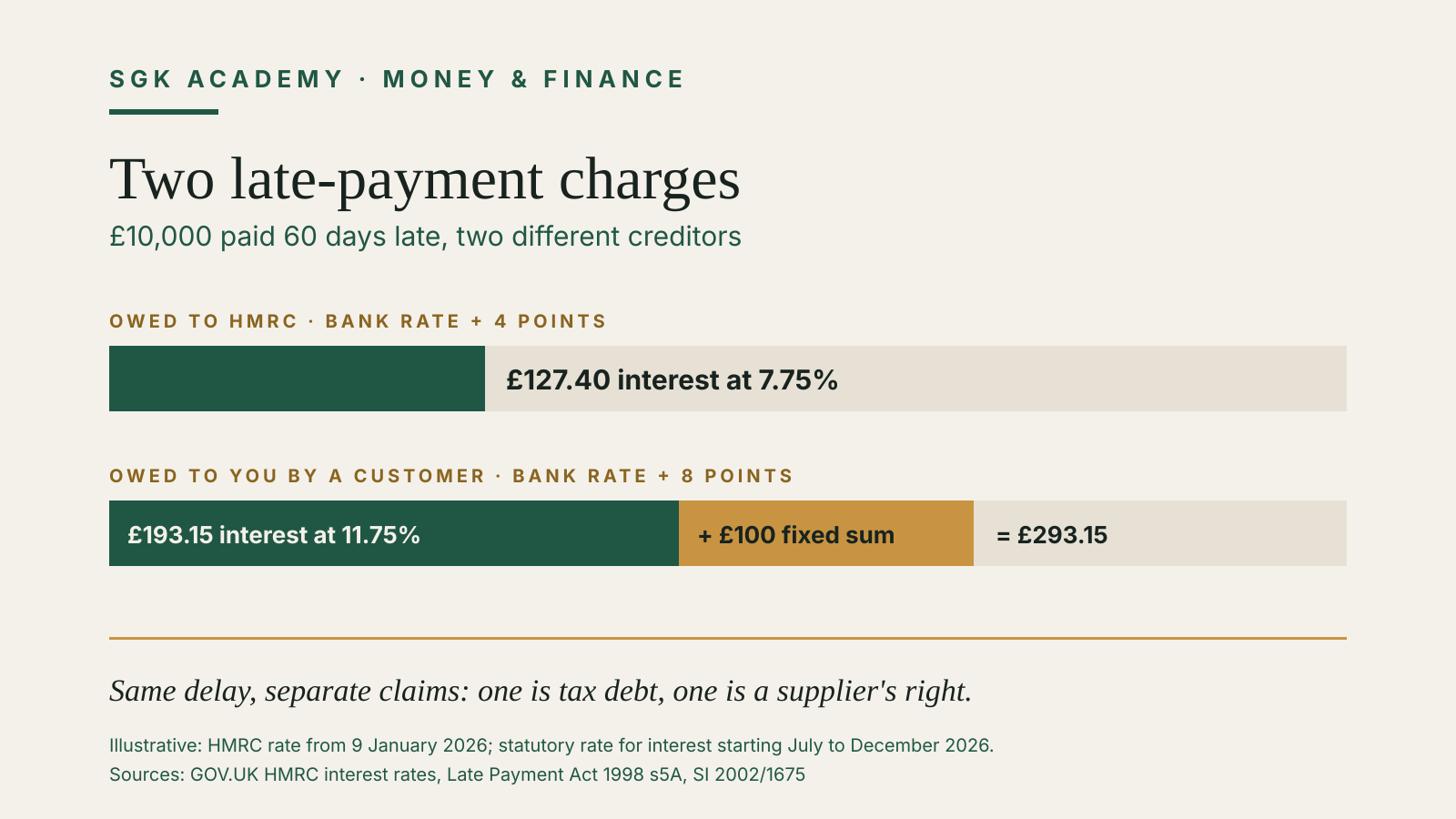
A worked example: both debts paid 60 days late
The figures below are illustrative. They assume no part payments and no rate change during the 60 days.
| Line | Tax owed to HMRC | Invoice owed by a customer |
|---|---|---|
| Principal | £10,000 | £10,000 |
| Rate | 7.75% (HMRC rate from 9 January 2026) | 11.75% (3.75% on 30 June 2026 plus 8 points) |
| Interest for 60 days | £10,000 × 7.75% × 60 ÷ 365 = £127.40 | £10,000 × 11.75% × 60 ÷ 365 = £193.15 |
| Fixed sum | None | £100, because the debt is £10,000 or more |
| Total charge | £127.40, payable to HMRC | £293.15, claimable from the customer |
The tax figure is a cost to the company. The invoice figure is money the company may claim, and only if the contract has no substantial remedy of its own. A live demand still needs the correct legal rate, start date, principal changes and rounding. Our guide to statutory late-payment interest covers the commercial-invoice calculation and recovery-cost bands in more detail.
Fixed recovery costs belong to the invoice route
Commercial-debt law can provide a fixed recovery sum once statutory interest starts to run. Section 5A of the Act sets £40 for a debt under £1,000, £70 for a debt from £1,000 to under £10,000 and £100 for a debt of £10,000 or more. The supplier may also claim reasonable recovery costs that the fixed sum does not cover.
Those amounts are not additions to an HMRC tax-interest calculation. They belong to the supplier’s commercial-debt claim.
Likewise, an HMRC penalty is separate from HMRC late payment interest. A business may owe both, but one should not be described as the other. HMRC’s manual explicitly says late payment interest is not a penalty.
A cash-flow problem can create both charges
Picture a small agency waiting for a £20,000 customer payment. The customer misses the invoice deadline. The agency then cannot pay VAT on time.
Two records now matter:
- the agency’s receivable from its customer, including any contractual or statutory commercial interest;
- the agency’s tax liability to HMRC, including HMRC late payment interest and any separate penalty rules.
Charging the customer does not pause the HMRC clock. Receiving statutory interest later does not retrospectively erase the cost of late tax. The agency should contact HMRC about the tax debt while separately following its customer-reminder and recovery process. GOV.UK’s page on difficulties paying HMRC explains how to ask for a payment plan.
A dated chase sequence can help preserve the commercial side of the record. See our overdue invoice reminder plan for a practical sequence.
What to put in your records
For HMRC interest, retain:
- the tax type and accounting period;
- the original payment deadline;
- amounts and dates of partial payments;
- HMRC statements, notices and payment-plan terms;
- the official rate table used for each period.
For a customer invoice, retain:
- the contract and purchase order;
- evidence of delivery or service completion;
- the invoice and proof it was received;
- the agreed payment date;
- reminders and dispute correspondence;
- your interest and recovery-cost calculation, with the reference Bank Rate date.
Do not merge the two in bookkeeping. HMRC interest is a cost of paying tax late. Interest received from a customer is income from a commercial claim. The accounting and tax treatment can depend on the business and jurisdiction, so use the correct ledger accounts and professional advice where material.
A decision checklist
Ask these questions in order:
- Who is owed the principal? HMRC points to the tax-interest route; your business points to the commercial-debt route.
- What created the debt? A tax statute and a supply contract are different foundations.
- What is the real due date? Use the tax deadline or contract/statutory payment date, not a guessed date.
- Which rate applies? HMRC’s rate can change during the debt; the statutory rate is fixed by the half-year in which interest starts.
- Did the principal change? Partial payments reduce the interest base.
- Is there a contractual remedy? It can displace statutory commercial interest if it is substantial.
- Are penalties or recovery costs separate? Keep them as distinct lines.
- Can every figure be reproduced? Save the source, effective date and calculation.
What to do when both debts are live
First, protect the tax position. Check the exact HMRC balance and rate, pay what you can without misallocating the payment, and contact HMRC if the business cannot clear the amount. Do not assume a customer dispute will suspend HMRC interest.
Second, protect the receivable. Confirm the invoice is valid, resolve genuine disputes, send a dated reminder, and decide whether to add contractual or statutory interest. Keep the calculation transparent enough for the customer to reproduce.
Third, update the cash forecast. Interest can be small day by day but material over a long delay. A 13-week cash flow forecast makes the gap visible before another tax deadline arrives, and the cash runway calculator shows how many months the current balance covers if the customer keeps paying late.
The practical rule is simple: treat HMRC late payment interest as a tax-debt calculation and statutory B2B interest as a supplier’s commercial claim. They may arise from the same cash shortage, but they do not share a creditor, legal basis or invoice.



