
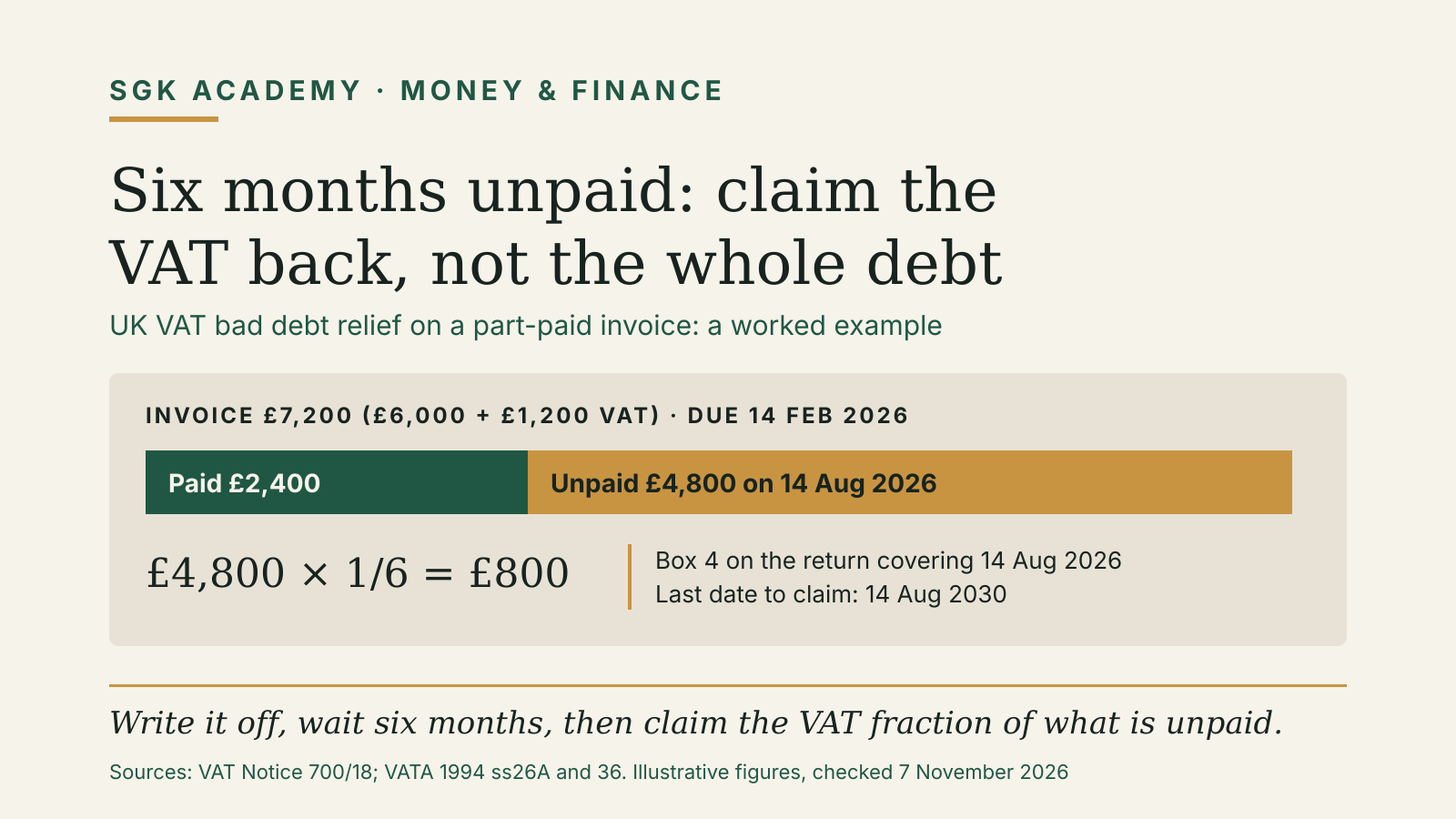
A UK VAT-registered business can claim back the VAT it paid HMRC on an unpaid invoice once the debt is six months old, counted from the later of the supply date and the due date. The claim covers only the VAT in the unpaid part, goes in box 4 of the VAT Return for the period in which you become entitled, and must be made within 4 years and 6 months of that same later date.
The relief gives you the VAT back, not the debt. On a £1,200 invoice that includes £200 VAT, the most you can recover from HMRC is £200, and only if the customer has paid nothing.
Checked against HMRC’s VAT Notice 700/18 (last updated 18 September 2025), the VAT Act 1994 and GOV.UK on 7 November 2026. Figures in the examples are illustrative.
The five conditions that still matter
VAT Notice 700/18 lists seven conditions, but two only affect supplies made before 1997. For an invoice raised today, all five of these must be true:
| Condition | What it means in practice |
|---|---|
| You accounted for the VAT and paid it to HMRC | The sale went through a VAT Return. If it never did, there is nothing to relieve. |
| You wrote the debt off in your VAT accounts | Move it to a separate bad debt account. Writing off in the VAT records is required; the customer still owes you. |
| The price was not above your normal selling price | Relief is limited to a customary value. |
| The debt has not been paid, sold or factored under a legal assignment | A debt sold outright to a factor gives no relief while it is assigned. |
| Six months have passed | Counted from the later of the date of supply and the date payment was due under your terms. |
None of these requires the customer to be insolvent, to have been taken to court or to have stopped trading. A solvent customer who simply refuses to pay qualifies once the six months are up.
The law behind the notice is section 36 of the VAT Act 1994, with the claim mechanics in Part XIX of the VAT Regulations 1995. HMRC’s detailed internal guidance is the VAT Bad Debt Relief manual.
When the six months start
The clock runs from the later of two dates: when you made the supply and when payment was “due and payable”. HMRC says the due date can come from your normal credit terms or from any longer period you agreed with the customer.
That has a practical consequence. If you agree a payment plan that pushes the due date back, you also push back the date you can claim. If you only agree to wait without changing the due date, the original clock keeps running. Write down which one you agreed. Our overdue invoice reminder sequence covers how to put a payment plan in writing.
You cannot claim early on a previous return. HMRC says the claim goes on the return for the accounting period in which you become entitled, so the earliest claim is on the return covering the date the six months end.
A dated example: part-paid invoice, quarterly returns
A design studio on quarterly VAT returns (quarters ending March, June, September and December) invoices a client:
- Invoice: £6,000 plus £1,200 VAT = £7,200, dated and supplied 15 January 2026, payment terms 30 days, so due 14 February 2026.
- Part payment: the client pays £2,400 on 10 February 2026, then stops responding.
| Date | What happens | Rule |
|---|---|---|
| 7 May 2026 | Studio pays HMRC the £1,200 output VAT with its January to March return | Return and payment due one month and 7 days after the quarter (GOV.UK) |
| 14 August 2026 | Six months after the due date; £4,800 still unpaid | Notice 700/18, para 2.3 |
| By 30 September 2026 | Studio writes the £4,800 off in its VAT accounts and opens a bad debt account entry | Condition 2 |
| 7 November 2026 | July to September return claims £800 in box 4 | £4,800 × 1/6 (the VAT fraction at 20%) |
| 14 August 2030 | Last day a claim can be made | 4 years 6 months after the due date |
The £800 is the VAT fraction of the unpaid balance, not of the original invoice. HMRC says that after a part payment you can only claim the VAT relating to the amount still unpaid. Claiming £1,200 here would overclaim by £400.
Between 7 May and 7 November 2026 the studio has funded £1,200 of VAT it never received from the client, and it gets £800 of that back at the earliest on the November return. If unpaid invoices are a regular feature of your business, model that gap in the cash runway calculator.
If the money arrives later
In March 2027 the client’s liquidator pays a dividend of £600. HMRC’s formula for paying back part of the relief is:
amount claimed × payment received ÷ amount outstanding when the claim was made
£800 × £600 ÷ £4,800 = £100, which goes in box 1 of the return for the period in which the £600 arrived. Every later receipt for the same supply also goes in the bad debt account.
If there are several unpaid invoices
When a customer owes on more than one invoice and pays a round sum without saying what it is for, HMRC requires you to allocate the payment to the earliest supply first. That matters when invoices carry different VAT treatments, because the payment can wipe out a zero-rated invoice and leave the standard-rated ones unpaid. Paragraph 3.3 of the notice has a six-invoice worked example; supplies made on the same day are pooled and treated as one.
What your customer has to do
The other side of bad debt relief is input tax clawback. Under section 26A of the VAT Act 1994, a business that reclaimed VAT on a purchase and has not paid for it within six months of the later of the supply date and the due date must repay that input tax. The supplier does not send a notice; the customer has to track it.
In the example, suppose the client is VAT registered, reclaimed the full £1,200 and also files quarters ending September. HMRC’s formula is input tax deducted × unpaid amount ÷ total consideration:
£1,200 × £4,800 ÷ £7,200 = £800, entered as a negative amount in the VAT account and reducing box 4 on its July to September 2026 return.
The two figures match because the client deducted all the VAT. A partly exempt customer that only deducted half would repay half as much. If the customer later pays, it can reclaim the input tax in proportion to the payment in box 4 of the period it pays.
HMRC applies an extra-statutory concession here: if an insolvency procedure starts after the supply but before the clawback falls due, the business is not required to repay the input tax (Notice 700/18, para 4.9, referring to VAT Notice 48).
Which box on the VAT Return
| Situation | Box | Effect |
|---|---|---|
| Supplier claims bad debt relief | Box 4 | Increases VAT reclaimed |
| Supplier later receives some or all of the debt | Box 1 | Repays the VAT element of the receipt |
| Customer has not paid after six months | Box 4 | Reduced by the input tax clawback |
| Customer pays after a clawback | Box 4 | Input tax reclaimed in proportion to the payment |
Records to keep
For every claim, HMRC wants a copy of the VAT invoice and a separate bad debt account showing, for each supply:
- the amount written off and the VAT you are claiming;
- the VAT period in which you claim;
- the total VAT charged and the period in which you originally accounted for it;
- any payment received;
- the customer’s name; and
- the invoice date and number.
Keep these for four years from the date of the claim. HMRC notes that this does not shorten the general six-year VAT record rule; our guide to how long to keep business records sets out the wider retention periods.
Cases that change the answer
Cash accounting. Under the VAT Cash Accounting Scheme you only pay VAT when the customer pays, so there is no relief to claim. HMRC says the same for retail schemes that adjust for debtors. The trade-off between invoice-based and cash-based records is covered in cash vs accrual accounting.
Factored debts. If you sold the invoice outright to a factor with no right to take it back, you cannot claim. If the agreement provides for reassignment, relief becomes available once the debt comes back to you, but never while it sits with the factor. See invoice factoring vs discounting for how the two arrangements differ.
Credit notes. HMRC says you may not issue a credit note just because a customer has not paid. A credit note is for a genuine mistake, an overcharge or an agreed reduction in price. Using one to cancel a bad debt understates your sales.
Security, guarantors and mutual debts. Reduce the claim by the value of any enforceable security, and by anything a guarantor or director pays you. If you also owe the customer money, net it off first: HMRC’s example of a £720 debt with £115 owed back gives relief of £605 × 1/6 = £100.83.
Bad debt insurance. If you insured against bad debts and the insurer pays you, HMRC says your entitlement to relief is not affected.
Margin schemes. Relief is capped at the VAT on the margin. HMRC published a short page on this on 2 November 2026 that points back to paragraphs 5.7 and 5.8 of the notice.
Buying a business. You can only claim on supplies you made, unless you took over the seller’s VAT registration number on form VAT68.
Claiming after you have deregistered
A business that has cancelled its VAT registration can still claim relief on debts from supplies made while it was registered, within the same 4 years and 6 months. Since 18 September 2025 GOV.UK has offered an online service for this, signed in through Government Gateway, with form VAT427 kept as a postal alternative (GOV.UK). HMRC says it aims to process repayments within 30 working days and may ask for original invoices. Office holders in liquidations and bankruptcies use form VAT426 instead.
Before you claim: a short checklist
- Confirm the due date the customer agreed to, including any extension.
- Add six months to the later of the supply date and that due date.
- Write the debt off in the VAT accounts and record it in the bad debt account.
- Work out the unpaid balance after allocating any payments to the earliest invoices.
- Multiply by the VAT fraction (1/6 at 20%, 1/21 at 5%) and enter it in box 4 of the return covering the date in step 2.
- Diary the 4 years 6 months deadline, and keep chasing the debt: relief does not cancel it.
If the debt is still young, the late payment interest you may be entitled to charge is a separate claim against the customer and has nothing to do with the VAT relief.



