Cash and accrual accounting answer the same question, “how much did the business make?”, by recording income and costs at different moments. Under the cash method, a sale counts when the money arrives and a cost counts when you pay it. Under the accrual method, a sale counts when you earn it, usually when you invoice, and a cost counts when you incur it, whether or not money has moved.
For a freelancer or small business, the choice affects the profit shown in a given year, the tax due on it, how much bookkeeping you do and what a lender sees. It is also partly made for you: tax authorities decide which businesses may use the cash method. This guide compares the two methods with a worked example, then sets out the UK and US rules as they stood on 10 October 2026, with links to the official guidance.
The difference in one table
| Question | Cash method | Accrual method |
|---|---|---|
| When is a sale recorded? | When payment is received | When it is earned, typically on invoicing |
| When is a cost recorded? | When it is paid | When it is incurred, typically when you are billed |
| Unpaid customer invoices at year end | Not yet income | Already income, shown as receivables |
| Unpaid supplier bills at year end | Not yet a cost | Already a cost, shown as payables |
| Records needed | Bank and payment records, receipts | Invoices issued and received, plus adjustments for amounts owed |
| What it shows well | Cash actually available | Profit earned in the period |
HMRC’s cash basis guidance uses almost the same wording: with cash basis you record income or expenses when you receive money or pay a bill; with traditional accounting you record them by the date you invoiced or were billed. The IRS’s Publication 538 describes the cash method as reporting income in the tax year you receive it and deducting expenses in the year you pay them, and the accrual method as reporting income when you earn it and deducting expenses when you incur them.
A worked example: one December invoice
The figures below are illustrative.
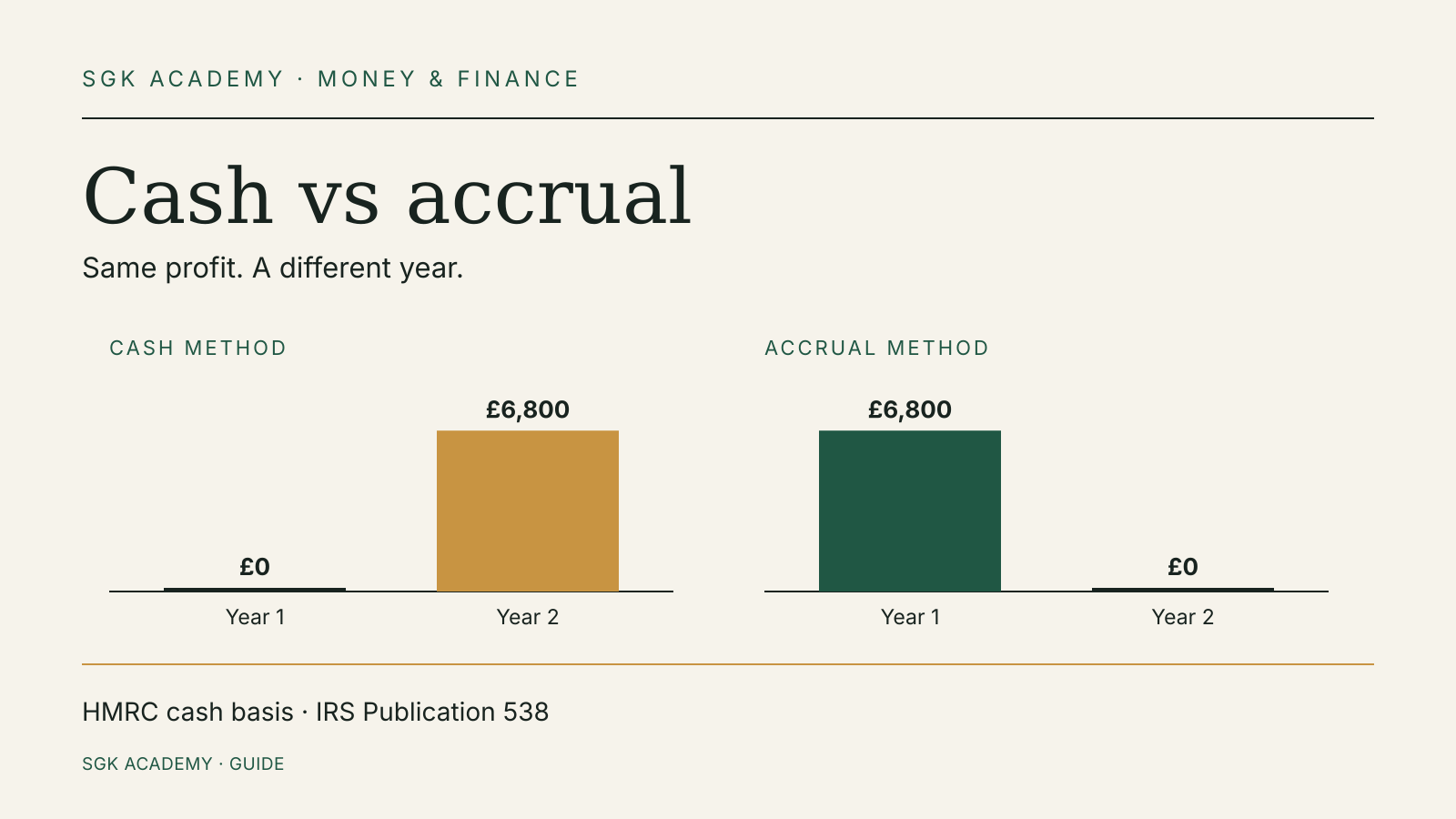
A designer working as a sole trader invoices a client £8,000 on 15 December for work finished that month. The client pays on 20 January. In December the designer is also billed £1,200 for software, payable on 10 January. The designer’s accounts run to 31 December.
| Item | Cash method: year 1 | Cash method: year 2 | Accrual method: year 1 | Accrual method: year 2 |
|---|---|---|---|---|
| Client invoice of £8,000 | 0 | 8,000 | 8,000 | 0 |
| Software bill of £1,200 | 0 | −1,200 | −1,200 | 0 |
| Effect on profit | 0 | 6,800 | 6,800 | 0 |
Over the two years the total profit is identical: £6,800. What changes is the year in which it appears. Under the cash method, the profit moves into the year in which the money actually changed hands. Under accruals, it stays in the year the work was done.
That timing is the practical heart of the choice. The cash method can stop a business paying tax on money it has not yet received, which HMRC names as a benefit. The accrual method gives a truer picture of how a given month or year performed; HMRC notes that a bank considering a loan could ask for accounts drawn up that way.
SGK Academy’s guide to profit vs cash flow explains the related problem of a profitable business running out of cash; the cash runway calculator turns that into a number of months.
UK: cash basis is the default for sole traders and partnerships
Since the 2024 to 2025 tax year, the cash basis has been the default way for self-employed people and partnerships to calculate trading profits. The change was made by Finance Act 2024, which inserted a rule that the profits of a trade must be calculated on the cash basis unless the trade is excluded or an election for generally accepted accounting practice has effect.
Before then, the cash basis was optional and limited by turnover. According to HMRC’s policy paper on expanding the cash basis, a business could join only with cash-basis turnover under £150,000 and had to leave in some cases above £300,000. That turnover restriction was removed entirely. Section 16 of Finance Act 2024 also lists the removal of restrictions on deductions for loan interest and on certain loss reliefs under the cash basis.
Key points from the official guidance:
- Who uses it. HMRC calls cash basis the standard way to record income and expenses for a sole trader or a partnership without corporate partners.
- Who cannot. Some businesses cannot use it; HMRC gives limited companies as the example.
- Opting out. A business can elect to calculate profits under generally accepted accounting practice, which HMRC calls traditional accounting. The election has effect for the tax year it is made and later years, until the business elects to return to the cash basis.
- Why opt out. HMRC suggests traditional accounting might suit a business that is complex, for example with high levels of stock, or that needs finance, because a bank could ask for accounts showing what the business owes and is owed.
- Switching. Moving between methods can require one-off adjustments. HMRC’s HS222 helpsheet explains that leaving the cash basis produces an overall adjustment: a negative one allowed as an expense, or a positive one taxed as adjustment income, normally spread over six years.
When you file a Self Assessment return using traditional accounting, HMRC says you need to say that you used it.
VAT has its own cash scheme
The income tax cash basis does not change how VAT is accounted for. VAT normally follows invoices: HMRC says you report and pay the difference between sales and purchase invoices even if they have not been paid. A VAT-registered business can apply to the separate VAT Cash Accounting Scheme, under which it pays VAT on sales when customers pay and reclaims VAT on purchases when it pays suppliers.
HMRC’s eligibility page says the business’s estimated VAT taxable turnover must be £1.35 million or less in the next 12 months, and it must leave the scheme if turnover exceeds £1.6 million. The scheme cannot be used with the Flat Rate Scheme, for invoices with payment terms of six months or more, or for invoices raised in advance, among other exclusions listed there. A sole trader can therefore be on the cash basis for income tax and on standard invoice-based VAT accounting at the same time.
US: the cash method, with limits for companies
The IRS does not require any single accounting method. Publication 538, in its January 2022 revision, says you choose a method when you file your first return, must use one that clearly reflects income, and generally need IRS approval to change it later. Business and personal items can be on different methods, and separate businesses with separate books can use different methods.
Points from Publication 538 that matter for small businesses:
- Most individuals and many small businesses use the cash method.
- Constructive receipt. Under the cash method, income counts when it is credited to your account or made available to you without restriction, even if you have not taken possession. You cannot hold checks to move income into the next year.
- Prepaid expenses. A cost paid in advance is generally deductible only in the year to which it applies, unless it qualifies for the 12-month rule.
- Excluded entities. A corporation other than an S corporation, a partnership with such a corporation as a partner, and a tax shelter generally cannot use the cash method.
- Exceptions. A corporation or partnership that is not a tax shelter can use the cash method if it meets a gross receipts test based on average annual gross receipts for the three prior tax years. The threshold is indexed for inflation, so check the current figure in the IRS’s annual inflation adjustments rather than an older publication. A qualified personal service corporation can also use the cash method.
- Inventories. If an inventory is necessary to account for income, an accrual method is generally required for purchases and sales, with an exception for small business taxpayers described in the publication.
- Failing the test. A corporation or partnership that stops meeting the gross receipts test must change to an accrual method for that year and file Form 3115.
Which method fits which business
The rules above set the outer limits. Within them, the choice is practical.
| Situation | Method that usually fits | Reason |
|---|---|---|
| Freelancer paid within days of invoicing, no stock | Cash | Little timing difference; simplest records |
| Consultant with 60-day payment terms and large year-end invoices | Accrual, or cash with a clear receivables list | Year-end timing shifts large amounts between years |
| Seller holding significant stock | Accrual | Costs match the period in which goods are sold |
| Business applying for a loan or raising investment | Accrual accounts for the lender | Shows what the business owes and is owed |
| UK limited company | Not the income tax cash basis | HMRC lists limited companies among businesses that cannot use it |
| US C corporation that fails the gross receipts test | Accrual | Required by the rules in Publication 538 |
Even a business that files on the cash basis can track receivables and payables in its bookkeeping software. That list is what tells you whether next month’s income will cover next month’s bills, whatever method the tax return uses.
Pitfalls to avoid
- Treating the cash basis as a tax saving. It changes timing, not total profit over the life of the business. A large receipt delayed past year end is taxed in the next year.
- Forgetting VAT. Income tax on the cash basis does not put VAT on a cash basis. Check which VAT scheme you are actually registered under.
- Mixing methods inconsistently. The IRS requires a method that clearly reflects income and is applied consistently from year to year; HMRC requires adjustments when you switch.
- Ignoring constructive receipt. In the US, money made available to you counts as received under the cash method.
- Switching without planning. In the UK, leaving the cash basis can create adjustment income. In the US, a change of method generally needs IRS approval through Form 3115.
Sources and version
Checked 10 October 2026 against HMRC’s cash basis guidance, the policy paper on expanding the cash basis, Finance Act 2024, Schedule 10 and section 16, the HS222 helpsheet, HMRC’s VAT Cash Accounting Scheme pages, and IRS Publication 538 (revision January 2022). This guide explains general rules; it does not choose a method for any particular business.