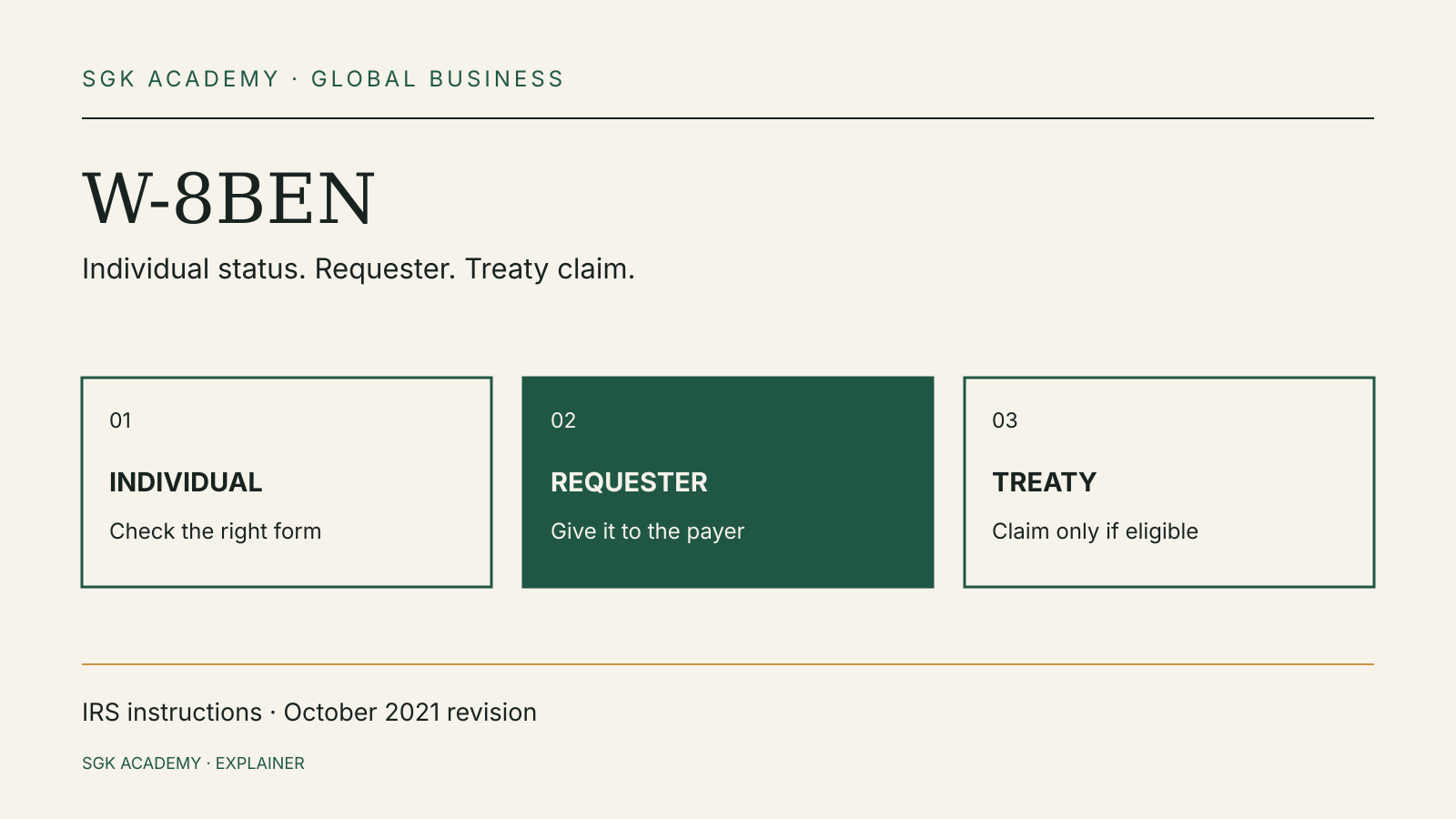
Form W-8BEN is a US tax-status certificate for individuals. A payer or financial institution may ask for it to document that you are a foreign beneficial owner or account holder and, where applicable, to support a claim for tax-treaty benefits.
You give it to the requester, not to the Internal Revenue Service (IRS). Completing it does not automatically make every payment tax-free or establish that every foreign freelancer owes US withholding tax.
The IRS instructions, revised October 2021 and checked for this guide on 9 October 2026, explain the form’s scope. Start with the identity of the recipient and the type of income. Those two questions determine whether W-8BEN is the appropriate form before you reach the individual fields.
Check that the form is for the right person
The IRS says W-8BEN is generally used by a nonresident alien individual who is the beneficial owner of an amount subject to withholding, or by an individual account holder documenting nonresident status to a foreign financial institution.
“Individual” matters. A foreign entity ordinarily uses W-8BEN-E for its foreign status and applicable treaty claim. A US citizen or other US person generally uses W-9. Living outside the United States does not by itself make a US citizen eligible to use W-8BEN.
The instructions also distinguish acting for yourself from acting as an intermediary for someone else. A foreign intermediary uses W-8IMY. An account in your name and a payment you beneficially own are not interchangeable with a payment you hold as an agent or custodian.
Some single-owner businesses are disregarded entities for US tax purposes. The IRS instructions generally look to the owner, rather than the disregarded entity, for the relevant documentation. An individual owner may therefore be the person completing W-8BEN. A hybrid entity claiming treaty benefits is an important exception identified in the instructions.
Do not choose the form from the trading name on an invoice alone. If the business structure or tax classification is unclear, establish that classification with the requester or the person handling your tax affairs.
Identify the income before claiming a benefit
W-8BEN can establish foreign status without claiming a reduced treaty rate. The IRS says an eligible requester may ask for it whether or not you are claiming an exemption or reduction.
The form also has limits. An individual claiming an exemption for compensation for personal services performed in the United States is directed to Form 8233 or W-4, as applicable. Income effectively connected with a US trade or business generally requires W-8ECI, subject to the instructions’ partnership distinctions.
A simple decision table helps keep those cases apart:
| Situation described in the IRS instructions | Form to investigate |
|---|---|
| Foreign individual beneficial owner or relevant individual account holder | W-8BEN |
| Foreign entity documenting its status or claiming treaty benefits | W-8BEN-E |
| US citizen or other US person | W-9 |
| Foreign intermediary acting for others | W-8IMY |
| Relevant effectively connected income | W-8ECI |
| Individual claiming an exemption for US-performed personal services | 8233 or W-4, as applicable |
This is a routing table, not a determination of your personal tax treatment. Partnerships, trusts and mixed income can involve additional documentation.
The source of the income is another separate issue. The instructions describe a general 30% withholding regime for specified US-source fixed or determinable annual or periodical income, with relevant exceptions and other regimes. That is not a rule that every invoice paid by a US company loses 30%. A customer’s country, your citizenship, the place services are performed and the nature of the income should not be collapsed into one assumption.
Give the form to the requester
The IRS is explicit: do not send W-8BEN to the IRS. Give it to the person requesting it, generally the payer, withholding agent or financial institution, before the relevant payment, credit or allocation.
The requester keeps and uses the certificate to carry out its documentation and withholding obligations. The form is therefore part of your relationship with that requester, even though the IRS publishes it.
Generally, you provide a separate form to each withholding agent. A requester may also require separate documentation for different income types when different benefits are claimed. Do not assume a form uploaded to one platform automatically covers another customer or financial institution.
Use the requester’s established submission route. The form contains an address, tax-identification information and a certification. Before uploading it, confirm that the request belongs to the actual payer or account provider and that you are using its official process.
Keep a copy of what you submitted, the requester and the signature date in your own records. That makes later renewal or a change in circumstances easier to manage. This recordkeeping suggestion is editorial; it is not a substitute for any retention rules applicable to your situation.
Read the identity and address fields carefully
Line 1 is your name. For an individual who owns a disregarded entity, the IRS instructions explain how to use the individual’s name and information and inform the withholding agent about an account in the entity’s name, including through reference information.
Line 2 asks for citizenship. The instructions include a specific rule for dual citizens: use the country in which you are both a citizen and resident at completion, or the most recent country of residence among your citizenship countries if you are resident in neither. A US citizen should not use this form.
Line 3 is the permanent residence address in the country where you claim tax residence. For a treaty claim, residence must be determined under the treaty. A financial institution’s address, a post-office box or an address used only for mailing is not the appropriate entry for this field.
If a jurisdiction does not use street addresses, the instructions allow a descriptive address that accurately indicates permanent residence. Line 4 is for a different mailing address.
These fields ask related but different questions. Citizenship is not automatically tax residence, and an address chosen for correspondence does not necessarily establish residence for treaty purposes. SGK Academy’s company tax residence guide covers the separate company-level question; it should not be used to answer an individual’s residence field.
Understand the tax ID and birth-date fields
Line 5 is for a US social security number or individual taxpayer identification number where applicable. The instructions explain circumstances in which a US taxpayer identification number is required, including certain partnership and treaty situations.
Line 6a is for a foreign tax identifying number (FTIN). In a specified financial-account situation, the instructions require an FTIN issued by the jurisdiction of tax residence, subject to listed exceptions. They also explain how an FTIN may support a treaty claim instead of a US TIN in relevant circumstances.
Line 6b indicates that an FTIN is not legally required. It is not a convenience box for someone who has not located their number. The instructions tie it to the relevant account-holder circumstances and to not being legally required to obtain an FTIN, including jurisdictions that do not issue one.
Line 7 permits reference information useful to the withholding agent, such as an account reference. Line 8 asks for a date of birth in the specified financial-account circumstances, using the form’s stated format.
Work from the instructions for the field and your actual situation. Avoid generic advice that every individual must enter exactly the same identifiers. Equally, do not assume that leaving an identifier blank is harmless because another payer previously accepted it.
A treaty claim needs its own reasoning
Part II is used when claiming applicable tax-treaty benefits. Line 9 identifies the country of treaty residence. Citizenship alone does not establish entitlement to a treaty benefit.
Line 10 is for benefits that require conditions beyond the representations in line 9 and Part III. The IRS instructions give examples including particular royalty claims, certain student or researcher claims, and business profits or gains not attributable to a permanent establishment.
For a relevant business-profits claim, the instructions say to identify the treaty article and explain that the profits or gains are not attributable to a permanent establishment. That is a factual and treaty-specific representation. It should not be copied from a template without establishing that it applies.
The instructions also discuss remittance-based treaty provisions. Some benefits depend on how much relevant income is remitted to and taxable in the treaty country. Again, the appropriate entry is not a universal “0%” sentence.
If a platform offers a preset treaty section, read what the selection represents. An available dropdown option is not evidence that you qualify. Ask the requester what documentation it needs, and resolve the underlying tax position before certifying it.
Our permanent establishment guide explains why business presence and the location of work can raise distinct questions. It provides background, not an automatic answer to a W-8BEN treaty claim.
Sign a certification you can stand behind
Part III is a certification, rather than an informal profile update. The beneficial owner or relevant account holder signs and dates it. An authorised agent needs the legal authority and accompanying documentation described in the IRS instructions.
An electronic submission may be allowed by the withholding agent. The instructions say the signature must indicate that an authorised person electronically signed, for example through a time and date stamp and an appropriate statement. Simply typing a name on the signature line is not an electronic signature under those instructions.
Use the requester’s documented signing process. If you are sending a paper form, review the completed version rather than relying on an earlier draft. Check that the information in the certification agrees with the identity and treaty entries above it.
A form completed by an accountant still requires an appropriate signatory. Preparation and authority to certify are different roles. The instructions warn that both the beneficial owner and an agent may incur penalties for an erroneous, false or fraudulent form.
Track expiry and changes separately
Generally, a W-8BEN establishes foreign status from the date it is signed through the last day of the third succeeding calendar year, unless a change in circumstances makes information incorrect.
For an illustrative form signed on 9 October 2026, that general rule points to 31 December 2029. It does not mean every form has an unconditional three-year lifetime. The instructions describe circumstances in which a certificate can remain effective indefinitely and refer to the relevant regulations.
A change in circumstances can require action sooner. If information becomes incorrect, the instructions generally require notifying the withholding agent, payer or relevant financial institution within 30 days and providing a new W-8BEN or another appropriate form.
The consequences of an address change depend on what the form certifies. A move to a US address affects foreign-status documentation. For a treaty claim, moving outside the country where you claimed treaty residence is also significant. Becoming a US citizen or resident alien changes the form-routing question.
Use two reminders: a calendar check for the general validity period and an event-based review when residence, status or the relevant income changes. The second reminder prevents an expiry date from becoming an excuse to keep using incorrect information.
Before submitting: a practical review
Read the finished form against these questions:
- Is the recipient an individual, and is their US tax status appropriate for W-8BEN?
- Does the income fall within the form’s scope, rather than a case requiring another certificate?
- Are citizenship, permanent residence and mailing address entered in their proper fields?
- Are the relevant US or foreign tax ID requirements understood?
- Does any treaty claim identify an actual applicable benefit and its conditions?
- Has the appropriate person signed through an accepted process?
- Is the form going to the real requester, with a copy and date recorded?
If a question remains unresolved, identify the specific issue instead of guessing an entry. That might be the entity classification, the income category or eligibility under a treaty article. A precise question gives the requester or tax adviser something useful to answer.
Source and version
Checked 9 October 2026 against the IRS Instructions for Form W-8BEN, revision October 2021. This guide explains that document’s individual-form workflow; it does not select a treaty rate or determine a reader’s personal tax liability.