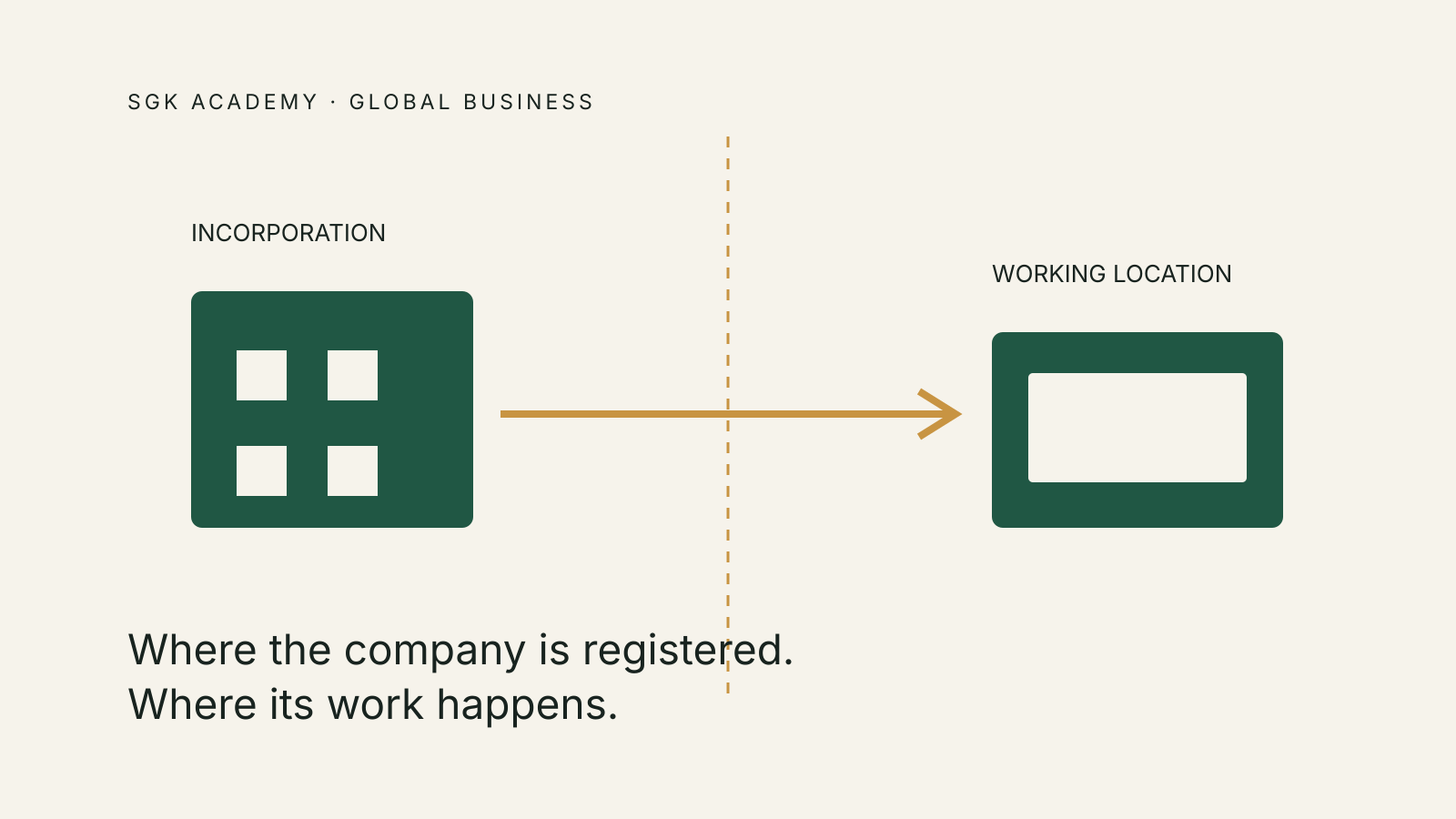
A founder can register a company in one country and do its work in another. Permanent establishment remote work questions arise when that activity gives the company a taxable business presence where the founder is working. A registration certificate alone does not settle the issue.
The assessment concerns the company’s activities, the location and continuity of its work, and the applicable domestic rules and tax treaty. For a small business, it deserves attention before a temporary arrangement becomes a recurring way of operating.
This guide uses published UK examples to explain the questions to ask. Those examples are evidence of how HMRC approaches particular circumstances, not a worldwide exemption or a ruling on a reader’s company.
Start with the company, the location and the activity
A useful first step is to write down what the founder actually does from the other country. “Working remotely” can mean answering occasional messages, delivering the company’s core service, managing staff, or making commercial decisions from a regular office.
Those descriptions have different implications for a factual review. The location of the work matters alongside its character. So do the expected duration, repeat visits and involvement of other people working for the same company.
In its domestic-law permanent establishment guidance, HMRC describes two routes for a non-resident company in the UK: a fixed place through which its business is wholly or partly carried on, and an agent who habitually exercises authority to do business on its behalf, subject to the independent-agent distinction.
The guidance’s examples of places include an office, a branch and a place of management. A founder reviewing a move therefore needs a fuller description than “the company has no local subsidiary.” The absence of a separately incorporated local entity does not itself answer those tests.
Use SGK’s jurisdiction reference to organise the company’s registration information. Keep the permanent establishment assessment alongside that information, rather than treating incorporation as a substitute for reviewing the work performed abroad.
Fixed-place and agent questions are separate
A physical working arrangement is one part of the review. Authority exercised on behalf of the company is another.
HMRC’s cross-border working examples explicitly say that a business must consider a dependent-agent permanent establishment separately on the same facts. An example addressing permanence at a place is therefore not a conclusion that every possible permanent establishment test has been satisfied or excluded.
For a founder, the relevant fact record should identify who negotiates, who approves commercial terms and who has authority to act for the company. That record is for an adviser to assess under the applicable rules; it does not mean that every negotiation or signature automatically creates a permanent establishment.
The practical mistake is to ask only whether the company rents an office. A review limited to premises can miss the separate question about a person’s activity and authority.
| Review area | Facts to assemble |
|---|---|
| Working location | Home, shared workspace, affiliate office or other premises used |
| Continuity | Actual dates, planned returns and expected duration |
| Business activity | Services delivered, management work and other company functions |
| Authority | Commercial roles, approvals and powers exercised locally |
| Applicable rules | Company and working jurisdictions, domestic provisions and relevant treaty |
This is a preparation table, not a legal test with a score.
Read time-based examples in their full context
HMRC gives the example of Juan, an employee of a foreign entity who spends 40 calendar days, including his holiday, in Brighton and uses a UK affiliate’s office. He repeats the visit six months later.
In that example, HMRC says the permanence test is not met. It also says that an expected annual pattern involving Juan, successors or colleagues could require the company to consider the cumulative UK time.
The distinction is between the arrangement described and a different, recurring arrangement. It would be wrong to lift the 40-day figure out of the example and publish it as a general safe limit for every business.
Another example concerns Francine, whose permanent employment contract permits a fixed three-month UK working period each year. HMRC says that the expected cumulative presence over the following years meets the permanence test. Whether a permanent establishment is actually created still depends on the wider facts.
Meeting one condition and reaching the final conclusion are different stages. The examples are particularly useful because they show both limitations: a brief visit is not automatically a permanent establishment, and an arrangement meeting permanence is not automatically a complete finding.
The company’s continuity can outlast one person’s visit
A founder might try to assess an arrangement employee by employee. HMRC’s example of Company T shows why that can be incomplete.
Over nine months, six employees take turns spending six weeks at an affiliate’s London office for a project. HMRC says the permanence test is met because changes in the visiting personnel do not interrupt the company’s continuous presence.
The example concerns a particular company and office arrangement. It does not turn every rotating team into a permanent establishment. Its useful lesson is narrower: the assessment can concern the continuity of the business’s presence, rather than only the stay of one individual.
For planning purposes, record all relevant company activity at a location. A calendar containing only the founder’s travel dates can omit the staff or successors who maintain the arrangement.
Similarly, record what was expected when the arrangement began and when the expectation changed. A one-off visit extended into an ongoing operation is a different factual story from a completed short project.
Core business activity needs careful classification
HMRC’s domestic guidance describes an exclusion for activities that are preparatory or auxiliary in relation to the business as a whole. It lists examples, but also explains that the character of the company’s trade matters.
Its market-research illustration makes the point. Collecting information may be auxiliary in some circumstances, but collecting market-research information for a company whose main trade is market research can be the essence of the business.
A small service company should therefore avoid calling work “administration” simply because it is done from a laptop. Describe the actual output and how it relates to the business.
For example, the record for an illustrative software consultancy could distinguish delivering client work from maintaining an internal list of potential contacts. Those descriptions do not determine the tax outcome. They give the adviser a clearer basis for examining whether the activities fall within a relevant exception.
A useful question is: if this activity stopped, what part of the company’s service would stop with it? The answer helps describe the work; it is not an alternative statutory test.
OECD guidance does not replace the applicable treaty
On November 19, 2025, the OECD announced an update to its Model Tax Convention, including clarification of cross-border home-office arrangements. The announcement reflects the importance of this issue for employers and internationally mobile workers.
A model convention and commentary are not the same document as the bilateral treaty applicable to a particular company. The adviser must identify the relevant treaty and its provisions alongside domestic law.
HMRC’s domestic guidance also explains the relationship between UK rules, treaty law and model commentary. In particular, it says treaty law takes precedence over domestic law, while describing limits on the treatment of commentary changes for UK domestic interpretation.
For a founder, the takeaway is to request a jurisdiction-specific assessment. “The OECD updated its guidance” is useful context, but cannot on its own establish how an individual arrangement is treated in every country.
Keep the company’s tax questions separate from personal ones
The HMRC cross-border examples focus on corporation tax. They expressly do not address personal or indirect tax consequences.
That scope matters. A conclusion about a fixed-place permanent establishment in those examples does not settle the founder’s personal tax position, the company’s tax residence, VAT, payroll or other obligations.
Make a list of the questions the proposed move raises and ask which have actually been answered. A permanent establishment analysis should not be presented as a general approval of the whole arrangement.
SGK’s VAT threshold reference and filing deadline tool address other administrative questions. They can help organise a review, but their figures do not determine whether working abroad creates a permanent establishment.
Likewise, company tax residence deserves a separate assessment. Using a permanent establishment conclusion as an answer to where the company is resident would combine two questions that need their own analysis.
Prepare the review before the arrangement becomes routine
Consider an illustrative founder whose company is incorporated in Country A and who plans to work regularly from Country B. No tax outcome can be assigned from those two facts alone.
A useful briefing for an adviser would include the company’s business, the premises to be used, the proposed timetable, the founder’s authority and the role of any colleagues. It should distinguish the planned arrangement from what has already happened.
Include contracts and relevant working policies where available. If the arrangement uses another company’s office, describe the relationship and actual access rather than calling the premises “not our office” and leaving the matter there.
Ask the adviser to identify the applicable domestic and treaty provisions, explain which facts are decisive and specify which other tax questions remain outside the assessment. If a fact changes, ask whether the conclusion needs revisiting.
Keep that record with the company’s administration. It provides a clearer basis for subsequent review than a broad statement that remote work was once approved.
Sources
HMRC, INTM264050: domestic permanent establishment definition and INTM264435: fixed-place examples for cross-border working, reviewed October 7, 2026. OECD, Model Tax Convention update announcement, November 19, 2025. The preparation examples and tables are editorial analysis.