VAT in the Digital Age changes several parts of EU VAT administration on different dates. For a small business, the useful starting point is its transactions: where customers are, whether they are businesses or consumers, and whether sales run through a platform. Those facts determine which part of ViDA deserves attention first.
Reviewed against European Commission material and the adopted legislation on 6 October 2026. This guide covers the EU framework; a business’s actual filing and invoicing duties also depend on national implementation.
The dates belong to different changes
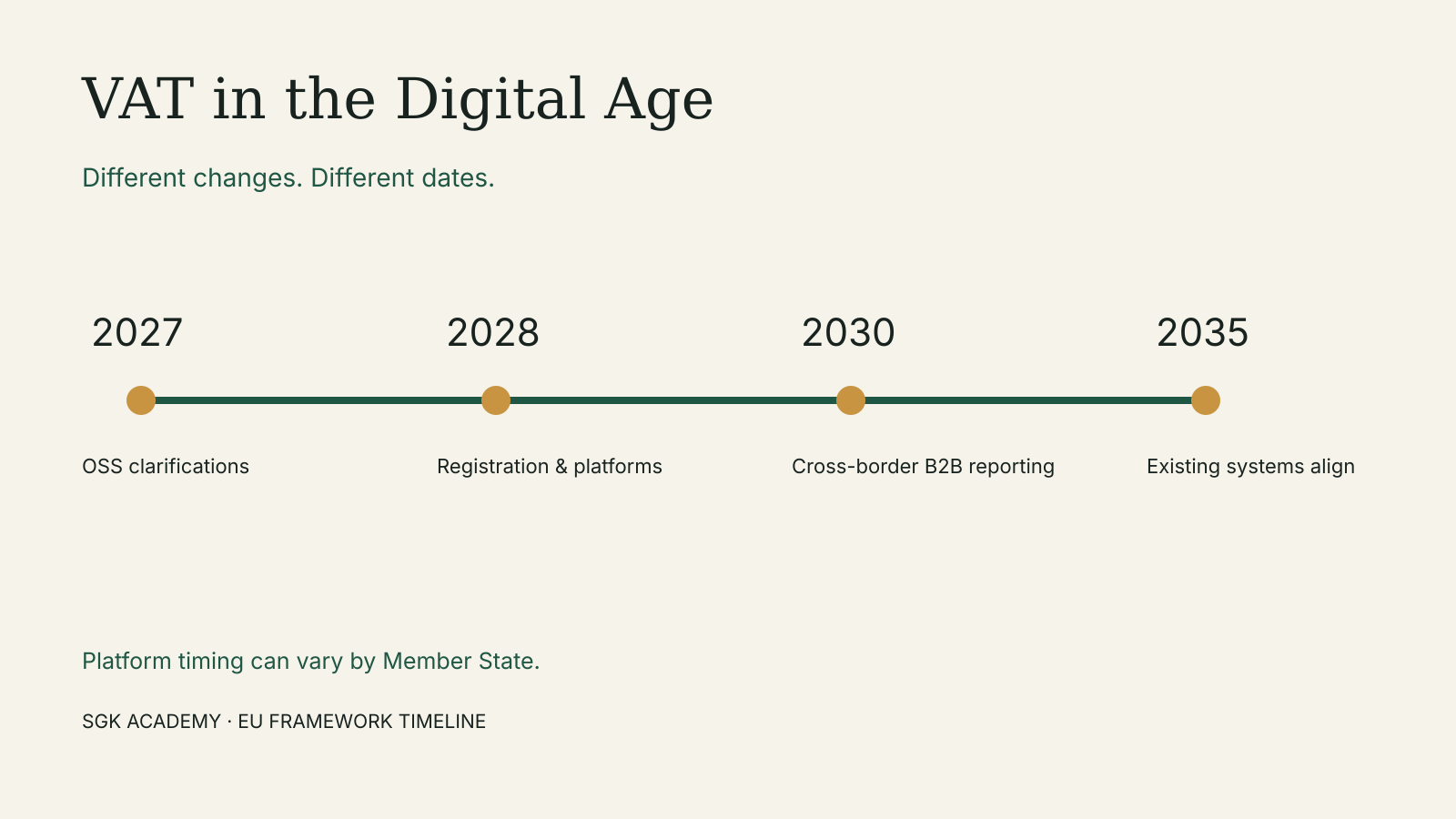
The European Commission’s ViDA overview identifies three main strands: digital reporting based on electronic invoices, VAT treatment of certain platforms, and a wider single VAT registration system. The package was adopted on 11 March 2025. Its timeline stretches well beyond 2027.
| Date | EU framework milestone | Question for a small business |
|---|---|---|
| 1 January 2027 | Initial changes and clarifications to One-Stop Shop and Import One-Stop Shop rules | Does an existing special-scheme registration or sales process need an update? |
| 1 July 2028 | Main single VAT registration changes; the platform strand begins, subject to the permitted national timing described below | Could more transactions use a special scheme, or could a platform account for VAT? |
| 1 July 2030 | Digital reporting for relevant cross-border business-to-business transactions | Can the invoicing system produce and transmit the required structured data? |
| 1 January 2035 | Alignment deadline for qualifying existing national real-time reporting systems | How will the domestic system converge with the EU framework? |
A date on this table is a trigger for checking the relevant rules. It does not establish that every company has the same obligation that morning. A freelancer selling services to another business, a seller moving stock between countries and an accommodation host have different transaction patterns.
There is also a timing qualification for platforms. Council Directive (EU) 2025/516, Article 6, permits Member States to apply the relevant platform provision from 1 July 2028 up to 1 January 2030. A platform business therefore needs the national start date, rather than an assumption that every market switches together.
What deserves attention before 2027
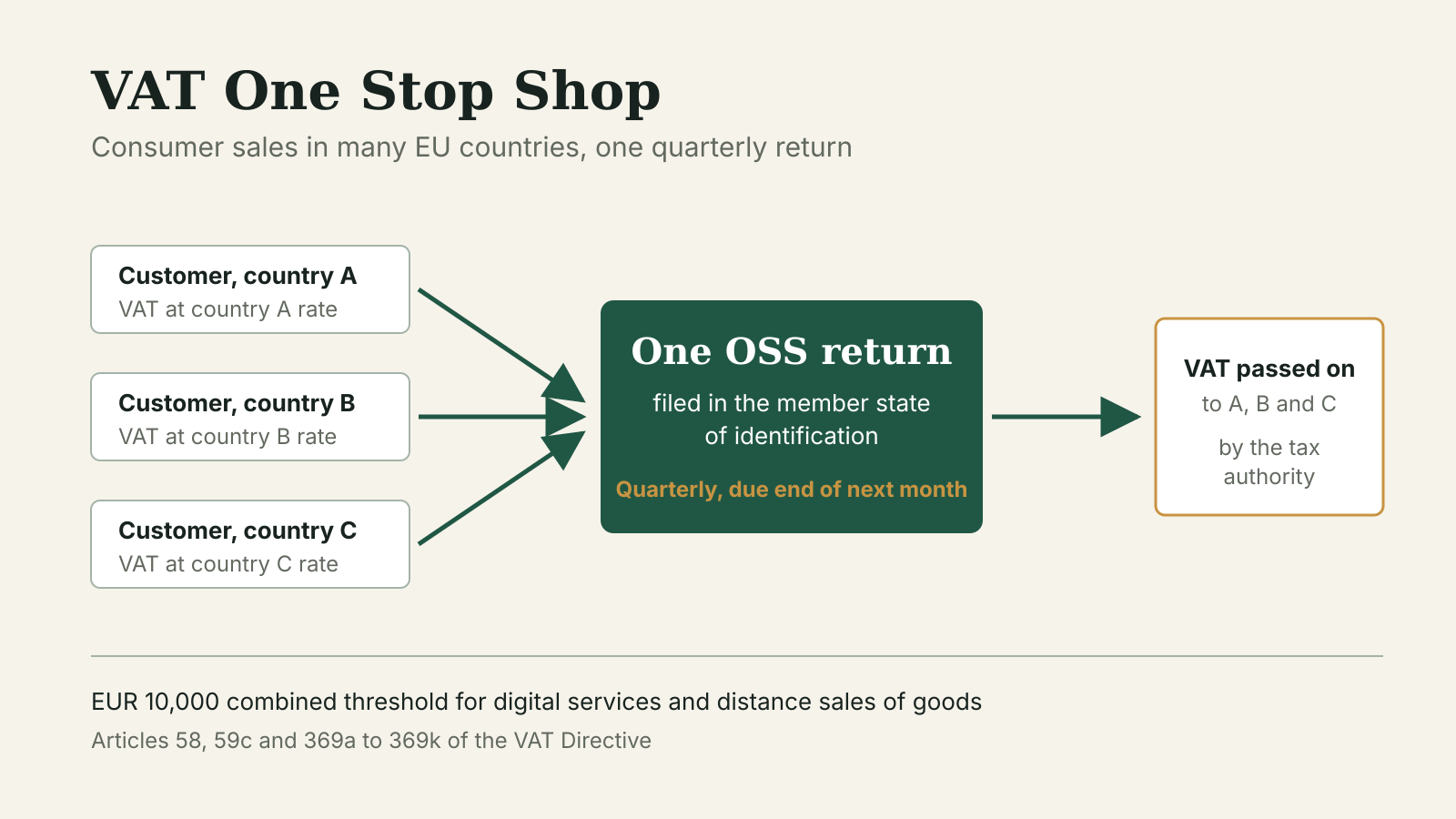
The Commission’s 2026 work programme announcement describes the January 2027 stage as including clarification of OSS and IOSS rules and extension of OSS to cross-border B2C e-charging supplies.
For a business already using a special scheme, a sensible preparation task is to ask its accountant or software provider which of its transactions are affected. Give them examples of actual sales routes. An answer about “ViDA compliance” without reference to those routes is too broad to support a change in the accounts.
Keep the existing workflow visible while doing that review. Write down where the customer country comes from, where tax treatment is selected, which system holds the invoice and how corrections reach the return. A change in one screen can be missed by a separate spreadsheet or export. The aim is to identify the point at which a new rule would enter the process.
A business that does not use OSS should first establish why. It may have only domestic customers, supply businesses rather than consumers, or have an activity requiring a different analysis. Do not enrol in a scheme merely because a software banner mentions an EU reform. Our OSS guide explains the distinction between a scheme for reporting VAT and the underlying treatment of a sale.
Map sales before selecting software
Create a small transaction register for the review. It can start with a spreadsheet; it should describe the business, rather than reproduce a vendor’s product categories.
For each recurring sales route, record the seller entity, customer type, customer country, supply type, fulfilment location and any platform involved. Add the current VAT treatment, the invoice system and the reporting route. Where an answer is uncertain, identify who will resolve it and the evidence they will use.
An illustrative design studio might have domestic business clients, business clients elsewhere in the EU and occasional consumer purchases of a downloadable product. That is three routes to investigate. Calling the studio “a services business” hides the consumer route; calling all foreign sales “exports” hides the distinction between customer types. This example is a proposed review method, not a conclusion about the VAT due on any particular sale.
Include purchases as well. An owner may focus on outgoing invoices while its bookkeeper imports supplier documents through an unrelated tool. Ask how the business will receive structured invoices, retain their original data and connect corrections to the accounting record. A supplier’s successful transmission and your own successful posting are separate events.
The register also makes professional advice more useful. Instead of asking whether ViDA affects the company, ask which recorded route changes, on what national effective date, and what information must move between systems.
Electronic invoices are a data question
A human-readable invoice helps a customer inspect a charge. A structured electronic invoice also carries fields that software can process. Planning for structured exchange therefore requires more than choosing a new appearance for the document.
The directive connects the future EU reporting framework to the European electronic invoicing standard. It also leaves room for permitted domestic formats and national arrangements. The exact technical route should be checked against the jurisdiction and transactions concerned. Our European e-invoicing guide separates those national mandates from the wider EU timetable.
When evaluating a provider, ask it to demonstrate a complete synthetic transaction. Create a fictional customer, issue an invoice, deliver it through the proposed channel and inspect the recipient’s imported record. Correct it and export both documents. Check what an operator sees when delivery fails. None of those steps proves legal compliance, but they reveal whether a claimed feature fits the operating process.
The distinction matters for a small team. If only one person understands a failure queue, a holiday can become a reporting problem. Put responsibility for failed messages, rejected invoices and corrections into the same operating notes as the normal invoice run. Include an escalation route to the provider and accountant.
Also ask what data can be retrieved after ending the subscription. An export that contains totals but loses the original structured invoice may be inadequate for the recordkeeping process the business has designed. Obtain a sample export before committing and have the relevant adviser assess what must be retained.
Cross-border B2B reporting from 2030
The 2030 stage introduces digital reporting requirements for relevant cross-border B2B transactions, based on electronic invoicing. Domestic duties can arise on different timetables. A business should therefore keep two entries in its compliance calendar: the EU cross-border milestone and the applicable national invoice or reporting requirement.
For preparation, trace the delay between the commercial event and the accounting record. Does a salesperson issue the invoice immediately, or send a weekly spreadsheet to a bookkeeper? Does a customer correction wait until month-end? These questions identify dependencies that become more important when reporting moves closer to the transaction.
Avoid turning that observation into an unsupported deadline for every invoice. The directive contains detailed rules and exceptions. The correct operational deadline needs to be established for the transaction, including how self-billing and corrections are handled. Ask for a written example using a transaction the business actually makes.
A useful calendar entry names the action and its owner. “ViDA in 2030” is a reminder to do research. “Confirm reporting route for EU business-client invoices with adviser by [chosen review date]” is work somebody can complete. The chosen review date is an internal planning decision, not a statutory deadline.
For the current treatment of a cross-border service, use our reverse-charge guide. ViDA preparation should not replace the checks already needed to issue today’s invoices.
Platforms: identify who is supplying what
The platform rules concern specified short-term accommodation rental and road passenger transport facilitated through electronic interfaces. They are not a general rule that every marketplace must collect VAT for every seller.
The adopted directive’s deemed-supplier provision includes conditions involving the underlying supplier’s VAT identification and declaration that it will charge VAT. It also provides for national choices. A host or transport operator should examine the applicable national implementation and the platform’s resulting process before changing its invoice or bookkeeping treatment.
For an accommodation operator, an operational review could start with three documents: a booking confirmation, a platform settlement statement and the operator’s invoice record. Identify what each says about the supplier and tax. If the platform’s tax process changes, ask how that change will appear in all three. This is a document-checking exercise; it does not determine whether a particular booking falls within the provision.
A platform’s deduction from a payout also needs classification. A commission, a withheld amount and VAT accounted for by the platform are different accounting questions. Have the bookkeeper map the settlement fields before importing a new format into the accounts. Keep an example of the old and new statements so that a discrepancy can be investigated.
Single VAT registration does not mean one tax rule
The single VAT registration strand aims to reduce the situations requiring multiple registrations through expanded schemes and related measures. That does not mean an EU business can ignore where transactions take place or apply one tax rate to all customers.
For a seller of physical goods, distinguish customer sales from movement of its own inventory. Record where stock is held, who owns it during a transfer and which entity makes the eventual sale. Those facts can affect the analysis even when the checkout system is unchanged.
For a service business, establish whether a proposed simplification covers its particular supplies. The phrase “single VAT registration” is not enough evidence to cancel an existing registration or stop a return. Ask an adviser to identify the legal basis, effective date and transition steps for the specific registration concerned.
Keep a separate decision log for registrations. Each entry should state why the registration exists, what transactions use it and what would have to be true before it could close. Attach the advice supporting a change. This prevents a software migration from accidentally becoming a tax-registration decision.
Questions worth putting in a provider contract
A provider should be able to describe which countries, formats and transaction types its offering supports today. Separate that from a promise to support later requirements. Ask how future scope will be confirmed, whether an integration or additional subscription is needed, and who handles changes in national specifications.
Establish responsibility at the boundary between services. The invoicing product may create a valid document while another connector submits it. Find out which service records acceptance or rejection and how the operator receives notice. A successful API request can mean that a message was received; the business still needs to know what happened to the invoice.
Request a correction example, a failure example and a full export. Use fictional records so the demonstration does not require disclosing real customer information. Write down the expected result before the demonstration. This gives the team something concrete to compare with the provider’s output.
Finally, price the work around the subscription: setup, accountant review, integration, staff training and recurring exception handling. These are planning categories, not estimated costs. The business can obtain quotations for the parts it actually needs.
A preparation file a small team can maintain
Keep the transaction register, national-rule references, provider answers and implementation decisions together. Add a review date to each substantive conclusion. If a source or product changes, the person reviewing the file should be able to see which operating decision relied on it.
Use VAT thresholds when checking registration thresholds and filing deadlines when organising the existing calendar. Do not copy those figures into a ViDA project note unless there is a reason to maintain a second version.
The next useful action is usually narrow: confirm the treatment of one sales route, test one invoice exchange or obtain the national start date for a platform activity. Completing that action produces evidence for the next decision. A general claim that the business is “ready for ViDA” cannot do the same work.