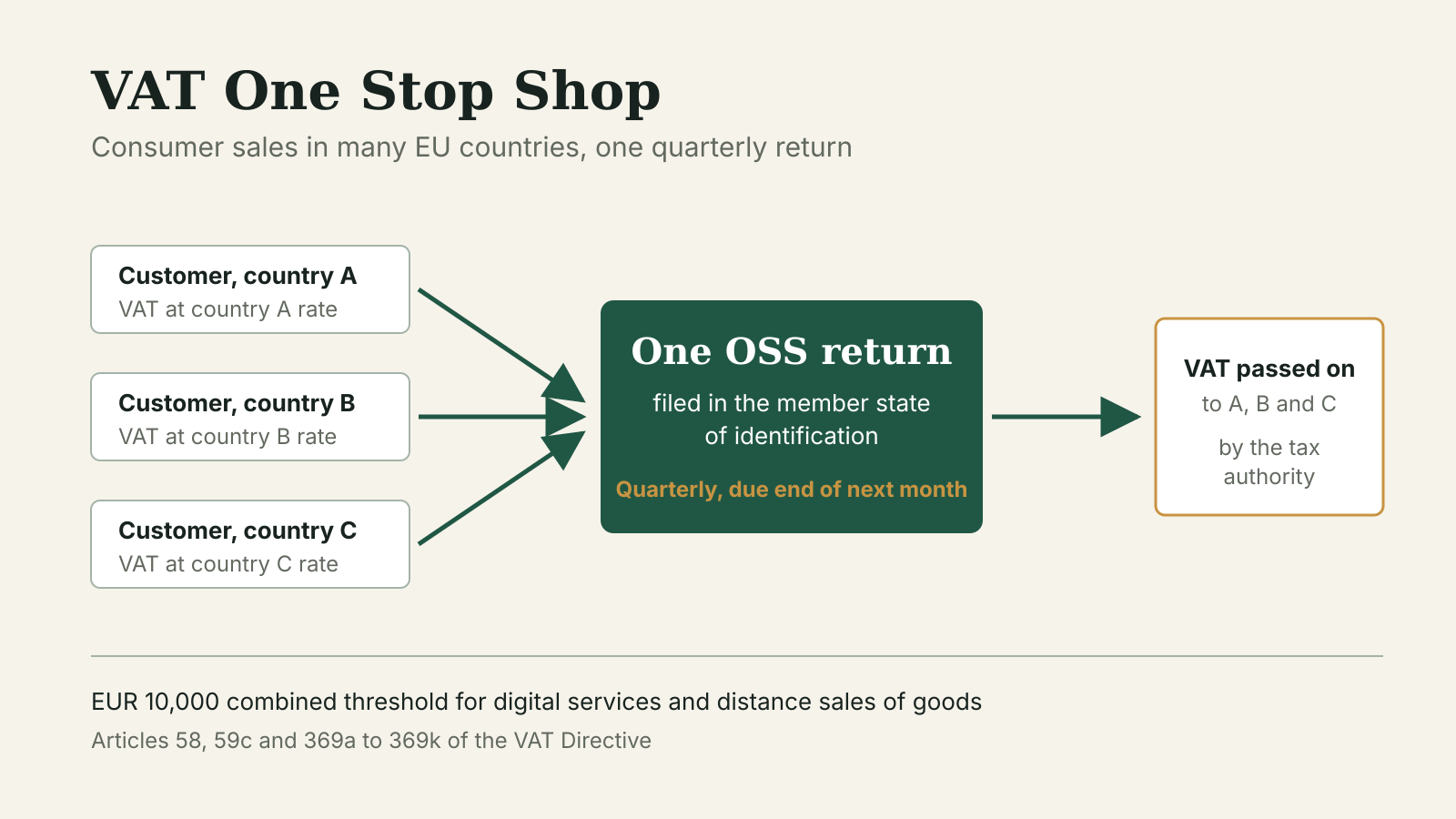
The VAT One Stop Shop (OSS) lets a business that sells to consumers in several EU countries declare and pay the VAT of all those countries in one quarterly return, filed in one member state. It does not change which country’s VAT applies. It only changes where you report it. For a founder selling software, downloads, online courses or physical products to private customers across the EU, it is usually the difference between one extra return each quarter and a VAT registration in every country where a customer lives.
This guide explains when consumer sales start to carry the customer’s VAT, which of the three OSS schemes fits which business, how the return and payment work, what records to keep and how people get thrown out of the scheme. It is built on the EU VAT Directive, its implementing regulation and the European Commission’s OSS guidance. Sources were checked on 3 October 2026.
What the One Stop Shop is, and what it is not
The Commission’s One Stop Shop page describes it as an extension of the mini One Stop Shop (MOSS) that ran from 1 January 2015 for telecoms, broadcasting and electronic services. Since 1 July 2021 it covers three special schemes:
| Scheme | Who can use it | What goes in it | Return period |
|---|---|---|---|
| Union scheme | Businesses established in the EU (services and goods); non-EU businesses for goods only | Services to consumers in member states where the seller has no establishment; intra-EU distance sales of goods; some platform sales | Calendar quarter |
| Non-Union scheme | Businesses not established in the EU | Services to consumers anywhere in the EU | Calendar quarter |
| Import scheme (IOSS) | EU businesses; non-EU businesses through an EU intermediary, with limited exceptions | Distance sales of goods imported into the EU in consignments of EUR 150 or less, excluding excise goods | Calendar month |
Three points from the Commission’s guidance shape every decision about it.
It is optional. Without it, the seller would have to register in each member state where it makes these sales. With it, the seller registers once, in its member state of identification.
It is all or nothing within a scheme. The Commission is explicit: once you choose a scheme, you must declare every supply that falls under it in every member state. You cannot use OSS for Germany and register locally in France for the same kind of sale.
It sits on top of your normal VAT return. In the Commission’s words, the OSS returns “are additional and do not replace the VAT return a taxable person submits to his Member State under his domestic VAT obligations.”
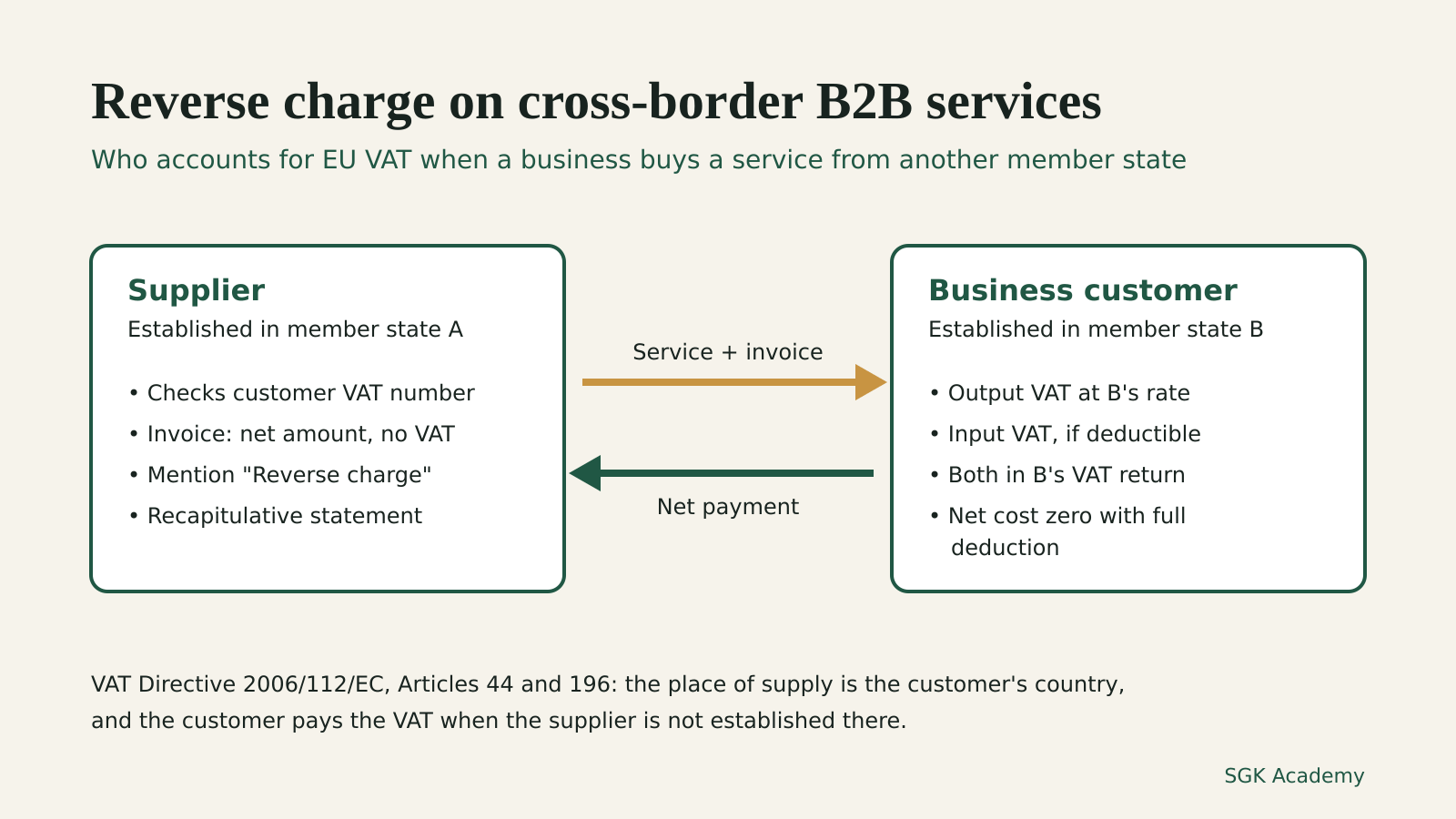
The OSS is for sales to consumers and other non-taxable persons. Sales of services to businesses in other member states normally follow the reverse charge, where the customer accounts for the VAT, and they stay out of OSS. Our guide to reverse charge VAT on services in the EU covers that side.
When a consumer sale carries the customer’s VAT
The OSS only matters once your sales are taxed in the customer’s country. For most founders that question turns on what they sell.
Digital services that run on their own. Telecommunications, broadcasting and electronically supplied services (TBE services) sold to consumers are taxed where the customer is established, has a permanent address or usually resides, under Article 58 of the VAT Directive. Article 7(1) of Implementing Regulation (EU) No 282/2011 defines electronically supplied services as services delivered over the internet or an electronic network whose nature makes them “essentially automated and involving minimal human intervention”. Software subscriptions, downloadable templates, e-books and pre-recorded course libraries are the usual examples. Article 7(3) excludes, among other things, teaching where a teacher delivers the course content over the internet.
Live-streamed activities. Since 1 January 2025, Council Directive (EU) 2022/542 has moved cultural, artistic, sporting, scientific, educational and entertainment activities that are “streamed or otherwise made virtually available” to the customer’s place of residence when sold to consumers (Article 54(1), second subparagraph). A paid live webinar for private customers in five countries is taxed in those five countries.
Physical goods shipped across a border. An intra-EU distance sale of goods is taxed where the transport to the customer ends, under Article 33(a).
Most other services are not affected. The general rule for services to consumers in Article 45 taxes them where the supplier is established. A consultant, coach or designer who does individual work for a private client in another member state charges VAT at home, if they charge VAT at all, and has nothing to declare in OSS. Some other services have their own rules, such as work connected with land, which is taxed where the property is.
The EUR 10,000 threshold
Article 59c of the Directive keeps small cross-border sellers on their home VAT for TBE services and distance sales of goods. According to the Commission’s Guide to the VAT One Stop Shop, three conditions must all be met:
- The supplier is established, or in the absence of an establishment has its permanent address or usually resides, in only one member state.
- It supplies TBE services to consumers in other member states, or ships goods from its own member state to consumers in others.
- The total of those supplies, without VAT, does not exceed EUR 10,000 in the current calendar year and did not in the preceding calendar year.
Below the line, those sales are domestic sales and “cannot be declared in the OSS”, in the guide’s words. The amount is one combined total: TBE services and distance sales of goods are added together, and the total covers all other member states, not each country separately.
Three details catch people out.
- The switch happens mid-year. Article 59c(2) says that once the threshold is exceeded during a calendar year, the destination rules apply “as of that time”. You do not wait until 1 January.
- The preceding year counts. A business that went over EUR 10,000 in 2026 is outside the threshold for all of 2027, even if 2027 sales are small.
- Only one establishment. The Commission’s guide notes that a business with establishments in more than one country cannot use the threshold. A business established outside the EU is not covered by it either, so it applies destination VAT from the first sale.
The threshold covers only TBE services and distance sales of goods. Live-streamed activities fall under Article 54, not Article 58, so check with your tax authority before assuming a live online course stays on home VAT below EUR 10,000.
You may also opt into destination taxation below the threshold; under Article 59c(3) that choice covers at least two calendar years.
The EUR 10,000 figure is separate from the domestic small-business exemption limits each country sets, and from the EUR 100,000 Union turnover limit in the EU SME scheme. Those are covered in our guide to the EU SME VAT scheme, and each country’s domestic limit is in the VAT registration thresholds catalog.
Which scheme and which country
An EU business uses the Union scheme in its home country. The Commission’s registration page says the member state of identification is where the business is established. You register with your existing national VAT number; there is no separate OSS number, and you need a valid VAT number before you can register. A business with fixed establishments in several member states can choose among them, but is then bound for the current year and the two following years.
One limit matters for founders with staff or an office in a second country: in the Union scheme, “services supplied to non-taxable persons that take place in a Member State in which the supplier has an establishment cannot be declared in the Union scheme”. Those sales go in the domestic VAT return of that country.
A business outside the EU uses the non-Union scheme for services. It can choose any member state, which issues a number in the format EUxxxyyyyyz that can only be used for the scheme. The Commission notes that being VAT-registered elsewhere in the EU does not prevent a non-EU business from using it. Non-EU businesses declare their consumer sales of services in all member states through it, including sales in the member state of identification.
Goods imported into the EU go through the import scheme. It covers consignments of EUR 150 or less. A seller established outside the EU normally has to appoint an EU-established intermediary; the Commission names Norway as the exception, for goods shipped from Norway, because the EU has a mutual-assistance agreement for VAT recovery with it.
When registration takes effect
The Commission’s guide gives the normal start date as the first day of the calendar quarter after you tell the member state of identification that you want to use the scheme. If you register on 15 February, the scheme covers supplies from 1 April.
There is an early-start rule for a first supply made before that date. If you inform the member state of identification by the tenth day of the month after that first supply, the scheme applies from the date of the supply. Miss that date, and the guide says you must register and account for VAT in each member state of consumption directly. Changes to your registration details are due by the tenth day of the month after the change.
Filing and paying the OSS return
The Commission’s page on declaring and paying in OSS sets the rhythm for the Union and non-Union schemes:
| Quarter | Return and payment due |
|---|---|
| 1 January to 31 March | 30 April |
| 1 April to 30 June | 31 July |
| 1 July to 30 September | 31 October |
| 1 October to 31 December | 31 January of the following year |
The deadline does not move when it falls on a weekend or public holiday, and you may not file before the quarter has ended. A return is due even when you made no OSS sales in the quarter; the Commission calls it a nil return.
For each member state of consumption, the return lists the taxable amount and VAT at the standard rate and at each reduced rate. The Union scheme return separates services from goods and sales made from the home country from sales made from fixed establishments elsewhere. Each return gets a unique reference number, which must be quoted with the payment. Articles 369h and 369i of the Directive set the return and the payment in euro, unless a member state outside the euro area requires its own currency.
Rates are the customer’s country’s rates. The return uses each member state’s own rates, which the Commission publishes in its Taxes in Europe Database. Our VAT thresholds and rates catalog lists the standard and reduced rates for every EU member state.
A negative balance does not offset others. If a correction leaves a negative balance for one member state, the Commission says it “will not be taken into account for the total amount of VAT due in any of the other Member States”. That member state refunds the excess under its own rules.
Corrections go in a later return. Article 369g(4) of the Directive requires amendments to be included in a subsequent return within three years of the date the original return was due. The Finnish Tax Administration’s OSS guidance spells out what happens after that: corrections and the related VAT must be sent to the member state of consumption directly.
Input VAT stays outside OSS. The OSS return has no box for VAT you paid. Article 369j of the Directive says a business using the Union scheme may not deduct, through the scheme, VAT incurred in the member states of consumption on those activities; it reclaims it under the cross-border refund procedure of Council Directive 2008/9/EC, or through its domestic return where it is registered there. VAT on costs at home goes through your normal return as before.
Worked example (illustrative figures)
A founder runs a one-person company established in Portugal that sells downloadable design templates to private customers through its own website. The templates are delivered automatically, so they are electronically supplied services. The VAT rates below are hypothetical round numbers chosen to keep the arithmetic readable; use the real rates from the VAT rates catalog.
Year 1. Sales to consumers in other member states total EUR 6,200 without VAT. The company is established only in Portugal and is under EUR 10,000 in this year and the one before, so it charges Portuguese VAT on every sale and declares it in its Portuguese return. OSS is not relevant.
Year 2. A product launch takes cross-border consumer sales past EUR 10,000 on 14 July. From that moment, sales to customers in other member states carry the VAT of the customer’s country. The company registers for the Union scheme in Portugal. Because its first sale under the new rule is on 14 July, it informs the Portuguese tax authority by 10 August so that the scheme covers sales from 14 July.
Its third-quarter sales to other member states, net of VAT, look like this:
| Member state of consumption | Net sales | Hypothetical rate | VAT due |
|---|---|---|---|
| Country A | EUR 4,000 | 20% | EUR 800 |
| Country B | EUR 2,500 | 25% | EUR 625 |
| Country C | EUR 1,500 | 19% | EUR 285 |
| Total | EUR 8,000 | EUR 1,710 |
The company files one Union scheme return in Portugal by 31 October, quoting the return’s reference number when it pays EUR 1,710. Portugal splits the return and passes each country’s share on. Sales to Portuguese customers stay in the normal Portuguese return.
Year 3. Cross-border sales fall to EUR 7,000. The company is still outside the threshold, because it exceeded EUR 10,000 in the preceding year. It keeps filing OSS returns.
The pricing point. If the website shows one gross price everywhere, say EUR 30 including VAT, the company keeps EUR 25.00 net where the rate is 20% and EUR 24.00 where it is 25%. That is arithmetic, not a rule, but it is the reason many sellers show prices by country once they move to destination VAT.
Records and evidence
What to keep. Article 63c of Implementing Regulation 282/2011 lists the records an OSS user must keep, including the member state of consumption, the type of supply, its date, the VAT due, payments on account and “information used to determine the place where the customer is established, has his permanent address or usually resides”. The Commission’s record-keeping page adds that they must be kept for 10 years from the end of the year of the transaction, even if you stop using the scheme, and be made available electronically on request. Failing to provide them within a month of a reminder counts as persistent non-compliance.
How to show where the customer is. For TBE services and streamed activities, Article 24b of the implementing regulation generally lets you presume the customer’s location from two items of non-contradictory evidence listed in Article 24f, such as the billing address, the IP address of the device, bank details or the country code of a mobile SIM. A business whose supplies of this kind do not exceed EUR 100,000 in the current and preceding year can rely on one item of evidence supplied by a third party involved in the sale, such as a payment provider. Card checkout data and an IP country that agree make a simple, durable record; save them with each transaction.
Invoices. Under the Union and non-Union schemes there is no obligation to issue an invoice for these consumer sales, according to the Commission. If you do issue one, the invoicing rules of the member state of identification apply. Distance sales of goods outside the Union scheme are an exception and need an invoice.
Leaving the scheme, and being excluded
Voluntary exit. The Commission’s deregistration and exclusion page requires you to inform the member state of identification at least 15 days before the end of the quarter before the one in which you stop. To leave from 1 July, tell it by 15 June. The exit takes effect on the first day of the next quarter.
Exclusion for persistent failure. The member state of identification sends a reminder on the tenth day after a missed return. A business that receives reminders for three consecutive periods and does not file within ten days of each is treated as persistently non-compliant and excluded.
Quarantine. Exclusion for persistent failure removes the business from all three schemes and bars it from registering for any of them for two years. During that time, every consumer sale taxed in another member state needs a local VAT registration there. Austria’s business service portal (USP) also lists exclusion where no OSS sales are made for eight calendar quarters.
Common mistakes
- Treating OSS as a VAT exemption. OSS changes where you report, not how much VAT is due. The rates are the customer’s country’s rates.
- Counting the EUR 10,000 per country. It is one total across all other member states, for TBE services and distance sales of goods together.
- Forgetting the preceding year. Crossing EUR 10,000 keeps destination VAT for the whole of the next calendar year.
- Putting B2B sales in OSS. Sales to businesses with a valid VAT number go through the reverse charge and your recapitulative statement, not OSS.
- Using OSS for a country where you have staff or an office. Union scheme service sales into a member state where you are established belong in that country’s domestic return.
- Skipping nil returns. A quarter with no OSS sales still needs a return, and three unanswered reminders lead to exclusion.
- Trying to reclaim costs through the OSS return. It has no deduction box; foreign input VAT goes through the refund procedure.
Checklist before your first OSS quarter
- Add up your cross-border consumer sales of TBE services and distance sales of goods for this year and last year, without VAT.
- If the total is near EUR 10,000, decide what happens on the day you cross it: prices, checkout settings and the evidence you capture.
- Confirm which scheme applies: Union scheme if you are established in the EU, non-Union scheme for services if you are not, import scheme for low-value imported goods.
- Register through your member state of identification’s portal, and use the early-start rule if your first sale under destination VAT comes before the next quarter.
- Record, for each sale, the customer’s country and the evidence behind it, the net amount, the rate applied and the VAT.
- File each quarterly return, including nil returns, by the end of the following month and pay with the return’s reference number.
- Keep records for ten years and make corrections in a later return within three years.
- Keep filing your normal domestic VAT return; OSS does not replace it.
The VAT in the Digital Age package extends this model. According to the European Commission’s ViDA page, minor clarifications for OSS and IOSS users take effect by 1 January 2027, and the Single VAT Registration reforms, which bring more business-to-consumer sales into the OSS, start on 1 July 2028. For annual accounts and corporate tax dates, which follow separate national calendars, use the company filing deadlines calculator.
Questions
What is the VAT One Stop Shop?
It is an optional EU system that lets a business declare and pay, in one quarterly return filed in one member state, the VAT due in other member states on sales to consumers. It covers services such as digital products and streamed events, intra-EU distance sales of goods and, through the import scheme, low-value imported goods.
Do I have to register for OSS?
No. OSS is optional. If your consumer sales are taxed in other member states and you do not use OSS, you must register for VAT in each of those countries instead. If you join a scheme, you must use it for all qualifying sales in all member states.
What is the EUR 10,000 OSS threshold?
It is the combined annual limit, without VAT, for cross-border sales of telecommunications, broadcasting and electronic services and intra-EU distance sales of goods to consumers in other member states. Below it, a business established in only one member state can charge its home VAT. Once the total is exceeded in the current or preceding calendar year, the customer’s country’s VAT applies.
When is the OSS return due?
For the Union and non-Union schemes, by the end of the month after each calendar quarter: 30 April, 31 July, 31 October and 31 January. Payment is due by the same date, and the deadline does not move for weekends or holidays.
Can I reclaim VAT on my costs through the OSS return?
No. The OSS return has no deduction section. VAT paid in your own country goes through your normal return; VAT paid in other member states is reclaimed through the EU refund procedure or through a local return where you are registered.