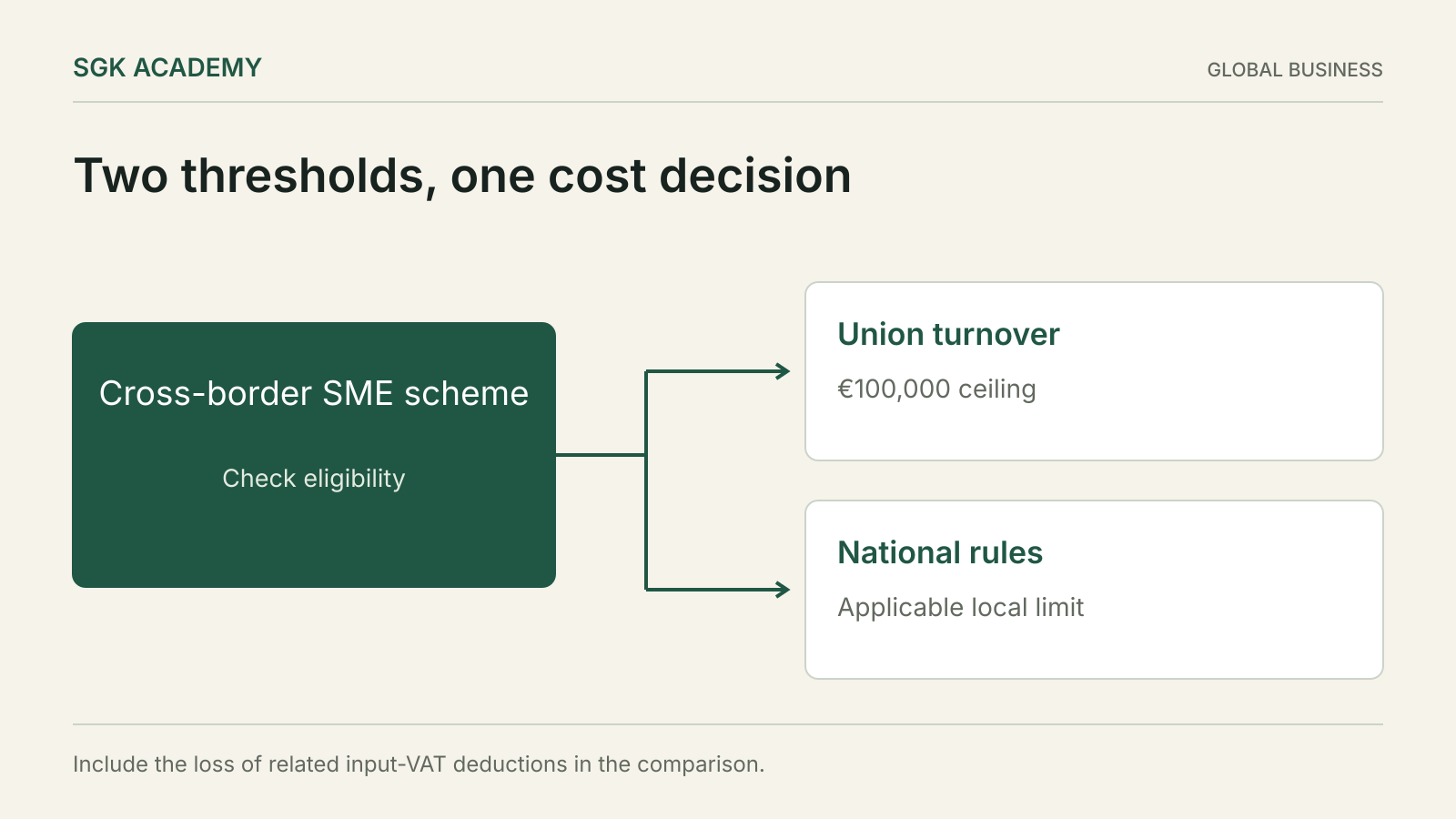
The EU SME VAT scheme can reduce the VAT burden on eligible small enterprises, including some cross-border sales, but an exemption can also remove the right to deduct related input VAT. The useful comparison is therefore the total effect on prices, costs and administration. Being below a turnover threshold is only the beginning of the decision.
The cross-border framework has applied since 1 January 2025. For a business planning its 2026 sales, the central questions are where it is established, where its supplies are taxable, whether it meets both Union and national conditions, and whether exemption is commercially helpful. This guide explains the framework without selecting a tax treatment for a particular business.
Distinguish the Union ceiling from national limits
The European Commission’s 2024 explanatory notes describe a Union annual turnover threshold of €100,000 for the cross-border scheme. That figure is not a universal VAT-registration threshold for every country.
National annual thresholds still matter in the Member States where exemption is sought. The notes explain that a national threshold cannot exceed €85,000, while countries may set lower or differentiated thresholds under the framework.
A business can therefore satisfy the Union ceiling and still fail a relevant national condition. Conversely, losing cross-border eligibility does not by itself answer every question about domestic treatment. Keep the two levels separate in the sales forecast.
Check the actual national rules and the turnover periods they use. Do not copy a threshold from a formation agent’s comparison table and assume it applies to every activity, every supply and every year.
Establishment is more than an address on an invoice
The Commission’s notes describe the scheme as available to qualifying enterprises established in the EU. A non-EU enterprise does not become eligible merely because it has a fixed establishment or VAT registration in a Member State.
This matters for founders who choose a foreign company first and examine VAT later. Company registration, business establishment and the place where a particular supply is taxed are related questions, but they are not interchangeable.
Write down where central administration is carried out and where the business actually operates. Then have the relevant establishment question assessed under the scheme’s rules. A mailbox, payment account or customer location does not provide a complete answer.
For a sole trader, personal circumstances may also be relevant to the establishment analysis. Keep the description factual: where the person lives, works and manages the activity. Marketing terms such as “borderless business” do not resolve a tax rule.
Map the supply before choosing the scheme
VAT treatment depends on what is supplied, to whom and where. Selling physical goods to consumers can raise different questions from providing services to businesses. The customer’s country alone does not determine every result.
Create a transaction map with the product or service, customer type, customer location, place of supply, expected turnover and current treatment. This is the information needed to assess the exemption and alternatives such as ordinary VAT accounting or a relevant One Stop Shop arrangement.
Do not treat the SME scheme as a replacement for understanding the transaction. It simplifies particular obligations when its conditions are met. It does not make every import, purchase, reverse-charge obligation or excluded transaction disappear.
Where the business has mixed activities, consider them separately. A general statement that the company is “VAT exempt” can hide supplies or purchases that need a different analysis.
The input-VAT trade-off can change the result
The Commission’s notes explain the central exchange: an eligible business can exempt covered supplies, but loses the right to deduct input VAT associated with those exempt supplies. That lost deduction can be material for a business with substantial purchases.
Consider an illustrative service business with a fixed consumer price of €12,000 and purchases costing €3,000 before VAT. Assume a hypothetical VAT rate of 20% on both sales and fully related purchases, with no other complications.
| Simplified annual comparison | Ordinary VAT treatment | Exempt covered sales |
|---|---|---|
| Consumer payments | €12,000 | €12,000 |
| Output VAT included in receipts | €2,000 | €0 |
| Purchases before VAT | €3,000 | €3,000 |
| VAT on purchases | €600, deductible in this example | €600, not deductible |
| Amount after these purchases and VAT | €7,000 | €8,400 |
This example isolates the mechanics. It assumes full deductibility in the ordinary regime, a fixed VAT-inclusive consumer price and no other expenses. It is not a quotation of a Member State’s rate or a claim that exemption always improves profit.
Now consider a business buying expensive equipment or selling mainly to customers who can deduct VAT. The commercial comparison can change. Model your actual pricing convention and purchases rather than adopting the result from a different business.
Business customers and consumers see prices differently
A consumer usually compares the total amount paid. A business customer with a right to deduct VAT may compare the net cost after deduction, subject to its own circumstances. That difference affects how much of a potential exemption benefit the supplier can retain.
If a business customer expects a €10,000 net price under ordinary treatment, removing VAT from the invoice does not necessarily allow the supplier to raise the underlying price. The customer may simply expect to continue paying the same net amount.
For consumer sales, a fixed final price may leave more room for the supplier to retain the difference, but competition and contracts still matter. Some businesses may choose to lower prices instead.
Build separate scenarios for existing contracts and new sales. A tax election does not automatically rewrite the commercial agreement. Check how prices are expressed and whether the contract permits the proposed adjustment.
Registration and reporting remain part of the work
For cross-border use, the framework involves a prior notification through the Member State of establishment and a single identification number with an EX suffix. The Commission’s notes also describe quarterly turnover reporting through that Member State.
Do not treat submitting a notification as proof that every desired exemption is already available. Confirm the applicable start and the Member States and activities covered through the official process.
Keep a register of where the business uses the scheme, the relevant national limits, the evidence of acceptance and the reporting dates. A small spreadsheet can be sufficient if it is kept current.
The simplification is valuable precisely because the reporting route is more coordinated. It is not the absence of records. The business still needs reliable sales data to show whether it remains eligible and to complete the required reports.
Monitor turnover before a threshold is crossed
Annual turnover can grow unevenly. A large project or seasonal sales period may move the business close to a ceiling much faster than a monthly average suggests.
Use a running total by Member State and a Union total calculated under the relevant definitions. Do not assume that the number on a management dashboard is automatically the legally relevant turnover measure.
Set an internal alert below the applicable limit so there is time to examine the next invoices. The size of that alert is a management choice, not an additional legal threshold. A business with large contracts needs more warning than one with many small predictable sales.
The Commission’s notes distinguish exceeding the Union ceiling from exceeding a national limit. The former can end cross-border eligibility across Member States; the latter can affect the relevant national exemption. Transitional rules and reporting consequences require checking for the actual situation.
Plan the transition in invoices and accounting
If the business leaves an exemption, the accounting system and customer communication may need to change. Determine the effective treatment before issuing invoices that span the transition.
Review product prices, invoice templates, tax codes and the way sales are reported. A correct tax decision can still produce errors if old settings remain in the billing software.
For recurring subscriptions, identify which invoices and periods are affected. For a quoted project, review the contract’s tax wording rather than deciding unilaterally that the customer will absorb an extra charge.
Also ask how purchases and assets are treated when entering or leaving the scheme. Input-tax adjustments and mixed-use questions can be more complex than the simplified example above. Those are specific matters for the relevant national guidance and professional advice.
Compare the alternatives using one set of assumptions
Build a short comparison of ordinary treatment and the exemption for the same expected sales, customer mix, purchases and administrative effort. Include the cost of advice and software changes if they are material.
Record assumptions explicitly: whether prices are fixed including VAT, whether customers can deduct it, which purchases relate to exempt supplies and whether turnover is expected to exceed a limit. Change one assumption at a time to see what drives the result.
Do not choose a scheme solely because it reduces the number of registrations or produces a lower-looking invoice. A simpler process can still be more expensive if it sacrifices substantial input deductions.
The decision should be explainable in ordinary terms: which supplies qualify, what obligations remain, how costs and prices change, and what will happen if the business grows. If those answers are unclear, the scheme has not yet been evaluated.
Ask for a comparison that includes purchases
When requesting advice, provide a sample month of sales and purchases, the expected annual turnover by country and the customer mix. Ask the adviser to show the financial effect under both treatments using those same facts.
That request is more useful than asking whether the business is simply eligible. Eligibility establishes an option; the comparison helps decide whether to use it. Also ask which assumptions would change the recommendation, such as a large equipment purchase or a new market. Keep those triggers beside the turnover alerts so that the decision is reviewed before the business’s pattern changes materially.
Questions
Is €100,000 the VAT-registration threshold everywhere in the EU?
No. It is the Union annual turnover ceiling relevant to the cross-border SME scheme. National exemption thresholds and other conditions remain separate.
Can a non-EU company use the scheme through an EU VAT registration?
The Commission’s explanatory notes say that non-EU enterprises are not eligible merely through an EU fixed establishment or registration. Establishment must be assessed under the actual rules.
Can an exempt business deduct VAT on its related purchases?
The exemption removes the right to deduct input VAT associated with the exempt supplies. Mixed activities and transitions need a more specific analysis.
Does the scheme remove all VAT administration?
No. Prior notification, identification and turnover reporting remain relevant, and not every transaction is necessarily covered by the exemption.