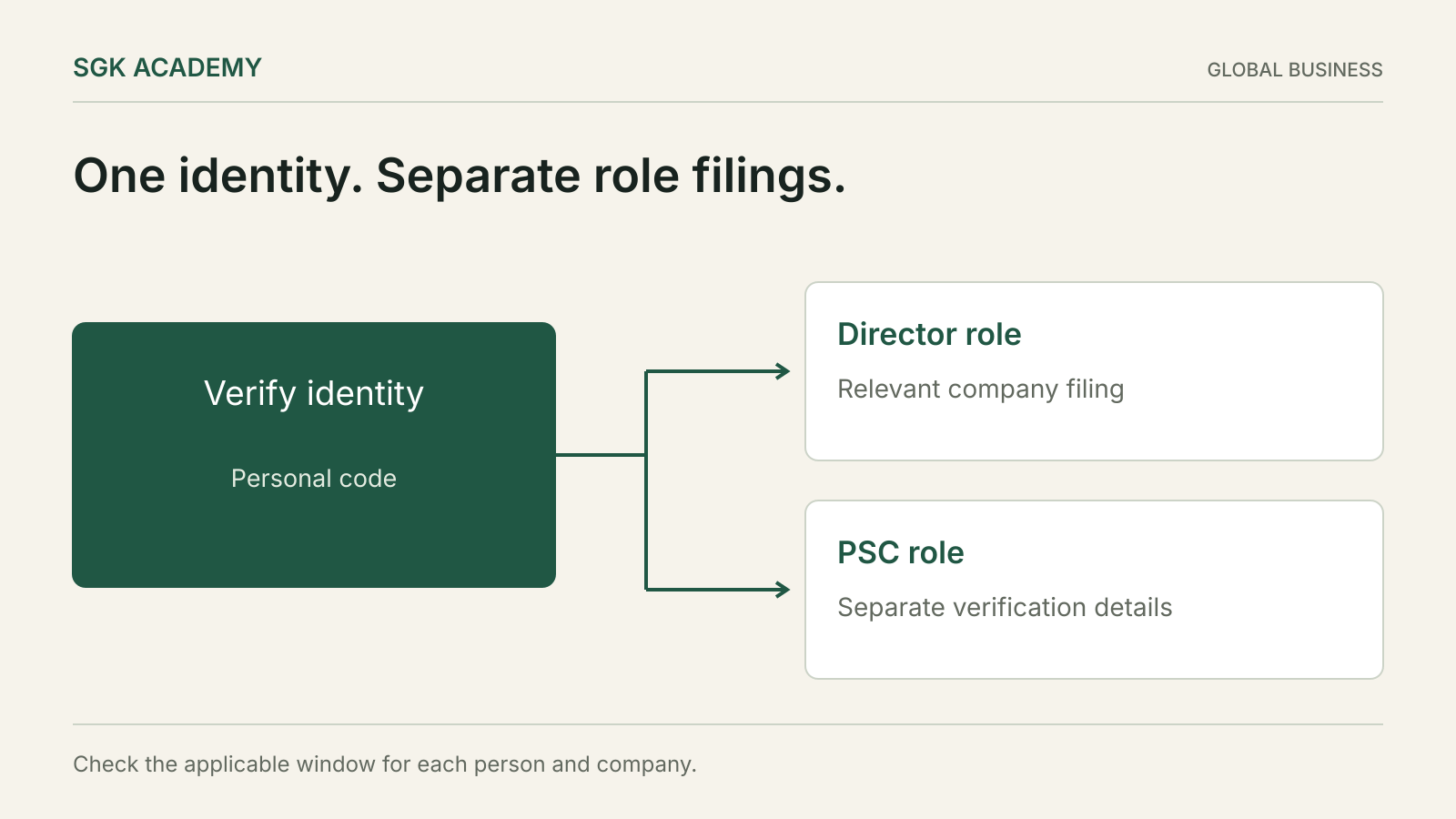
Companies House PSC identity checks require more than completing an identity-verification appointment. A verified person receives a personal code, but that code must also be supplied for the relevant role at the correct time. Someone who is both a director and a person with significant control can therefore complete one step and still have another filing to make.
Companies House’s 16 January 2026 explanation sets out the distinction and the relevant PSC windows. For a small company, the practical job is to connect people, roles, dates and evidence in one calendar. This guide follows that January explanation; it does not assume that later phases of the wider reform are already in force.
Identify the role before opening a form
A person with significant control, or PSC, is someone who owns or controls the company under the applicable tests. Companies House’s January explanation notes examples involving more than 25% of shares or voting rights and other forms of control.
Do not assume that “shareholder”, “director” and “PSC” describe the same thing. A director can have no shares. An owner can retain significant control without taking part in everyday management. Family arrangements and rights over decisions can require attention beyond a simple percentage column.
Start with the company’s actual register and ownership documents. Record the people currently shown as directors and PSCs, then identify where the same person holds both roles. If the ownership structure is unclear, resolve that question before treating identity verification as the only outstanding task.
A filing agent can help with the process, but the company should still understand the map. Otherwise a message saying “verification complete” may be interpreted as covering every role when it refers only to the initial identity check.
Verification produces a code; filing connects the role
According to the January guidance, a person can verify through the Companies House service using GOV.UK One Login or through an Authorised Corporate Service Provider, usually shortened to ACSP. Verification produces the Companies House personal code.
The same personal code can be used to connect the verified identity to the person’s roles. That does not mean the roles connect automatically. The guidance explicitly says that providing the code as a director on a confirmation statement does not complete the separate PSC requirement.
Think of this as two records: evidence that the person has been verified, and evidence that the required verification details have been supplied for a particular company role. Keep both statuses in the calendar.
Avoid sending the code to someone merely because they have emailed about a filing. Establish who is authorised to handle it and use the intended channel. The code is an administrative credential, not a piece of marketing information to circulate widely.
Put the correct fourteen-day window in the calendar
For an existing PSC who is also a director of the same company, the January explanation says the PSC period starts on the day after the company’s confirmation statement date. Its example uses a 31 March 2026 statement date and a PSC window from 1 to 14 April.
For an existing PSC who is not a director of that company, the explanation uses the first fourteen days of the person’s birth month. A new PSC has a different route: details can be supplied when first added or within fourteen days of the date on the direction letter sent afterwards.
These distinctions matter because “fourteen days” is incomplete without its starting event. A spreadsheet that stores only a deadline but not its basis will be difficult to check later.
| Situation described in January guidance | Event used for planning | What to verify |
|---|---|---|
| Existing PSC and director of the same company | Day after confirmation statement date | The company-specific window |
| Existing PSC who is not a director | First fourteen days of birth month | The date shown for that person |
| New PSC | Addition to register or direction letter | The letter’s date and instructions |
| One person with several roles | Separate role submissions | Completion for each relevant role |
Check the actual due dates on the Companies House register and the relevant notice. Do not replace those records with a date inferred from a general article, especially where a person’s circumstances have changed.
Work through a small-company example
Consider an illustrative company with two directors, Maya and Daniel. Maya also holds a controlling shareholding and is recorded as a PSC. Daniel is not a PSC. A third person, Leila, is a PSC but not a director.
The company should not create one task called “verify all three people” and assume that it covers the filing. It needs an identity-verification status for each relevant person, the director-related requirements, and the separate PSC submissions for Maya and Leila.
Suppose the company’s confirmation statement date is 31 March. Under the January explanation, Maya’s existing PSC window follows that date. Leila’s existing PSC window instead follows the birth-month rule. Those two tasks can fall in different months even though they concern the same company.
The example deliberately leaves Leila’s birth month unspecified. The person maintaining a shared calendar may need the resulting window, but does not necessarily need to copy a complete date of birth into every project-management tool. Keep personal information proportionate to the task.
Check data before the window opens
The PSC service compares the verified identity details with the register. The January guidance identifies mismatches, including an incorrect date of birth or incorrect details supplied during ACSP verification, as possible reasons the connection cannot be completed.
Review the relevant details early enough to correct a problem. Discovering a mismatch on the last day turns a manageable data issue into a deadline problem. Record the source of the mismatch before changing anything, so that the correct record is amended.
Distinguish an inaccurate company record from an inaccurate verification record. Repeating the same submission will not necessarily fix either. Follow the relevant Companies House correction guidance or ask the authorised provider to investigate the part it supplied.
Keep a simple issue log: affected person and role, description of the mismatch, responsible party, date raised and next action. Avoid copying identity documents into an ordinary task board. A status record can coordinate the work without duplicating sensitive evidence.
Coordinate with the accountant or agent explicitly
An engagement to prepare accounts does not automatically include every confirmation-statement or identity-verification task. Ask what the provider will do, what it needs from the company, and who confirms completion.
Agree a handover date before the legal deadline. If the provider needs a personal code, establish the secure route and which role it will be used for. If the company will submit the PSC details itself, record that decision so both parties do not assume the other is handling it.
Request evidence of the completed submission or the resulting register status, as appropriate. An email saying that documents have been received is not the same as a completed filing. Likewise, an identity-check receipt does not prove that a PSC role has been connected.
The point is not to create an elaborate compliance project. A small company can manage the process with a clear table and a named owner, provided the table distinguishes the actual steps.
Plan for absence and failed submissions
The January explanation says that a PSC who cannot provide verification details on time can request a fourteen-day extension before the deadline passes. Eligibility, timing and the live service instructions should be checked when using that route.
An extension should not be assumed to happen automatically. Record whether it has been requested and what response was received. If the service rejects a submission, keep the error and the time, then follow the appropriate correction or support route.
Plan around holidays, travel and access to accounts. A founder may be willing to deal with the filing but unable to access the verification service while away. Establishing the authorised agent or backup process beforehand can reduce avoidable urgency.
Do not share another person’s login as a shortcut. Use the official means of filing or authorised representation. Solving a deadline problem by weakening account control can create a separate problem for the company and the individual.
Store completion evidence by company and role
A useful record has a row for each relevant person-role combination. Include the company number, role, verification status, applicable period, filing owner, completion date and location of the evidence. The personal code itself can remain in a more restricted place.
For someone involved in several companies, repeat the role rows rather than reusing one ambiguous “done” flag. The identity may have been verified once, but the company-specific requirements still need to be tracked.
After a filing, read back the persisted result. Check that the right person and role were updated. If the register or service takes time to reflect a change, keep the submission evidence and check again through the normal process.
Review the calendar when a person becomes or ceases to be a PSC, changes roles or joins another company. A static annual reminder can become misleading when the underlying facts change.
Keep the reform’s stages separate
Companies House identity verification is part of a broader programme of company-law changes. A news article about one phase does not establish the start date or requirements of another phase.
For each task, record the specific official guidance and the date it addresses. Use the January PSC explanation for the PSC process described here. Check separate official instructions for director filings, authorised agents and other changes instead of assuming one common deadline.
This approach also makes later updates easier. If a rule changes, the company can identify which rows and assumptions need revision. Without that record, a revised article may cause unnecessary work on tasks that were already correctly completed.
The immediate outcome should be modest and verifiable: the right person is verified, the correct role details are supplied within the applicable window, and the company can produce evidence of completion.
Questions
Does verifying as a director also complete my PSC requirement?
Not by itself. Companies House’s January 2026 guidance says the personal code must also be supplied through the PSC process for the relevant role.
Do I need a new personal code for every company?
The guidance says verification produces one personal code that can be used for the person’s roles. Separate role submissions can still be required.
Can an accountant supply my PSC verification details?
An authorised person or provider can handle the relevant process where permitted. Agree the scope and secure handover explicitly rather than assuming it is included in another service.
Where should I check my actual deadline?
Use the Companies House register and any relevant direction letter, alongside the official guidance for your circumstances.