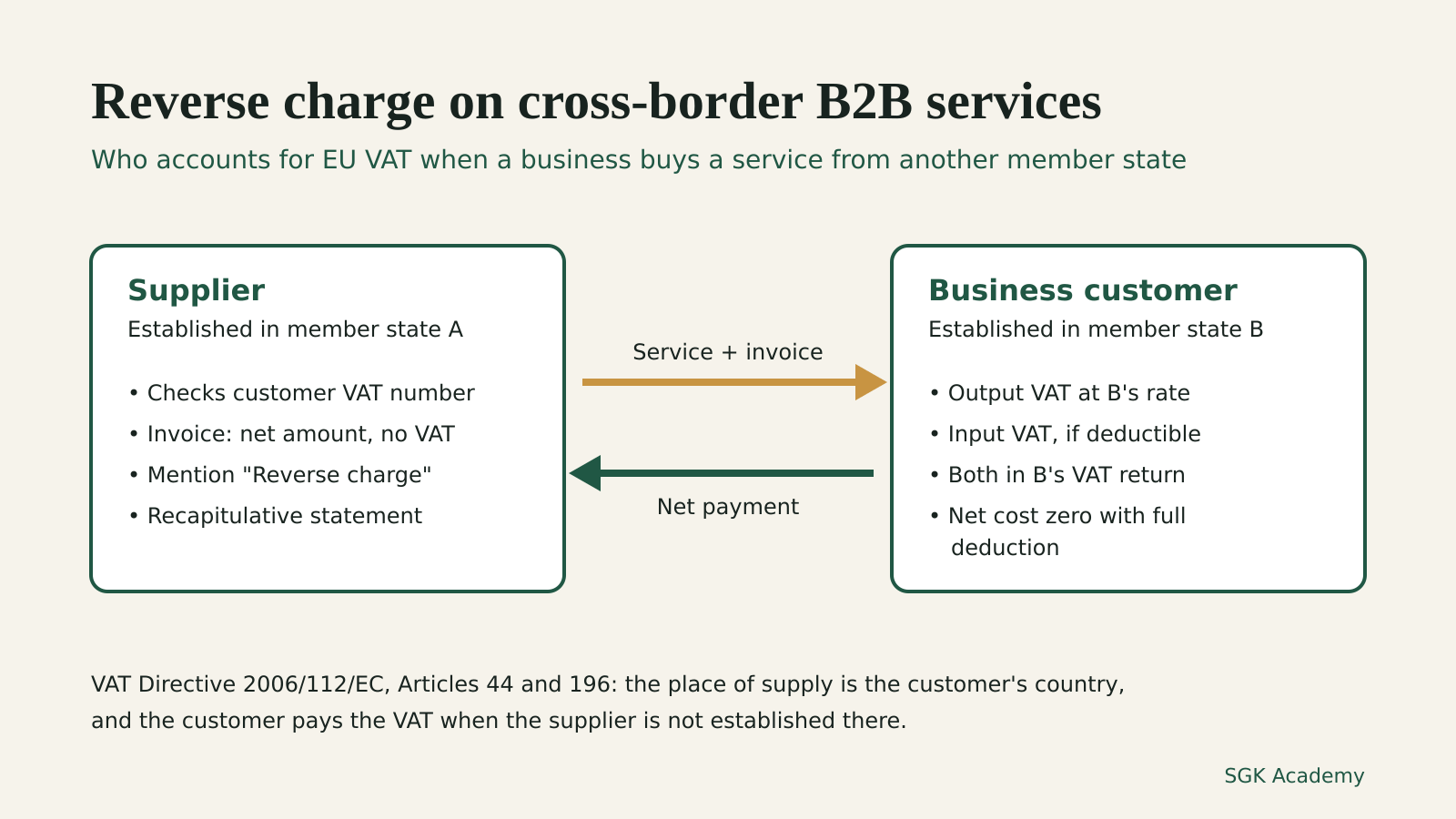
The reverse charge on VAT for services in the EU decides who pays the tax when one business sells a service to a business in another member state. In the standard case the supplier charges no VAT, writes “Reverse charge” on the invoice, and the customer declares the VAT in its own country’s return, usually deducting the same amount in that return. Both sides still have paperwork, and the supplier carries the risk if the customer was not really a business.
This guide works through the rule from the founder’s side: when it applies, what each party records, which exceptions move the tax elsewhere, and how the UK fits in since it left the EU VAT system. It is built on the VAT Directive, the EU implementing regulation and HMRC’s own notices. Sources were checked on 2 October 2026.
The rule in one paragraph
Two articles of Council Directive 2006/112/EC do most of the work. Article 44 sets the place of supply for business-to-business services: “the place where that person has established his business”, meaning the customer. If the service goes to a fixed establishment of the customer elsewhere, the place of supply is that fixed establishment. Article 196 then says who pays: VAT “shall be payable by any taxable person… to whom the services referred to in Article 44 are supplied, if the services are supplied by a taxable person not established within the territory of the Member State.”
Put together: a Spanish designer billing a German software company has made a supply that takes place in Germany, and the German company accounts for German VAT on it. The designer does not register in Germany and does not charge Spanish VAT.
The European Commission’s Your Europe page on cross-border VAT says the same thing in plain words: when you sell services to businesses based in another EU country, “you don’t usually need to charge your customers VAT. Your customers will pay VAT on the services received at the applicable rate in their country (using the reverse charge procedure).” It also notes that the supplier can still deduct the VAT paid on related expenses.
Three conditions before you drop the VAT
The general rule is simple, but it rests on three facts the supplier should be able to show.
1. The customer is a taxable person acting as such. Article 44 applies only to services supplied to a business. Article 18(1) of Implementing Regulation (EU) No 282/2011 gives the supplier a working test: unless it has information to the contrary, it may treat an EU customer as a taxable person where the customer has given its VAT identification number and the supplier “obtains confirmation of the validity of that identification number and of the associated name and address”. In practice that confirmation comes from the Commission’s VIES VAT number validation service. Article 18(2) works the other way: a customer who has not given a VAT number may be treated as a non-taxable person.
2. The customer belongs in a different member state from the supplier. Article 196 bites only where the supplier is “not established” in the customer’s member state. A Dutch supplier selling to a Dutch company charges Dutch VAT in the usual way.
3. The service follows the general rule. Some services have their own place-of-supply rules, covered below. If one of those applies, Article 196 may not.
Keep the evidence for each point with the invoice: the VIES result with its date, the customer’s address and the contract or order describing the service.
What the supplier does
The supplier’s side of a cross-border B2B service has four parts.
Invoice with the right mentions. Article 226 lists what a VAT invoice must contain. Two points matter here. Point (4) requires the customer’s VAT identification number where the customer is liable for the VAT, and point (11a) requires, “where the customer is liable for the payment of the VAT, the mention ‘Reverse charge’”. The invoice shows the net amount, no VAT, and that wording.
Issue the invoice on time. Under Article 222, for services where the customer pays the VAT under Article 196, “an invoice shall be issued no later than on the fifteenth day of the month following that in which the chargeable event occurs.” For a project finished on 20 October, the invoice is due by 15 November.
Report the sale in the recapitulative statement. Article 262 requires every VAT-registered business to submit a recapitulative statement (often called an EC Sales List) listing the customers to whom it supplied services taxed under Article 196. Under Article 263 it covers each calendar month, though member states may allow quarterly filing for services. The European Commission describes it as “a simple form submitted on a monthly/quarterly basis by traders, in addition to their VAT return, to declare goods delivered and services provided to traders in other Member States, containing the VAT number of the customers and the aggregated value of supplies per customer during a given period” (COM(2022) 703, footnote 4). Each country runs its own form and deadline, so check your tax authority’s page.
Declare the value in the VAT return. The supplier reports the net value of these sales where its national return form asks for it, and declares no output VAT on them.
Small businesses under a VAT exemption
A founder using a national small-business exemption is still a taxable person. Article 214(1)(e) requires member states to identify for VAT “every taxable person, established within their respective territory, who supplies services within the territory of another Member State for which VAT is payable solely by the recipient pursuant to Article 196.” In other words, an exempt freelancer who invoices a business customer in another member state needs a VAT identification number for that purpose, even if they charge no VAT at home. Our guide to the EU SME VAT scheme explains the exemption itself, and the VAT thresholds by country list each country’s domestic limit.
What the customer does
For the customer, the reverse charge turns a purchase into a two-line entry in its own VAT return.
The customer calculates VAT on the net invoice amount at its own country’s rate and declares it as output VAT. In the same return it claims the same amount as input VAT, to the extent it would be entitled to deduct VAT on that purchase if a local supplier had charged it. For a business with full deduction rights, the two amounts cancel. For a business with partly exempt activity, such as some financial or medical services, only part is deductible, and the reverse charge becomes a real cost. That is the reason for the rule: the customer pays the same VAT it would have paid buying locally.
Article 214(1)(d) requires member states to identify “every taxable person who within their respective territory receives services for which he is liable to pay VAT pursuant to Article 196.” A customer that is VAT-exempt at home still needs a VAT number to account for the reverse charge on services bought from abroad.
Worked example (illustrative figures)
A web developer established in Portugal builds a booking system for a hotel company established in Austria. The contract price is EUR 8,000, the work is completed on 28 October, and the hotel company gives its Austrian VAT number, which the developer confirms in VIES.
| Step | Supplier (Portugal) | Customer (Austria) |
|---|---|---|
| Invoice | EUR 8,000 net, no VAT, customer’s VAT number, “Reverse charge”, issued by 15 November | Receives invoice for EUR 8,000 |
| VAT return | Net value of EUR 8,000 reported as the Portuguese form requires; no output VAT | Output VAT on EUR 8,000 at the Austrian rate; same amount as input VAT if fully deductible |
| Recapitulative statement | Lists the customer’s VAT number and EUR 8,000 | Nothing to file for this purchase |
| Cash | Receives EUR 8,000 | Pays EUR 8,000; net VAT cost zero with full deduction |
If the rate in the customer’s country were a hypothetical 20%, the customer would record EUR 1,600 as output VAT and EUR 1,600 as input VAT. For current national rates, see the VAT thresholds and rates catalog, for example the entry for Austria.
Now change one fact. The hotel company gives no VAT number and the developer cannot find one in VIES. Under Article 18(2) of the implementing regulation, the developer may treat the customer as a non-taxable person, the general B2C rule in Article 45 applies, and the place of supply becomes the supplier’s own country. The developer would then charge Portuguese VAT, unless an exemption applies to them at home. A missing VAT number moves the tax, so it is worth asking for the number before the first invoice, not after.
When the general rule does not apply
The Directive contains special place-of-supply rules in Articles 46 to 59. Two come up often for small businesses.
Services connected with land and buildings. Under Article 47, the place of supply of services connected with immovable property, “including the services of experts and estate agents”, is where the property is located. An architect in Belgium designing a renovation in France makes a supply in France, whoever the customer is. Depending on French rules, the architect may need to deal with French VAT rather than simply writing “Reverse charge”.
Admission to events. Under Article 53, the place of supply of admission to cultural, artistic, sporting, scientific, educational or entertainment events, such as conferences, is where the event takes place. A conference organiser in Italy selling tickets to a German business charges Italian VAT.
There is also a use-and-enjoyment option. Article 59a allows member states, for certain services, to treat the place of supply as outside the EU where “the effective use and enjoyment of the services takes place outside the Community”, or inside their territory where use and enjoyment take place there. Not every country uses it, and the services covered differ.
If your service is near one of these lines, read the relevant article and your tax authority’s guidance before you choose the invoice wording.
Timing: when the VAT becomes due
For reverse-charged services, member states cannot use their usual flexibility over the chargeable event. Article 66 lets countries make VAT chargeable when the invoice is issued or when payment is received, but its last subparagraph says this derogation “shall not, however, apply to supplies of services in respect of which VAT is payable by the customer pursuant to Article 196.” The chargeable event is the completion of the service, or an earlier payment.
Long contracts have their own rule. Under the second subparagraph of Article 64(2), services taxed under Article 196 “which are supplied continuously over a period of more than one year and which do not give rise to statements of account or payments during that period, shall be regarded as being completed on expiry of each calendar year”. A retainer billed only at the end of an 18-month project still creates a VAT point at each 31 December.
Fixed establishments: the trap for founders who travel
Article 44 sends the tax to the customer’s place of business, or to a fixed establishment that receives the service. Article 11(1) of the implementing regulation defines a fixed establishment as an establishment with “a sufficient degree of permanence and a suitable structure in terms of human and technical resources to enable it to receive and use the services supplied to it for its own needs.”
The supplier’s own position can also change. Article 196 applies only where the supplier is not established in the customer’s country. A founder whose company is registered in one member state but who runs it day to day from another should check where the business is established for VAT before relying on the reverse charge. The same facts can create a permanent establishment for income tax, a separate question covered by our guide to Estonian e-residency and tax.
The UK since 1 January 2021
The UK is outside the EU VAT system, but its rules for business services follow the same logic. HMRC’s VAT Notice 741A, Place of supply of services, says in paragraph 6.3 that “the B2B general rule for supplies of services is that the supply is made where the customer belongs.”
A UK business selling services to an EU business. The supply is made in the customer’s country, which Notice 741A paragraph 2.1 calls “outside the scope” of UK VAT. The supplier does not charge UK VAT and should keep evidence that the customer is in business and belongs abroad. Paragraph 6.3 says that for EU customers the VAT registration number “is the best evidence”, and that where a customer cannot provide a VAT number or other evidence of business activity, “the supply should be treated as a B2C transaction.” Paragraph 2.3 asks for invoices that “make clear the nature of the services involved.” The EU customer then accounts for VAT in its own country under Article 196, because the supplier is not established there. In the UK return, VAT Notice 700/12 puts the value of such supplies in box 6. UK businesses no longer submit EC Sales Lists for services supplied to EU businesses from 1 January 2021, according to HMRC’s withdrawn guidance on reporting EU sales.
A UK business buying services from abroad. Paragraph 5.6 of Notice 741A says that if you belong in the UK, receive B2B general rule services, and your supplier belongs outside the UK, “the reverse charge applies”. Paragraph 5.2 explains the entries: output tax in box 1, input tax in box 4, and the full value of the supply in boxes 6 and 7. Paragraph 5.1 adds that this applies “if your supplier belongs outside the UK even if they have a UK VAT registration number.”
Common mistakes
- Not checking the VAT number. A number typed on a purchase order is not confirmation. Run it through VIES and keep the result.
- Writing “VAT exempt” or “0%” instead of “Reverse charge”. The Directive asks for the specific mention because the customer, not the supplier, is liable.
- Forgetting the recapitulative statement. The sale must appear on it even though no VAT was charged; tax authorities use the statements to match your sales against your customers’ returns.
- Assuming every B2B service follows the general rule. Property-related services and event admission are taxed where the property or event is.
- Treating a small-business exemption as a reason to skip VAT registration. Articles 214(1)(d) and (e) still require identification for reverse-charged services in both directions.
- Using the invoice date as the tax point. For reverse-charged services, the service completion date, or an earlier payment, decides the period.
A checklist for a new cross-border B2B client
- Ask for the client’s VAT number and full legal address before work starts.
- Check the number and name in VIES, and save the result with its date.
- Confirm that the service follows the general B2B rule and not a property, event or other special rule.
- Confirm your own place of establishment, especially if you work from more than one country.
- Set up the invoice template with the client’s VAT number, a clear service description, no VAT and the mention “Reverse charge”.
- Issue the invoice by the 15th of the month after completion.
- Add the sale to your recapitulative statement and to your VAT return as your national form requires.
- For contracts longer than a year without interim invoices, note each 31 December as a VAT point.
- If you are a UK business, keep evidence of business status and treat the supply as outside the scope of UK VAT, reporting the value in box 6.
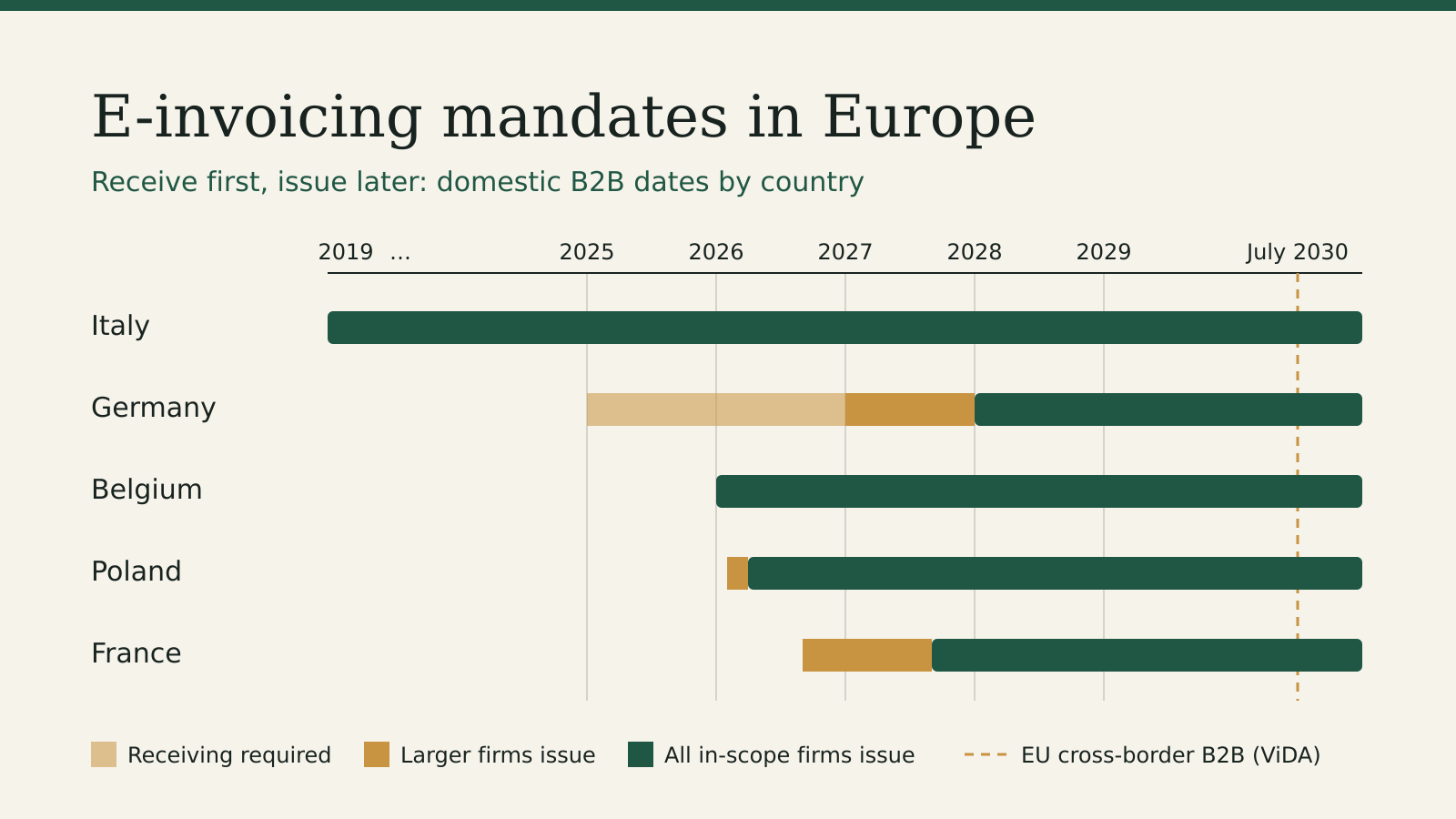
From 2030 the VAT in the Digital Age package changes invoicing and reporting for cross-border B2B transactions, replacing recapitulative statements with digital reporting based on e-invoices; the European Commission’s ViDA page sets out the timeline. Our guide to e-invoicing mandates in Europe covers the domestic rules arriving before then. For annual accounts and tax return dates, a separate calendar, use the company filing deadlines calculator.
Questions
Do I charge VAT when I invoice a business in another EU country?
Usually not, for services under the general B2B rule. If the customer is a business established in another member state and you have confirmed its VAT number, the customer accounts for VAT under the reverse charge in Article 196 of the VAT Directive, and your invoice carries the mention “Reverse charge”.
What should a reverse charge invoice say?
Article 226 requires the customer’s VAT identification number and the mention “Reverse charge”, alongside the usual invoice details such as your VAT number, the date, a sequential number, a description of the service and the net amount.
What happens if my EU customer has no VAT number?
Under Article 18(2) of Implementing Regulation 282/2011, you may treat a customer who has not given a VAT number as a non-taxable person. The service then falls under the general B2C rule and is usually taxed in your own country.
Does a UK freelancer charge VAT to EU business clients?
No, for general rule services. HMRC’s Notice 741A treats them as supplied where the customer belongs, so they are outside the scope of UK VAT; the value goes in box 6 of the UK return and the EU customer accounts for any local VAT.
Do I need a VAT number if I am under the small-business threshold?
For cross-border B2B services, usually yes. Article 214(1)(e) requires identification for a taxable person who supplies services in another member state where the customer pays the VAT, and Article 214(1)(d) does the same for a business that receives such services.