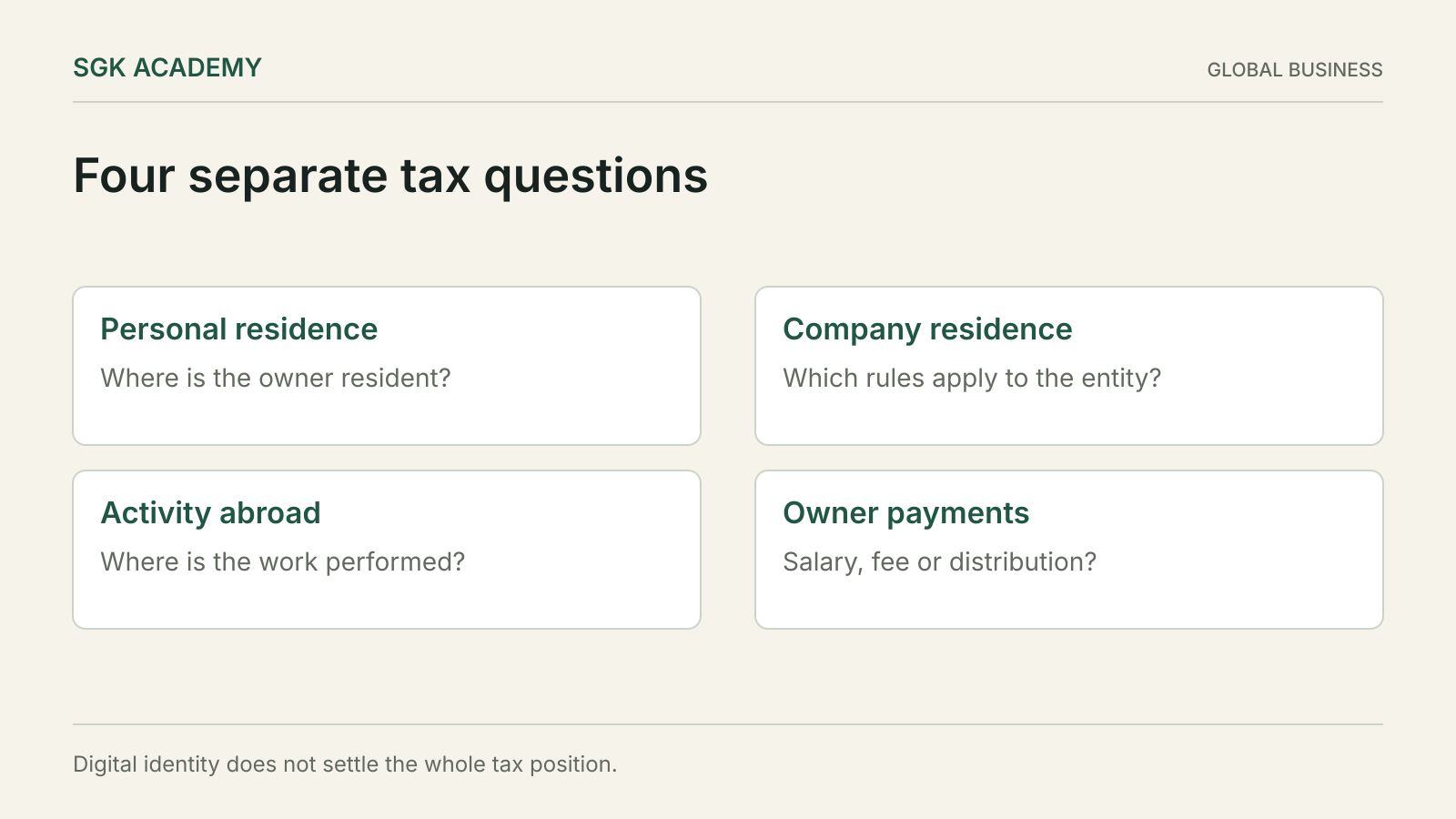
Estonian e-residency provides access to digital administration; it does not move the owner or settle every tax question surrounding a company. A useful assessment separates personal tax residence, corporate tax residence, business activity in other countries and the treatment of payments to the owner. Confusing those questions is how a convenient company-registration service becomes an unexpected tax problem.
This guide focuses on the structure of the decision rather than a country ranking or a promise of a low rate. It is for an independent professional or small company considering an Estonian OÜ while the people doing the work may live elsewhere.
Start with what e-residency actually changes
The official e-Residency programme’s taxation explanation distinguishes digital identity from physical and tax residence. Access to online services is not the same as moving to Estonia.
An e-resident can use the relevant digital tools to administer a company. That can be operationally useful, but the person’s home, working location and personal circumstances still matter to the countries connected with them.
Write those facts down before comparing tax headlines. Include where the owner lives, where the work is performed, where management decisions are made, where staff are located and where customers are served.
Do not use a general day-count slogan as a substitute for the applicable residence rules. Different countries can consider different factors, and treaty analysis may be necessary where claims overlap. The digital identity itself does not resolve that analysis.
Question one: where is the person tax resident?
Personal tax residence concerns the individual. It can affect the treatment of salary, dividends, director’s remuneration and other income, including income received from a foreign company.
The official programme explains that e-residency does not make the holder an Estonian tax resident. It also notes that residents are generally taxed on worldwide income in their state of residence, with the actual method depending on that country’s rules.
For a mobile founder, collect a factual timeline rather than assuming that frequent travel means residence nowhere. Record homes, days, family and work connections where relevant to the jurisdictions being assessed.
The output you need is a reasoned conclusion for the relevant period, including any filing requirements and unresolved issues. A registration certificate from the company is not evidence that the owner’s personal residence has changed.
Question two: where is the company tax resident?
The official programme states that a company incorporated under Estonian law is an Estonian tax resident. It also explains that another country may use management-related tests that can produce a dual-residence question.
That does not mean every Estonian company managed abroad necessarily has the same outcome. The relevant domestic rules, facts and any treaty provisions need to be assessed.
Separate the legal place of incorporation from the location of actual management. Where are important commercial decisions made? Who makes them? Where are contracts approved and business risks managed? A service address alone does not answer those questions.
If advisers in two countries reach different initial views, ask them to identify the assumptions and legal rules behind those views. A useful joint analysis resolves the interaction rather than leaving the founder with two unrelated summaries.
Question three: does activity create obligations elsewhere?
A company can have tax obligations in another country because of its activities there even when its place of incorporation remains Estonia. Permanent establishment is one important concept, but it is not the only cross-border tax question.
The Estonian Tax and Customs Board’s guidance for companies established by e-residents explicitly warns that Estonian tax residence does not automatically exempt a company from taxation where it operates or earns income.
For a small business, the relevant facts may include a regular place of work, employees, a person acting for the company, and the nature and duration of the activity. The exact test depends on the relevant rules and treaty.
Do not assume that online delivery removes physical facts. A consultant can deliver a report digitally while doing the work from a fixed location. A software business can sell internationally while its management and staff remain concentrated in one country.
Question four: what kind of payment reaches the owner?
Money paid to an owner can be salary, a director’s fee, a dividend, reimbursement or another type of payment. These labels correspond to different facts and can produce different obligations.
The Estonian authorities distinguish employment income, management-body remuneration and distributions. The treatment can depend on where work is performed, the recipient’s circumstances and the relevant cross-border rules.
A founder who performs several roles should not assume that every withdrawal can simply be called a dividend. Document what the payment represents and have the treatment assessed consistently with the actual activity.
Keep corporate tax and the owner’s personal tax separate in the model. Tax paid by one legal person does not automatically become a credit available to another. Relief mechanisms have conditions and may require evidence and filings.
Use a fact map before requesting advice
An adviser can give a more useful answer when the business facts are specific. A short map is often enough to reveal the questions that need attention.
| Fact | Why it matters | Evidence to collect |
|---|---|---|
| Owner’s residence and travel | Personal residence and income treatment | Factual timeline |
| Company incorporation | Corporate-law and residence starting point | Registry documents |
| Actual management | Possible additional residence analysis | Decision-making arrangements |
| Work and staff locations | Activity, payroll and establishment questions | Contracts and working pattern |
| Customer type and location | VAT and other transaction questions | Sales breakdown |
| Payments to the owner | Classification and reporting | Role descriptions and payment records |
This is an information request, not a test that produces an automatic tax answer. The same fact can matter differently under different countries’ rules.
Avoid sending sensitive documents indiscriminately to several providers. Establish the engagement and secure document route, then supply what is needed for the assessment.
Work through an illustrative remote-founder case
Imagine a founder who lives and works in Country A, owns an Estonian OÜ and serves business customers in several countries. The company has an Estonian administrative service provider, but the founder makes its commercial decisions from Country A.
The digital administration may be convenient. It does not establish that Country A has no claim on the founder or the company. The assessment must consider the individual’s residence, the company’s management and activity, and how the founder is paid.
Now suppose the founder hires an employee in Country B. That creates another set of facts to review. The original company-formation advice may not have covered employment, payroll or activity in that country.
The example deliberately uses unnamed countries. Choosing real jurisdictions would require their specific rules and treaty relationships. The educational point is that the operating model, not just the incorporation location, determines the questions.
Model costs without assuming away foreign obligations
A useful annual budget includes administration in Estonia and any obligations created elsewhere. Accounting, filings, payroll support and cross-border advice may all be relevant to the actual arrangement.
Do not compare an Estonian package price with the full cost of a domestic company if the package excludes work still required in the owner’s country. Use the same scope on both sides.
List one-off costs separately from recurring costs. Include changes such as hiring, relocation, adding an owner or closing the company. A structure that is convenient at launch can become more demanding when the business changes.
Also include founder time. If the arrangement requires collecting records for two sets of advisers, reconciling classifications or maintaining additional filings, that work has an operating cost even when no separate invoice arrives.
Keep VAT and payroll outside the corporate-tax shortcut
A statement about when corporate income tax arises does not answer VAT, payroll or social-security obligations. These need their own analysis.
For VAT, identify the supplies, customers and relevant locations. Do not assume that a company registration number, a VAT number and an e-resident’s personal code perform the same function.
For payroll and remuneration, identify the work performed and where it is performed. A person acting as both employee and director may need more than one question answered.
Our EU SME VAT scheme guide illustrates why establishment, transaction type and thresholds need to be considered together. It should not be used to assume that a particular Estonian company qualifies without examining its facts.
Ask for conclusions with assumptions attached
A useful advisory response should state which facts were relied on, which countries were considered, which taxes and filings are covered, and what changes would require a new review.
Ask how double taxation relief would work in the specific arrangement and what evidence is needed. “A treaty exists” is not the same as demonstrating that a particular item receives relief.
Clarify who will prepare each return and provide the necessary information. The founder should be able to identify the responsible person and deadline without reconstructing the engagement from old emails.
Keep the written conclusion with the fact map. When the founder moves, hires or changes payment arrangements, compare the new facts with the assumptions. This makes review targeted rather than starting again from a marketing claim.
Decide whether the structure remains useful after the tax review
The correct answer may still be that an Estonian company is operationally useful. Digital administration, service availability and the business’s commercial needs can be valid reasons to choose it.
The decision is stronger when those benefits survive a realistic tax and cost analysis. It should not depend on assuming that foreign activity is invisible or that personal obligations disappear.
Compare the proposed arrangement with a simpler alternative using the same revenue, work location and payment pattern. Record what the additional structure achieves and what it requires.
You are ready to proceed when the four questions have distinct answers and the remaining uncertainties are explicit. Convenience in administration is a benefit; clarity about obligations is what makes that convenience sustainable.
Questions
Does Estonian e-residency change my personal tax residence?
No. It provides digital access, while personal tax residence depends on the applicable rules and your actual circumstances.
Can an Estonian company owe tax outside Estonia?
Yes. Management or business activity elsewhere can create obligations under the relevant rules. The result requires a fact-specific assessment.
Are dividends and salary interchangeable for an owner-manager?
No. The payment should reflect its actual nature and be assessed under the relevant corporate, personal and employment rules.
Does avoiding double taxation mean no filings are needed?
Not necessarily. Relief can depend on reporting and evidence even where additional tax is not ultimately payable.