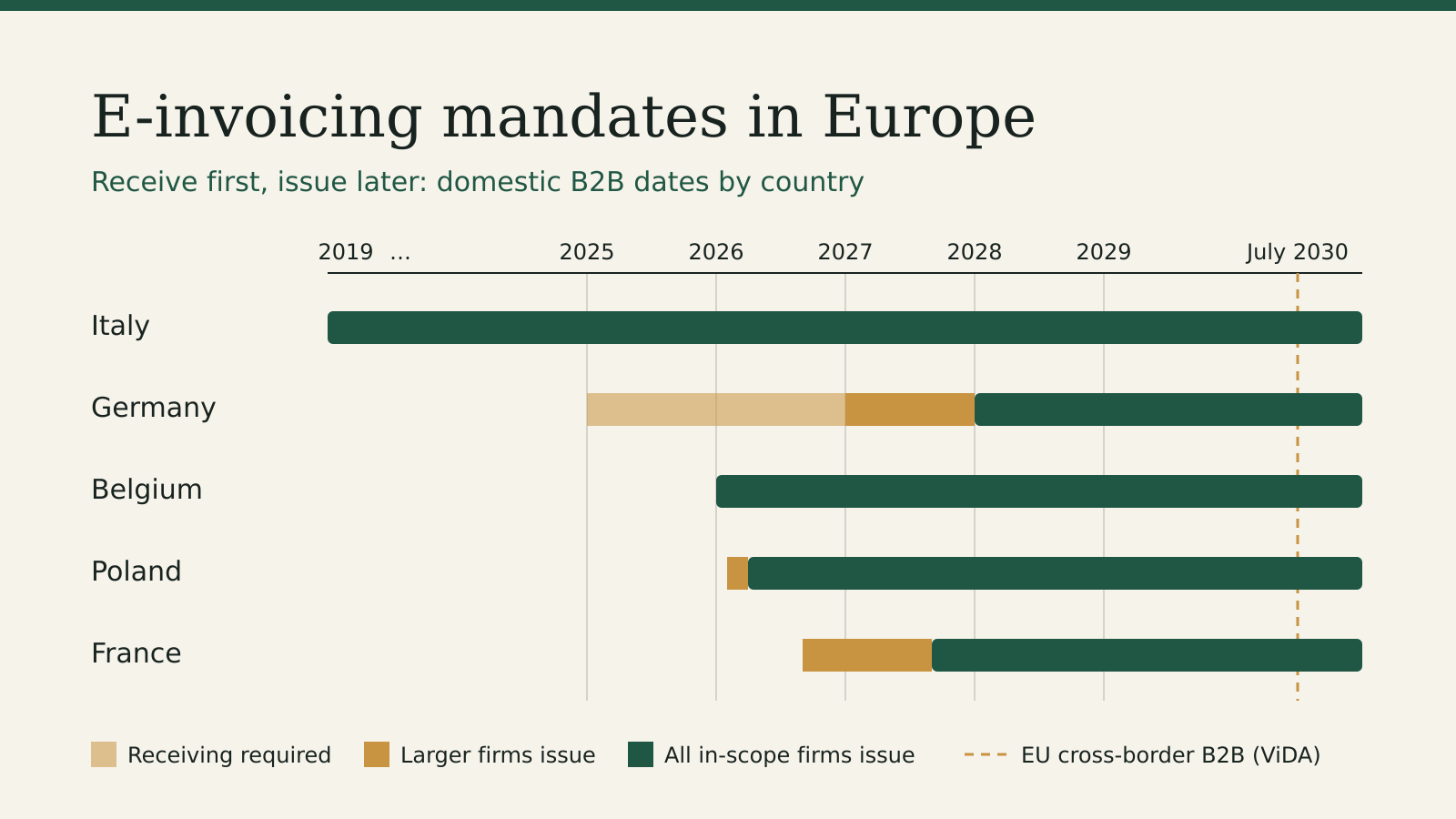
E-invoicing mandates in Europe now reach ordinary small businesses, not only large groups and public-sector suppliers. Since 1 September 2026, every VAT-liable business established in France must be able to receive electronic invoices. Belgium has required structured B2B e-invoices since 1 January 2026, Poland moved most taxpayers onto its national system on 1 April 2026, and Germany’s issuing obligation begins in 2027 for larger businesses and in 2028 for the rest. Italy has run a mandatory system since 2019.
For a founder, the practical questions are narrower than the headlines suggest. Is your business established in a country with a mandate? Do you need to receive, issue, or both? From which date? And does a PDF sent by email still count? This guide answers those questions country by country, using the tax authorities’ own pages, and ends with a checklist you can work through before the next deadline. Facts were checked on 2 October 2026.
What counts as an e-invoice now
In everyday language, an emailed PDF is an “electronic invoice”. Under the new rules it usually is not. The mandates require a structured invoice: a file whose data fields can be read and processed by software without a person retyping them.
Germany’s Federal Ministry of Finance puts it plainly in its e-invoice FAQ: since 1 January 2025, an e-invoice exists only if it is issued, transmitted and received in a structured electronic format that allows electronic processing, and a simple PDF does not meet that definition. France’s economy ministry says the same about scanned paper invoices, ordinary PDFs and documents sent by email in its reform overview. Belgium’s official e-invoice FAQ points to EN 16931, the European standard that fixes the meaning of invoice data, and to the Peppol BIS format as the default.
The second difference is the route. Some countries let the two businesses choose how the file travels. Others prescribe a channel: an approved platform in France, the Peppol network by default in Belgium, a national clearing system in Italy and Poland. A correct file sent the wrong way can still fail the rule. In Italy, the Agenzia delle Entrate states that an electronic invoice sent directly to the client’s certified email, bypassing its Sistema di Interscambio (SdI), is treated as not issued.
The timeline at a glance
| Country | Receiving | Issuing | Channel |
|---|---|---|---|
| Italy | Since 1 January 2019 | Since 1 January 2019; flat-rate (forfettario) taxpayers since 1 January 2024 | Sistema di Interscambio (SdI) |
| Germany | Since 1 January 2025 | Optional until 31 December 2026; required from 1 January 2027 if prior-year turnover was above €800,000; required for almost everyone from 1 January 2028 | Parties agree (email, portal, EDI and others) |
| Belgium | Since 1 January 2026 | Since 1 January 2026 | Peppol by default |
| Poland | Through KSeF since 1 February 2026 | 1 February 2026 for the largest taxpayers; 1 April 2026 for others; small monthly invoice totals may stay outside KSeF until 31 December 2026 | KSeF (national system) |
| France | Since 1 September 2026 | Large and mid-size companies since 1 September 2026; SMEs and micro-businesses from 1 September 2027 | Approved platform (plateforme agréée) |
Each row is explained below with its source. The table covers domestic B2B invoices between businesses established in the country; invoices to consumers and to foreign customers follow different rules.
France: everyone receives now, small firms issue from September 2027
The French reform took effect on 1 September 2026. According to economie.gouv.fr, every business must now be able to receive electronic invoices, whatever its size. Large companies and intermediate-size companies (ETI) must also issue all their invoices electronically and transmit transaction and payment data to the tax administration, a process called e-reporting. Small and medium-sized enterprises and micro-businesses must issue e-invoices and submit e-reporting data from 1 September 2027.
The scope is wide. The ministry says the reform covers every business, sole trader and liberal profession subject to VAT, whatever its size, turnover, legal form or tax regime. That includes micro-entrepreneurs under the franchise en base: they do not charge VAT, but they remain VAT-liable persons and so fall under the reform for both receiving and issuing. The e-invoicing obligation concerns transactions between businesses established in France and subject to VAT; VAT-exempt operations are outside it.
Invoices must travel through a platform approved by the state, either directly or through compatible software connected to one. Each business must designate its platform. The tax administration keeps the list of registered platforms up to date on impots.gouv.fr, as its four-question leaflet explains. A business that uses no invoicing software can create invoices on the platform itself.
Four new mandatory invoice mentions apply from 1 September 2026, according to the same ministry page: the customer’s SIREN number; the category of operation (sale of goods, supply of services, or both); a note when the supplier has opted to pay VAT on debits; and the delivery address where it differs from the customer’s billing address. Update invoice templates even if your own issuing date is 2027, because these fields are part of the invoice content, not only of the new transmission route.
When the customer is a consumer or is established abroad, the supplier sends the invoice through its usual channel and reports the transaction or payment data through its platform instead. The government has said the start-up phase is handled with “bienveillance et tolérance” towards businesses facing difficulties on 1 September; that is a statement of approach, not a published grace period with an end date.
Belgium: structured B2B invoices through Peppol since January 2026
Belgium was quicker. Its official e-invoice site states that since 1 January 2026 all Belgian enterprises liable to VAT must use structured electronic invoices with each other. Sending a PDF by email or through a platform is no longer enough, and invoices travel over the Peppol network. A business that works only for private clients does not have to issue e-invoices to them, but it must still be able to receive structured invoices from its suppliers.
The B2B FAQ adds several points founders ask about. The obligation also applies to businesses using the small-business VAT exemption, at least for receiving invoices (the exemption limit is in our VAT thresholds table). Invoices drawn up from 1 January 2026 must be structured even if the work was done earlier. A customer cannot force a supplier to use its own portal without explicit consent. And VAT-registered persons not established in Belgium and without a permanent establishment there are not subject to the obligation, even if identified for VAT in Belgium, although the FAQ notes the law is still being amended on this point.
Belgium also published its penalties. The specific-questions FAQ lists a new fine for failing to have the technical means to issue and receive a structured invoice: €1,500 for a first offence, €3,000 for a second and €5,000 for later offences, with existing invoicing fines continuing to apply. FPS Finance announced a tolerance period for the first three months of 2026 for businesses that had taken timely and reasonable steps. That period has ended. For self-billing invoices, the FAQ described flexibility until 30 June 2026.
Germany: receive since 2025, issue from 2027 or 2028
Germany split the change into a receiving duty and a later issuing duty. The BMF FAQ explains that from 1 January 2025 an e-invoice is generally required for supplies between domestic businesses, with transitional rules. During 1 January 2025 to 31 December 2026, every issuer may choose to send another type of invoice instead: paper is always allowed, and a PDF or other non-structured electronic invoice is allowed if the recipient agrees. For an issuer whose previous-year turnover was no more than €800,000, that option lasts until the end of 2027. EDI procedures that do not already meet the e-invoice definition may also continue until the end of 2027.
The practical result is a two-step date. A business that turned over more than €800,000 in 2026 must issue e-invoices to German business customers from 1 January 2027. A smaller business has one more year. Both have had to accept e-invoices since January 2025.
The ministry’s October 2025 guidance letter fills in the details. The obligation applies when both businesses are resident or established in Germany, including through a German establishment involved in the supply. The recipient does not need to consent to receiving an e-invoice and must have the technical means to receive one; ordinary email is an acceptable route and no separate mailbox is required. Small-amount invoices, travel tickets and invoices issued by small businesses under the German small-business scheme may always be sent as ordinary invoices, though small businesses must still be able to receive e-invoices.
Unlike France, Belgium, Italy and Poland, Germany does not prescribe a national channel at this stage. The parties agree on the format, provided it meets the legal requirements, and on how the file travels.
Poland: KSeF for issuing and receiving
Poland built its mandate around a central system, the Krajowy System e-Faktur (KSeF). The Ministry of Finance’s KSeF scope page sets the dates. Taxpayers whose 2024 sales, including VAT, exceeded PLN 200 million had to issue invoices in KSeF from 1 February 2026. Everyone else followed on 1 April 2026. Receiving invoices through KSeF has been mandatory since 1 February 2026.
There is one transitional relief for the smallest invoicers. According to the ministry’s KSeF questions and answers, until 31 December 2026 a taxpayer may issue invoices outside KSeF, on paper or electronically, in any month in which the total sales including VAT documented by such invoices does not exceed PLN 10,000. If that limit is exceeded, KSeF becomes mandatory from the invoice that crossed it. The ministry’s 1 April 2026 notice confirms that these businesses join from 1 January 2027. The FAQ also states that legal form does not matter: active and VAT-exempt taxpayers with an invoicing obligation issue through KSeF according to these stages.
Italy: the system other countries studied
Italy’s requirement is the oldest in this guide. The Agenzia delle Entrate’s FAQ on issuing e-invoices dates the general obligation to invoices issued from 1 January 2019, under the 2018 Budget Law. At first, flat-rate taxpayers under the forfettario regime were exempt. The agency’s 2024 briefing confirms that from 1 January 2024 the obligation extended to the remaining exempt categories, including forfettario taxpayers with revenue up to €25,000.
For a freelancer who has moved to Italy and uses the flat-rate regime, this means there is no remaining size-based escape from SdI. The agency also notes that when an Italian business invoices a non-resident that is identified for VAT in Italy, it may send the invoice through SdI with a default recipient code, while the non-resident is not obliged to issue or receive e-invoices.
Where cross-border founders fit
The national mandates above are mainly domestic. They apply to businesses established in the country, invoicing other businesses established in the same country. That has three practical consequences for founders who work across borders.
First, your company’s location matters more than your customer’s. A Belgian-established company must be on Peppol; a company established elsewhere and invoicing a Belgian client is, according to the Belgian FAQ, outside the obligation unless it has a Belgian permanent establishment. In Germany, the obligation applies only where both parties are established there. In France, the e-invoicing obligation covers transactions between businesses established in France; a French supplier invoicing a foreign customer reports the transaction data instead.
Second, a local establishment can pull you in. If a foreign company has a fixed or permanent establishment in one of these countries that takes part in the supply, read the national rules again. “Established” is a tax concept, not a matter of where the company was registered. Our company formation comparison lists each country’s VAT and filing basics, and the question of when a founder’s own work creates an establishment abroad deserves its own analysis.
Third, your customers’ systems may change how they ask you to invoice, even where the law does not oblige you. A French or Belgian client’s accounts team may prefer a structured file because it saves them work. That is a commercial request, not a legal duty, and you can decide whether to accommodate it.
2030: the EU layer arrives
The national systems will not stay separate forever. The EU’s VAT in the Digital Age (ViDA) package, described on the European Commission’s ViDA page, was adopted on 11 March 2025 and entered into force on 14 April 2025. From that date, Member States can introduce mandatory domestic e-invoicing under specific conditions without first asking for an EU derogation, which is why Belgium no longer needed the authorisation it had requested in 2023.
The cross-border step comes on 1 July 2030. From then, Digital Reporting Requirements based on e-invoicing apply to cross-border B2B transactions, and e-invoicing becomes the default method of invoicing. By 1 January 2035, Member States with domestic real-time reporting systems must align them with the EU model. For a small business invoicing clients in several EU countries, 2030 is the date when the cross-border invoice itself changes, not only the domestic one.
Three illustrative cases
These scenarios are simplified examples, not advice on a particular business.
A French micro-entrepreneur under the franchise en base. Since 1 September 2026 she must be able to receive e-invoices from suppliers, which means choosing an approved platform now. She must issue e-invoices to French business clients from 1 September 2027. Her invoice templates should already include the new mentions, such as the client’s SIREN number.
A German GmbH with €600,000 of turnover in 2026. It has been receiving e-invoices since 2025. Because its previous-year turnover is below €800,000, it may keep sending PDFs to German business customers that agree to them until 31 December 2027. If 2026 turnover had been €900,000, the issuing obligation would start on 1 January 2027. A business near that line should check the figure after closing its 2026 books, not on 31 December.
An Estonian company invoicing a Belgian client. If the company has no Belgian establishment, the Belgian structured-invoice obligation does not apply to it under the current FAQ. Its invoice still has to satisfy the VAT rules for the transaction, and the client may still ask for a Peppol invoice for convenience. In 2030, the EU cross-border rules will apply regardless of either country’s domestic mandate.
A readiness checklist
- List every country where your business is established for VAT, including branches and fixed establishments, and note which mandate applies.
- For each country, record two dates: when you must be able to receive, and when you must issue.
- Check whether your size triggers an earlier date: Germany’s €800,000 prior-year turnover line, Poland’s PLN 10,000 monthly relief, France’s split between large or mid-size companies and SMEs.
- Choose the channel the country requires: an approved platform in France, Peppol in Belgium, KSeF in Poland, SdI in Italy. In Germany, confirm a structured format with each customer.
- Ask your invoicing or accounting software provider, in writing, which formats and networks it supports and from what date.
- Update customer master data. French invoices need the client’s SIREN; Peppol and KSeF need correct identifiers to route invoices.
- Decide how you will keep readable copies. Belgium’s FAQ notes that the structured invoice must be kept for the full storage period and remain legible throughout it.
- Test with one friendly customer and one supplier before your deadline, and keep the confirmation that the file was delivered.
- Add 1 July 2030 to your calendar if you invoice business clients in other EU countries.
Filing dates for annual accounts and tax returns are a separate calendar; our company filing deadlines calculator covers those.
Questions
Is a PDF invoice still valid in the EU?
It depends on the country and the date. In Belgium, Poland and Italy, a PDF no longer satisfies the domestic B2B rule for businesses within scope. In Germany, a PDF is allowed with the recipient’s consent until the end of 2026, or the end of 2027 for issuers with prior-year turnover up to €800,000. In France, small businesses may issue other invoices until 1 September 2027 but must already be able to receive e-invoices.
Does a foreign company invoicing a French or Belgian client need an e-invoicing platform?
Not by default. The French obligation concerns transactions between businesses established in France, and Belgium’s FAQ excludes non-established businesses without a permanent establishment. An establishment in the country changes the analysis.
Do small or VAT-exempt businesses have to receive e-invoices?
In France, Belgium and Germany, yes: the official guidance applies the receiving duty to businesses using small-business VAT exemptions. Poland applies KSeF to exempt taxpayers that have an invoicing obligation.
When does e-invoicing become mandatory for cross-border B2B sales in the EU?
Under ViDA, Digital Reporting Requirements based on e-invoicing apply to cross-border B2B transactions from 1 July 2030.