EU VAT invoice requirements come from one list. Article 226 of the VAT Directive sets out the details a full invoice must carry, and the European Commission says that once they are on the invoice, no member state may block the customer’s VAT deduction by asking for more. Most invoices that cause trouble are missing an item from that list, or carry the wrong one for the transaction.
This guide goes through the list line by line, adds the mentions that depend on the sale, and covers simplified invoices, cross-border deadlines, currency and storage. It ends with a checklist.
The rules below are those in force on 5 October 2026, checked against the VAT Directive, the Commission’s invoicing page and HMRC guidance. National rules add detail in places, and those places are flagged.
Which country’s invoicing rules apply
Before checking the content, check whose rules you are following. Article 219a of the VAT Directive says invoicing is “subject to the rules applying in the Member State in which the supply of goods or services is deemed to be made”. There are two exceptions that matter to a small cross-border business:
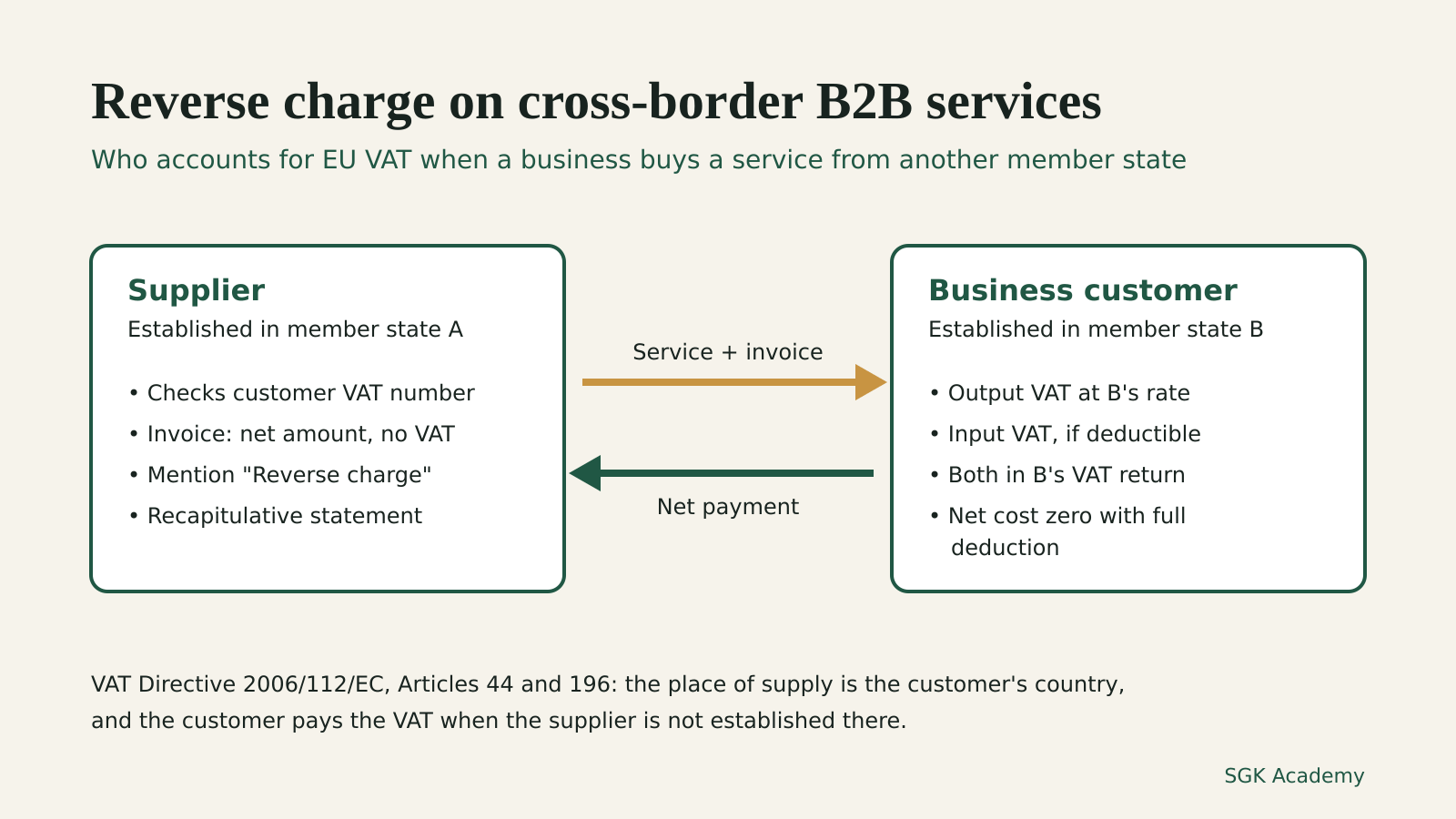
- If you are not established in the country where the supply takes place and your customer pays the VAT under the reverse charge, you follow the invoicing rules of the country where you are established. A consultant established in Ireland billing a business customer in Italy uses Irish invoicing rules, unless the customer self-bills.
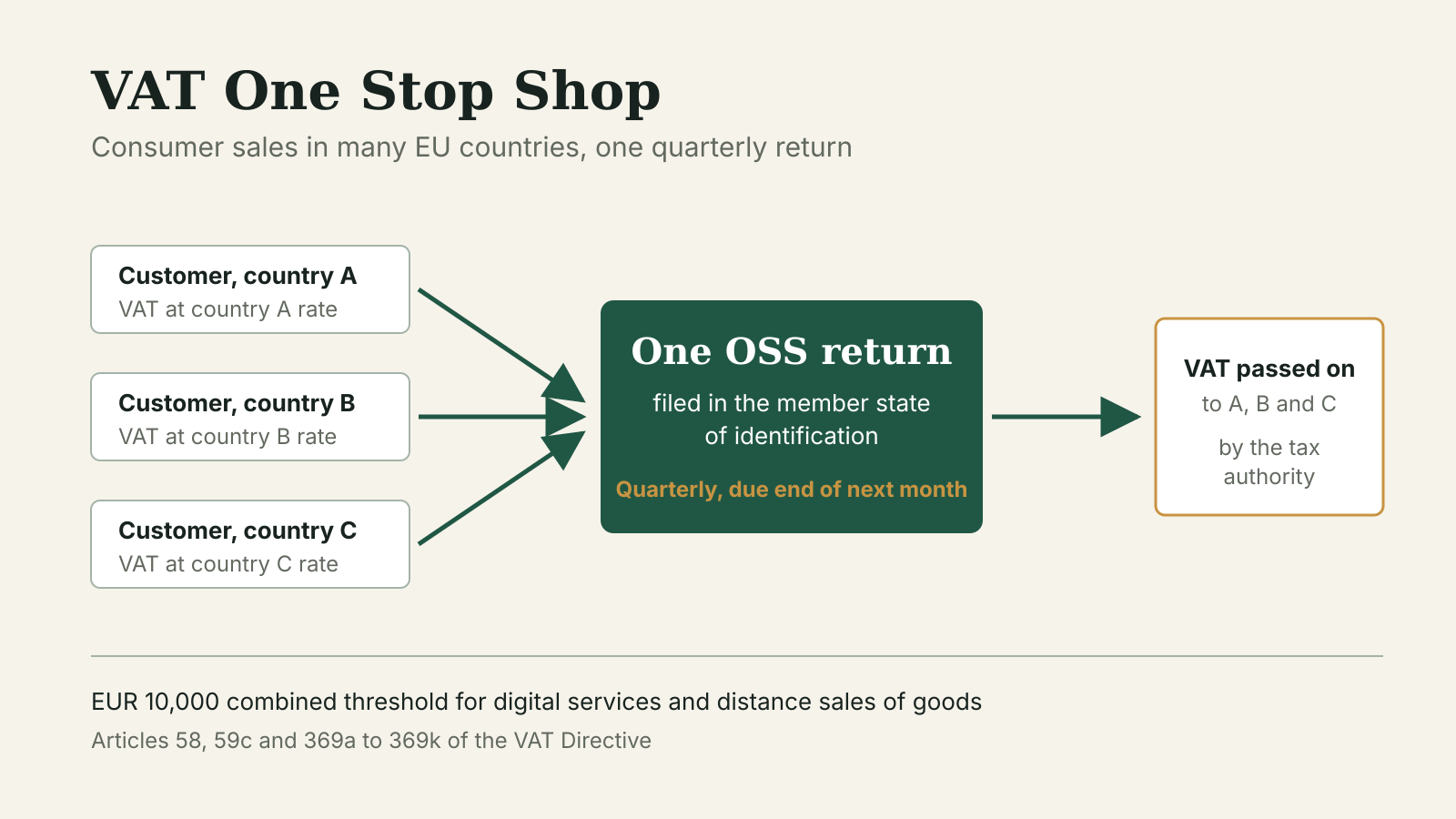
- If you use one of the One Stop Shop schemes, you follow the rules of the country where you are identified for that scheme. Our guide to the VAT One Stop Shop explains when that applies.
This matters because member states keep some choices: invoice deadlines for domestic sales, record-keeping periods, translation requests and, increasingly, mandatory e-invoicing formats.
When you must issue a VAT invoice
Under Article 220(1) of the VAT Directive, a taxable person must make sure an invoice is issued for:
- supplies of goods or services to another taxable person or to a non-taxable legal person;
- distance sales of goods covered by Article 33;
- exempt intra-EU supplies of goods under Article 138;
- payments on account received before a supply of goods in points 1 or 2;
- payments on account received from a business or non-taxable legal person before a service is completed.
The Commission’s invoicing page summarises this as an invoice “for most business-to-business (B2B) supplies and for certain business-to-consumer (B2C) transactions”. It lists two exceptions for business sales: exempt financial and insurance services under Article 135(1)(a) to (g), and other exempt transactions under Article 135(1)(h) to (l), where member states may choose not to require one. For sales to consumers, the EU-wide cases are distance sales taxed in another country when the One Stop Shop is not used, and new means of transport sent to another member state. National rules can require invoices for other consumer sales.
Two points catch out freelancers. A deposit or advance from a business client triggers its own invoice. And an invoice is the document the customer needs to deduct VAT, so a “payment request” or pro forma that lacks the required details does not do that job.
What a full VAT invoice must show
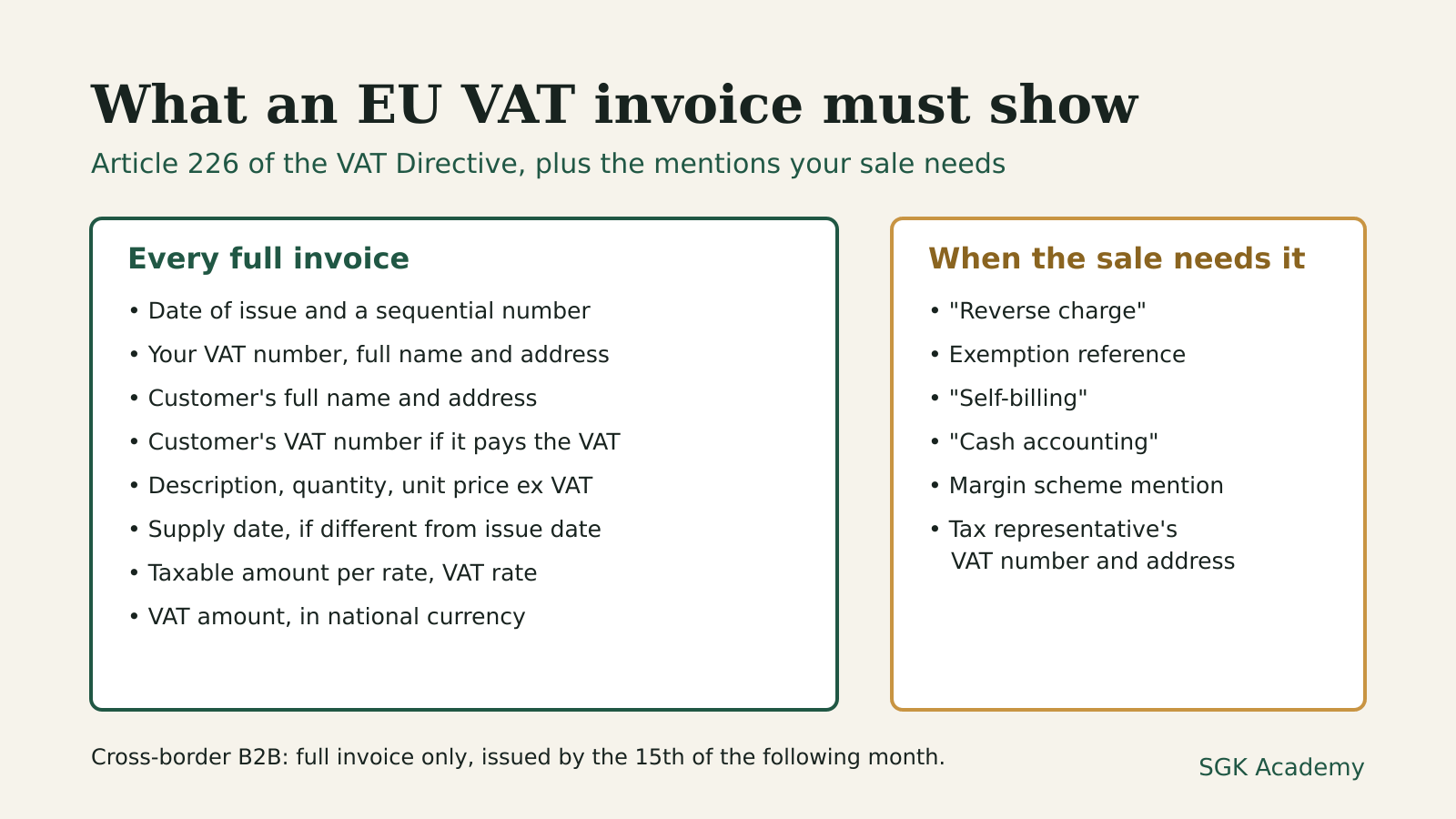
Article 226 of the VAT Directive opens with the words “only the following details are required for VAT purposes”. The table follows the Directive’s numbering. Points marked “when relevant” are covered in the next section.
| Art. 226 point | Detail | What it means in practice |
|---|---|---|
| (1) | Date of issue | The date the invoice is issued, not the date of the work |
| (2) | Sequential number | “A sequential number, based on one or more series, which uniquely identifies the invoice”. Separate series (for example by year or by entity) are allowed; gaps and reused numbers are what to avoid |
| (3) | Your VAT number | The number under which you made the supply |
| (4) | Customer’s VAT number | Required when the customer is liable for the VAT (reverse charge) or receives an exempt intra-EU supply of goods |
| (5) | Full name and address of you and the customer | Legal names and addresses, not only a trading name or email |
| (6) | Quantity and nature of goods, or extent and nature of services | “Consulting” alone is thin; “UX research, 32 hours, September 2026” is a description |
| (7) | Date of supply or payment on account | Required when it can be determined and differs from the issue date |
| (7a) | “Cash accounting” | When relevant |
| (8) | Taxable amount per rate or exemption, unit price excluding VAT, discounts | Break the total down by VAT rate; show discounts not already in the unit price |
| (9) | VAT rate applied | For each line or rate group |
| (10) | VAT amount payable | Unless a special arrangement excludes it |
| (10a) | “Self-billing” | When relevant |
| (11) | Exemption reference | When relevant |
| (11a) | “Reverse charge” | When relevant |
| (12) | New means of transport details | When relevant |
| (13), (14) | Margin scheme mentions | When relevant |
| (15) | Tax representative’s VAT number, name and address | When relevant |
The Commission’s page adds the consequence: once the information is on the invoice, “the invoice acts as proof that allows the business to deduct VAT in the EU Member State concerned. No EU Member State may prevent this by requiring extra information in the invoice.” It also says that “businesses may always include information on their invoices additional to that described above”. Payment terms, bank details and a purchase order number are commercial additions; they are useful, but EU VAT law does not require them today.
Mentions that depend on the transaction
Several points in Article 226 apply only to certain sales. Each one is a fixed mention or reference, and leaving it out is one of the commonest invoice faults.
- Reverse charge (point 11a). “Where the customer is liable for the payment of the VAT, the mention ‘Reverse charge’”. This is the mention most cross-border service businesses need. Our guide to reverse charge VAT on services in the EU covers when it applies.
- Exemption (point 11). “In the case of an exemption, reference to the applicable provision of this Directive, or to the corresponding national provision, or any other reference indicating that the supply of goods or services is exempt”. A business under a national small-business exemption is in this position; the EU SME VAT scheme guide explains that scheme.
- Self-billing (point 10a). When the customer issues the invoice instead of the supplier, the mention “Self-billing”.
- Cash accounting (point 7a). Where VAT becomes chargeable when payment is received under Article 66(b) and the deduction right follows the same timing, the mention “Cash accounting”.
- Margin schemes (points 13 and 14). “Margin scheme — Travel agents”, “Margin scheme — Second-hand goods”, “Margin scheme — Works of art” or “Margin scheme — Collector’s items and antiques”.
- Tax representative (point 15). Where a tax representative is liable for the VAT, its VAT number, full name and address.
- New means of transport (point 12). For intra-EU supplies of new vehicles, vessels or aircraft, the characteristics listed in Article 2(2)(b).
The Commission’s table phrases the exemption reference as “a reference to the appropriate (EU or national) legislation exempting it, or any other reference indicating it is exempt (at the choice of the supplier)”. In other words, you choose the form of words, but there must be one.
Cross-border B2B invoices: three extra rules
The deadline is set at EU level. Article 222 of the VAT Directive says that for exempt intra-EU supplies of goods and for services where the customer pays the VAT under Article 196, “an invoice shall be issued no later than on the fifteenth day of the month following that in which the chargeable event occurs.” For all other supplies, member states “may impose time limits”, so domestic deadlines vary by country.
No simplified invoice. Article 220a(2) of the VAT Directive bars simplified invoices for distance sales of goods, for exempt intra-EU supplies of goods, and where a supplier not established in the country of taxation makes a supply for which the customer is liable for the VAT. A reverse-charge invoice to a business in another member state must be a full invoice.
Points 8 to 10 can be replaced. Article 226a of the VAT Directive lets a supplier not established in the country where VAT is due, invoicing a customer who pays the VAT, omit points (8), (9) and (10) (the taxable amount breakdown, rate and VAT amount) and instead show the taxable amount by reference to the quantity or extent and nature of what was supplied. Most invoicing software simply shows a 0% or “not applicable” VAT line, which also works, but the reverse charge mention and the customer’s VAT number remain essential.
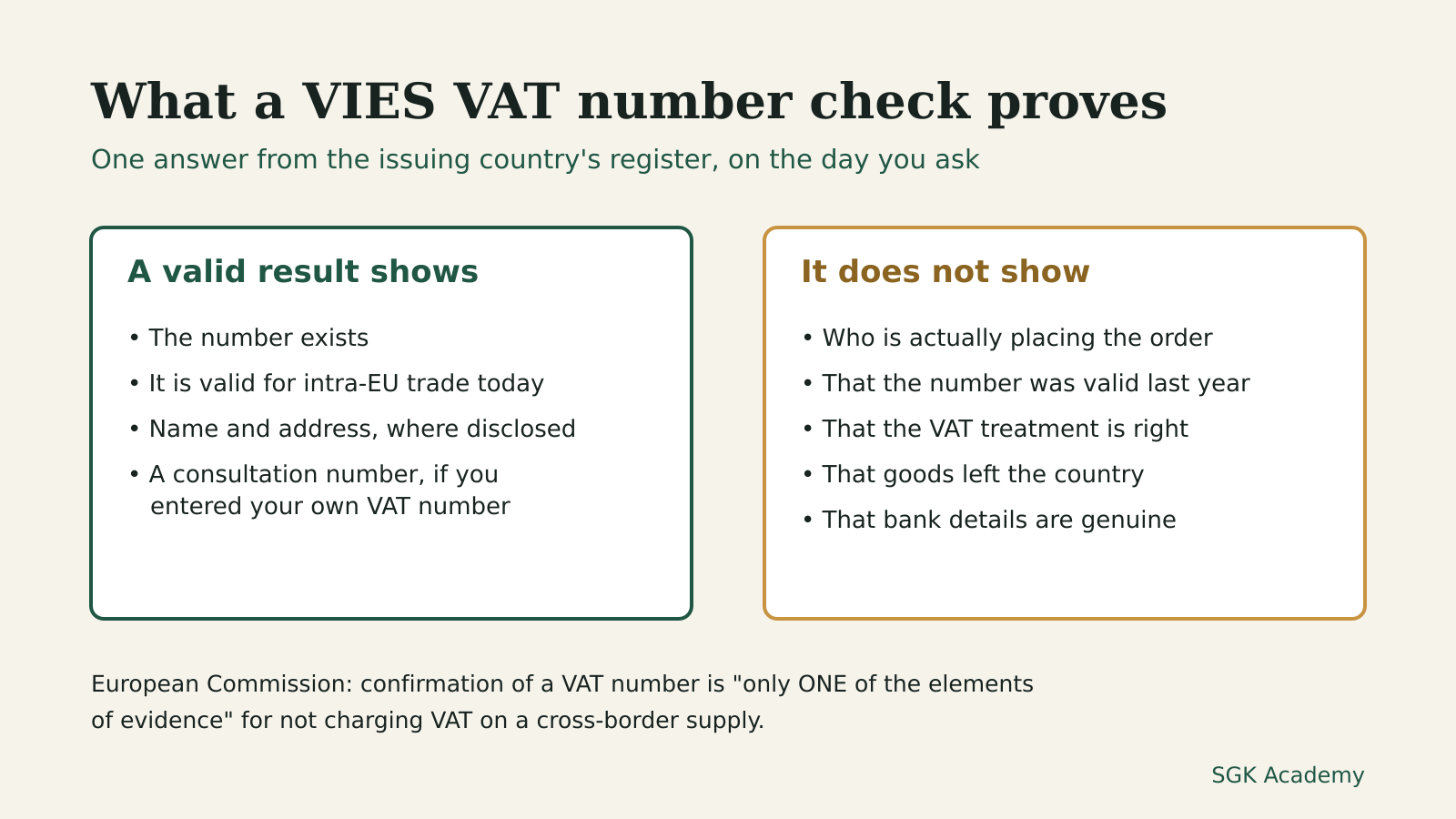
Before relying on the customer’s VAT number, check it. Our guide to the VIES VAT number check explains how to keep proof of that check.
Simplified invoices
A simplified invoice carries fewer details. Article 220a(1) of the VAT Directive says member states “shall allow” one where the invoice is not higher than EUR 100 (or the national-currency equivalent), or where the document is treated as an invoice under Article 219, such as a credit note. Directive (EU) 2020/285, applied from 1 January 2025, added a third case: “where the taxable person is benefitting from the exemption for small enterprises provided for in Article 284”.
Article 226b of the VAT Directive sets the minimum content of a simplified invoice:
- the date of issue;
- identification of the supplier;
- identification of the type of goods or services supplied;
- the VAT amount payable or the information needed to calculate it;
- on a credit note or other document treated as an invoice, “specific and unambiguous reference to that initial invoice and the specific details which are being amended”.
The Commission’s table lists the supplier’s VAT identification number as the identification on a simplified invoice. The restrictions in Article 220a(2) still apply, so the EUR 100 rule never covers a reverse-charge invoice from a non-established supplier.
Currency, language and format
Currency. Article 230 of the VAT Directive allows amounts “in any currency, provided that the amount of VAT payable or to be adjusted is expressed in the national currency of the Member State, using the conversion rate mechanism provided for in Article 91.” Under Article 91(2), that is the latest selling rate on the country’s most representative exchange market when VAT becomes chargeable, and member states “shall accept instead the use of the latest exchange rate published by the European Central Bank”. A EUR 4,000 invoice to a Swedish customer that carries Swedish VAT needs the VAT amount in kronor as well.
Language. Article 248a of the VAT Directive lets member states require a translation into their official languages “for certain taxable persons or certain cases”, but they “may not impose a general requirement that invoices be translated.” An English invoice is acceptable as a starting point.
Paper, PDF or e-invoice. The Commission’s page states that “electronic invoices are equivalent to paper invoices” and that businesses may issue them “subject to acceptance by the recipient”. Article 233 requires “the authenticity of the origin, the integrity of the content and the legibility” of every invoice from issue to the end of the storage period, and lets each business choose how, including “business controls which create a reliable audit trail”. Since 14 April 2025, the ViDA Directive (EU) 2025/516 has allowed member states to require businesses established on their territory to issue electronic invoices for domestic supplies, and several are doing so. Our guide to e-invoicing mandates in Europe tracks those dates. Spain’s Order HAC/1028/2026, published on 5 October 2026, starts the countdown to its B2B mandate.
The same ViDA directive changes parts of the list above from 1 July 2030, including a 10-day deadline for cross-border B2B invoices and the supplier’s bank account details as a new required item. Until then, the rules in this guide apply.
How long to keep invoices
There is no single EU retention period. Article 247 of the VAT Directive says “each Member State shall determine the period throughout which taxable persons must ensure the storage of invoices”, both for supplies in its territory and for invoices received by businesses established there. A member state may require invoices to be stored “in the original form in which they were sent or made available, whether paper or electronic”, and may restrict storage in countries without mutual-assistance arrangements. Check your own tax administration’s period; the Commission’s invoicing page points to its Tax Information Communication database for each member state’s own provisions.
The UK: similar list, different details
UK VAT invoices follow HMRC’s VAT guide (Notice 700), section 16, rather than the EU Directive. The list in paragraph 16.3.1 is close to Article 226 (a sequential number, the time of supply, your name, address and VAT number, the customer’s name and address, a description, quantities, rates and amounts, and the unit price), with four differences that matter in practice:
- the total VAT “must be expressed in sterling”, even when the rest of the invoice is in another currency;
- you “normally issue a VAT invoice within 30 days of the tax point”;
- a simplified invoice is allowed where “the value of the supply you are making is £250 or less” and the customer agrees;
- you may write invoices in another language but “must be able to provide English translations of specific invoices within 30 days” if an HMRC officer asks.
Worked example (illustrative)
A UX designer established and VAT-registered in the Netherlands completes 32 hours of research for a software company established in Germany during September 2026, at EUR 150 an hour. The customer has given its German VAT number, and the designer has checked it in VIES and saved the consultation number.
This is a business-to-business service where the customer pays the VAT under the reverse charge, so Dutch invoicing rules apply (Article 219a), the invoice must be a full invoice (Article 220a(2)), and it is due by 15 October 2026 (Article 222). It shows:
| Field | Entry |
|---|---|
| Invoice number | 2026-041, next in the designer’s 2026 series |
| Date of issue | 30 September 2026 |
| Date of supply | Services completed 30 September 2026 (same as issue date, so it could be omitted) |
| Supplier | Designer’s full name, Dutch address and Dutch VAT number |
| Customer | Company’s legal name, German address and German VAT number |
| Description | UX research, 32 hours, September 2026, EUR 150 per hour |
| Taxable amount | EUR 4,800 |
| VAT rate and amount | Not charged: customer liable for the VAT |
| Mention | “Reverse charge” |
The customer accounts for German VAT on EUR 4,800 in its own return. If the designer had sent a PDF headed “Invoice” with only the company’s name, an email address and a total, three required details would be missing: the customer’s address, its VAT number and the reverse charge mention.
A checklist before you send
- Confirm which country’s invoicing rules apply (Article 219a).
- Use the next number in the series; never reuse or skip without a record.
- Put the issue date, and the supply date if different.
- Show your full name, address and VAT number, and the customer’s full name and address.
- Add the customer’s VAT number for any reverse-charge or exempt intra-EU supply, after a VIES check.
- Describe the goods or services with quantity or extent, and show the unit price excluding VAT.
- Break down the taxable amount by VAT rate, with the rate and the VAT amount, or the right mention instead.
- Add any mention the sale needs: “Reverse charge”, an exemption reference, “Self-billing”, “Cash accounting” or a margin scheme mention.
- Express the VAT in the national currency if the invoice is in another currency.
- For cross-border B2B, issue by the 15th of the following month.
- Store the invoice in its original form for your country’s retention period.
Common mistakes
- Trading name only. Article 226(5) asks for the full name and address of both parties.
- Missing customer VAT number on a reverse-charge invoice. Point (4) requires it, and VIES evidence supports it.
- Using a simplified invoice for a cross-border B2B service. Article 220a(2) rules it out.
- VAT only in a foreign currency. Article 230 requires the VAT amount in the national currency where VAT is charged.
- Treating a pro forma as an invoice. If it lacks the Article 226 details, the customer cannot use it to deduct VAT.
Questions
What are the minimum VAT invoice requirements in the EU?
Article 226 of the VAT Directive lists them: date, sequential number, both parties’ names and addresses, your VAT number, the customer’s VAT number where it pays the VAT, a description with quantities, the supply date if different, the taxable amount by rate with unit price, the VAT rate and amount, plus any mention the transaction needs.
Does an EU invoice have to include “reverse charge”?
Yes, whenever the customer is liable for the VAT. Article 226(11a) requires “the mention ‘Reverse charge’”.
Can I issue a VAT invoice in US dollars or another currency?
Yes. Article 230 allows any currency, but the VAT payable must also be shown in the national currency of the member state concerned, converted under Article 91.
When is a simplified invoice allowed?
For invoices up to EUR 100, for documents such as credit notes, and for businesses using the small-business exemption, unless the sale is a cross-border reverse-charge or intra-EU supply where Article 220a(2) excludes it.