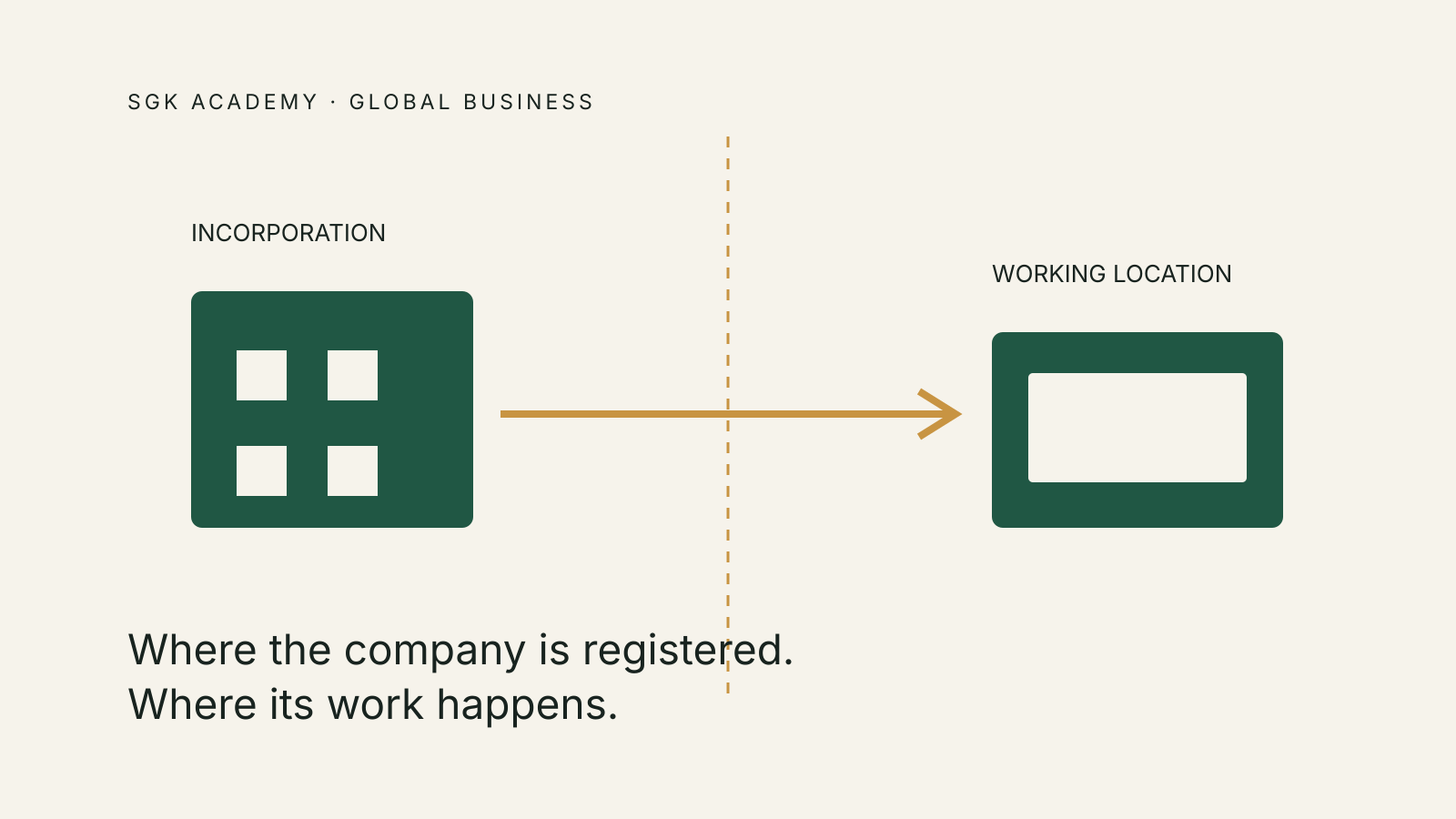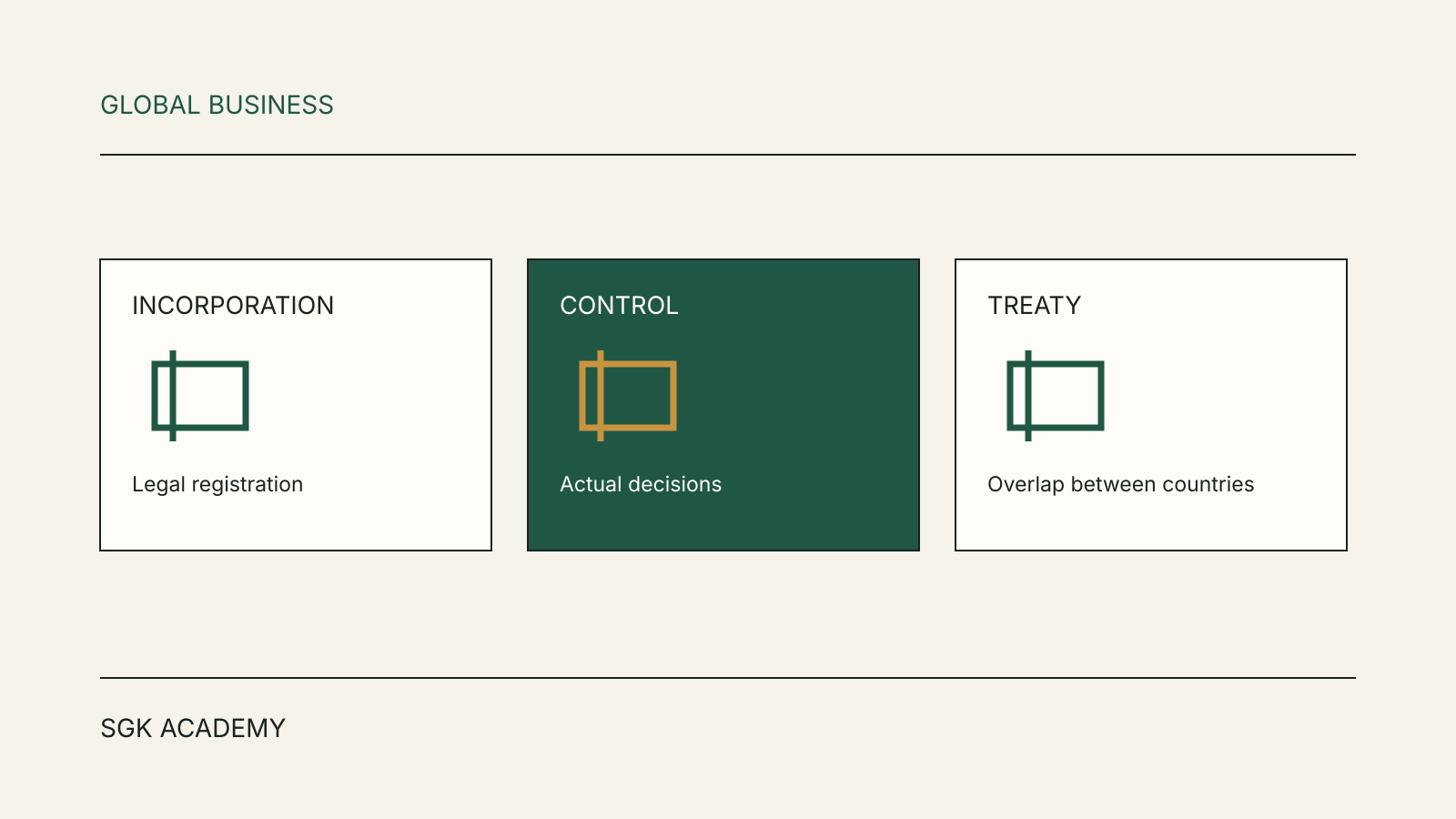
Company tax residence can follow where a company is incorporated, where its highest-level decisions are actually made, or the result of a treaty rule when two countries claim it. A founder who registers abroad and then runs the business from home therefore needs more than a registration certificate to understand the company’s tax position.
The UK’s published guidance offers a concrete example of how these questions fit together. This guide uses that example to explain a review process for a cross-border business. It does not turn the UK’s rules into a universal test for every country.
Start with the company, the countries and the period
Write down the legal entity you are assessing, its incorporation jurisdiction, the countries from which it is managed and the period under review. Keep the company’s position separate from the founder’s personal residence. They are different subjects, even when one person owns and operates the whole business.
A registered office tells you where the company has a legal address. A director’s mailing address tells you where correspondence may go. Neither fact, by itself, describes who actually controls the business. That requires a record of decisions and activity.
For a founder comparing formation options, the jurisdictions directory supplies registration and ongoing-administration information. Use it to identify the authorities and obligations to investigate. A headline corporation-tax rate cannot decide which country treats a particular company as resident.
Incorporation is one domestic-law test
HMRC’s company-residence overview says a company is UK resident if it is incorporated in the UK, with certain exceptions, or if its central management and control is in the UK. The incorporation guidance connects the first test to section 14 of the Corporation Tax Act 2009.
This matters when a UK company is run from abroad. Moving the founder’s laptop does not, by itself, erase the incorporation test. There may also be a residence question in the country where the founder now manages the company, which has to be checked under that country’s own law.
The reverse situation is different. A company incorporated elsewhere can come within the UK’s management-and-control test if the relevant control occurs in the UK. Registration abroad and management in the UK are therefore facts to examine together.
Do not reuse this two-test description as a country comparison table without researching each jurisdiction. The purpose of a domestic-law assessment is to establish what each country claims before considering how a treaty coordinates those claims.
Central management and control looks at real decisions
HMRC’s case-law guidance describes central management and control as a question of fact. It concerns the highest level of control over the business. The formal board may exercise that control, but a parent company or individual shareholder can assume it in practice.
A small company can make the issue especially visible. The founder may approve the budget, choose major suppliers, decide which contracts to accept and control the company’s financing. Another person may be listed as director while having little involvement in those decisions.
The review should therefore follow authority rather than a job title. Who can approve a material commitment? Who can reject one? Who sets the overall direction, and who merely implements the decision?
Routine administration remains part of the factual picture, but it should not be treated automatically as the highest-level control. Paying an approved invoice and deciding the company’s financing strategy describe different activities. A useful account of the business explains that difference with its actual records.
A board meeting abroad is evidence, not the whole answer
A meeting location can be relevant. It is less persuasive when the directors simply endorse decisions already made somewhere else. HMRC’s case-law account includes a situation in which a subsidiary’s directors stood aside while the parent company’s board exercised real control.
Consider an illustrative founder-owned company incorporated in country A. Its board meets there quarterly. Between meetings, the founder in country B negotiates major commitments, instructs the team and decides which proposals proceed. The important question is how much authority the board genuinely exercises, not whether there is a calendar invitation naming country A.
The example does not establish residence in either country. It identifies facts for the domestic-law review: the founder’s authority, the board’s participation, the decisions taken between meetings and the countries involved.
Minutes should describe what happened. Rewriting them to suggest a decision occurred somewhere it did not would make the factual record less reliable. The commercial arrangement and the documentation should tell the same story.
Effective management is related, but wording matters
A founder may encounter the phrase “place of effective management” in a treaty discussion and assume it is interchangeable with every domestic residence test. That shortcut loses an important distinction.
HMRC’s treaty guidance explains that treaty wording has changed. The OECD model’s corporate tie-breaker moved from a place-of-effective-management approach to a determination by competent authorities. Some UK treaties already used an authority-based approach; others may be modified through the Multilateral Instrument.
The practical task is to read the applicable agreement and any relevant modifications. A phrase used in an older article or another country’s treaty may not describe the rule governing your two countries and period.
Place of effective management can still be a factor. The point is to locate it within the rule actually being applied, rather than treating it as an automatic answer derived from one director’s address.
Dual residence is a starting point for treaty analysis
Two countries can each consider the same company resident under their domestic laws. A treaty then becomes relevant to the overlap. It does not replace the need to understand either domestic test.
The UK overview describes a company as treaty non-resident when the relevant company-residence tie-breaker awards residence to the treaty partner. Under section 18 of the Corporation Tax Act 2009, the company is then treated as non-resident for UK tax purposes.
That outcome requires the applicable treaty analysis. It cannot be inferred simply because the company has filed a return, obtained a certificate or paid some tax in another country.
Keep the questions in sequence:
| Stage | What the review establishes |
|---|---|
| Country A’s domestic rules | Why A does or does not claim company residence |
| Country B’s domestic rules | Why B does or does not claim company residence |
| Applicable treaty and modifications | Which rule addresses the overlap |
| Treaty result and implementation | What the result means for the company’s actual filings |
This sequence also keeps a professional review focused. “Where is the company resident?” is a broad request; a dated factual account and two identified rule sets make it answerable.
An authority-based tie-breaker can weigh several connections
HMRC’s standard tie-breaker guidance explains that some agreements require discussions between the two countries’ competent authorities. It lists potential considerations including incorporation, central management and control, effective management, business activities, employees, premises and economic connections.
No single item in that list is presented as a universal deciding factor. A company with a substantial operating business in one country and management in another presents a different factual picture from an entity with little activity in either.
HMRC also describes the possible result as sole residence in one country or continued dual residence. An authority process is therefore not a promise that a preferred country will receive residence.
For a founder, this creates a planning issue: identify the process, evidence and unresolved overlap early enough to manage reporting obligations. An expected treaty outcome should not silently become the assumption on which every invoice and filing rests.
Residence and permanent establishment answer different questions
Company residence concerns the company as a taxpayer under the relevant residence rules. A permanent establishment question concerns a taxable business presence in another country. They can appear in the same cross-border arrangement, but proving one does not dispose of the other.
The remote-work and permanent-establishment guide examines a founder’s working location from that separate angle. Read it alongside a residence review when activity occurs outside the incorporation country.
For example, changing who controls a company does not automatically remove an overseas office, employee or business operation from the facts. Likewise, concluding that a founder’s work creates no permanent establishment does not prove the company has only one possible residence.
Keeping the assessments separate avoids a common planning failure: one convenient answer is reused for incorporation, residence, business presence, VAT and the owner’s personal position, although each question requires its own rules.
Build a decision record before commissioning the review
A useful evidence pack describes the business in ordinary language before attaching legal labels. Include the incorporation documents, ownership and director structure, the locations from which people perform their roles, and a dated account of material decisions.
Use actual records to explain authority. A contract approval, budget discussion or financing instruction can show who decided, what information they considered and whether someone else could decline the proposal. A document’s storage location does not tell you where the decision occurred.
Separate established facts from uncertainties. If you cannot reconstruct who approved an important commitment, say that in the private review pack. An unsupported assumption should not be presented as a conclusion.
The following working checklist is an organizational aid, not a statutory document list:
- Identify the company and the accounting or tax period being reviewed.
- Map incorporation, directors, owners, employees, premises and operating activities.
- Describe which decisions count as major decisions for this particular business.
- Record who makes those decisions and where that person acts.
- Identify the domestic residence rules in every relevant country.
- Locate the current treaty, its corporate residence provision and relevant modifications.
- List the filings or tax positions that depend on the outcome.
Revisit the facts when the business changes
A founder’s relocation, a new controlling shareholder or a change in how the board functions can alter the facts behind an earlier assessment. The right review date follows the change in the business, rather than the date on which someone notices a convenient tax rate.
Ask the reviewer what assumptions their conclusion relies on. Then keep those assumptions beside the business records so a later change is recognizable. “The board exercises real authority from country A” is useful only if the way decisions are made continues to support it.
The filing-deadline tool helps organize administrative dates after you identify the obligations that apply. It cannot determine residence, and entering a jurisdiction into a calculator does not establish that a company belongs within its tax regime.
A sound working file should make the company’s structure, decision process and treaty analysis understandable to the next person who needs to review them.