Invoice factoring advances cash against eligible unpaid invoices and puts collections with the finance provider. Invoice discounting funds the same kind of asset but leaves collections with your business. Both sit under invoice finance, the broader category. Asking whether to choose factoring “or invoice finance” therefore mixes a product with the category it belongs to.
For a small firm, the useful comparison is factoring versus discounting, then an ongoing facility versus funding selected invoices. Start with the work you need done: obtaining cash, running collections, or both. This guide uses the British Business Bank’s UK guidance to explain the mechanisms. Providers and contracts set the actual eligibility, security and pricing.
What happens between issuing an invoice and getting paid
Imagine a business has completed a job, issued an invoice and agreed that its customer can pay later. The sale may already appear in its records, while the cash needed for wages or materials has not arrived. That timing problem is the one invoice finance addresses.
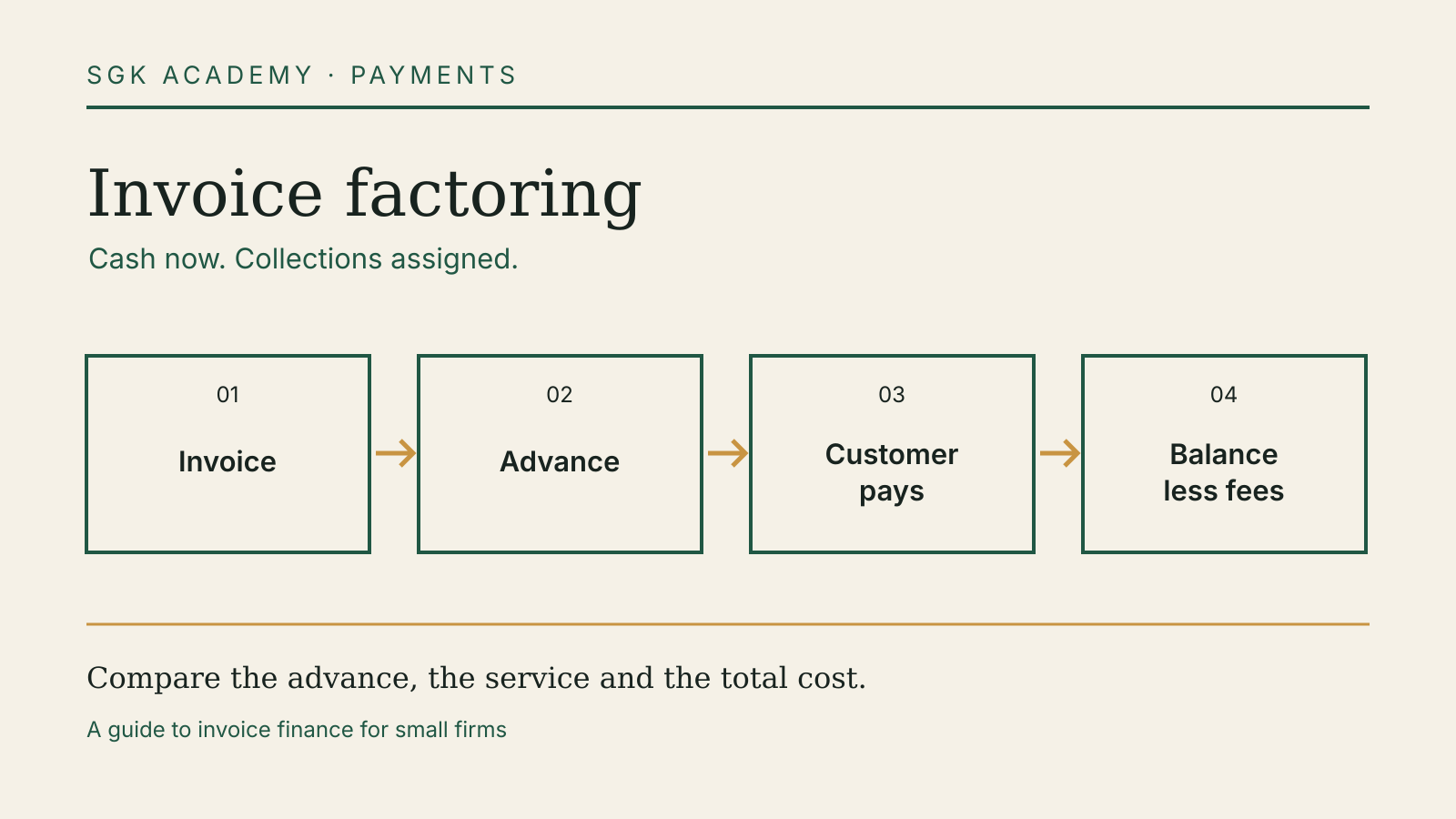
A provider assesses the outstanding invoices and the customers expected to pay them. Eligible invoices support an advance. When the customer pays, the provider makes the retained balance available after its fees. New invoices and customer payments change the amount available under an ongoing facility.
The British Business Bank describes advances of up to 80 or 90 per cent in its invoice finance guide ↗. Treat those as a description of the product, not an entitlement to a particular percentage. Its guidance says the provider’s risk assessment determines the advance.
An advance brings forward receipt of existing sales. It does not create another sale or increase the invoice’s face value. That is why the distinction in profit versus cash flow still matters after funding is arranged.
Factoring and discounting assign collections differently
| Question | Invoice factoring | Invoice discounting |
|---|---|---|
| What supports the funding? | Eligible unpaid invoices | Eligible unpaid invoices |
| Who manages the sales ledger and collects? | The provider supplies that service | Your business retains the day-to-day work |
| Will customers know? | They are likely to know | Many facilities are undisclosed |
| What are you buying? | Funding plus collection and ledger support | Primarily funding |
| What should you compare beyond the advance? | Collection service, customer contact and total fees | Funding cost, reporting duties and your collection capacity |
These are the main distinctions in the British Business Bank’s guidance. Product names alone do not establish every responsibility. Ask the provider to explain who contacts customers, how disputed invoices are handled and where customers send payment.
Factoring can be useful when a small team needs collection support as well as cash. That support has a cost, but it may also replace work the team currently pays someone to do. Compare the service with the work it actually takes over.
Discounting retains the customer relationship and collection process inside the business. That can fit a firm with reliable credit control. It is less useful to treat “we keep control” as a benefit if nobody has time to chase overdue invoices or reconcile receipts.
Disclosure also needs a contract check. The British Business Bank says many discounting facilities are undisclosed; it does not say every facility is confidential under every circumstance. Decide what customers will be told before changing payment instructions.
Calculate the cash in two stages
The advance percentage tells you how much may arrive initially. The retained balance tells you what remains to be released when the customer pays. Fees reduce the total cash your business keeps.
Here is an illustrative calculation, not a provider quote. Assume:
- An eligible invoice has a face value of £10,000.
- The advance is 90 per cent, or £9,000.
- A service fee is 1 per cent of the invoice, or £100.
- A simplified financing charge is 0.5 per cent of the £9,000 drawn for one 30-day period, or £45.
- The customer pays in full at the end of that period, and the example deducts both fees from the retained balance.
| Stage | Calculation | Cash |
|---|---|---|
| Advance | £10,000 × 90% | £9,000 |
| Amount initially retained | £10,000 − £9,000 | £1,000 |
| Assumed total fees | £100 + £45 | £145 |
| Balance released after payment | £1,000 − £145 | £855 |
| Total cash retained by the business | £9,000 + £855 | £9,855 |
The fee cost is £145 in this example. Quoting only “90 per cent advanced” would miss both the later receipt and the cost.
Real facilities can calculate charges differently and deduct them at different times. Ask for a cash schedule using your invoices, expected collection dates and likely drawings. Include every applicable charge rather than trying to translate this simplified example into a lender’s tariff.
Now assume the customer takes a second 30-day period and the example adds another £45 financing charge. The service fee remains £100 under our assumptions; total cost becomes £190, the balance released becomes £810 and total cash retained becomes £9,810.
That second calculation exposes the question a headline fee cannot answer: what happens to the cost when payment is late? The answer depends on the charge basis, the amount drawn and the agreement. Ask the provider to calculate a late-payment case using its actual terms.
Estimate funding from eligible invoices, not total turnover
Annual sales are not the same as today’s available funding. A facility is linked to the invoice book that the provider accepts and the proportion it will advance.
Suppose a business has £40,000 outstanding, but the provider accepts £30,000 for the calculation. With an assumed 85 per cent advance, the supported amount would be £25,500 before considering any existing drawings or other contract adjustments. This is another hypothetical example, with no claim that a particular provider would accept those invoices.
The practical task is to obtain an eligible-invoice calculation from the provider. Ask which invoices qualify, what happens when one becomes disputed or overdue, and whether customer concentration affects the calculation. Do not assume every pound on the ledger supports the same advance.
The British Business Bank says providers examine the business and its debtor book, including the likelihood that customers will pay. Its guidance also explains that funding can grow with turnover and reduce when turnover falls. Build that reduction into a cash forecast if sales are seasonal.
A lower funding balance during a quiet month can arrive at the same time as fixed bills. Compare that scenario with the cash need you are trying to cover. An invoice facility may help bridge a collection delay while still being a poor match for a persistent shortfall unrelated to receivables.
Check fit before comparing advertised prices
Invoice finance normally serves businesses selling to other businesses on credit terms. The British Business Bank says providers may consider other situations, but a different customer mix can reduce the finance offered. A business paid immediately by consumers should not assume it has the same funding asset as a B2B supplier waiting for settlement.
Trading history and record quality also matter. Expect questions about accounts, outstanding invoices and how long customers actually take to pay. An invoice with a clear description and agreed terms is easier to explain than a ledger full of unexplained balances.
Use the provider’s assessment to establish fit before comparing a headline advance. Useful inputs include the amount currently outstanding, collection history, disputed balances and the cash required over the next several payment cycles.
If the records need work, an invoice review workflow can help structure the checking process. It does not establish whether a lender will accept an invoice. A human still needs to resolve differences between the invoice, delivery evidence and customer agreement.
Responsibility for non-payment needs its own question
Funding an invoice does not automatically transfer every loss to the provider. The British Business Bank says the business may remain responsible if its customer does not pay, depending on the agreement. Bad-debt protection can sit alongside the facility, with its own terms.
Ask the provider to explain the non-payment case in writing. When can an advance be recovered from your business? What does any protection cover? Which events or disputes fall outside it? Who decides that a receivable no longer qualifies for funding?
Those questions distinguish collection assistance from protection against loss. A provider can chase an invoice without promising to absorb its unpaid balance. Avoid choosing on the assumption that the word “factoring” settles both issues.
Customer payment instructions deserve a controlled handover too. Establish who confirms a change, who sends it and how your customer verifies it. The process in invoice fraud payment checks is relevant when introducing a new collection arrangement.
Compare service fees, funding charges and the exit
The British Business Bank describes two usual cost components: a service fee related to invoice value and a discount charge based on funds used. It says factoring’s service fee is generally higher because it includes ledger and collection support.
That does not produce a reliable all-in ranking from two advertised percentages. One offer may include more work, or calculate the charge on a different base. Request the same invoice and collection scenarios from each provider.
| Ask for | Why it changes the comparison |
|---|---|
| The service-fee calculation | Shows what invoice value or volume generates the fee |
| The financing-charge calculation | Shows the effect of drawings and time outstanding |
| All additional applicable charges | Prevents an incomplete total-cost comparison |
| Minimum agreement period and notice | Establishes how long the commitment lasts |
| Ending or transferring the facility | Shows what remains to settle when leaving |
| Reporting and reconciliation duties | Reveals the work your team must still perform |
| Collection and dispute handling | Defines the service you are paying for |
The British Business Bank’s invoice finance checklist ↗ asks businesses to understand the costs, who manages collections and how long the agreement lasts. Use the written agreement to answer those points, including what happens at its end.
Consider selected invoices when the need is occasional
An ongoing facility is not the only model. The British Business Bank distinguishes selective invoice finance, which can cover selected customer accounts, and spot factoring, which can cover distinct invoices.
That difference can matter for a firm facing one unusually large invoice or an occasional gap. Ask whether funding can be limited to the receivable creating the problem, what that narrower arrangement costs and what commitments remain.
For a continuing gap across many invoices, compare the ongoing facility with the collection cycle as a whole. Funding only the largest invoice may leave payroll dependent on several smaller customers. The right scope follows the cash forecast, not the appeal of financing fewer records.
Prepare a decision record before signing
Put the cash requirement, collection responsibility and loss responsibility on one page. A workable record should identify the invoice pool being assessed, the expected advance, the fee calculation and the dates cash is needed.
Then test three situations: customers pay on time, customers pay later than usual, and sales fall enough to reduce available funding. Use actual provider terms for each. Check whether the business can still pay its bills and meet its obligations under the agreement.
Invoice finance can address a delay between delivery and collection. It cannot make persistently unprofitable sales profitable. The British Business Bank makes that limitation explicit. If costs exceed the money earned from sales, bringing cash forward leaves that underlying problem in place.
Sources
- British Business Bank: Invoice finance ↗, read October 8, 2026. UK product mechanics, collections, eligibility, cost components and limitations.
- British Business Bank: Invoice finance checklist ↗, read October 8, 2026. Preparation, records, costs and agreement questions.
The calculations in this guide are teaching examples. Their rates and collection timing are assumptions, not offers or eligibility promises.
Questions
Is invoice factoring different from invoice finance?
Factoring is one type of invoice finance. Invoice discounting is another. Compare the actual products and responsibilities rather than treating the category as a competing product.
Does invoice factoring mean the provider takes every unpaid-debt risk?
No. Responsibility depends on the agreement. Collection support and bad-debt protection are different things; inspect the terms of each.
Does a 90 per cent advance mean the other 10 per cent is a fee?
No. In the example, the provider initially retains 10 per cent, then releases it after customer payment minus applicable fees. Ask how your proposed facility calculates and releases that balance.