Most small businesses meet the EU AI Act as users. They pay for a chatbot, a writing assistant, an image generator or a recruitment tool that someone else built. The Act calls that role a deployer, and its obligations for deployers are narrower than the headlines about fines suggest. They are not zero, though, and the timetable changed in July 2026.
This guide sets out what applies to a small company that uses AI tools in its work, as of 10 October 2026. It is based on Regulation (EU) 2024/1689 (the AI Act) and on Regulation (EU) 2026/1744, the “Digital Omnibus on AI”, which amended it. It covers businesses that use AI systems; a company that builds and sells its own AI product has provider obligations that go beyond this guide.
Are you a deployer?
Article 3(4) defines a deployer as a natural or legal person, public authority, agency or other body using an AI system under its authority, except where the system is used in the course of a personal non-professional activity. Article 2(10) confirms that the Regulation does not apply to the obligations of deployers who are natural persons using AI for purely personal, non-professional purposes.
For a business, the test is simple. If the company, or staff acting for it, uses an AI system in its work, the company is a deployer of that system. A freelancer who uses an AI assistant to draft client deliverables is using it professionally. A founder who asks a chatbot to plan a family holiday is not.
The provider is the business that develops the system, or has it developed, and places it on the market under its own name. Most of the Act’s technical requirements, from documentation to conformity assessment, fall on providers. A small business that only subscribes to tools is rarely a provider. It can become one if it builds a system and offers it to others under its own name, which is a separate analysis.
What changed in July 2026
The Digital Omnibus on AI was adopted on 8 July 2026 and published in the Official Journal on 24 July 2026. It entered into force on the third day after publication. For a small deployer, four changes matter.
| Topic | Before the Omnibus | After the Omnibus |
|---|---|---|
| AI literacy (Article 4) | Providers and deployers had to take measures to ensure, to their best extent, a sufficient level of AI literacy of their staff | Providers and deployers must take measures to support the development of AI literacy; no specific level must be guaranteed |
| High-risk obligations for Annex III uses | Applied from 2 August 2026 | Apply from 2 December 2027 |
| High-risk obligations for products under Annex I | Applied from 2 August 2027 | Apply from 2 August 2028 |
| Marking of AI-generated content by providers | Applied from 2 August 2026 | Systems already on the market before that date have until 2 December 2026 |
The Omnibus also added new prohibitions on AI systems that generate non-consensual intimate content and child sexual abuse material, which apply from 2 December 2026, and extended some measures for small and medium-sized enterprises to a new category of small mid-cap enterprises.
AI literacy: an obligation to take measures
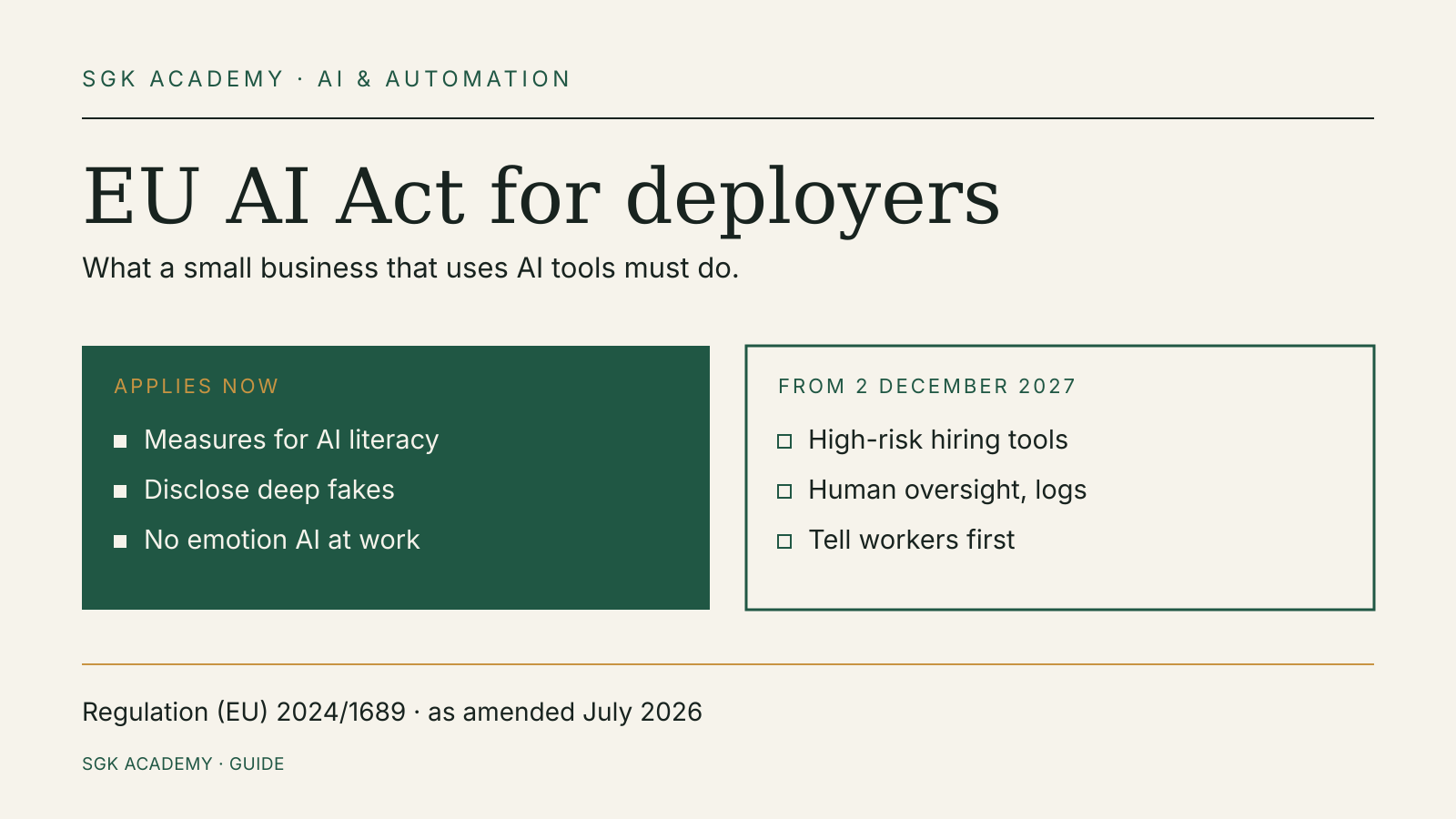
The original Article 4 required providers and deployers to take measures to ensure, to their best extent, a sufficient level of AI literacy of their staff. That obligation has applied since 2 February 2025, together with the rest of Chapters I and II.
The amended Article 4 now reads, in its first paragraph, that providers and deployers “shall take measures to support the development of AI literacy of their staff and other persons dealing with the operation and use of AI systems on their behalf”. The measures take into account those people’s technical knowledge, experience, education and training, the context in which the systems are used and the people on whom they are used. The paragraph ends: “This obligation does not require providers or deployers to guarantee any specific level of AI literacy of any individual.”
The amendment also places duties on public bodies. The Commission and the Member States must support providers and deployers, “in particular SMEs”, in meeting the obligation, and the Commission must publish practical examples of how to comply. The recitals explain why the change was made: stakeholders reported that a stringent obligation did not suit all providers and deployers and created an additional burden, particularly for smaller enterprises.
For a five-person company, proportionate measures could include:
- a one-page note listing the AI tools in use, what each is approved for and what must not be entered into them;
- a short session when someone starts using a new tool, covering how it can be wrong and who checks its output;
- a named person who reviews the list when a tool is added or its terms change; and
- a record of what was done and when.
These are editorial suggestions about how a small business might evidence that it took measures. The Regulation does not prescribe a format, and the Commission’s practical examples, once published, are the better reference.
Transparency duties that apply since 2 August 2026
Article 50 became applicable on 2 August 2026, the Regulation’s general date of application. It splits transparency duties between providers and deployers.
What sits with the provider. Article 50(1) requires providers of AI systems intended to interact directly with people to design them so that people are informed they are interacting with an AI system, unless that is obvious. Article 50(2) requires providers of systems generating synthetic audio, image, video or text to mark outputs in a machine-readable format. A company using a vendor’s customer-service chatbot relies on the vendor for those features, but should check that it has not switched them off or hidden them in its own website integration.
What sits with the deployer. Article 50(3) and (4) place three duties on deployers:
- Deployers of an emotion recognition system or a biometric categorisation system must inform the people exposed to it, and process personal data in line with the GDPR.
- Deployers of an AI system that generates or manipulates image, audio or video content constituting a deep fake must disclose that the content has been artificially generated or manipulated. For evidently artistic, creative, satirical or fictional work, the duty is limited to disclosing the existence of such content in a way that does not hamper the work.
- Deployers of an AI system that generates or manipulates text published to inform the public on matters of public interest must disclose that the text was artificially generated or manipulated. This does not apply where the content has undergone human review or editorial control and a natural or legal person holds editorial responsibility for the publication.
Article 50(5) requires the information to be given in a clear and distinguishable manner, at the latest at the time of the first interaction or exposure, and to meet applicable accessibility requirements.
For most small businesses, the deep fake rule is the one to build into marketing practice. A synthetic video of a real-looking person, a cloned voice in an advertisement or an altered photo of real premises needs a disclosure. Article 3(60) defines a deep fake as AI-generated or manipulated image, audio or video content that resembles existing persons, objects, places, entities or events and would falsely appear to a person to be authentic or truthful. Abstract illustrations that would not be mistaken for real people or places fall outside that definition.
Practices that are banned outright
Article 5 lists prohibited AI practices, and it has applied since 2 February 2025. Most of the list concerns governments and large platforms, but one prohibition is directly relevant to employers. Article 5(1)(f) prohibits placing on the market, putting into service or using AI systems “to infer emotions of a natural person in the areas of workplace and education institutions”, except where the system is intended for medical or safety reasons.
A tool that claims to read employees’ mood from video calls, or to score candidates’ enthusiasm from their faces, needs scrutiny before purchase. “We only use it internally” does not help: use is itself within the prohibition.
High-risk uses: what a small employer should plan for
Annex III lists high-risk uses. Two sections are the ones small businesses are most likely to encounter as deployers.
Employment and workers’ management (Annex III, point 4). This covers AI systems intended to be used for recruitment or selection, in particular to place targeted job advertisements, to analyse and filter job applications and to evaluate candidates. It also covers systems used to make decisions affecting terms of work-related relationships, promotion or termination, to allocate tasks based on individual behaviour or personal traits, or to monitor and evaluate performance and behaviour.
Creditworthiness (Annex III, point 5(b)). This covers AI systems intended to evaluate the creditworthiness of natural persons or establish their credit score, with an exception for systems used to detect financial fraud. A lender is the obvious case; a small business extending credit to individual customers using a scoring tool should check whether its tool falls here.
Since the Omnibus, the obligations in Chapter III, Sections 1 to 3, apply to Annex III systems from 2 December 2027. That gives a small employer time, but the obligations themselves are concrete. Under Article 26, deployers of high-risk AI systems must:
- use the system in accordance with the provider’s instructions for use;
- assign human oversight to people with the necessary competence, training, authority and support;
- ensure that input data they control is relevant and sufficiently representative for the system’s purpose;
- monitor operation, inform the provider of risks, and suspend use and notify where they consider the system presents a risk;
- keep the logs under their control for a period appropriate to the purpose, of at least six months unless other law provides otherwise;
- before using a high-risk system at the workplace, inform workers’ representatives and affected workers; and
- use the provider’s information when carrying out a data protection impact assessment under the GDPR, where one is required.
A practical step now is to ask the vendor of any screening or performance tool whether it classifies its system as high-risk, and what instructions for use and logs it will provide by December 2027.
Penalties, and how the Act treats small firms
Article 99 leaves the rules on penalties to Member States, which must make them effective, proportionate and dissuasive and take into account the interests and economic viability of SMEs, including start-ups. The Regulation sets maximum fines:
| Infringement | Maximum fine |
|---|---|
| Prohibited practices (Article 5) | EUR 35 million or 7% of total worldwide annual turnover, whichever is higher |
| Deployer obligations for high-risk systems (Article 26) and transparency obligations (Article 50), among others | EUR 15 million or 3% of turnover, whichever is higher |
| Incorrect, incomplete or misleading information to authorities | EUR 7.5 million or 1% of turnover, whichever is higher |
For SMEs, including start-ups, Article 99(6) reverses the rule: each fine is capped at the percentage or the amount, whichever is lower. These are ceilings set by the Regulation, not amounts that authorities are expected to impose for minor lapses.
Worked example: a design studio with eight people
The following scenario is illustrative.
An eight-person design studio in Portugal uses a writing assistant for proposals, an image generator for early concepts, a meeting transcription tool, and an applicant-tracking system that ranks job applications.
- AI literacy. The studio is a deployer of all four tools. It keeps a short register of the tools and their approved uses, runs a briefing when a new tool is introduced and records both. That is a measure supporting AI literacy under the amended Article 4.
- Proposals. Text drafted with the assistant and reviewed by a designer before sending is not public-interest text published to inform the public, so Article 50(4) does not require a label. The studio may still choose to tell clients how it works.
- Concept images. If a concept shows a realistic synthetic person presented as real in a campaign the studio publishes, the deep fake disclosure applies. An abstract mood board does not raise that issue.
- Hiring. Ranking applications is a recruitment use listed in Annex III, point 4. From 2 December 2027 the studio will need the Article 26 measures, including human oversight and informing workers’ representatives and affected workers before use. Its vendor contract should say who supplies the instructions for use and the logs.
- Emotion analysis. If the transcription tool offers a “sentiment of participants” feature for internal meetings, the studio should not switch it on for staff, given the workplace prohibition in Article 5(1)(f).
A checklist for this quarter
- List every AI tool the business uses, who uses it and for what.
- Mark any tool used for hiring, staff evaluation, task allocation or customer credit scoring as a possible high-risk use, and ask the vendor how it classifies the system.
- Check marketing workflows for synthetic people, voices or places, and add a disclosure step.
- Confirm that vendor chatbots on your site still tell visitors they are talking to an AI system.
- Remove or disable any feature that infers employees’ emotions.
- Record the literacy measures you take, and revisit them when the Commission’s practical examples are published.
- Keep the GDPR in view. The AI Act does not replace data protection rules, and several of its obligations refer to them directly.
SGK Academy’s guides on AI agent tests and prompt injection cover the operational side of using AI tools safely.
Sources and version
Checked 10 October 2026 against Regulation (EU) 2024/1689, in particular Articles 2, 3, 4, 5, 26, 50, 99 and 113 and Annex III, and against the amending Regulation (EU) 2026/1744 (Digital Omnibus on AI), published in the Official Journal on 24 July 2026. The legislative history is summarised in the European Parliament Research Service briefing on the Digital Omnibus on AI. National penalty rules and guidance from market surveillance authorities may add detail; this guide does not classify any particular tool.