
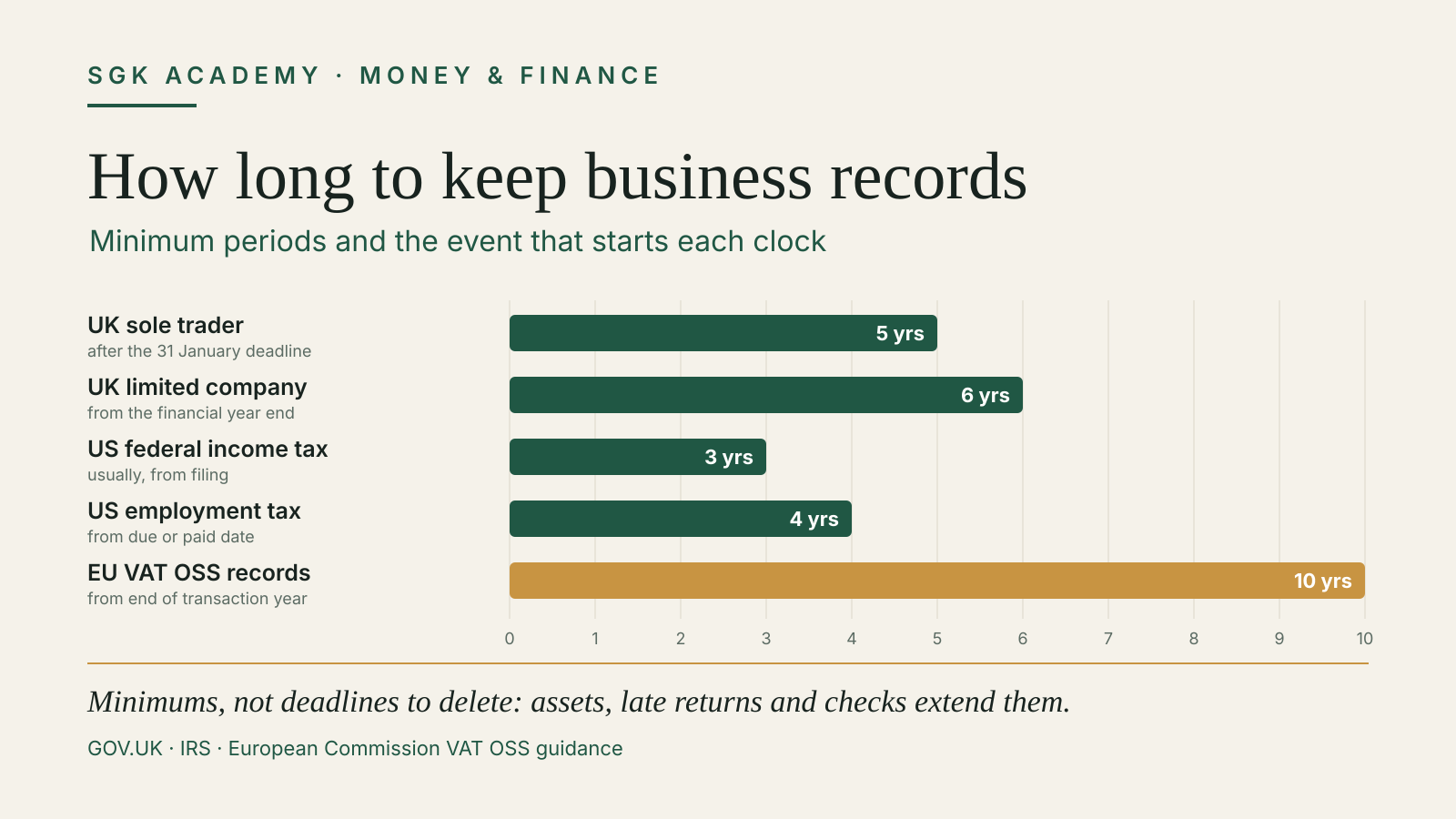
How long to keep business records depends on the country, the tax involved and what the document proves. A UK sole trader usually works from a five-year rule after the Self Assessment deadline. A UK limited company normally keeps accounting records for six years from the end of the financial year. The US federal starting point is often three years, with important exceptions. EU businesses using VAT One Stop Shop must retain the scheme records for ten years from the end of the transaction year.
Those periods are minimums, not a universal disposal schedule. A document tied to an asset, an open tax check, payroll, a late return or a contract may need to stay longer.
Source check: Rules in this guide were reviewed on 26 October 2026 against current GOV.UK, IRS and European Commission guidance. It covers UK tax records, US federal tax records and EU VAT OSS records. Other countries and non-tax duties can set different periods.
The retention periods at a glance
| Record set | Minimum period in the official guidance | When the clock starts |
|---|---|---|
| UK self-employed business records | At least 5 years | After the 31 January submission deadline for the relevant tax year |
| UK limited-company accounting records | 6 years | From the end of the company financial year they relate to |
| US federal income-tax support | Usually 3 years | Generally after the return was filed |
| US employment-tax records | At least 4 years | After the tax becomes due or is paid, whichever is later |
| EU VAT OSS records | 10 years | From the end of the year in which the transaction was made |
The safest working rule is to attach a disposal date to each record set, then suspend disposal when an exception applies. A folder called “keep for six years” is too vague if nobody knows which year the six-year period starts from.
UK sole traders and partnerships
HMRC says a self-employed person must keep business records for at least five years after the 31 January submission deadline for the relevant tax year.
For example, the online filing deadline for the 2025 to 2026 tax year is 31 January 2027. Applying the rule means keeping the supporting records until at least the end of January 2032.
The records should support income, expenses and the other figures on the return. That usually includes invoices, receipts, bank records and calculations used to arrive at the reported profit. If traditional accounting is used, records may also need to show year-end debtors, creditors, stock, bank balances and owner contributions or drawings.
A return sent more than four years late follows a different rule. GOV.UK says those records must be kept for 15 months after the late return is sent.
Read the actual HMRC wording in Business records if you’re self-employed. For the timing of income and expenses before they reach the return, see cash versus accrual accounting.
UK limited companies
A UK limited company must normally keep its company and accounting records for six years from the end of the last financial year they relate to.
The accounting set covers money received and spent, assets, debts, stock and the evidence used to prepare annual accounts and the Company Tax Return. Invoices, receipts, bank statements, contracts, orders, delivery notes and relevant correspondence can all form part of that evidence.
HMRC lists circumstances that require a longer period:
- a transaction spans more than one accounting period;
- the company bought an asset expected to last more than six years;
- the Company Tax Return was filed late; or
- HMRC has started a compliance check into the return.
A director should therefore avoid deleting a whole financial-year folder on its nominal expiry date without checking the contents. An equipment purchase may still support a live tax calculation after the ordinary six-year period.
The full list is on GOV.UK’s company and accounting records page. A company that has stopped trading still has filing and evidence duties; use the dormant-company checklist to separate dormancy from dissolution.
US federal tax records
The IRS says records supporting income, deductions or credits should be kept until the period of limitations for the return runs out. The general income-tax period is three years, but the official list includes longer cases.
Keep the records for:
- three years when none of the longer exceptions applies;
- three years from filing or two years from payment, whichever is later, when claiming a credit or refund after filing;
- seven years for a worthless-security loss or bad-debt deduction;
- six years when omitted income is more than 25% of the gross income shown on the return;
- indefinitely when no return was filed;
- indefinitely for a fraudulent return; and
- at least four years for employment-tax records, measured from when the tax becomes due or is paid, whichever is later.
The IRS also advises keeping copies of filed returns. They provide a reference for later returns and amended calculations.
Records connected to property need their own clock. The IRS says to keep them until the limitations period expires for the year in which the property is disposed of. That evidence may be needed to calculate depreciation, basis and the gain or loss on sale. A nontaxable exchange can carry the old property’s basis into the replacement property, so the older records may remain relevant.
The official periods are in How long should I keep records?. The IRS also lists the supporting documents that can prove purchases, sales, expenses and assets in What kind of records should I keep?.
If estimated payments are involved, save each worksheet and payment confirmation with the return-year file. The US estimated-tax guide explains why a later recalculation should not replace the earlier evidence.
EU VAT One Stop Shop records
VAT OSS has its own ten-year retention rule. The European Commission says a taxable person or intermediary must keep the scheme records for ten years from the end of the year in which the transaction was made. The rule continues to apply even after the business stops using the scheme.
The retained information includes the Member State of consumption, type and date of supply, VAT payable, payments on account and the evidence used to determine where the customer is established or normally resides.
The records must be available electronically and without delay when requested by the Member State of identification or a Member State of consumption. The Commission says failure to provide them within a month after a reminder can be treated as persistent non-compliance and lead to exclusion from the scheme.
The rule is specific to OSS and IOSS records. It is not a ten-year rule for every business record in every EU country. National company, payroll and tax laws still need a separate check.
Read the Commission’s Record Keeping and Audits in OSS and keep the transaction trail described in the VAT One Stop Shop guide.
Build a disposal schedule that can survive an audit
Start with the event that controls the deadline. That could be a filing date, financial year end, tax payment date, asset disposal or transaction year. Save that date as metadata instead of relying on the filename alone.
For each folder or archive, record:
- the legal entity and jurisdiction;
- the tax or reporting period;
- the record type;
- the normal disposal date;
- any exception that suspends disposal;
- the system that holds the original; and
- the person who approved deletion.
A small business does not need an elaborate records-management platform to do this. A spreadsheet or document register can work if it is backed up, access is controlled and the dates are reviewed. The practical test is whether the business can retrieve the invoice, payment evidence and calculation that support a reported number.
Keep the source record, not only a summary
An accounting entry is useful, but it may not prove the whole transaction. Keep the document that shows the supplier or customer, amount, date, description and payment evidence. For an asset, preserve purchase cost, improvements, depreciation and disposal documents as one chain.
Exporting data from a service is also part of retention. If invoices, card settlements or expense receipts sit inside a subscription product, check whether they can be exported before cancelling the account. The finance software guide uses portability as a selection test for exactly this reason.
Do not let routine deletion outrun an open issue
Pause deletion when a return is late, a tax authority has opened a check, a refund claim is still possible, an asset remains in use, a contract dispute is unresolved or a regulator has issued a preservation request.
The tax minimum may also be shorter than another legitimate need. The IRS explicitly tells businesses to check whether creditors or insurers require longer retention. Employment, product, privacy and litigation rules can also apply to the same document.
A retention schedule should make that conflict visible. Keep the longer period when two valid rules cover the same record, and document why.



