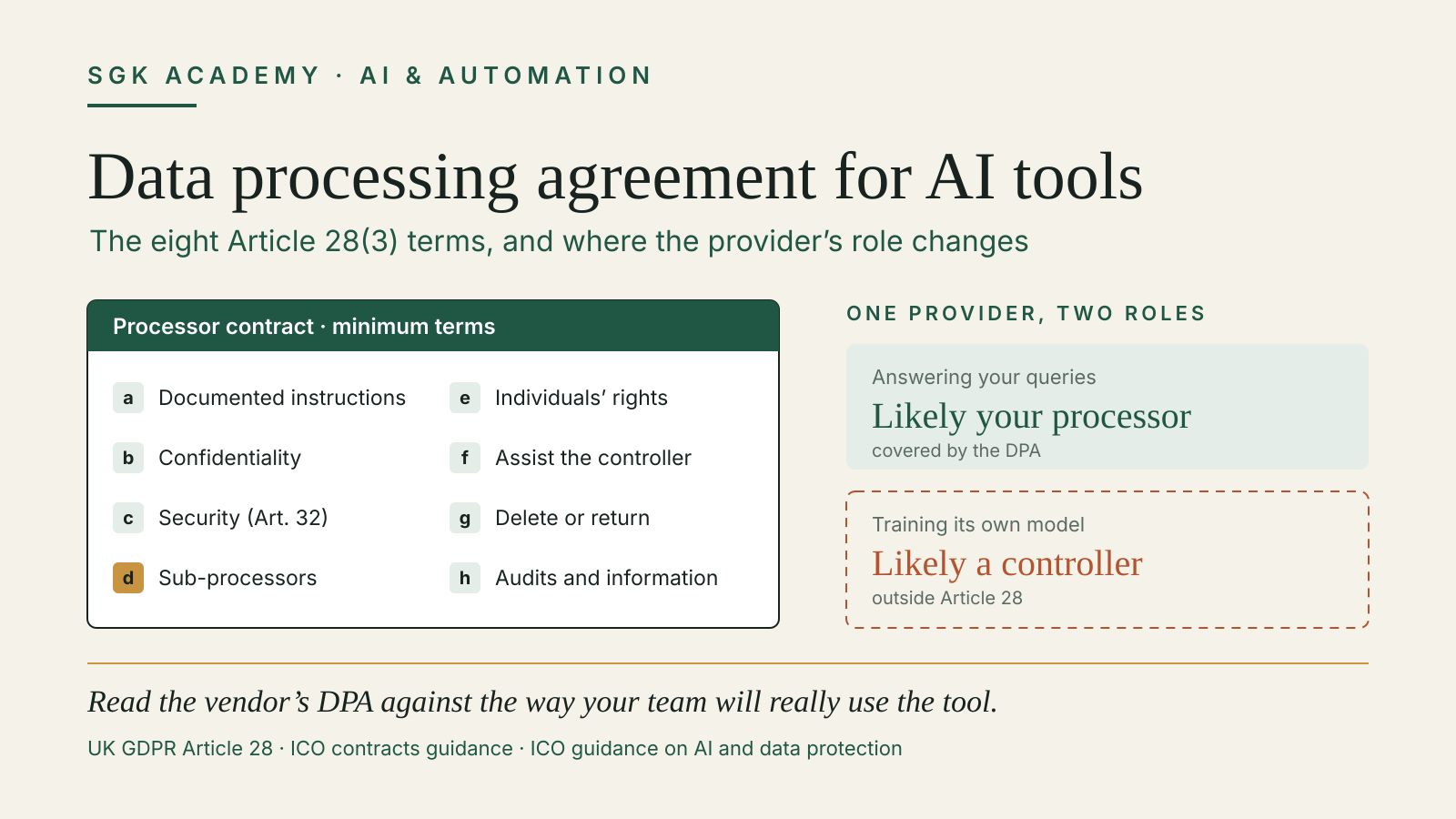
A data processing agreement for AI tools is the written contract that UK GDPR Article 28 requires when an AI provider handles personal data on your behalf. If your team pastes customer emails into an assistant, sends CVs to a screening service or routes support tickets through a model API, the provider is often your processor for that work. The contract has to say what it may do with the data, and it must contain eight minimum terms.
Source and version check: reviewed 26 October 2026 against UK GDPR Article 28 on legislation.gov.uk, the ICO’s guidance on contracts between controllers and processors, the accountability chapter of its AI guidance and its brief guide to international transfers (last updated 15 January 2026). The ICO marks its contracts guidance as under review after the Data (Use and Access) Act 2025, so recheck it before relying on a detail. This guide covers UK GDPR, with notes on the EU version; it is not legal advice.
The short answer
| Question | What the law and the ICO say |
|---|---|
| Is a written contract required? | Yes. Article 28(3) says processing by a processor must be governed by a binding contract or other legal act, and Article 28(9) says it must be in writing, which includes electronic form |
| Who has to have it? | The controller and the processor. When the processor uses a sub-processor, there must be a contract between those two as well |
| Is a vendor’s online DPA enough? | It can be, if it binds the provider to you and contains the Article 28(3) details and terms. You still have to check it |
| Does it matter that the tool is AI? | The rules are the same, but the ICO notes that an AI provider can be a processor for one purpose and a controller for another |
| Who is liable if the provider gets it wrong? | The controller remains responsible for its own compliance and for choosing a processor that gives sufficient guarantees |
Are you the controller, and is the AI provider your processor?
UK GDPR defines a controller as the person or body that determines the purposes and means of processing, and a processor as one that processes personal data on the controller’s behalf. The ICO’s guidance on contracts between controllers and processors gives a cloud example that maps neatly onto many AI products: an organisation that uses a cloud service to store and analyse its data remains the controller, and the cloud provider is its processor.
The ICO’s chapter on accountability and governance in AI adds three points that matter when you buy an AI service rather than build one:
- Labels in the contract do not decide the role. An organisation that determines the purposes and means of processing is a controller, regardless of how a services contract describes it.
- One provider can hold two roles. In the ICO’s example of a provider that runs prediction or classification services through an API, the provider is likely to be a controller for creating and training its own model, while the client is more likely to be the controller, and the provider a processor, for the predictions made on the client’s queries.
- Isolation can keep a provider in the processor role. Where a provider isolates client-specific models so that each client makes the overarching decisions about its own model, the ICO says the client will be the sole controller and the provider a processor, provided the isolation is complete and auditable.
The second point is the one small businesses tend to miss. If a provider’s terms allow it to use your inputs to train or improve its general models, that use is a purpose the provider has chosen for itself. For that part of the processing it is acting for its own ends rather than on your documented instructions, and a contract that calls it your “processor” throughout does not change the analysis.
The eight terms every processor contract must contain
Article 28(3) of UK GDPR requires the contract to set out the subject matter and duration of the processing, its nature and purpose, the type of personal data and categories of data subject, and the controller’s obligations and rights. It then lists eight terms. The ICO’s page on what needs to be included in the contract treats them as a minimum that the parties can add to.
| Article 28(3) term | What the contract must say | What to look for in an AI provider’s DPA |
|---|---|---|
| (a) Documented instructions | The processor acts only on your documented instructions, including for international transfers, unless the law requires otherwise | A clear description of what the service does with inputs, outputs and files, and whether model training on your data is excluded or switchable |
| (b) Confidentiality | People authorised to process the data are bound by confidentiality | A confidentiality commitment that covers staff, contractors and any human reviewers |
| (c) Security | The processor takes all measures required by Article 32 | Encryption, access control, incident handling and testing, described in the DPA or a linked security document |
| (d) Sub-processors | No other processor without your prior specific or general written authorisation, with notice of changes and a chance to object | A published sub-processor list, a notice method you will actually see, and an objection route |
| (e) Individuals’ rights | The processor helps you respond to requests under Chapter III | How you can find, export or delete a person’s data held in chat histories, logs and uploaded files |
| (f) Assisting the controller | Help with security, breach notification, DPIAs and prior consultation with the ICO | A breach-notice commitment and documentation you can use in a DPIA |
| (g) End of contract | At your choice, deletion or return of the data, and deletion of copies unless the law requires storage | Retention periods for prompts, logs and files, and what happens to backups |
| (h) Audits and information | All information needed to show compliance, and audits or inspections by you or an auditor you appoint | Audit reports or certifications offered in place of an on-site audit, and the process for asking further questions |
On the last term, Article 28 also requires the processor to tell you immediately if, in its opinion, one of your instructions infringes data protection law.
Two practical points from the ICO help when reading a vendor document. First, instructions can be documented in any written form, including email, as long as they can be saved. Second, data in backups may not disappear the day a contract ends; the ICO says that can be acceptable if the data is put beyond use and deleted on the processor’s next deletion cycle.
Sub-processors: where AI supply chains get long
An AI product is often a layer on top of other services. A writing assistant may call a model provider, store files with a cloud host and send logs to a monitoring service. Each of those can be a sub-processor.
The rules are specific. Under Article 28(2), the processor must not engage another processor without your prior specific or general written authorisation. With a general authorisation, it must tell you about intended additions or replacements so you can object. Under Article 28(4), the same data protection obligations must be passed down to the sub-processor by contract, and if the sub-processor fails, the original processor remains fully liable to you.
For a small business, a general authorisation is usually the realistic choice. The control that matters is the notice. If changes are announced only on a web page you never visit, subscribe to the update feed or set a calendar reminder to check the list.
International transfers sit beside the DPA, not inside it
Many AI providers process data outside the UK. The ICO’s brief guide to international transfers, last updated on 15 January 2026, uses a three-step test. You are making a restricted transfer when UK GDPR applies to the data you are sending, you are initiating the transfer to an organisation outside the UK, and that organisation is a separate legal entity. The ICO says the rules apply to all restricted transfers, even small, infrequent ones, and to sole traders and the self-employed.
Every restricted transfer needs one of three mechanisms: UK adequacy regulations, appropriate safeguards such as the International Data Transfer Agreement (IDTA), the International Data Transfer Addendum or binding corporate rules, or an exception. If you rely on appropriate safeguards, the ICO’s checklist includes a transfer risk assessment.
The processor contract connects to this through Article 28(3)(a): the processor may transfer personal data abroad only on your documented instructions. So the DPA should say where data is processed, and the transfer documents should be attached or referenced. A DPA that is silent on location leaves both questions open.
Checking an AI vendor’s DPA in practice
Where an AI provider offers a DPA, it is usually a standard document, either built into its business terms or available to sign, and a small business is rarely in a position to negotiate it. That makes the review a question of fit: does the standard document cover the way you intend to use the tool?
Work through these questions before the tool touches customer or staff data:
- Which plan does the DPA cover? A DPA tied to a business or API plan does not help if staff use personal accounts for the same work.
- Is training on your data excluded, and is that a contract term or a setting? If it is a setting, record who controls it and check it after plan changes.
- What is retained, where and for how long? Prompts, outputs, uploaded files, conversation history and abuse-monitoring logs can have different periods.
- Who are the sub-processors, and how will you hear about changes?
- Where is the data processed, and which transfer mechanism covers it?
- How fast will the provider tell you about a personal data breach? Your own reporting clock is covered in the data breach reporting guide.
- Can you find and delete one person’s data? You will need this to answer a subject access request or an erasure request.
- What evidence of security will the provider give you? Under Article 28(1) you may only use processors that provide sufficient guarantees.
The ICO lists examples of how a controller can assess “sufficient guarantees”: compliance with industry standards where they apply, technical expertise to help with security, breach notification and DPIAs, documentation such as privacy, records-management and information-security policies, and adherence to an approved code of conduct or certification scheme. It also says that checking does not stop at signature; controllers should monitor a processor’s compliance on an ongoing basis.
A worked example
A three-person recruitment agency wants to use an AI tool to summarise CVs and draft shortlists for clients. The candidates’ names, employment histories and contact details are personal data, and the agency decides why and how they are processed. It is the controller.
The agency’s review of the vendor’s terms, set out as an illustration rather than a description of any real product, might look like this:
| Check | Finding | Action |
|---|---|---|
| DPA in place? | Incorporated into the business plan terms | Move all staff to business accounts; stop personal-account use for candidate data |
| Training on customer data? | Off by default on the business plan, stated in the DPA | Save the clause and the plan name in the vendor file |
| Retention | Inputs and outputs held for 30 days for abuse monitoring | Note the period in the agency’s records-of-processing entry |
| Sub-processors | List published; email notice of changes | Add the notice address to a shared inbox |
| Location | Processing in the US under a transfer addendum | Keep a copy of the transfer documents and the transfer risk assessment |
| Breach notice | “Without undue delay” | Add the vendor contact to the breach plan |
| Rights requests | Admin console can search and delete by user, not by candidate | Ask how a single candidate’s data can be located; record the answer |
Because CV screening can feed decisions about people, the agency should also screen the project for a DPIA. The DPIA for AI tools guide walks through that process, and the automated decision-making guide covers the separate rules when a decision is made solely by automated means.
Using standard clauses
UK GDPR allows standard clauses to be used for the processor contract. The ICO says the UK regime allows it to issue such clauses, and points to the clauses adopted by the Danish data protection authority and approved by the EDPB; it says a contract using those without amendment should comply with Article 28.
In the EU, the European Commission adopted standard contractual clauses between controllers and processors under Article 28(7) of the EU GDPR on 4 June 2021. These are separate from the clauses used for transfers outside the EEA. The EDPB’s Guidelines 07/2020 on the concepts of controller and processor remain the main EU reference on roles. The ICO notes that EDPB guidance is no longer binding under the UK regime, though it may still help.
For a small business buying an AI tool, these clauses matter mostly as a benchmark. If a vendor’s DPA covers each Article 28(3) point as clearly as the standard text, it is doing its job.
Keep the file you will need later
A signed or accepted DPA is only useful if you can produce it. For each AI tool that handles personal data, keep:
- the DPA version and acceptance date, and the plan it applies to;
- the training and retention settings, with a dated screenshot;
- the sub-processor list as it stood when you started, and later notices;
- the transfer mechanism and any transfer risk assessment;
- the DPIA or the note explaining why one was not needed;
- the owner inside your business who reviews the vendor.
Treat the file like other business records and decide in advance how long to keep it after the tool is retired; the record retention guide explains how to set disposal dates. The same vendor file supports the wider supplier review described in software supplier checks.
Official sources
- UK GDPR Article 28 on legislation.gov.uk
- UK GDPR Article 32 on legislation.gov.uk
- ICO: When is a contract needed and why is it important?
- ICO: What needs to be included in the contract?
- ICO: Responsibilities and liabilities for controllers using a processor
- ICO: What are the accountability and governance implications of AI?
- ICO: A brief guide to international transfers
- European Commission: Standard contractual clauses for controllers and processors in the EU/EEA
- EDPB: Guidelines 07/2020 on the concepts of controller and processor in the GDPR