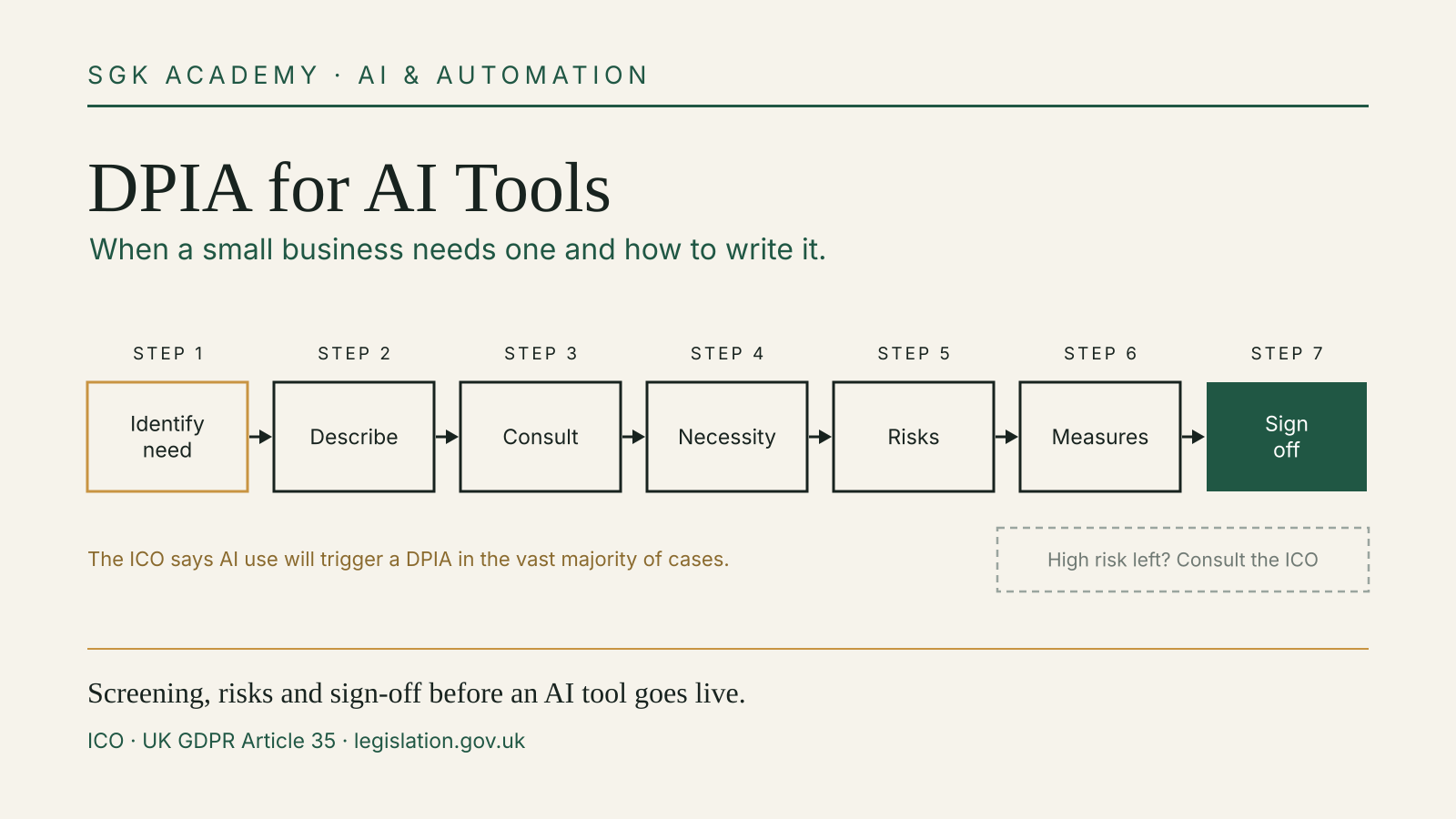
A DPIA for AI tools is the written risk assessment UK data protection law expects before a business uses AI on people’s personal data in a way that is likely to be high risk. The Information Commissioner’s Office says that in the vast majority of cases using AI will meet that test, and that where you decide it does not, you still need to document why. For a small business it is usually a few pages, but it must be done before the tool goes live.
Source and version check: reviewed 22 October 2026 against the ICO’s guidance on data protection impact assessments, its list of processing likely to result in high risk, and the accountability chapter of its guidance on AI and data protection. The ICO marks these pages as under review following the Data (Use and Access) Act 2025, so check them again before relying on a detail. This guide covers UK GDPR; it is not legal advice.
The short answer
| Question | What the ICO says |
|---|---|
| Is a DPIA a legal requirement? | Yes, under UK GDPR Article 35, where processing is likely to result in a high risk to individuals |
| Does using AI usually trigger it? | In the vast majority of cases, according to the ICO’s AI guidance |
| What if we decide no DPIA is needed? | Document the decision and the reasons, including your DPO’s advice if you have one |
| When must it be done? | Before the processing starts, and kept under review afterwards |
| Can the vendor do it for us? | You can use a processor’s or developer’s work, but you remain responsible |
| What if a high risk remains? | You must consult the ICO before going ahead |
| What can go wrong if we skip it? | Enforcement action, including a fine of up to £8.7 million or 2% of global annual turnover if higher |
What a DPIA is, in plain terms
The ICO’s page What is a DPIA? describes it as a process to systematically analyse, identify and minimise the data protection risks of a project or plan. It does not have to remove all risk. It has to show that you have looked at the risk honestly and decided whether the remaining level is acceptable given what you are trying to achieve.
Three features make it different from a supplier questionnaire:
- It is about harm to people, not risk to your business. The ICO links risk to physical, material or non-material damage to individuals, such as discrimination, fraud, financial loss, reputational damage or loss of confidentiality.
- It is yours. You can outsource the drafting, and you may use a product developer’s assessment to inform your own, but responsibility stays with your organisation.
- It is a living document. The ICO says it should be reviewed when anything significant changes, including new technology, a new security flaw or a new public concern.
The same page sets out what is at stake. Under UK GDPR, failing to carry out a DPIA when one is required may lead to enforcement action, including a fine of up to £8.7 million, or 2% of global annual turnover if higher.
When an AI tool needs a DPIA
The legal test in Article 35(1) is whether a type of processing, particularly using new technologies, is likely to result in a high risk to the rights and freedoms of individuals. The ICO’s page When do we need to do a DPIA? treats this as a screening exercise: you are looking for red flags, not proving harm.
Three cases that always need one
Article 35(3) lists three types of processing that always require a DPIA. Each can arise with AI:
- systematic and extensive evaluation of personal aspects based on automated processing, including profiling, on which decisions with legal or similarly significant effects are based;
- large-scale processing of special category data, or data about criminal convictions and offences;
- systematic monitoring of a publicly accessible area on a large scale.
A tool that scores job applicants or decides who gets credit terms falls squarely under the first. Our guide to automated decision-making under UK GDPR covers the separate rules on solely automated decisions.
The ICO’s own list
The ICO has published ten further types of processing that require a DPIA. Its list of processing likely to result in high risk names artificial intelligence, machine learning and deep learning as examples of innovative technology, and says a DPIA is required where innovative technology is combined with any other criterion from the European guidelines (WP248rev01). Other entries on the list that small businesses meet when they adopt AI include:
- denial of service: decisions about access to a product, service, opportunity or benefit based to any extent on automated decision-making, such as credit checks;
- large-scale profiling, where the ICO lists “application of AI to existing process” as an example;
- biometric data used to uniquely identify someone, such as voice or facial recognition for access control;
- data matching from multiple sources, for example for fraud prevention or direct marketing;
- tracking, including data processing at the workplace and in home and remote working.
The nine screening criteria
Outside those lists, the ICO points to nine criteria from the European guidelines: evaluation or scoring; automated decision-making with legal or similar effect; systematic monitoring; sensitive or highly personal data; large-scale processing; matching or combining datasets; vulnerable data subjects; innovative use of technology; and processing that prevents people exercising a right or using a service. In most cases, the ICO says, two of these together indicate a DPIA is needed, although that is not a strict rule.
For AI tools the “innovative use” box is often ticked already, so one more factor, such as employee data or customer scoring, is usually enough.
A quick screen for common small-business tools
The examples below are illustrations of how the ICO’s criteria apply, not rulings. Your own facts decide the answer.
| Tool and use | Flags it raises | Likely outcome |
|---|---|---|
| AI screening of CVs or ranking candidates | Innovative technology, evaluation or scoring, possible significant effect | DPIA needed |
| Call or meeting transcription that analyses staff performance | Innovative technology, workplace monitoring, evaluation | DPIA needed |
| Chatbot answering customer questions that can refuse refunds or accounts | Innovative technology, denial of service | DPIA needed |
| AI tool matching customer records from several sources for marketing | Innovative technology, data matching | DPIA needed |
| Writing assistant used on marketing copy with no customer data | Little or no personal data | Screen and record the decision |
| Invoice extraction tool reading supplier documents | Some personal data, limited effect on individuals | Screen carefully and record the reasoning |
The last row is where many founders stop too early. Supplier invoices often contain names, email addresses and bank details of sole traders, which is personal data. Our guide to AI invoice review covers the workflow side.
What the ICO expects a DPIA for AI to contain
The ICO’s AI accountability guidance and its general page on how to do a DPIA set out seven steps. Here is what each means when the “project” is a tool you buy rather than build.
1. Identify the need
Run the screen above and keep the result. The ICO says that if you decide a DPIA is not needed, an annotated copy of its screening checklist can be enough to show you considered it. If in doubt, it strongly recommends doing one.
2. Describe the processing
Describe the nature, scope, context and purpose. For an AI tool, the ICO asks for a systematic description that includes data flows and the stages at which AI processing and automated decisions may affect people, plus any variation or margin of error in the system’s performance that could affect fairness. In practice, record:
- what personal data goes into the tool, from where, and about whom;
- what the tool produces and who acts on it;
- where the data is stored, for how long, and whether the vendor uses it for its own purposes;
- whether the vendor acts as your processor, and any sub-processors (the data processing agreement guide covers the contract terms);
- the number of people affected and whether children or other vulnerable people are among them.
The ICO accepts that you can reproduce technical material from a processor, such as a data-flow diagram, but says you should avoid copying large sections of the vendor’s literature into your own assessment.
3. Consult
You should seek and document the views of the people whose data you will process, or their representatives, unless there is a good reason not to, such as commercial confidentiality, security or disproportionate effort. Internally, involve whoever is responsible for information security. If you use a processor, the ICO says your contract should require it to assist.
4. Assess necessity and proportionality
This is the step the ICO is most direct about. Deploying AI should be driven by evidence that there is a problem and a reasoned argument that AI is a sensible solution, “not by the mere availability of the technology”. The DPIA should show the less risky alternatives you considered and why you did not choose them. If the AI tool replaces or supports a human decision, the ICO suggests documenting how you would compare human and algorithmic accuracy side by side.
5. Identify and assess risks
Score each risk by likelihood and severity. The ICO’s list of harms to consider includes loss of control over personal data, discrimination, identity theft or fraud, financial loss, inability to access services or opportunities, loss of confidentiality and re-identification of pseudonymised data. For AI specifically, it asks you to consider both allocative harms, such as a recruitment system that disadvantages one group of candidates, and representational harms, such as stereotyping. Include security risks: what happens if the vendor’s account or your login is compromised. Our guide to data breach reporting explains the 72-hour rule if that risk materialises.
6. Identify measures
Against each risk, record what reduces it and whether it reduces or eliminates it. The ICO’s examples include data minimisation and giving people a chance to opt out. Common measures for bought-in tools are:
- turning off vendor use of your data for model training where the contract allows;
- removing identifiers before data is sent to the tool;
- limiting which staff can use the tool and on which data;
- keeping a meaningful human review of any output that affects a person, with the power to overturn it;
- setting a retention period for prompts, transcripts and outputs;
- training the people who use it.
7. Sign off and record the outcome
The ICO says to record the additional measures, whether each risk has been eliminated, reduced or accepted, the overall residual risk, the DPO’s opinion if you have a DPO, and whether you need to consult the ICO. Then put the action points into your project plan with named owners.
When you must consult the ICO
Prior consultation is about residual risk. The ICO’s page Do we need to consult the ICO? says that if your DPIA identifies a high risk that you cannot reduce, you must consult it and cannot start the processing until you have. If your measures bring the risk below high, you need not consult.
The ICO says it will tell you within 10 days whether it has accepted the DPIA for prior consultation, and will give written advice within eight weeks of receipt, extendable to a maximum of 14 weeks in complex cases. Possible outcomes range from advice, through an official warning, to a limitation or ban on the processing. For a small business, the practical lesson is to redesign the use of the tool before reaching that point.
A worked example
This scenario is illustrative.
A twelve-person recruitment agency wants an AI tool that reads incoming CVs, extracts skills and ranks candidates for each vacancy. Consultants will see the top twenty.
- Screen. The tool is AI (innovative technology), it scores people, and a low score effectively removes a candidate from consideration. Two criteria at least: a DPIA is needed.
- Describe. CVs arrive by email and job boards; they include names, contact details, work history and sometimes health or other special category information that candidates volunteer. The vendor processes them in its cloud and, by default, retains them for 90 days.
- Consult. The agency asks a sample of recent candidates and its consultants how they would expect CVs to be handled, and asks the vendor for its testing information.
- Necessity. The problem is volume. A keyword filter was considered and rejected because it missed relevant candidates; a manual first read of every CV remains possible.
- Risks. Candidates from some groups may be ranked lower if the model reflects past hiring patterns; volunteered health data is processed for no reason; a vendor breach would expose thousands of CVs.
- Measures. The agency switches off vendor training on its data, cuts retention to 30 days, strips special category fields before ranking, has a consultant review every rejection before it is sent, and runs a quarterly comparison between the tool’s rankings and consultants’ independent shortlists.
- Outcome. Residual risk is recorded as medium, below high, so no prior consultation is required. The DPIA is scheduled for review after six months or any change to the vendor’s model.
The vendor’s numbers, the retention periods and the review interval here are the agency’s own choices, not legal requirements.
Where a DPIA fits with other AI rules
A DPIA under UK GDPR does not replace other assessments. The ICO notes that you can combine it with other impact assessments, so long as the result covers everything a DPIA requires. If your business also has customers or users in the European Union, read our guide to the EU AI Act for small businesses, which has its own obligations depending on how the AI system is used.