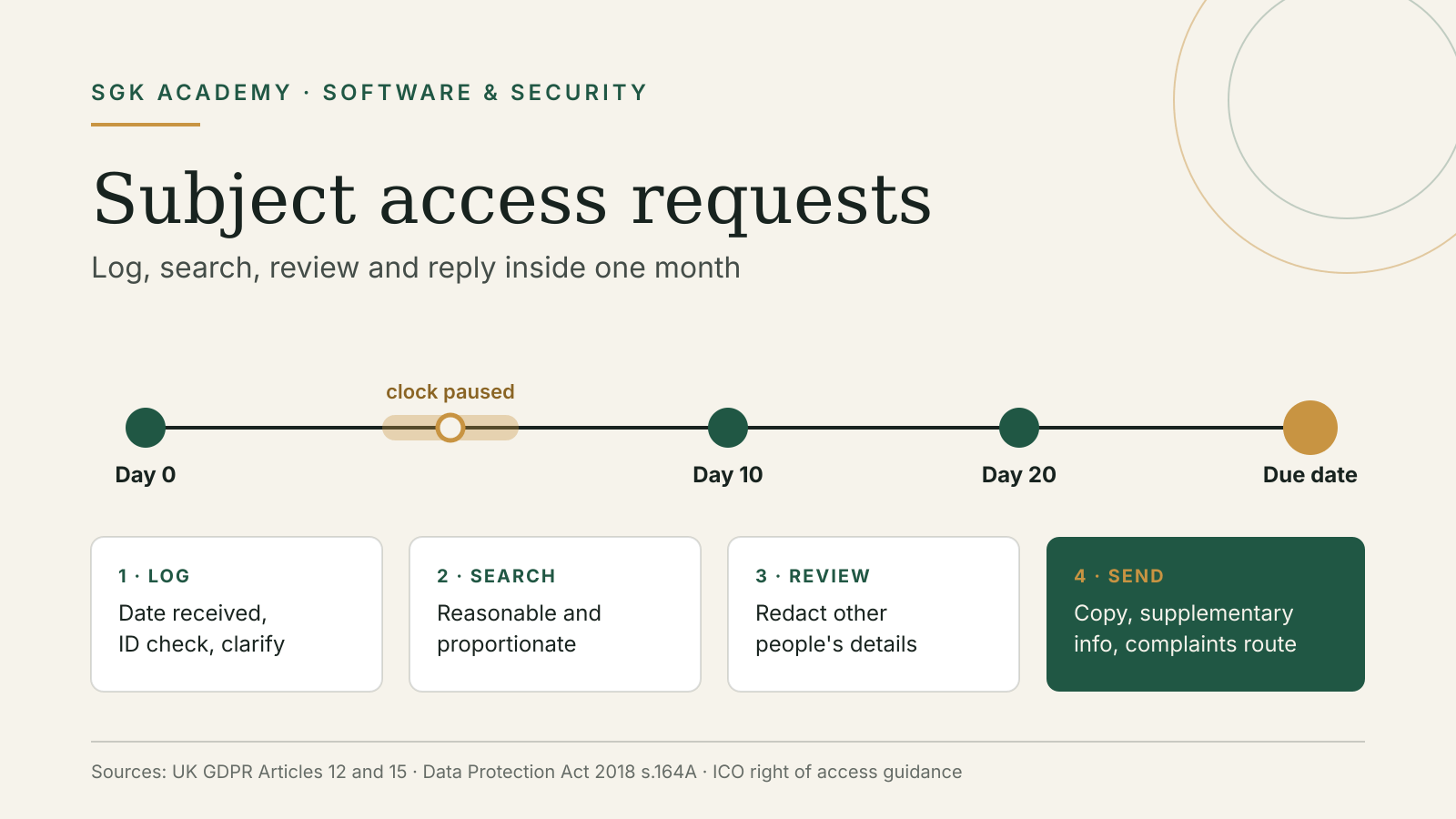
A subject access request can reach a small business through a support inbox, a letter, a phone call or a social media message, and the one-month clock starts when it arrives, whether or not anyone recognises it. This guide sets out how a UK small business can spot a request, confirm identity, search its systems in proportion, handle information about other people and send a complete reply on time. It follows UK GDPR Articles 12 and 15, the Data Protection Act 2018 and current Information Commissioner’s Office guidance.
Source and version check: written on 24 October 2026 from the UK GDPR text on legislation.gov.uk, the Data Protection Act 2018 as amended by the Data (Use and Access) Act 2025, and ICO right-of-access guidance last updated 16 July 2026. The regulator’s legal name became the Information Commission on 30 September 2026; its guidance and complaints service still sit on ico.org.uk. This guide is general information, not legal advice. Check the linked sources before you act on a live request.
What a subject access request is
Article 15 of the UK GDPR gives a person the right to ask an organisation three things: whether it processes their personal data, a copy of that data, and a set of supplementary facts about the processing. The ICO calls this the right of access, and a request to use it is a subject access request, often shortened to SAR.
The person does not have to use that phrase. The ICO says a request can be made verbally or in writing, including through social media, and does not need to mention the law, the words “subject access” or any form. A customer who writes “please send me everything you hold about me” has made a valid request. So has a former employee who asks a manager on the phone for “all the emails that mention me”.
A request can also come through someone else. A solicitor, an advice service or a family member can make it on the person’s behalf when they have authority to do so. Your job is to check that authority, not to refuse because the request did not come from the individual directly.
What the person is entitled to receive
The copy of the data is only part of the reply. Article 15(1) also lists the supplementary information the person must be told, unless it is already in a privacy notice you can point them to. In practice that means:
| Item | What to say in plain terms |
|---|---|
| Purposes | Why you use their data |
| Categories | The kinds of data you hold, such as contact details, order history, call notes |
| Recipients | Who you share it with, including suppliers and any recipients outside the UK |
| Retention | How long you keep it, or how you decide |
| Other rights | Rectification, erasure, restriction and objection |
| Complaints | Their right to complain to you and to the Information Commission |
| Source | Where you got the data, if not from them |
| Automated decisions | Whether any decision about them is made by automated means, with meaningful information about the logic |
| Transfers | The safeguards used if data goes outside the UK |
The complaints line changed this year. Article 15(1)(ea) now requires you to tell the person that they can complain to you, and section 164A of the Data Protection Act 2018 requires you to make complaints easy, for example with an electronic form, to acknowledge a complaint within 30 days and to respond without undue delay. A reply that only says “you may complain to the ICO” is now incomplete.
How the one-month deadline works
Article 12(3) says you must act on a request without undue delay and at the latest within one month of receipt. The ICO explains how to count that month, and the rules are more precise than many teams assume.
- Start on the day of receipt. The clock runs from the day the request arrives, including a weekend or a day when the inbox is not being watched.
- End on the same date next month. A request received on 2 November is due on 2 December.
- Use the last day when the date does not exist. A request received on 31 January is due on the last day of February.
- Move a weekend or bank holiday deadline to the next working day. If the due date falls on a non-working day, you have until the next working day.
The ICO also accepts a fixed 28-day working target as a way to stay inside every month. For a small team, a spreadsheet that applies one rule consistently is safer than counting by hand each time.
Waiting for identity
If you have reasonable doubts about who is asking, you can ask for information to confirm their identity. The ICO says the time limit then starts from the day you receive that information. The check must be proportionate. If the person is a current customer writing from the email address on their account, asking for a passport scan is excessive. If an unknown address asks for a former employee’s grievance file, asking a question only that person could answer, or checking against details you already hold, is more reasonable.
Ask for identity straight away. A request that sits in a queue for three weeks before anyone asks for proof has used most of the month for nothing.
Stopping the clock for clarification
When you hold a large amount of information about someone and cannot tell what they want, you can ask them to clarify. The ICO calls this “stopping the clock”. The time limit pauses on the day you ask and resumes the day after you receive the answer.
The ICO’s own example: a request received on 14 May, clarification requested on 15 May and an answer received on 18 May gives a response date of 18 June. You can only stop the clock when the clarification is reasonably required to identify the information or the processing. You cannot use it to ask what format the person wants, and you cannot force them to narrow the request. If they decline, you still have to carry out a reasonable search.
Extending by two months
Article 12(3) allows a further two months where requests are complex or numerous. You must tell the person within the first month that you are extending, and explain why. The ICO lists factors that can make a request complex, such as archived data that is technically hard to retrieve, applying an exemption across a large volume of sensitive information, or needing specialist legal advice that you do not routinely obtain.
Two points matter for small firms. A request is not complex just because it involves a lot of information. It is not complex just because a processor, such as your payroll or CRM provider, holds the data. The ICO also says you must be able to show why a request is complex in your particular circumstances.
A response plan for a small team
The steps below are a working sequence for an owner-managed business or a small team without a dedicated privacy officer. Adjust the owners and dates to your own setup.
Day 0 to 2: log, acknowledge and check identity
- Log the request in one place with the date received, the channel, the person’s name and the due date.
- Acknowledge it in writing. The ICO’s audit toolkit treats acknowledgement as good practice.
- Decide whether identity or authority needs checking. If it does, ask now and record the date the information arrives.
- Decide whether clarification is reasonably required. If it is, ask now so the pause starts early.
Day 2 to 10: search in proportion
Article 15(1A) of the UK GDPR, added by the Data (Use and Access) Act 2025 and treated as in force from 1 January 2024, says the person is only entitled to information you can provide from a reasonable and proportionate search. The ICO says you should weigh the circumstances of the request, the difficulty of finding the information and the fundamental nature of the right of access. You must be able to explain why a search would be disproportionate.
Build a short system map before the first request arrives. For most small businesses it looks like this:
| System | Typical owner | What to search for |
|---|---|---|
| Email accounts | Each mailbox holder | Name, email address, phone number, order or employee number |
| CRM or helpdesk | Sales or support lead | Contact record, tickets, call notes |
| Accounting and invoicing | Finance | Customer account, invoices, payment notes |
| Payroll and HR files | Owner or HR | Contract, appraisals, absence records, disciplinary notes |
| Shared drives and chat tools | Each team | Documents and messages naming the person |
| Supplier portals | Account owner | Data held by processors on your behalf |
The map should match your supplier list. If you have already worked through software supplier checks, you know which processors hold personal data and how to get it out of them. People who have left the business still count. Their mailboxes and shared folders often hold the material a former employee asks for, which is one reason to follow an employee offboarding access checklist that keeps records retrievable after an account is closed.
Day 10 to 20: review and redact
Read what the search returned before anyone sends it. You are providing information, not necessarily whole documents. The ICO’s guidance gives an example where a person who has already received their own data, with third-party details removed, asks again for the unredacted originals. The employer was entitled to treat that follow-up as excessive.
Information about other people needs the most care. Article 15(4) says the right to a copy must not adversely affect the rights and freedoms of others, and the Data Protection Act 2018 sets out how to deal with it. The ICO recommends three steps:
- Can you comply without identifying the other person? Remove names or details where that leaves the requester’s information intact, while remembering what the requester may already know.
- Has the other person consented? If so, you must disclose. You are not obliged to ask, and asking may be inappropriate, for example where the other person is your employee and cannot freely refuse.
- Is it reasonable to disclose without consent? Consider the type of information, any duty of confidentiality, the steps you took to seek consent and any refusal. Staff acting in their work role, whom the requester already knows, are more likely to be named than an anonymous member of the public.
Other exemptions in Schedule 2 of the Data Protection Act 2018, such as legal professional privilege and management forecasts, can also apply. Use them item by item, record the reason, and do not withhold a whole file because one page is exempt.
Day 20 to 28: assemble and send
- Put the data into an intelligible form. Internal codes and abbreviations need a key.
- Add the supplementary information, either in full or by linking to an up-to-date privacy notice and confirming that it applies.
- If the request came electronically, Article 15(3) says the reply should normally be in a commonly used electronic form unless the person asks otherwise.
- Send it securely. The ICO accepts remote access to a secure portal as a way to provide the copy. A password manager that can share a one-time password through a separate channel is more practical than sending a password-protected file and its password in the same email.
- Record what you sent, the date and anything you withheld with the reason.
Fees, refusals and repeated requests
A subject access request is normally free. Article 12(5) allows you to charge a reasonable fee or refuse only when a request is manifestly unfounded or excessive, and Article 15(3) allows a reasonable fee for further copies.
The ICO describes the threshold as high. A request is manifestly unfounded when the person clearly has no intention of exercising the right, for example by offering to withdraw it in return for a payment, or when it is plainly malicious and aimed at disruption. The ICO says the person’s motive, including a wish to use the data in litigation, does not on its own make a request invalid. Rude language does not either.
If you refuse in whole or in part, Article 12(4) requires you to tell the person, without undue delay and within one month, why you are not acting, that they can complain to you, that they can complain to the Information Commission and that they can seek a judicial remedy. Keep the evidence behind the decision, because the ICO expects it to be clearly explained.
Worked example
This is an illustrative scenario, not a real case. A design studio with nine staff receives an email on Monday 2 November 2026 from a client who ended a contract last month. The email asks for “every record you hold on me and my company’s account manager conversations”. The studio logs it the same day with a provisional due date of Wednesday 2 December 2026.
The sender’s address matches the client’s account, so no identity check is needed. The studio holds four years of project email with this client, so on Wednesday 4 November it asks whether the client wants everything or particular projects. The client replies on Monday 9 November and names two projects. Following the ICO’s counting method, the clock paused from 4 to 9 November, so the response is now due on Tuesday 8 December 2026.
The search covers two mailboxes, the project management tool, the invoicing system and a former designer’s archived mailbox. Messages that mention another client are redacted, while the account manager’s name stays in because the client dealt with her directly. The reply goes out on 30 November through a secure link, with a covering letter listing the supplementary information and how to complain to the studio and to the Information Commission.
Common mistakes
- Treating the request as a complaint. A request inside a complaint is still a request with its own deadline.
- Starting the clock late. The deadline runs from receipt, not from when the request reaches the right person.
- Asking for ID by default. Proportionate checks only, and only when there is reasonable doubt.
- Forgetting the complaints wording. Since June 2026, the reply needs to mention the right to complain to you as well as to the regulator.
- Leaving processors out of the search. Data held by a supplier on your behalf is still your data for this purpose.
- Requiring a SAR as a condition of employment or service. Forcing someone to obtain their own records through a SAR, such as a criminal records check, is a criminal offence. This is a different issue from responding to a request someone chose to make.
If the same records come up in a security incident, the escalation steps in data breach reporting for small businesses follow a separate 72-hour clock that runs alongside, not instead of, any SAR deadline.
Official sources
- UK GDPR Article 15: right of access by the data subject, legislation.gov.uk
- UK GDPR Article 12: transparent information and modalities, legislation.gov.uk
- Data Protection Act 2018 section 164A: complaints to controllers, legislation.gov.uk
- Data Protection Act 2018 Schedule 2 Part 3: protection of the rights of others, legislation.gov.uk
- Data (Use and Access) Act 2025, legislation.gov.uk
- A guide to subject access, ICO
- What should we consider when responding to a request?, ICO
- How do we find and retrieve the relevant information?, ICO
- When can an exemption apply to information about other people in a SAR?, ICO
- When can we consider a SAR to be manifestly unfounded or excessive?, ICO
- Subject access request Q&As for employers, ICO
- Data (Use and Access) Act 2025: data protection and privacy changes, GOV.UK
- EDPB Guidelines 01/2022 on the right of access, for businesses that also serve EU customers