Home › Guides › Dormant company accounts
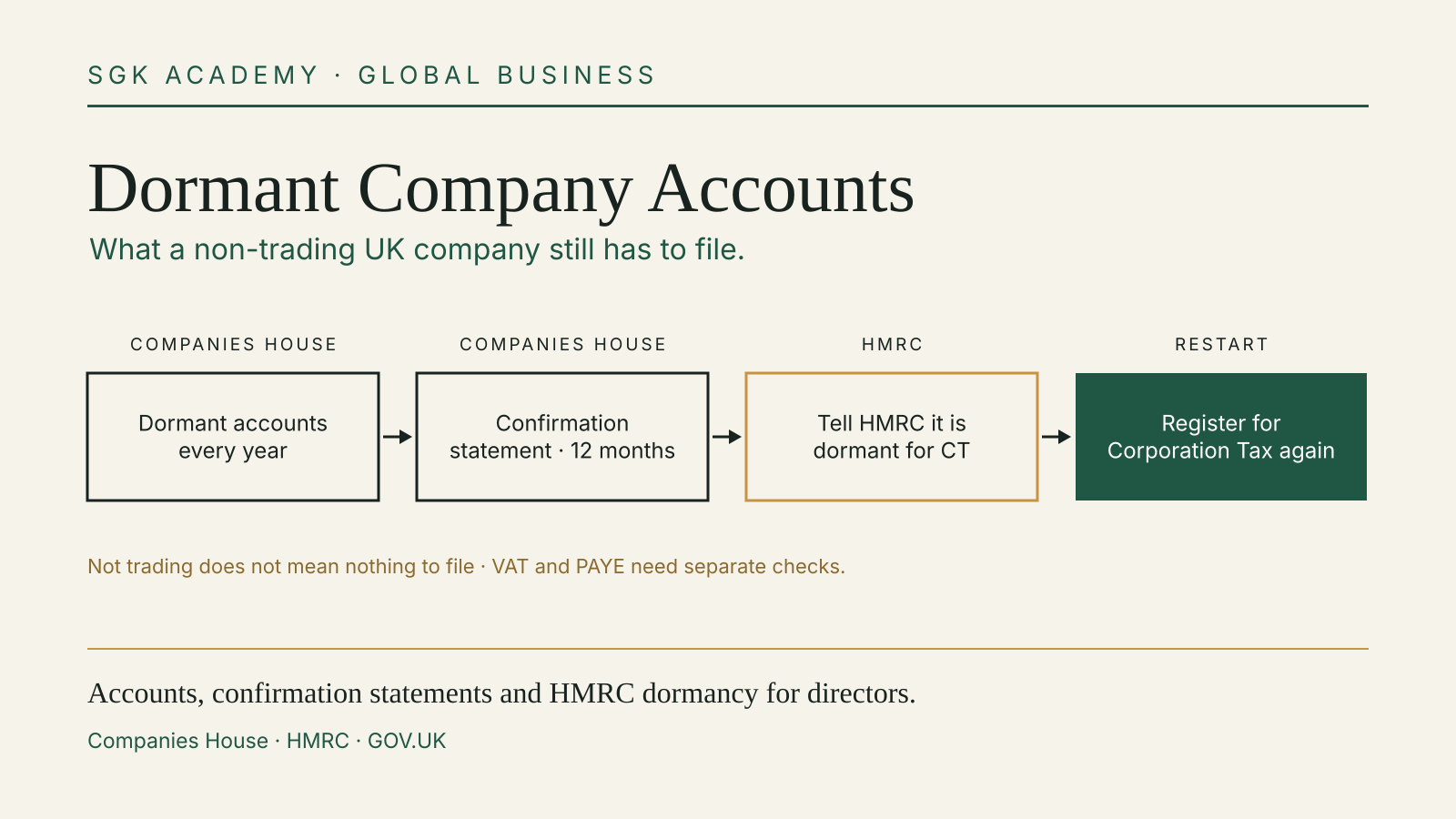
A dormant company still has filing work to do. Directors normally need to send accounts to Companies House, file a confirmation statement, and keep the company’s records current even when it is not trading.
In brief A company can be dormant for Companies House, for Corporation Tax, or both. Those tests are related but not identical. Dormancy does not remove the annual Companies House obligations: file the accounts that apply to the company and submit at least one confirmation statement every 12 months. Tell HMRC separately when the company becomes dormant for Corporation Tax.
What “dormant” means
A company is generally dormant for Companies House if it had no significant accounting transactions during the financial year. Companies House guidance excludes a few narrow items from “significant transactions”, including incorporation share payments, Companies House filing fees, and penalties for filing accounts late.
HMRC uses its own Corporation Tax test. A company can be dormant for Corporation Tax when it has stopped trading and has no other income, or when a newly incorporated company has not started trading. That is why a Companies House status does not, by itself, settle the tax position.
If the company has bank interest, investment income, sales, costs connected with trading, payroll activity, or another transaction that may be significant, do not assume the dormant accounts route is available. Check the facts against current Companies House and HMRC guidance or ask an accountant.
The annual filing checklist
Dormancy makes the accounts simpler for some companies; it does not make the company disappear from the register.
1. File accounts with Companies House
Every company must file annual accounts, including companies that are dormant or not trading. A dormant company that also qualifies as small can usually file dormant accounts and does not have to include an auditor’s report.
For a private company, the normal filing deadline is nine months after the end of the accounting reference period. The usual first-accounts deadline is 21 months after incorporation, though first accounts and changed accounting periods can have special rules. Check the exact date on the company register rather than calculating it from memory.
Filing dormant accounts online is free. Late filing can trigger an automatic penalty, and repeated non-compliance can lead to enforcement or strike-off action.
2. File a confirmation statement
The confirmation statement is separate from the accounts. It confirms that the information Companies House holds—such as the registered office, officers, people with significant control, share information, and business activities—has been checked and updated where necessary.
A company must file at least one confirmation statement every 12 months. The review period normally ends 12 months after incorporation for the first statement, or 12 months after the previous confirmation statement date. The filing window continues for 14 days after the review period ends.
As of 23 October 2026, the Companies House fee is £50 for an online confirmation statement and £110 for the paper CS01 form. The fee is charged with the first confirmation statement in each 12-month payment period; additional statements filed within the same payment period do not normally require another annual fee.
The fee has changed over time, so use the live Companies House service rather than an older article or saved checklist.
3. Tell HMRC about Corporation Tax dormancy
If the company is not trading and is dormant for Corporation Tax, tell HMRC using its dormant-company service. After HMRC accepts the dormant status, the company normally does not need to file another Company Tax Return unless HMRC asks for one or the company starts trading again.
A notice to file a Company Tax Return should not be ignored. If HMRC has issued a notice, follow it or contact HMRC even when the company has had no activity.
VAT and PAYE need separate attention. HMRC says a VAT-registered company that does not intend to trade again should normally deregister within 30 days. If it plans to restart, it may need to keep submitting nil VAT returns. A PAYE scheme may need to be closed if the company will not restart in the tax year.
Accounts and confirmation statements are not interchangeable
| Filing | What it covers | Typical timing for a private company |
|---|---|---|
| Annual accounts | The company’s financial position and the accounts format it qualifies to use | Normally nine months after the financial year ends |
| Confirmation statement | The accuracy of information held on the public register | At least once every 12 months, with a 14-day filing window |
| Company Tax Return | Corporation Tax information for HMRC | Usually not required after HMRC accepts dormancy, unless HMRC asks or trading restarts |
Filing one does not satisfy the others. A company can have dormant accounts accepted and still be overdue for its confirmation statement.
A practical director’s routine
Start with the company’s public register page and note the accounts due date and confirmation statement date. Then:
- Review the bank account and bookkeeping records for any transaction that could affect dormancy.
- Confirm whether the company meets both the Companies House and HMRC tests.
- Prepare the appropriate dormant accounts and have a director approve them.
- Review every confirmation-statement field before filing; update information through the correct Companies House process where required.
- Save the submission receipts and the accounts approved by the director.
- Add reminders well before both deadlines, not on the filing date itself.
- Recheck VAT, PAYE, licences, insurance, and banking arrangements that may continue independently of dormancy.
The company remains a legal entity. Directors must still keep records and respond to official correspondence sent to the registered office or registered email address. The record retention guide sets out how long UK company records must be kept.
When the company starts trading again
Companies House does not require a separate “restart trading” notice. The next non-dormant accounts show the change. HMRC is different: register the company for Corporation Tax again when business activity resumes.
HMRC says the company should tell it within three months of starting the new Corporation Tax accounting period. Which date starts that clock, and the penalties for missing it, are set out in how to register for Corporation Tax. After restarting, the company may need statutory accounts, Corporation Tax payment, and a Company Tax Return on the normal timetable.
Do not delete dormant-period records after reopening. The first active accounts and tax return may need dates and balances that connect the dormant and trading periods.
Common mistakes
- Treating “no sales” as proof of dormancy while the company has other income or significant transactions.
- Filing dormant accounts but forgetting the confirmation statement.
- Using an old confirmation-statement fee from a historic Companies House blog post.
- Ignoring an HMRC notice to deliver a Company Tax Return.
- Assuming a dormant company can ignore VAT or PAYE.
- Waiting until the deadline before checking the authentication code or Companies House account access.
- Filing the next accounts as dormant after the company has restarted activity.