You register a UK company for Corporation Tax by telling HMRC that the company has started to do business, and the law gives you three months from that date to do it. For most companies formed online at Companies House, HMRC already has a record and has posted a 10-digit Unique Taxpayer Reference (UTR) to the registered office.
What remains is to add Corporation Tax to the company’s business tax account and give the start date. A company incorporated outside the UK that becomes liable to UK Corporation Tax uses a separate HMRC form and a placeholder UTR.
The date that matters is not the incorporation date. It is the day the company comes within the charge to Corporation Tax, which for a UK company is the day it starts to carry on business. Getting that date right decides both the registration deadline and the first accounting period HMRC will expect a return for.
Checked against GOV.UK guidance and legislation.gov.uk on 5 November 2026. This explains the registration rules; it is not advice on whether a particular company is trading or UK resident.
Two notices, two clocks
Most guides mention one deadline. The legislation has two separate duties, and they run on different clocks with different penalties.
| Notice of coming within the charge | Notice of chargeability | |
|---|---|---|
| Law | Finance Act 2004, section 55 | Finance Act 1998, Schedule 18, paragraph 2 |
| What it says | The first accounting period has begun | The company is chargeable to tax for a period and has not been sent a notice to file a return |
| Deadline | Not later than three months after the accounting period begins | Twelve months from the end of the accounting period |
| Penalty for missing it | Up to £300, then up to £60 a day if the failure continues (TMA 1970, section 98) | A percentage of the tax left unpaid because HMRC was not told (FA 2008, Schedule 41) |
| What HMRC calls it | “Tell HMRC your company is now active” | Usually invisible, because registering satisfies it |
When you register through HMRC’s online service within three months, you deal with the first notice, and HMRC then issues a notice to deliver a Company Tax Return, which removes the need for the second. The second duty matters to a company that never registered at all: it is what turns a late registration into a tax-geared penalty once profits have gone untaxed.
Section 55 also has a reasonable-excuse rule built in. A company with a reasonable excuse is not treated as having failed until the excuse ends, provided it then gives notice without unreasonable delay.
When the three months start
Section 9 of the Corporation Tax Act 2009 says an accounting period begins when the company comes within the charge to Corporation Tax, and that a UK resident company is treated as coming within the charge when it starts to carry on business.
HMRC’s guidance on trading and non-trading lists what usually makes a company active: carrying on a trade or profession, buying and selling goods, providing services, earning interest, managing investments or receiving any other income. GOV.UK’s company set-up page adds buying, selling, advertising, renting a property and employing someone as examples of starting to do business.
Two points catch founders out:
- Interest counts. A company that opens a business savings account and earns interest has income, even if it has not yet found a customer. HMRC lists earning interest as activity.
- Preparation does not. HMRC says pre-trading activities such as writing a business plan or negotiating contracts, and pre-trading expenditure incurred to decide whether to start, do not by themselves mean the company has started trading.
HMRC also notes that “active” for Corporation Tax is not necessarily the same as the test Companies House or the VAT rules use. A company can be dormant at Companies House and active for Corporation Tax, or the reverse.
A dated example: incorporated in January, trading in March
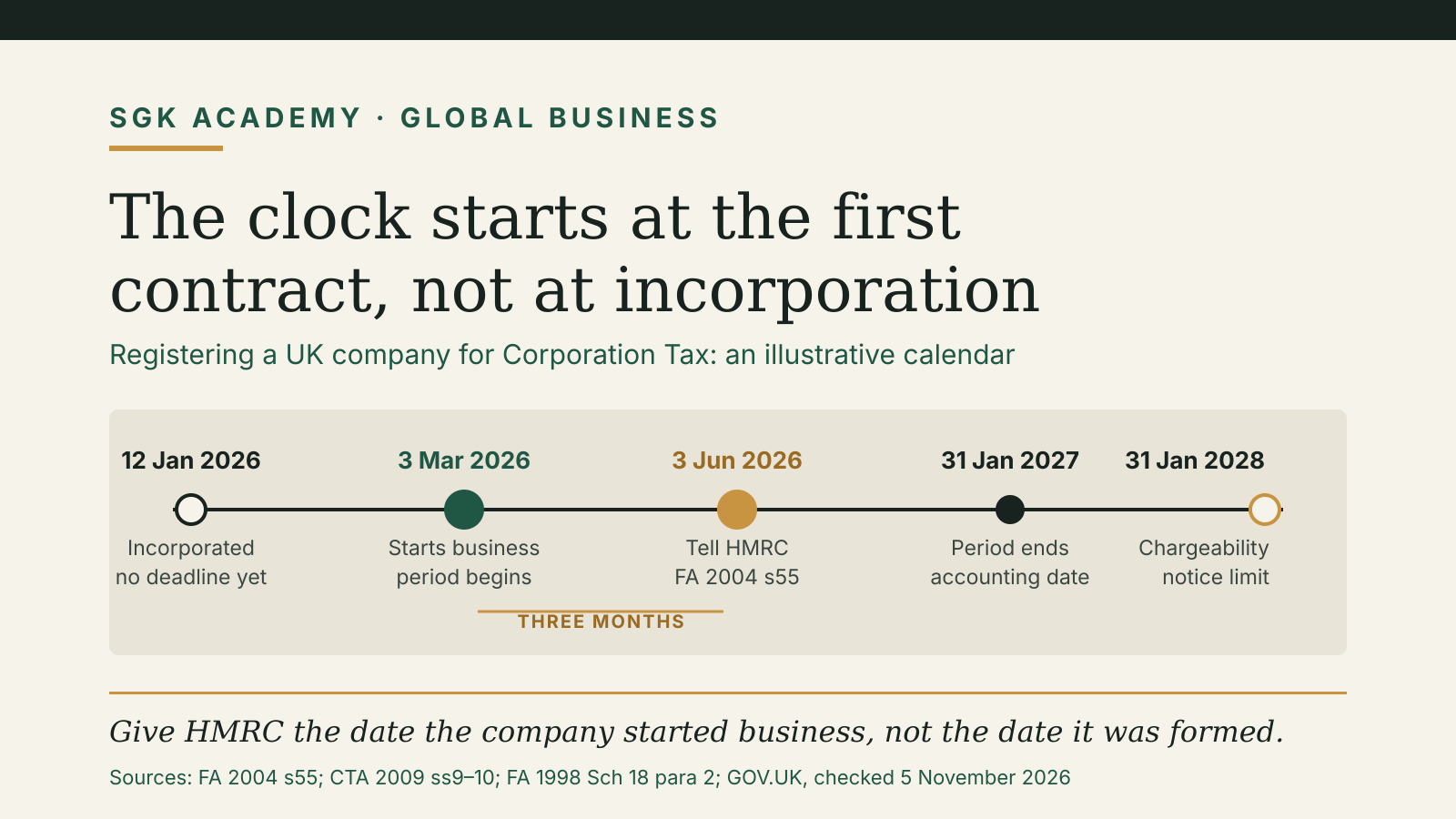
This is an illustrative calendar, worked from the statutory rules above. The company is formed in England, keeps the default accounting reference date and does nothing until it signs its first paid client.
| Date | Event | Rule applied |
|---|---|---|
| 12 January 2026 | Company incorporated | Accounting reference date becomes 31 January, the last day of the month in which the anniversary of incorporation falls (Companies Act 2006, s391(4)) |
| 12 January to 2 March 2026 | No income, no trading | No Corporation Tax accounting period yet |
| 3 March 2026 | First paid contract starts | First accounting period begins (CTA 2009 s9(2)) |
| 3 June 2026 | End of the three months | Section 55 notice due; register online by this date |
| 31 January 2027 | Accounts made up to this date | First accounting period ends on the accounting date (CTA 2009 s10) |
| 31 January 2028 | Twelve months after the period ends | Latest date for a paragraph 2 notice if HMRC never asked for a return; also the return filing date in this example (CTM93030) |
The period of account here runs from 12 January 2026 to 31 January 2027, which is just over twelve months, but the Corporation Tax accounting period is shorter because it only starts on 3 March. When you register, the start date you give is 3 March 2026, not 12 January. If you give the incorporation date by mistake, HMRC expects a return covering weeks in which the company did nothing.
The payment date for this period’s Corporation Tax and the Companies House accounts deadline are in our company filing deadlines tool, which works them out from a year-end.
Which route applies to your company
GOV.UK runs several registration routes. The company’s place of incorporation and the reason it is taxable decide which one you use. Forming the company itself, with the current Companies House fee and filing duties, is covered on our United Kingdom jurisdiction page.
| Your company | How it registers | UTR |
|---|---|---|
| UK company formed online at Companies House and set up for Corporation Tax at the same time | Already set up; check the start date when you begin trading | Posted to the registered office |
| UK company formed by post, through an agent or third-party software, or online without activating a business tax account | Add Corporation Tax services to the business tax account (GOV.UK) | Posted to the registered office; request it online if nothing arrives within 15 working days |
| UK company that cannot use the online service | Letter to Corporation Tax Services, HM Revenue and Customs, BX9 1AX (GOV.UK) | Already issued |
| Company incorporated abroad but managed and controlled in the UK | Online form, printed and posted (GOV.UK) | Dummy UTR 2410555555 until HMRC issues one |
| Non-UK company trading through a dependent agent in the UK, with no physical UK establishment | Online form, printed and posted (GOV.UK) | Dummy UTR 2410555555 |
| Non-UK company with a physical presence in the UK | Register with Companies House; Corporation Tax is set up at the same time (same GOV.UK page) | Posted after Companies House registration |
| Non-UK company dealing in or developing UK land | Offshore property developer form (GOV.UK) | Dummy UTR 2410555555 |
| Non-UK company disposing of UK property or land | Separate disposal form (GOV.UK) | Dummy UTR 2410555555 |
| Non-UK company with UK rental income | Non-resident company landlord rules (GOV.UK) | Notify HMRC if the property business started on or after 6 April 2020 |
The dummy UTR exists only so that a letter can be matched to a registration in progress. HMRC’s guidance says it should be used only to chase the registration, and that the real Corporation Tax UTR follows by post. For non-UK companies, HMRC aims to process the registration within 15 working days, and says the UTR and the later activation code can each take 2 to 8 weeks to reach an overseas registered office. Build that into any plan to file or pay before a deadline.
What to have ready
For a UK company adding Corporation Tax online, GOV.UK asks for four things:
- the company registration number;
- the date the company started to do business, which becomes the start of the first accounting period;
- the date the first accounts will be made up to;
- the 10-digit UTR from any HMRC letter.
If you register by letter instead, The Corporation Tax (Notice of Coming within Charge — Information) Regulations 2004 set out what the notice must contain, and HMRC’s guidance repeats the list:
- company name and registered number;
- registered office address and principal place of business;
- the nature of the business;
- the date the accounting period started and the date to which accounts will be prepared;
- the full name and home address of each director;
- details of any business the company took over, and from whom;
- the parent company’s name and registered office, if the company is in a group;
- the date the company first had to operate PAYE, if it has.
HMRC adds that the letter must be signed by a director or the company secretary and include a declaration that the information is correct and complete.
A non-UK incorporated company that is UK resident gives a different set: country of incorporation and foreign registration number, any previous names, registered office, date of incorporation, the date it became liable to Corporation Tax, the intended first accounts date, group parent details and the contact person’s role. If you use a UK tax agent, HMRC asks for a form 64-8 as well.
After you register
HMRC sends the Corporation Tax activation code by post to the registered office within 10 days, or 21 days if you live abroad, together with the deadline for paying Corporation Tax. You need the code to finish activating the service. If it does not arrive or expires, GOV.UK lets you request a new one.
Check the registered office address at Companies House before you start. GOV.UK says this is where all letters are sent, so if the address belongs to a formation agent, make sure someone forwards HMRC post promptly. Changing the address is a Companies House filing, not an HMRC one.
A Company Tax Return is still required for a loss-making year or a year with nothing to pay, once HMRC has sent a notice to file.
A second case: an overseas company run from the UK
Suppose a founder set up a company in another country and later moved to London, where she now makes the strategic decisions alone. The company was never registered at Companies House.
Under UK rules, a company incorporated abroad is resident in the UK if its central management and control is here, unless a double taxation agreement gives sole residence to the other country. HMRC’s guidance for this route says the company becomes liable from the date it became UK resident, and must register within 3 months of that date. Becoming UK resident also ends any existing accounting period (CTA 2009 s10(1)(g)), so the first UK accounting period starts on the residence date, not on the company’s own year-start.
In practice the founder’s first job is to fix that date from evidence: where board decisions were taken and when that changed. Our guide to company tax residence explains central management and control and the treaty tie-breaker. If the company has a fixed place of business or a dependent agent in the UK but is still managed abroad, the question is a permanent establishment instead, covered in permanent establishment and remote work.
If you are already late
Register as soon as you notice, using the correct start date, even if it is months behind. The two penalty regimes work differently:
- The section 55 penalty is a fixed amount: up to £300, then up to £60 for each day the failure continues after that penalty is imposed (TMA 1970 s98). It does not depend on how much tax is due.
- The Schedule 41 penalty applies when tax goes unpaid because HMRC was not told the company was chargeable. For a domestic, non-deliberate failure the standard rate is 30% of the potential lost revenue, rising to 70% for deliberate and 100% for deliberate and concealed failures (para 6).
Disclosure reduces the Schedule 41 percentage. Under paragraph 13, a 30% penalty can fall to 0% for an unprompted disclosure when HMRC becomes aware of the failure less than 12 months after the tax first became unpaid; after that, the floor is 10%. A prompted disclosure has a floor of 10% or 20% on the same split. Telling HMRC before it asks is worth real money.
A company that was not active for a period and later starts again follows the same rule: HMRC says to tell it within three months of the new accounting period starting. Our guide to dormant company accounts covers the Companies House side of a dormant spell.
Questions founders ask
Does Companies House registration cover Corporation Tax?
Often, but not always completely. GOV.UK says a company registered online is usually set up for Corporation Tax at the same time unless it is dormant. A company formed by post, through an agent or with third-party software, or one that did not activate a business tax account, adds Corporation Tax services itself once it starts to do business.
Is the deadline three months from incorporation?
No. It is three months from the start of the first accounting period, which for a UK company is when it starts to carry on business. A company that stays inactive for six months after incorporation has no Corporation Tax deadline during those months.
Where is my company’s UTR?
On any HMRC letter to the company, sent to the registered office after incorporation. If nothing has arrived 15 working days after the company was registered, GOV.UK lets you request the UTR online.
Can a company with no UK address register?
A non-UK company registering through a dependent agent can use the agent’s UK address for registration, provided it registers as “UK Agent X acting as agent for” the company so that it gets its own UTR. Other non-UK routes post the UTR and activation code to the overseas registered office.
Do clubs and associations register the same way?
No. HMRC says unincorporated organisations such as clubs, societies and associations must tell it in writing, to the Corporation Tax Services address, when they become active. The online business tax account route is for companies.
Official sources
- GOV.UK: Corporation Tax overview
- GOV.UK: Corporation Tax trading and non-trading
- GOV.UK: add Corporation Tax services to your business tax account
- GOV.UK: register your company
- GOV.UK: Corporation Tax for non-UK incorporated companies
- GOV.UK: register a non-UK incorporated company for Corporation Tax if you’re a UK resident
- GOV.UK: register through a dependent agent permanent establishment
- GOV.UK: register an offshore property developer
- GOV.UK: register a non-resident company that disposed of UK property or land
- GOV.UK: Corporation Tax for non-resident company landlords
- HMRC Company Taxation Manual CTM34210: non-resident companies’ liability
- HMRC Company Taxation Manual CTM93030: filing date
- Finance Act 2004, section 55
- Corporation Tax (Notice of Coming within Charge — Information) Regulations 2004, SI 2004/2502
- Finance Act 1998, Schedule 18, paragraph 2
- Taxes Management Act 1970, section 98
- Finance Act 2008, Schedule 41, paragraphs 6 and 13
- Corporation Tax Act 2009, sections 9 and 10
- Companies Act 2006, section 391
Rules checked against the sources above on 5 November 2026. This is a general guide, not personal tax advice.