Invoice payment terms set when a customer must pay and which event starts the countdown. For a small business choosing net 14, 30 or 60, the useful question is whether cash will arrive before wages, subcontractors and other bills fall due. Agree the terms before accepting the work, then put a specific due date on each invoice.
This guide explains the choices and the UK business-to-business rules. Cross-border contracts need their own governing-law and customer checks; a UK deadline is not a worldwide rule. The examples below are illustrative calculations, not terms imposed on any real customer.
Net 30 needs a starting date
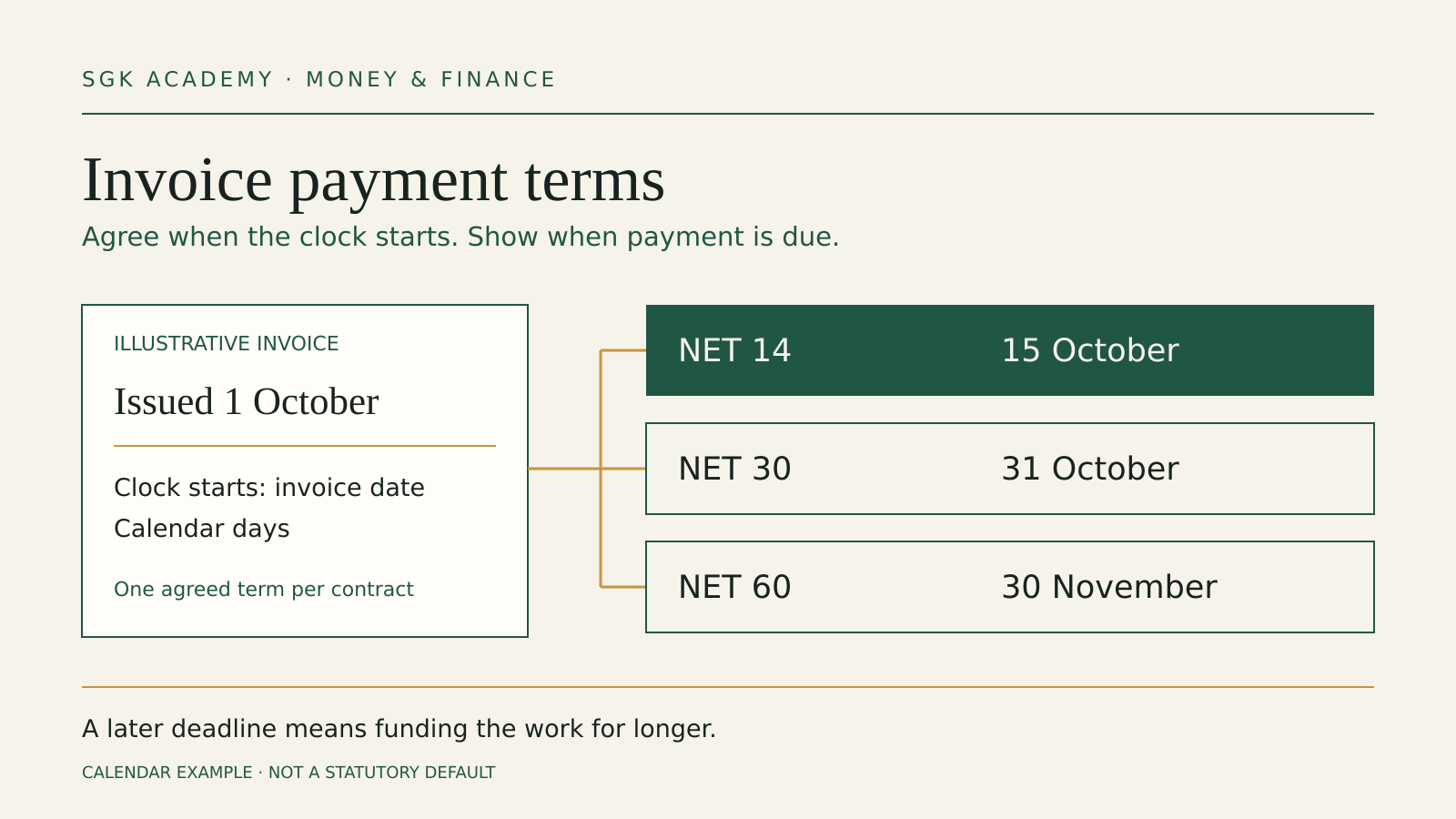
“Net 30” normally describes payment of the full invoice amount within 30 days of an agreed starting event. That event could be the invoice date, receipt of a valid invoice or delivery of the work. Those choices produce different cash dates, so the number alone leaves an important question unanswered.
Suppose an invoice is issued on 1 October, delivered to the customer on 3 October and accepted after a purchase-order check on 8 October. A contract counting 30 calendar days from issue points to 31 October; one counting from receipt points to 2 November. A term tied to acceptance may move again if acceptance is delayed. Write down which event applies, how receipt is established and what makes an invoice valid.
Also distinguish calendar days from working days and “30 days” from “the end of next month”. If the customer pays suppliers only on a monthly run, ask whether your agreed deadline falls before that run. An accounts-payable process can explain a delay, but it should not silently redefine the contract.
A clear invoice line for the first example would be: “Payment due 31 October 2026, 30 calendar days from the invoice date.” The date makes the customer’s task easier; the signed agreement determines whether that wording reflects the deal.
What the UK default actually says
GOV.UK’s payment-obligations guidance says businesses can set payment terms, including upfront payment and early-payment discounts. Its late commercial payments guidance adds the timing rules for business debts.
For an agreed payment date, the government says the period must usually be within 30 days for public authorities or 60 days for business transactions. Businesses can agree more than 60 days if the longer period is fair to both businesses. That qualification matters: 60 days is not a promise that every customer can impose any wording it wants, and 30 days is not the only permitted commercial term.
When no payment date is agreed, the guidance says payment becomes late 30 days after the customer receives the invoice or the goods or service is delivered, whichever is later. This is a fallback rule. It is a poor substitute for agreeing the trigger, deadline and invoice requirements before delivery.
These rules concern late commercial payments. Consumer sales, disputed performance and contracts governed by another country’s law need separate treatment. A statement printed on an invoice after the work is finished may not settle a disagreement about what was agreed beforehand.
Choose a deadline your cash flow can carry
There is no universal best term. A shorter period gives you less customer credit to finance, while a longer period may fit a large buyer’s procurement process. The choice has to work with the timing of your own costs.
| Term, counted from an agreed invoice date | Possible use | Cash question to answer |
|---|---|---|
| Payment upfront | A first order or work requiring immediate cash outlay | Will the buyer agree, and what refund or cancellation terms apply? |
| Net 14 | A short project with a prompt approval process | Can the customer validate and pay the invoice within two weeks? |
| Net 30 | A regular business relationship with monthly billing | Can you cover costs while one month’s invoices remain unpaid? |
| Net 60 | A buyer seeking a longer credit period | Can your business fund the gap without relying on this invoice paying early? |
| Deposit plus staged payments | A project that takes several weeks | Are the stages, acceptance conditions and remaining amounts clear? |
These are commercial examples, not legal entitlements or proof of an industry standard. A customer with a 60-day policy may accept a deposit or staged billing; another may require all suppliers to use the same process. Ask before pricing the job.
A margin percentage does not answer the funding question. Your profit may look healthy while most of the invoice is tied up in receivables. Our profit and cash flow guide explains that distinction and how to put receipts into a weekly forecast.
Work out the cost of waiting
Consider a hypothetical consultancy issuing a £12,000 invoice after completing a project. At the invoice date it has £5,000 available for ongoing operating costs, which run at £1,000 a week. Assume the invoice is paid exactly on the agreed day, there are no other receipts and costs continue evenly. This simplified model ignores VAT and financing charges.
| Invoice paid after | Costs before receipt, calculated as days ÷ 7 × £1,000 | Cash just before receipt |
|---|---|---|
| 14 days | £2,000 | £3,000 |
| 30 days | About £4,286 | About £714 |
| 60 days | About £8,571 | About minus £3,571 |
Net 30 leaves little spare cash; net 60 creates a funding shortfall before the customer pays. The £12,000 invoice has not changed. Its timing has.
Now stress-test a late payment. A ten-day delay adds about £1,429 of costs in this model. The net-30 balance would fall from roughly £714 to roughly minus £714. A deadline that works only when every customer pays precisely on time leaves no room for an administrative problem.
Use your actual payment dates and cost schedule rather than the even-spending assumption above. Payroll, tax and supplier bills tend to arrive in lumps. The cash runway calculator helps with a broad estimate, but a dated weekly forecast is needed for a particular invoice.
If a buyer requires longer terms, negotiate before taking the order. Options might include a deposit, smaller billing stages, a different price or a lower exposure limit. Check the full cost of any funding: invoice factoring and discounting introduce provider fees, eligibility rules and a separate collections relationship.
Settle the invoice requirements before delivery
A valid invoice and an agreed payment date do different jobs. GOV.UK’s invoice checklist includes an identification number, both parties’ names and addresses, a description of the charge, supply and invoice dates, the amounts and applicable VAT. Limited companies must use their full incorporated name. VAT invoices have additional requirements.
The general checklist does not make a due date one of its listed mandatory invoice fields. Including one remains useful. Do not confuse that practical choice with a claim that every invoice legally needs the same payment-terms wording.
Ask the buyer what its system needs before you send the first invoice: the correct legal entity, purchase-order reference, billing contact, portal submission and any agreed delivery evidence. Those requirements should be reflected in the order or contract so that an unexpected approval step does not appear after you have spent the money.
For a cross-border customer, agree the currency and payment route too. A nominal invoice amount may differ from the usable amount received after bank charges or conversion. Our international transfer costs guide shows how to compare the sender’s debit with the recipient’s proceeds.
Discounts need their own arithmetic
An early-payment discount trades revenue for earlier cash. State the discount, its deadline and the full-payment deadline separately; confirm how your accounting and tax treatment handles it.
For example, a fictional £10,000 invoice offering a 2% discount for payment by day 10 would produce £9,800 if the buyer qualifies. The business gives up £200 to receive cash earlier. If full payment is otherwise due on day 30, that buys 20 days, assuming the buyer would actually have paid on time.
Compare that £200 with your available funding cost and the benefit of reducing exposure. It is not automatically cheap because the percentage looks small. A customer taking the discount but paying on day 30 has not delivered the agreed cash benefit; the treatment of that short payment should follow your agreement.
Do not offer a discount that takes the project below an acceptable margin or describe it as a guaranteed way to get paid. It is an option the customer can choose.
Make overdue invoices visible quickly
Keep a record of when an invoice was sent, received where known, due and paid. Check whether the buyer has raised a genuine query before treating a missing payment as a refusal to pay. Resend the invoice and supporting documents through the agreed channel, and keep the correspondence with the record.
UK guidance says a business may claim interest and debt recovery costs when another business pays late. Whether to claim, and which provisions apply to a particular debt, is a separate decision from selecting payment terms. This guide does not calculate an interest bill or recommend a recovery procedure.
For future work, use the payment history to review the amount of credit you extend. Several unpaid invoices to one buyer create a larger exposure than the single invoice you are currently chasing. Put that total into the forecast before agreeing another long payment period.