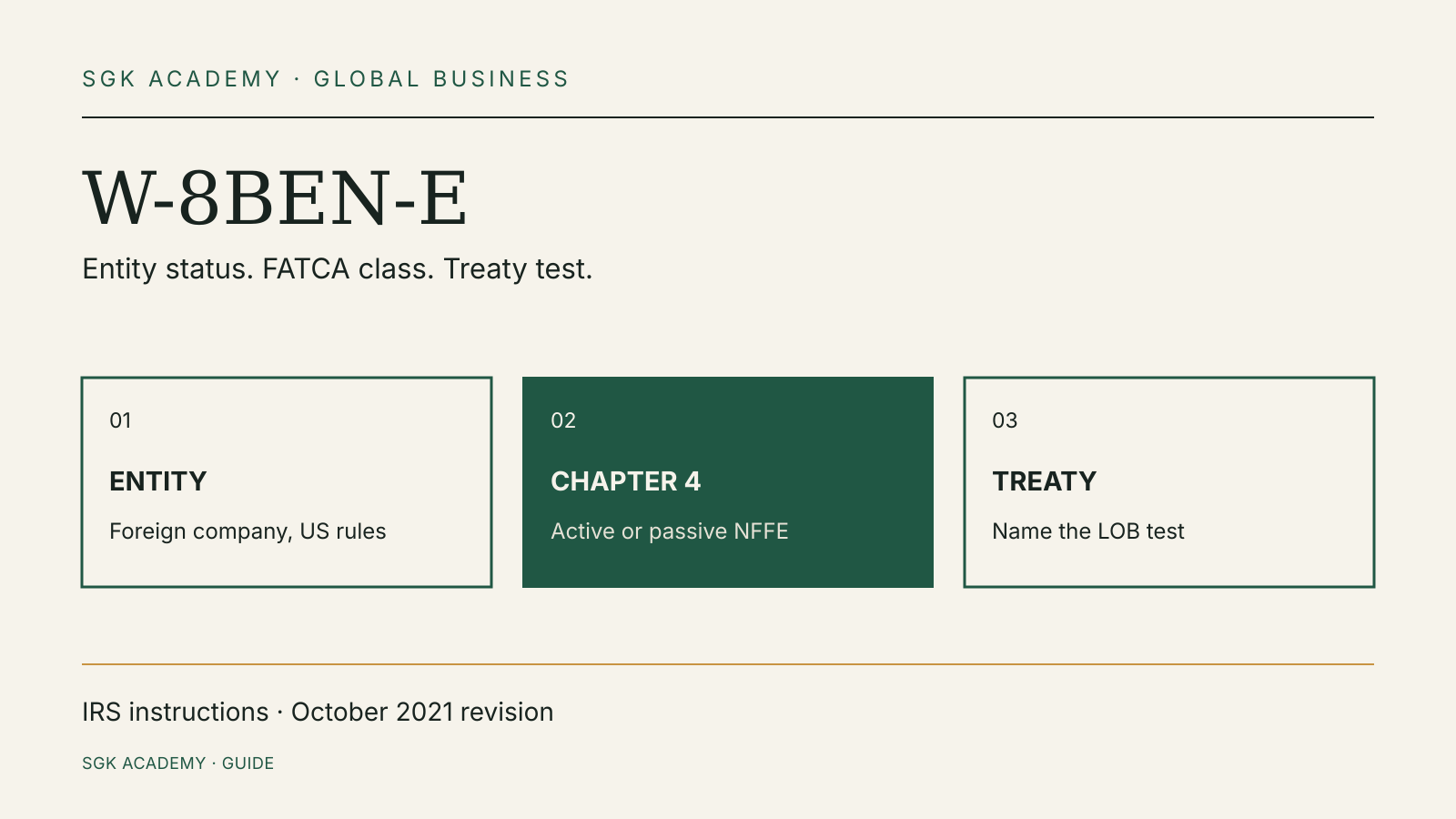
Form W-8BEN-E is the certificate a foreign company gives a US payer, platform or financial institution to document that it is not a US person, to state its FATCA status and, where it qualifies, to claim a reduced treaty rate. If a US client, marketplace or bank has asked your company to “fill in a W-8”, this is usually the form it means.
It is longer than the individual version because it asks two separate questions. The first, under chapter 3 of the Internal Revenue Code, is whether a payment to a foreign person should have US tax withheld. The second, under chapter 4 (FATCA), is what kind of foreign entity the company is. Most small trading companies answer the second question in a few boxes, but they still have to answer it.
This guide follows the IRS Instructions for Form W-8BEN-E, revision October 2021, checked on 10 October 2026, together with Publication 515 (2026). It covers a small operating company’s position. Banks, funds, trusts, partnerships and charities have additional parts and should read the instructions for their own status.
Is W-8BEN-E the right form?
The IRS says a foreign entity must give W-8BEN-E to the withholding agent or payer if it receives a withholdable payment, a payment subject to chapter 3 withholding, or if it holds an account with a foreign financial institution that asks for the form.
The instructions then list who should not use it. The ones that matter most to founders:
| Your situation | Form the instructions point to |
|---|---|
| Foreign company receiving payments for its own account | W-8BEN-E |
| Nonresident individual, including a sole trader | W-8BEN or 8233 |
| US person, including a company organised under a US state’s law | W-9 |
| Disregarded entity (for example a single-member LLC) | The owner’s form: W-8BEN, W-8BEN-E or W-9 |
| Acting for others as agent, nominee or custodian | W-8IMY |
| Income effectively connected with a US trade or business | W-8ECI |
| Foreign government or tax-exempt organisation claiming those exemptions | W-8EXP |
Two rows catch many founders out. A Delaware or Wyoming corporation is a US person, even if every owner lives abroad, so it gives a W-9, not a W-8. A single-member US LLC that has not elected to be taxed as a corporation is normally a disregarded entity: the instructions say its single owner provides the form, so a foreign individual owner gives W-8BEN and a foreign company owner gives W-8BEN-E. The entity’s US classification, not its legal form at home, decides which row applies.
Why the form is requested even when nothing is withheld
Publication 515 explains that foreign persons are generally subject to 30% US tax on certain US-source income, such as interest, dividends, rents, royalties and compensation for services, collected by withholding. A payer that cannot document who it is paying may have to withhold at that rate.
The source of income is a separate test from the payer’s location. Publication 515 says the place where personal services are performed determines their source, “regardless of where the contract was made, the place of payment, or the residence of the payer”. A design studio in Lisbon doing work in Lisbon for a client in Austin is earning foreign-source income for that work. The client still asks for a W-8BEN-E, because the form is how it shows the payment went to a foreign person.
The form also matters for reporting. Publication 515 states that foreign persons who provide a valid Form W-8 are exempt from backup withholding and Form 1099 reporting. Payments that are subject to chapter 3 withholding are reported on Form 1042-S instead.
Part I, lines 1 to 3: who the beneficial owner is
Line 1 is the legal name of the entity that beneficially owns the income. The instructions say a disregarded entity or branch should not enter its business name here; it enters the legal name of its owner, with an exception for a hybrid entity making a treaty claim.
Line 2 is the country of incorporation for a corporation, or the country under whose laws another entity was created.
Line 3 is for the name of a disregarded entity receiving the payment, but only in limited cases set out in the instructions (broadly, one with its own GIIN that is a reporting FFI and is not making a treaty claim). A small trading company usually leaves it blank. If you want the payer to know the account is held through a disregarded entity, the instructions suggest naming it on line 10.
Line 4: the US tax classification
Line 4 asks you to tick one box: corporation, partnership, disregarded entity, trust and so on. The instructions are explicit that the box represents your classification “under U.S. tax principles (not under the law of a treaty country)”.
For most private limited companies the answer is “Corporation”. If the entity is fiscally transparent at home or has made a US check-the-box election, the answer may differ, and a treaty claim by such an entity follows the hybrid-entity rules in the instructions. If you do not know whether an election was ever filed, find out before ticking a box.
Line 5: the FATCA (chapter 4) status
This is the line that makes W-8BEN-E look intimidating. It lists around 30 statuses, most of them for financial institutions, funds and public bodies. The instructions say you only need to give a chapter 4 status if you are the payee of a withholdable payment or are documenting an account with a foreign financial institution that asks for the form. By ticking a box you represent that you qualify for it in your country of residence, and most statuses require you to complete a matching part later in the form.
A company that sells software, consulting or design services is usually a non-financial foreign entity (NFFE). The two statuses it normally chooses between are:
| Status | Certification in the form | Part to complete |
|---|---|---|
| Active NFFE | Not a financial institution; less than 50% of gross income for the preceding calendar year is passive income; less than 50% of assets produce or are held for passive income (weighted quarterly average) | Part XXV |
| Passive NFFE | Not a financial institution and not certifying another NFFE status | Part XXVI, plus either “no substantial US owners” (line 40b) or a list of them in Part XXIX |
Passive income here includes dividends, interest, rents, royalties and annuities, with exceptions in the regulations. A consultancy whose revenue is service fees and whose assets are mainly receivables and cash used in the business will often meet the active NFFE tests. A holding company whose income is dividends from subsidiaries will often not. These are factual tests on the company’s own figures for the stated period, not a label to choose by preference.
The instructions add a practical point: an NFFE that might qualify as active may still tick passive NFFE and disclose its substantial US owners, or certify that it has none. If the requester is a bank in a country with a FATCA intergovernmental agreement, it may ask for the IGA’s own definitions, so read its covering note.
Line 9a asks for a GIIN, the identification number financial institutions receive when they register for FATCA. An NFFE does not have one and leaves it blank unless one of the listed statuses applies.
Lines 6 to 9: address and tax identification numbers
Line 6 is the permanent residence address in the country where the entity claims to be resident for income tax. The instructions exclude a financial institution’s address, a post office box or a mail-forwarding address unless it is the only address you use and appears in your organisational documents. For a treaty claim, residence must be determined in the way the treaty requires. If your company’s residence is uncertain, our company tax residence guide sets out how that question is reviewed.
Line 7 is a separate mailing address, if any.
Line 8 is the US employer identification number (EIN). Most foreign companies do not need one for this form. The instructions say a US TIN is required in listed cases, including when the entity claims treaty benefits and has not given a foreign tax identification number (FTIN) on line 9b.
Line 9b is the FTIN issued by the country of residence. It is mandatory for an account held at a US office of a financial institution that produces US-source income reportable on Form 1042-S, unless an exception applies. Outside that case it is optional, but the instructions say an FTIN on line 9b can support a treaty claim instead of a US TIN on line 8. Line 9c is for an account holder that is not legally required to obtain an FTIN.
If you do need an EIN, the Instructions for Form SS-4 (December 2025 revision) say the online application is only for applicants with a legal residence, principal place of business or principal office in the United States or a US territory, and the responsible party needs an SSN, EIN or ITIN. An entity with no US presence can apply by telephone on 267-941-1099 (not toll-free), or by fax or mail with Form SS-4.
Part III: claiming treaty benefits
Part III is optional. Complete it only if the company is claiming a reduced rate of, or exemption from, withholding under an income tax treaty.
Line 14a names the treaty country and certifies residence there.
Line 14b certifies that the entity derives the income and meets the treaty’s limitation on benefits (LOB) article, if it has one, by ticking the test it relies on. The instructions summarise the common tests: government, pension fund, publicly traded company, subsidiary of a publicly traded company, ownership and base erosion, derivative benefits (generally EU, EEA and USMCA treaties), active trade or business, “No LOB article in treaty” and others. They also warn that the summaries “may not be relied upon for making a final determination”. You check the text of the LOB article in your own treaty.
For a founder-owned company, the ownership and base erosion test and the active trade or business test are the ones most often examined. The first generally requires more than 50% of vote and value to be owned by qualifying residents of the same country, and less than 50% of gross income to be paid to non-qualifying persons. The second generally requires an active business in the country of residence and income connected with it. Which applies, and on what conditions, depends on the treaty.
Line 15 is for benefits that need conditions beyond line 14, such as a lower dividend rate based on ownership percentage and holding period, or business profits not attributable to a US permanent establishment. You name the article and paragraph and set out the conditions you meet. Our permanent establishment guide explains why that representation needs facts behind it.
If the services are performed outside the United States, the income is foreign-source and a treaty claim may not be needed at all for chapter 3 purposes. Many companies still complete Part III because a platform’s form flow asks for it. Claim only what you can support.
Part XXX: signing
The form must be signed and dated by an authorised representative or officer, who also certifies the legal capacity to sign for the entity on line 1. An agent signing under a power of attorney must attach it; Form 2848 can be used.
A withholding agent may accept an electronic signature. The instructions say it must indicate that the form was electronically signed by an authorised person, for example with a time and date stamp and a statement, and that “simply typing your name into the signature line is not an electronic signature”.
By signing, the representative agrees to provide a new form within 30 days of a change in circumstances that makes the form incorrect.
Where the form goes, and how long it lasts
The IRS is direct: do not send W-8BEN-E to the IRS. Give it to the person requesting it, before the payment is made, credited or allocated. Generally a separate form goes to each withholding agent, and an agent paying more than one type of income may ask for a form per income type.
Validity follows the same rule as the individual form. A W-8BEN-E generally remains valid from the date it is signed until the last day of the third succeeding calendar year, unless a change in circumstances makes information on it incorrect. A form signed on 10 October 2026 therefore generally runs to 31 December 2029.
Changes that should prompt a new form include a move of the company’s tax residence, a change in US classification, a change in ownership that affects an LOB test, a year in which passive income reaches half of gross income, or income becoming effectively connected with a US business. The instructions say that last change makes the form no longer valid.
A worked example (illustrative)
A two-person software consultancy is incorporated and tax resident in Ireland. It has no US office or staff. A US marketplace asks it for a W-8BEN-E before releasing payouts.
| Line | Entry | Why |
|---|---|---|
| 1 | The company’s legal name | It beneficially owns the fees |
| 2 | Ireland | Country of incorporation |
| 4 | Corporation | Its US classification; no election filed |
| 5 | Active NFFE | Last year’s income was service fees; assets are trading cash and receivables |
| 6 | Registered office in Dublin | Permanent residence address for tax |
| 9b | Irish tax reference | Supports any treaty claim without an EIN |
| 14a–14b | Only if the marketplace asks for a treaty claim and the company has checked which LOB test it meets | |
| 39 | Ticked | Part XXV certification for active NFFE |
| XXX | Signed by a director, with the platform’s e-signature process |
The facts in this example are invented to show how the lines connect. They are not a template: an Irish holding company, a company with a US-resident shareholder or one with staff working in the US would answer several lines differently.
Before you sign: a checklist
- Confirm the entity is foreign under US rules and is not disregarded.
- Tick the US classification on line 4, not the local legal form.
- Work out the chapter 4 status from last year’s income and this year’s assets, and complete the matching part.
- Use the address where the company is resident for tax, not a forwarding address.
- Add the FTIN on line 9b; get an EIN only if the instructions require one.
- Make a treaty claim only after reading the treaty’s LOB article.
- Sign as an authorised officer through the requester’s own process.
- Diary the expiry date and note what would count as a change in circumstances.