Card processing fees are what a business pays its acquirer to accept a card payment. In the EU and the UK, part of that bill is regulated: the interchange fee paid to the cardholder’s bank is capped at 0.2% of the payment for most consumer debit cards and 0.3% for consumer credit cards. Scheme fees and the acquirer’s own margin are set commercially. This guide separates the parts, shows what the caps cover and explains when a card cost may be passed on.
The rules quoted below come from the EU Interchange Fee Regulation, the UK’s retained version of it, the EU Payment Services Directive and the UK surcharge regulations. The worked figures are arithmetic on those caps. Where a figure is a hypothetical quote rather than a legal limit, the text says so.
Who is paid when a customer taps or types a card
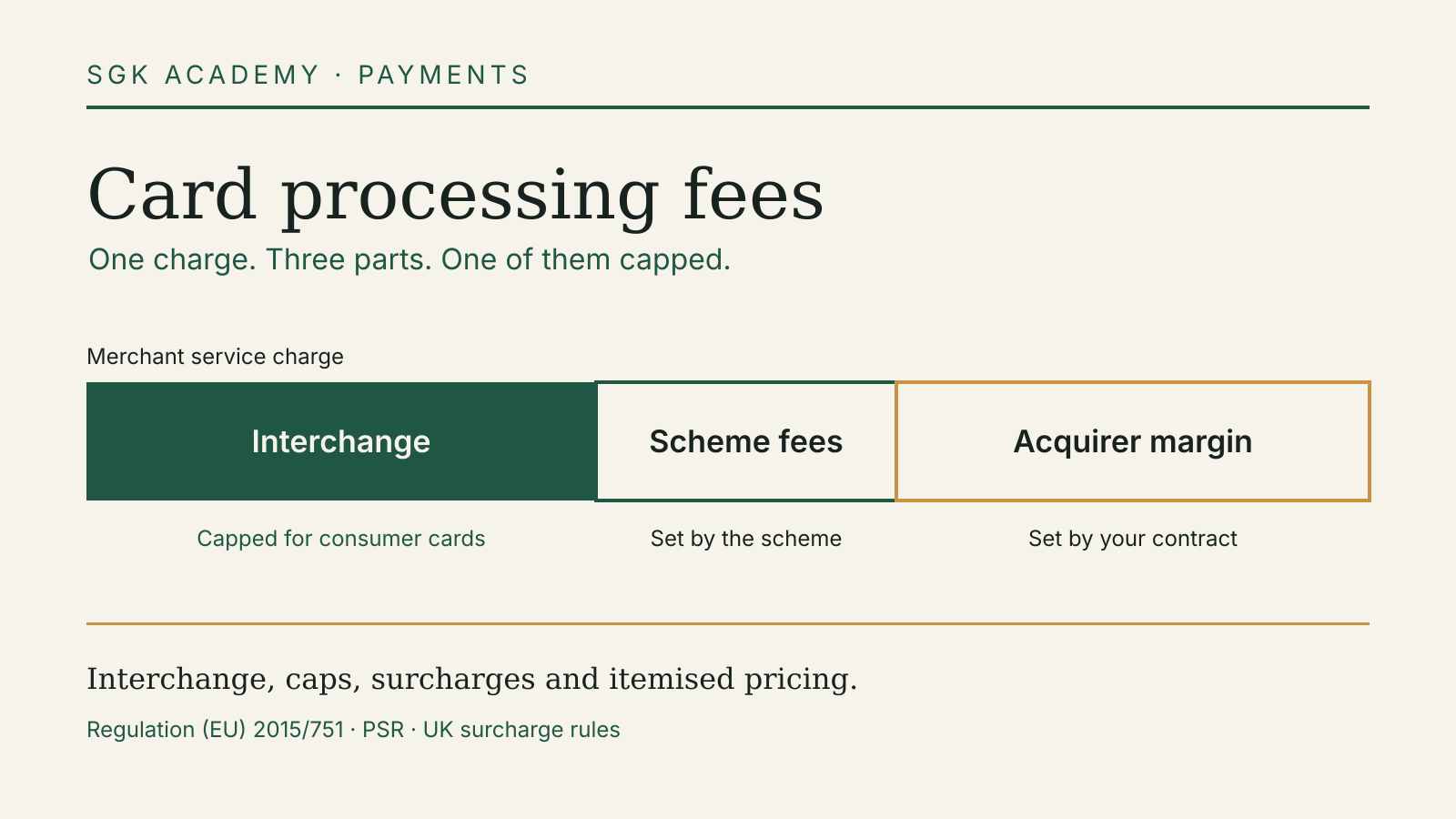
A card payment in a four-party scheme such as Visa or Mastercard involves the customer’s bank, the merchant’s acquirer and the scheme that connects them. Regulation (EU) 2015/751, usually called the Interchange Fee Regulation (IFR), gives the legal names. The acquirer is the payment service provider that contracts with a business to accept and process card payments. The issuer provides the card to the customer. The interchange fee is a fee paid for each transaction between the issuer and the acquirer. The merchant service charge is the fee the business pays the acquirer.
In plain terms, the merchant service charge is the whole bill you see. Inside it, the acquirer passes the interchange fee to the issuer, pays fees to the card scheme and keeps the rest as its margin for processing, risk and service. Article 9 of the IFR names all three components when it requires acquirers to show “merchant service charges, interchange fees and scheme fees” in their agreements.
| Component | Who receives it | Regulated by the IFR caps? |
|---|---|---|
| Interchange fee | The customer’s card issuer | Yes, for consumer debit and credit cards in scope |
| Scheme fees | The card scheme (for example Visa or Mastercard) | No cap in the IFR |
| Acquirer margin and processing | Your acquirer or payment provider | No cap; set by your contract |
This split matters when you compare quotes. A low headline percentage can still cost more if the provider applies it to card types with low interchange, or adds separate fees for refunds, chargebacks or terminal hire. The caps limit only the first row.
The interchange caps inside the EU
Article 3 of the IFR says payment service providers shall not offer or request an interchange fee of more than 0.2% of the value of the transaction for a consumer debit card transaction. Article 4 sets the equivalent limit for consumer credit cards at 0.3%. Both apply to card payments within the Union where both the payer’s and the payee’s payment service providers are located there (Article 1(1)).
Member States have some room for domestic payments. For domestic debit transactions, a country may set a lower percentage cap, optionally with a fixed maximum amount, or allow a flat fee of no more than EUR 0.05 per transaction, possibly combined with a percentage of up to 0.2%, provided the scheme’s total stays within 0.2% of its annual domestic debit card value. For domestic credit transactions, a country may set a lower cap. Your acquirer can tell you which domestic levels apply in your market; the regulation sets the ceiling.
Article 1(3) takes three things out of the cap chapter entirely:
- transactions with commercial cards;
- cash withdrawals at ATMs or bank counters;
- cards issued by three-party schemes, where the scheme itself acts as issuer and acquirer.
A commercial card, under Article 2(6), is a card issued to an undertaking, a public body or a self-employed person, limited to business expenses, where payments are charged directly to the business’s account. If you sell mostly to other companies that pay with company cards, the consumer caps may cover only a small share of your volume.
What the caps mean on a single sale
These figures are the maximum interchange the caps allow. They are not your total processing cost, because scheme fees and the acquirer’s margin come on top.
| Sale | Card type (in scope) | Cap | Maximum interchange |
|---|---|---|---|
| EUR 40 | Consumer debit | 0.2% | EUR 0.08 |
| EUR 40 | Consumer credit | 0.3% | EUR 0.12 |
| EUR 1,000 | Consumer credit | 0.3% | EUR 3.00 |
| EUR 1,000 | Commercial card | Not capped by the IFR | Set by the scheme |
The last row is the one founders tend to miss. A business-to-business firm whose customers pay EUR 1,000 invoices by company card is outside the consumer cap for those payments, so the interchange part of the bill is whatever the scheme sets.
The UK caps after Brexit
The UK kept its own version of the regulation. On legislation.gov.uk, the UK text of Article 3 caps interchange at 0.2% for any UK debit card transaction, and Article 4 caps it at 0.3% for any UK credit card transaction. The site also lists a future revocation of the regulation under the Financial Services and Markets Act 2023 that it had not applied to the text when we checked; until that happens, the retained caps are the operative UK rule.
Payments between the UK and the EEA are a different matter. The Payment Systems Regulator (PSR) explains that after the UK left the EU, the EU regulation no longer applied to UK-EEA transactions. Its market review page says Mastercard and Visa then raised interchange on card-not-present UK-EEA consumer transactions from 0.2% and 0.3% to 1.15% and 1.5%, for debit and credit respectively.
The PSR’s review found that the increases cost UK businesses an extra £150 million to £200 million a year and concluded that a price cap was the only effective remedy. The cap would apply to what the PSR calls outbound transactions: online payments to UK merchants made with cards issued in the EEA. In October 2025 the PSR decided not to impose an interim cap and to set one cap after further analysis. Visa, Mastercard and Revolut challenged its power to do so; the High Court dismissed those claims on 15 January 2026 in R (Mastercard Europe SA) v Payment Systems Regulator. In February 2026 the PSR published a draft merchant survey to collect cost data for that analysis. We found no cap level published on the PSR pages we checked on 11 October 2026.
For a UK shop selling online into the EEA, the effect is easy to compute. On a £100 sale paid with an EEA consumer credit card, interchange at the 1.5% rate the PSR reported is £1.50. The same sale on a UK consumer credit card is capped at £0.30. If a large share of your online customers pay with EEA cards, ask your acquirer for a breakdown by card region before you assume the domestic caps describe your costs.
Itemised or blended pricing
Article 9 of the IFR, headed “Unblending”, requires each acquirer to offer and charge merchant service charges individually specified for different categories and brands of card with different interchange levels. The business can opt out by asking in writing for a blended rate. Acquirers must also include in their agreements individually specified information on the merchant service charge, interchange fees and scheme fees for each category and brand of card, unless the business later asks otherwise in writing. The UK version keeps the same article.
Itemised pricing is sometimes sold as “interchange plus” or “interchange plus plus”. The label matters less than whether the contract shows each of the three parts Article 9 names.
A simple way to see the difference uses hypothetical quotes, not market rates. Suppose a business takes EUR 20,000 a month in card payments, all consumer debit within its own EU country.
- Quote A (blended): one rate on all cards. The interchange share is hidden inside it.
- Quote B (itemised): interchange at cost (at most 0.2%, so at most EUR 40 on EUR 20,000), plus scheme fees as charged, plus a stated acquirer margin.
Under Quote B you can see that at most EUR 40 of the monthly bill is interchange; everything above that is scheme fees and the acquirer’s charge. Under Quote A you need the Article 9 information to make the same comparison. The blended rate may still be the better deal for a business that values a predictable charge, but you can only judge that once you know what is inside it.
Article 12 adds a reporting duty. After each card payment, the acquirer must give the business a reference for the transaction, the amount credited and the charges, showing the merchant service charge and the interchange fee separately. With the business’s prior consent, this can be aggregated by brand, application, payment instrument category and interchange rate, and the contract can provide it periodically, at least once a month.
Surcharges: when you may pass the cost on
Knowing your processing cost does not mean you can add it to the customer’s bill. Both the EU and the UK restrict surcharges, and the UK rule reaches further than many founders expect.
In the EU, Article 62 of the Payment Services Directive (EU) 2015/2366 says a payment provider shall not prevent a business from requesting a charge, offering a reduction or steering customers towards a payment method, and any charge may not exceed the direct cost of that instrument. Article 62(4) then requires Member States to ensure that businesses do not request charges for payment instruments whose interchange fees are capped under the IFR, nor for payment services covered by the SEPA Regulation (EU) No 260/2012. Article 62(5) lets each Member State prohibit or limit surcharges further, so check the national rule where you sell.
In the UK, regulation 6A of the Consumer Rights (Payment Surcharges) Regulations 2012, in force since 13 January 2018, says a payee must not charge a payer any fee for paying with a card-based instrument that is not a commercial card, an equivalent non-card instrument, or a payment service covered by the SEPA euro credit transfer and direct debit regulation. For other payment instruments, the fee may not exceed the cost the payee bears for that instrument. The wording is “a payee” and “a payer”, so the ban is not limited to consumers: a company paying your invoice with a personal debit card cannot be surcharged either. Regulation 4 separately limits any fee a trader charges a consumer to the trader’s cost.
| Situation | EU (PSD2 Article 62) | UK (2012 Regulations) |
|---|---|---|
| Customer pays with a consumer debit or credit card | No surcharge | No surcharge (regulation 6A) |
| Customer pays with a commercial card | Allowed up to direct cost, unless national law limits it | Allowed up to cost |
| Customer pays by SEPA credit transfer or direct debit | No surcharge | No surcharge (regulation 6A) |
| Offering a discount for a cheaper method | Allowed (Article 62(3)) | Not restricted by these regulations |
Choosing which cards to accept
You do not have to accept every card a scheme issues. Article 10 of the IFR stops schemes and providers from forcing a business that accepts one issuer’s card to accept all cards of that scheme. The exception is consumer cards of the same brand and category that carry capped interchange: if you accept a brand’s consumer debit cards, you accept all of them.
A business that chooses not to accept some cards must say so clearly, at the same time as it tells customers which cards it does take. In a shop, the notice goes at the entrance and at the till. For online sales, it goes on the website or app, in good time before the customer commits to buy. Declining commercial cards, for example, is a legitimate way to limit costs, but the customer must learn about it before checkout, not at the payment step.
A checklist for any processing quote
Use these questions before you sign or switch:
- Which pricing model is this? Ask for the Article 9 breakdown of merchant service charge, interchange and scheme fees by card category and brand.
- What share of my volume is consumer, commercial and cross-border? Your acquirer’s statements, under Article 12, should let you see this. UK merchants should split out EEA-issued cards online.
- Which fees sit outside the percentage? Refunds, chargebacks, terminal rental, gateway fees and minimum monthly charges are commercial terms; the caps do not touch them.
- How do settlement timing and reserves work? A cheap rate with a slow payout can still strain cash. Model the delay in the cash runway calculator.
- Does my checkout comply with surcharge and acceptance rules? Remove card surcharges on consumer cards, and display any card exclusions before the customer commits.
- What does it cost to leave? Check the notice period, termination fees and terminal ownership.
Card fees are one line in a wider cash picture. Our guide to profit versus cash flow explains why a profitable business can still run short, and the invoice factoring guide covers another way businesses pay to receive money sooner.
Sources and document dates
Checked 11 October 2026. Legislation: Regulation (EU) 2015/751 on interchange fees, EU text on EUR-Lex and the as-adopted text on legislation.gov.uk for Article 1, Article 2, Article 3, Article 4, Article 9, Article 10 and Article 12; the UK revised text of Article 3 and Article 4; Directive (EU) 2015/2366, Article 62; the Consumer Rights (Payment Surcharges) Regulations 2012, regulation 4 and regulation 6A. Regulator and court: PSR, market review into cross-border interchange fees, last updated October 2025; PSR, MR22/2.9 statement of reasons, October 2025; PSR, merchant survey invitation to comment, February 2026; High Court, [2026] EWHC 64 (Admin), 15 January 2026.