
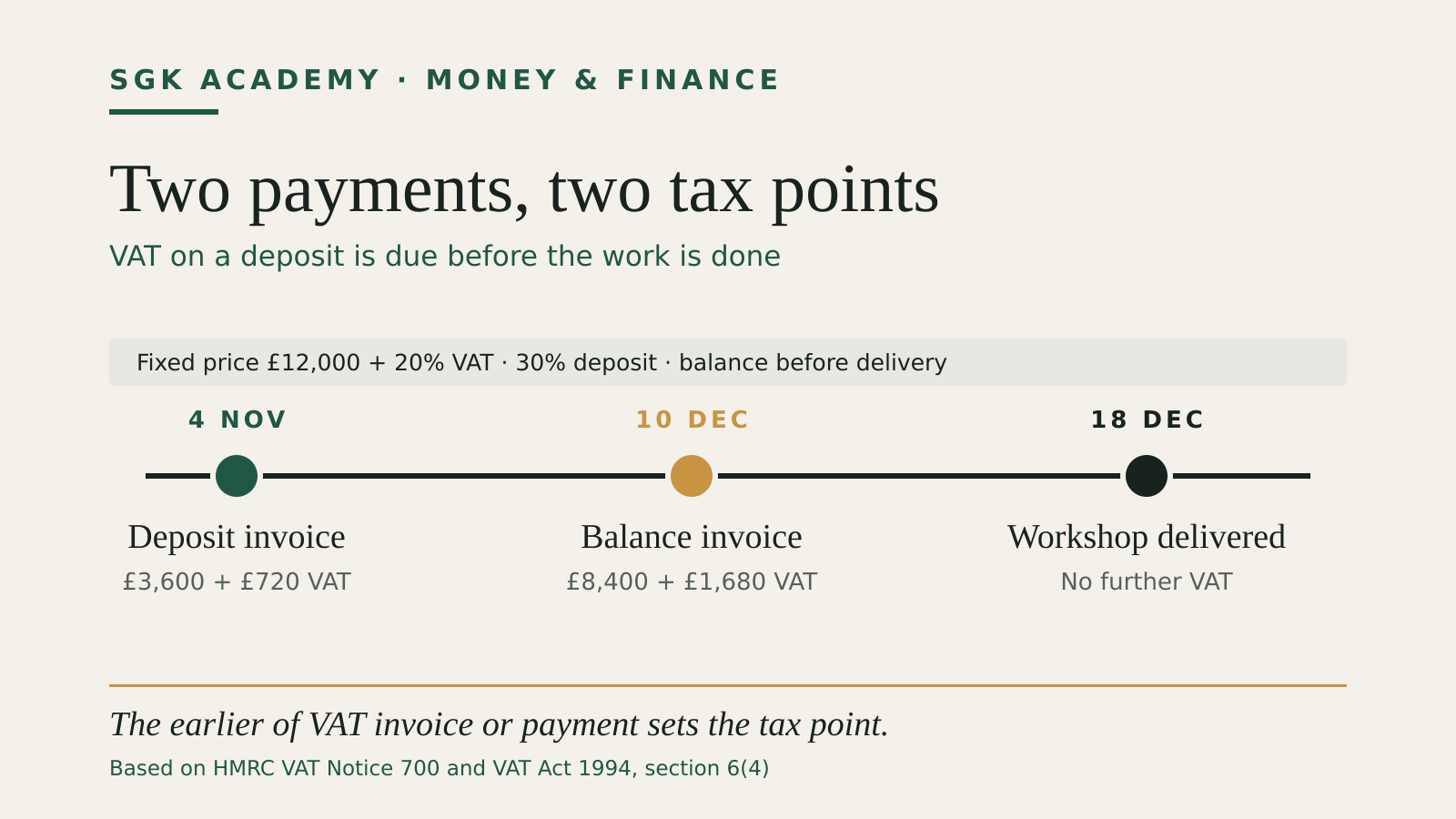
VAT is usually due on a customer deposit before the work is finished. For a UK VAT-registered business, the tax point is the earlier of issuing a VAT invoice for the advance payment and receiving the money. A later balance payment creates another tax point for that amount.
That rule is easy to miss when a quote says “30% deposit” but the bookkeeping workflow waits for delivery. The deposit is not merely cash held on account if it is part-payment for an identifiable supply.
Reviewed against HMRC’s VAT guidance, VAT Notice 700 and section 6 of the Value Added Tax Act 1994 on 31 October 2026. This guide explains the general rule; special schemes and sector rules can change the treatment.
The short answer
| Payment | When VAT is normally accounted for | Amount brought into the VAT return |
|---|---|---|
| Advance payment for goods or services | Earlier of the VAT invoice date and receipt date | The VAT-inclusive part of that advance payment |
| Remaining balance paid before delivery | Earlier of the balance invoice date and receipt date | The VAT-inclusive balance |
| Fully returnable hire security deposit | No VAT while it remains returnable | None |
| Deposit kept for loss or damage to hired goods | HMRC says no VAT is due on the retained compensation | None under the general returnable-deposit rule |
| Deposit kept after a customer cancels the future supply | VAT remains due on the amount received | The retained deposit |
The word “deposit” does not decide the result. Ask what the money is for and whether the customer is entitled to get it back.
A part-payment creates its own tax point
HMRC’s guidance on instalments, deposits and credit sales says an advance payment is a proportion of the selling price paid before the goods or services are supplied. The tax point is the earlier of two dates:
- the date the supplier issues a VAT invoice for the advance payment; or
- the date the supplier receives the advance payment.
The supplier includes VAT on that advance payment in the VAT return covering that tax point. It does not wait until the full project is complete.
If the customer pays the balance before delivery, the balance has a separate tax point. Again, the earlier of the balance invoice and payment date controls.
This is a timing rule. It does not mean the entire contract value becomes VAT due when only a part-payment has been invoiced or received. Each advance payment brings its own amount into account.
Where the rule comes from in the statute
HMRC’s guidance rests on section 6 of the Value Added Tax Act 1994. Subsections (2) and (3) set the basic time of supply: removal or availability of goods, and performance of services. Subsection (4) then overrides it. If the supplier issues a VAT invoice, or receives a payment, before that basic time, the supply is treated as taking place when the invoice is issued or the payment received, “to the extent covered by the invoice or payment”.
Those last words are the reason a 30% deposit brings only 30% of the price into the return. The statute moves the tax point forward for the amount actually invoiced or paid, not for the whole contract.
VAT Notice 700, paragraph 14.2.3 adds HMRC’s general view: most deposits serve primarily as advance payments and create tax points when received. Some deposits are not consideration for a supply at all, and their receipt creates no tax point. Hire security is HMRC’s main example. Another is a deposit held by a third party acting as stakeholder, rather than as the seller’s agent, in a property sale; no tax point arises until the money is released to the seller.
Worked example: a 30% project deposit
Assume a consultancy agrees a fixed price of £12,000 plus 20% VAT. The customer must pay 30% when booking and the rest before the final workshop.
| Event | Net amount | VAT at 20% | Gross amount | Tax point |
|---|---|---|---|---|
| Deposit invoice issued 4 November | £3,600 | £720 | £4,320 | 4 November, if this is before receipt |
| Deposit paid 7 November | — | — | — | No new tax point; the invoice already created it |
| Balance invoice issued 10 December | £8,400 | £1,680 | £10,080 | 10 December, if this is before receipt |
| Workshop delivered 18 December | — | — | — | No extra VAT on amounts already invoiced |
The business accounts for £720 in the return containing 4 November and £1,680 in the return containing 10 December. If the customer had paid the deposit on 2 November before any VAT invoice, 2 November would have been the first tax point.
The example assumes the whole service is standard-rated and the invoice dates are valid. A mixed, exempt or zero-rated supply needs its own analysis.
Variation: the balance is invoiced after delivery
Change one fact. The workshop is delivered on 18 December, nothing further has been invoiced or paid, and the balance invoice goes out on 23 December. The basic tax point for the £8,400 balance is 18 December, when the service is performed. Under the 14-day rule in paragraph 14.2.2 of VAT Notice 700, an invoice issued within 14 days after the basic tax point becomes the tax point, so the £1,680 is accounted for on 23 December.
If the invoice slipped to 5 January, more than 14 days after 18 December, the balance would fall back to the basic tax point of 18 December unless HMRC had approved an extension. For a business with a 31 December quarter end, that decides which return carries the £1,680. The deposit’s own tax point of 4 November is unaffected either way.
A returnable security deposit is different
A deposit paid when hiring equipment may be security rather than part of the hire price. HMRC says VAT does not have to be accounted for where the deposit is:
- refunded in full when the goods are returned safely; or
- kept to compensate the owner for loss or damage.
The reason matters. A refundable security amount is not automatically consideration for the hire. If some or all of it later becomes payment for an additional taxable supply, the position must be reviewed at that point rather than assumed from the label on the original receipt.
Keep the hire agreement clear about the conditions for refund and the circumstances in which an amount may be retained. A vague “deposit” line makes it harder to show whether the sum was security, an advance price payment or compensation.
A forfeited booking deposit keeps its VAT
The cancellation rule is different. When a customer pays against goods or services to be supplied later, HMRC requires VAT when the payment is received or the VAT invoice is issued, whichever comes first. If the customer then cancels and the supplier keeps the deposit, HMRC says VAT remains due on the money received.
Do not reverse output VAT simply because the customer did not take up the booking. A credit note or VAT adjustment needs a valid basis under the actual transaction and the supplier’s cancellation terms.
This distinction is practical:
- returnable hire security can sit outside VAT while it remains returnable;
- advance consideration for a future supply creates a tax point; and
- that advance retained on cancellation remains subject to VAT under HMRC’s published rule.
Instalments do not always mean VAT by instalment
Paying over time can describe several legal arrangements.
For a continuous supply, such as an ongoing service, HMRC says each VAT invoice or payment normally creates a tax point, whichever comes first. A supplier can issue an invoice covering regular payments for a period of up to a year, provided more than one payment is due. In that case, each payment is brought into account on its due date or receipt date, whichever is earlier. Notice 700 adds that the customer must not reclaim the VAT shown on such an invoice until the payment is due or has been made, whichever happens first.
A credit sale is different. The customer becomes the owner of the goods immediately but pays in instalments. A conditional sale leaves ownership with the supplier until payment. HMRC’s basic tax point for either is when the goods are supplied, with the usual rules for an earlier payment or VAT invoice and an invoice issued within 14 days after the basic tax point. VAT can therefore be due on the full goods value even though the customer pays later.
Do not configure accounting software around the word “instalment” alone. Identify whether the transaction is an advance payment, a continuous supply, a credit sale or a conditional sale.
Invoices that are drafted but not sent
An invoice prepared in the accounting system does not create a tax point. Notice 700 says a VAT invoice must be sent or given to the customer for them to keep, and that a tax point cannot be created simply by preparing an invoice. Many tools generate invoice numbers when a draft is saved, so check the date the invoice actually left the business.
The reverse risk matters too. Once a VAT invoice for a deposit has been issued, the VAT belongs in the return for that period even if the customer has not paid. HMRC states that you cannot delay accounting for VAT until you have received payment, unless you use cash accounting. If deposits are often late, a pro forma request can help. Paragraph 17.3 of Notice 700 says a pro forma should be clearly marked “this is not a VAT invoice”, that the customer cannot use it to reclaim input tax, and that a proper VAT invoice must follow once the supplier receives payment or makes the supply. How a pro forma differs from the commercial invoice that travels with exported goods is set out in pro forma invoice vs commercial invoice.
What the invoice and ledger should show
For each advance payment, retain enough information to reproduce the VAT return entry:
- customer and supply description;
- contract price and VAT rate;
- amount invoiced and amount received;
- VAT invoice date and payment date;
- tax point used and the reason it is earlier;
- VAT-exclusive and VAT amounts;
- later balance invoices, credit notes and refunds.
Post the deposit against the customer’s receivable or contract liability in a way that does not hide the output VAT. The accounting presentation depends on the business and reporting framework, but the VAT control account still needs to reconcile to the return.
Our milestone billing guide shows how to define invoice triggers and acceptance points. The 13-week cash flow forecast helps place deposit receipts and VAT payments in the weeks when cash actually moves, and the cash runway calculator shows how long reserves last once those VAT payments leave. What a valid VAT invoice must contain is covered in VAT invoice requirements; registration thresholds by country are in the VAT thresholds table.
A practical decision sequence
- Name the supply. What goods or services will the customer receive?
- Classify the money. Is it part of the price, returnable security or compensation?
- Record both dates. Capture the invoice date and the bank receipt date.
- Use the earlier date. That is normally the tax point for an advance payment.
- Calculate only the amount triggered. Do not bring in the unpaid balance unless another rule creates its tax point.
- Revisit cancellations and refunds. A retained booking deposit and a refunded security deposit have different outcomes.
- Reconcile the VAT return. Match each deposit tax point to the return period and ledger entry.



