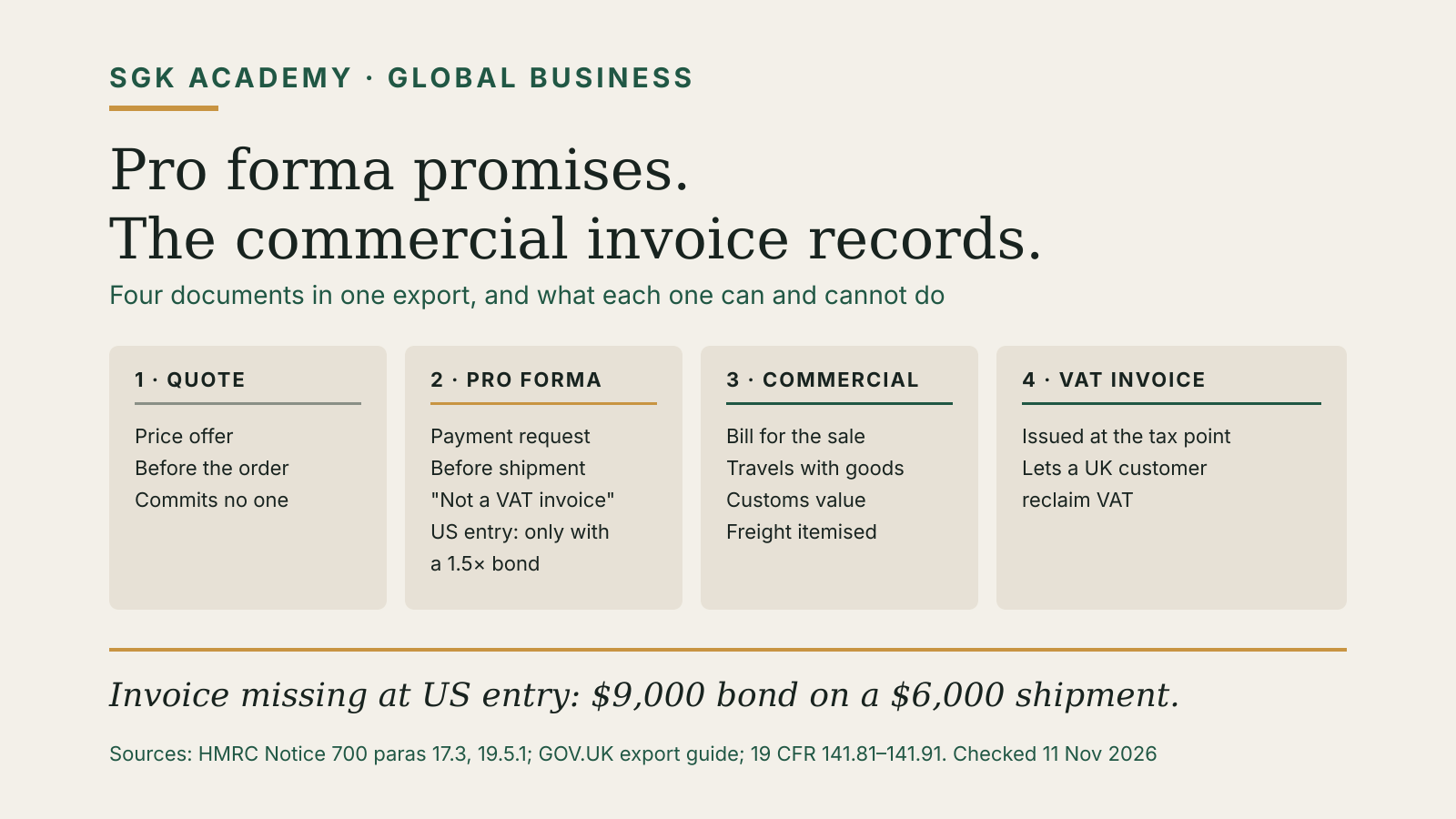
A pro forma invoice is a request for payment or a statement of what will be shipped, sent before the sale is final. A commercial invoice is the bill for a completed sale of goods, and it is the document customs uses to value a shipment that crosses a border. The pro forma comes first and promises; the commercial invoice comes with the goods and records.
The difference matters most in three places: when a buyer pays in advance, when goods clear customs, and when a UK VAT-registered customer wants to reclaim VAT. A pro forma does a job in the first, a limited one in the second, and none in the third.
Checked on 11 November 2026 against HMRC’s VAT Notice 700 (paragraphs 17.3 and 19.5.1; page last updated 25 June 2026), GOV.UK’s export step-by-step guide, the Department for Business and Trade’s export guidance on business.gov.uk, and US Customs and Border Protection’s invoice rules in 19 CFR Part 141, Subpart F. Figures in the worked example are illustrative.
Four documents that get called “invoice”
Exporters and their buyers often handle four documents in one deal. Only two of them are invoices in a legal sense.
| Document | When it is issued | What it is for | Can the buyer reclaim UK VAT with it? | Does US customs accept it at entry? |
|---|---|---|---|---|
| Quote | Before the order | Price offer the buyer can accept or ignore | No | No |
| Pro forma invoice | After the order, before shipment or payment | Payment request, advance-payment notice, import licence or letter-of-credit paperwork | No: HMRC says it cannot be used as evidence to reclaim input tax | Only as a stand-in, with a bond, when the commercial invoice is missing (19 CFR 141.91) |
| Commercial invoice | When goods ship | Bill for the sale and the customs value of the shipment | Not by itself, unless it also carries the VAT invoice details | Yes: required for each commercial shipment (19 CFR 141.81 and 141.83) |
| VAT invoice (UK) or tax invoice | At or near the tax point | Charges VAT and lets a registered customer reclaim it | Yes, if it shows the required details | Not relevant to customs |
The business.gov.uk export glossary puts the pro forma’s role plainly: it “can act as a quotation”, it is prepared before shipping, and it tells the buyer the goods, their value and other key specifications. It adds that exporters who say they are “paid by pro forma” mean payment in advance, with the pro forma as the notice of the full amount due. A commercial invoice, in the same glossary, “provides the information needed to clear your goods through customs in the destination country” and is used in most cases to assess duties and taxes.
Pro forma invoice vs invoice under UK VAT rules
For a UK VAT-registered seller, the line is drawn in paragraph 17.3 of Notice 700. HMRC describes pro forma invoices as offers that may or may not be taken up, where the goods or services “will not be supplied unless payment is received”. Three consequences follow:
- A pro forma “cannot be used as evidence to reclaim input tax, even if they show all the details required for a VAT invoice”.
- The seller should mark it clearly “this is not a VAT invoice”.
- Once the seller supplies the goods or services, or receives payment, it “must issue a proper VAT invoice”.
Paragraph 19.5.1 repeats the point from the buyer’s side: a document marked “pro-forma” or “this is not a tax invoice” is not evidence for reclaiming VAT.
The practical risk runs both ways. A seller who sends a document carrying every VAT invoice detail and no warning risks it being treated as a VAT invoice, and under paragraph 14.2.2 an issued VAT invoice fixes the tax point on its date, before any money has arrived. A buyer who pays against a pro forma and files it as a purchase invoice has no valid evidence for the VAT it claims. Our guide to VAT on deposits and advance payments covers how the tax point falls when the money then arrives, and VAT invoice requirements lists what the proper invoice has to show.
So the answer to “is a pro forma invoice a real invoice?” depends on the system asking. For accounts payable it is a payment request. For VAT it is not an invoice at all. For customs it is a fallback.
Pro forma invoice vs commercial invoice at the border
Leaving the UK
GOV.UK’s export guide says the completed invoice and any licences or certificates “must travel with the goods”. It sets one valuation rule that settles a common pro forma question: use the price you are selling the goods for, and if you are not selling them, use their market value. Freight or export insurance included in the price is listed separately.
That is why a pro forma is often what travels with samples, replacement parts sent free of charge, or goods going to a trade show. There is no sale, so there is no commercial invoice to issue, yet customs still needs a value and a description. The document is often headed “pro forma” or “no commercial value”, but the value it shows must be a real market value, not a nominal one.
GOV.UK’s guidance for international events lists the minimum data for a sample commercial invoice: exporter or EORI, consignee or delivery address, invoice number and date, Incoterms and currency, a detailed description with make, model or serial number and HS code if known, quantity, unit and total value, country of origin, gross and net weight, number of packages, and the reason for import (temporary or permanent). Use it as a checklist for a pro forma that will cross a border.
Arriving in the United States
US rules spell out the difference most explicitly. Under 19 CFR 141.81, a commercial invoice must be presented for each shipment when the entry summary is filed. The commercial-invoice paragraph of section 141.83 says it must be “prepared in the manner customary in the trade” and carry the details in sections 141.86 to 141.89.
A pro forma enters the US process in three situations:
| Situation | Rule | What CBP requires |
|---|---|---|
| No commercial invoice is needed at all, such as goods not for sale or commercial use, goods returned after repair abroad, goods entered temporarily under bond | 19 CFR 141.83(d) | Any invoice or bill the importer has; if none, a pro forma under 141.85 with enough information to examine the goods and set duties |
| A commercial shipment arrives but its invoice is not available in proper form | 19 CFR 141.91 | CBP must be satisfied the cause is beyond the importer’s control; a written declaration; a pro forma; a bond of 1.5 times the invoice value; the commercial invoice produced within 120 days of filing the entry summary (50 days if needed for statistics, unless extended) |
| Instalments of one order arriving over up to 10 days, invoiced together | 19 CFR 141.82, pro forma paragraph | A pro forma with each entry until the invoice arrives, a bond, and liquidated damages if more than 6 months pass without the invoice |
The pro forma CBP accepts is not free-form. Section 141.85 gives the wording: an importer’s statement that it does not hold the seller’s invoice, the basis for each value (order, exporter’s advice, previous shipments, market knowledge), a table of marks, quantities, unit and total prices, a list of charges such as packing, inland freight and ocean freight marked as included or not, the country of origin, and a promise to file any invoice that arrives later. It is signed by the importer, not the seller.
What a US commercial invoice must carry that a pro forma often lacks
Section 141.86 is the checklist. Several items are routinely missing from sellers’ pro formas:
- the port of entry the goods are going to;
- the time, place and parties of the sale;
- every charge on the goods itemised by name and amount (freight, insurance, commission, containers, packing), unless included in the price and identified as such;
- every discount from list price, by class of goods;
- rebates, drawbacks and bounties allowed on export;
- assists: dies, moulds, tools or engineering work supplied for production and not in the price;
- an English translation if the invoice is in another language;
- what each individual package contains;
- the name of a responsible employee of the exporter who knows the transaction.
A pro forma written as a payment request usually covers price, quantity and bank details. Copying it into the shipment paperwork without these fields is how a “pro forma vs commercial invoice” mix-up turns into a customs delay.
Worked example: one export, four documents
A UK company sells 400 replacement filters to a US distributor for $6,000, delivered on DAP terms, with 50% payable before shipment. The figures are illustrative; the rules are from the sources above.
| Date | Document | Amount on it | What it does | What it does not do |
|---|---|---|---|---|
| 3 November 2026 | Quote | $6,000 | Offers the price and terms | Commit either side |
| 6 November | Pro forma invoice, marked “this is not a VAT invoice” | $6,000, with $3,000 due now | Lets the distributor’s bank release the advance and its import team check the goods description and HS code | Create a sale for VAT or a customs value |
| 12 November | Advance of $3,000 received | — | Tax point for the advance under UK time-of-supply rules, even where the export itself is zero-rated (see the deposits guide) | — |
| 18 November | Commercial invoice travels with the goods | $6,000 plus itemised freight | Customs value and record of sale; the UK export declaration and US entry draw on it | Replace a VAT invoice for a UK customer |
| 2 December | US entry summary filed | — | CBP checks the commercial invoice against 141.86 | — |
Now change one fact. The commercial invoice was emailed but never reached the broker, and the distributor files the entry summary on 2 December with a pro forma under 141.91. CBP can accept it only on the section’s conditions. The bond is 1.5 × $6,000 = $9,000. The commercial invoice is due 120 days after 2 December, which is 1 April 2027 (29 days left in December, then 31, 28 and 31, plus 1 April). If the shipment’s statistics need the invoice, the 50-day limit applies instead. A missing seller document has moved $9,000 of bond capacity and a four-month follow-up onto the buyer, which is why buyers ask suppliers to send the commercial invoice with the goods and again to the broker.
For the UK side, the export guide says goods exported may qualify for zero-rating, and that a VAT-registered seller records exported goods in its VAT accounts even when they are zero-rated. The commercial invoice is the record that ties the sale, the export evidence and the payment together; the pro forma is a superseded draft once it exists.
When a pro forma is the right document
- Payment in advance. A buyer’s finance team usually needs a document to approve and pay. A pro forma gives one without creating a UK VAT invoice before the money arrives. It pairs naturally with milestone billing and with stricter invoice payment terms for new or overseas customers.
- Buyer’s import paperwork. Some importers need a priced description before they can apply for a licence, open a letter of credit or book a customs broker. The business.gov.uk export invoice checklist lists the pro forma among the “related paperwork” the final commercial invoice should reference by number and date.
- Goods that are not sold. Samples, free replacements and items for exhibitions still need a value for customs. A pro forma stating market value is the usual vehicle; GOV.UK’s rule that the market value applies when goods are not sold governs the figure.
- Checking the deal before shipment. Weight, packaging, HS codes and Incoterms can be agreed on the pro forma, then copied to the commercial invoice without surprises.
When it is the wrong one
- As the only document with a commercial shipment to the US. Section 141.81 requires the commercial invoice; the pro forma route in 141.91 is an exception with a bond.
- As evidence for a UK VAT reclaim. Paragraphs 17.3 and 19.5.1 rule this out.
- Without the “this is not a VAT invoice” line, when the seller is UK VAT-registered and the figures would otherwise look like a VAT invoice.
- With a token value on goods that are not sold. GOV.UK asks for market value.
Checklist for the hand-off from pro forma to commercial invoice
- Number the pro forma in its own series, so it never sits in the sales invoice sequence.
- Head it “Pro forma invoice”, add “this is not a VAT invoice” if you are UK VAT-registered, and state the validity period of the prices.
- Agree weights, packaging, HS codes, country of origin and Incoterms on the pro forma.
- When the goods ship, issue the commercial invoice from your sales invoice sequence and quote the pro forma’s number and date on it.
- Itemise freight, insurance and packing, and name a contact who knows the transaction (both required by 19 CFR 141.86 for US imports).
- Send the commercial invoice with the goods and separately to the buyer’s customs broker.
- Issue the VAT invoice when the tax point arrives, or make the commercial invoice also meet the VAT invoice requirements.
- Plan the cash: an advance against a pro forma moves money forward, and the cash runway calculator shows what that gap is worth to a small exporter.