
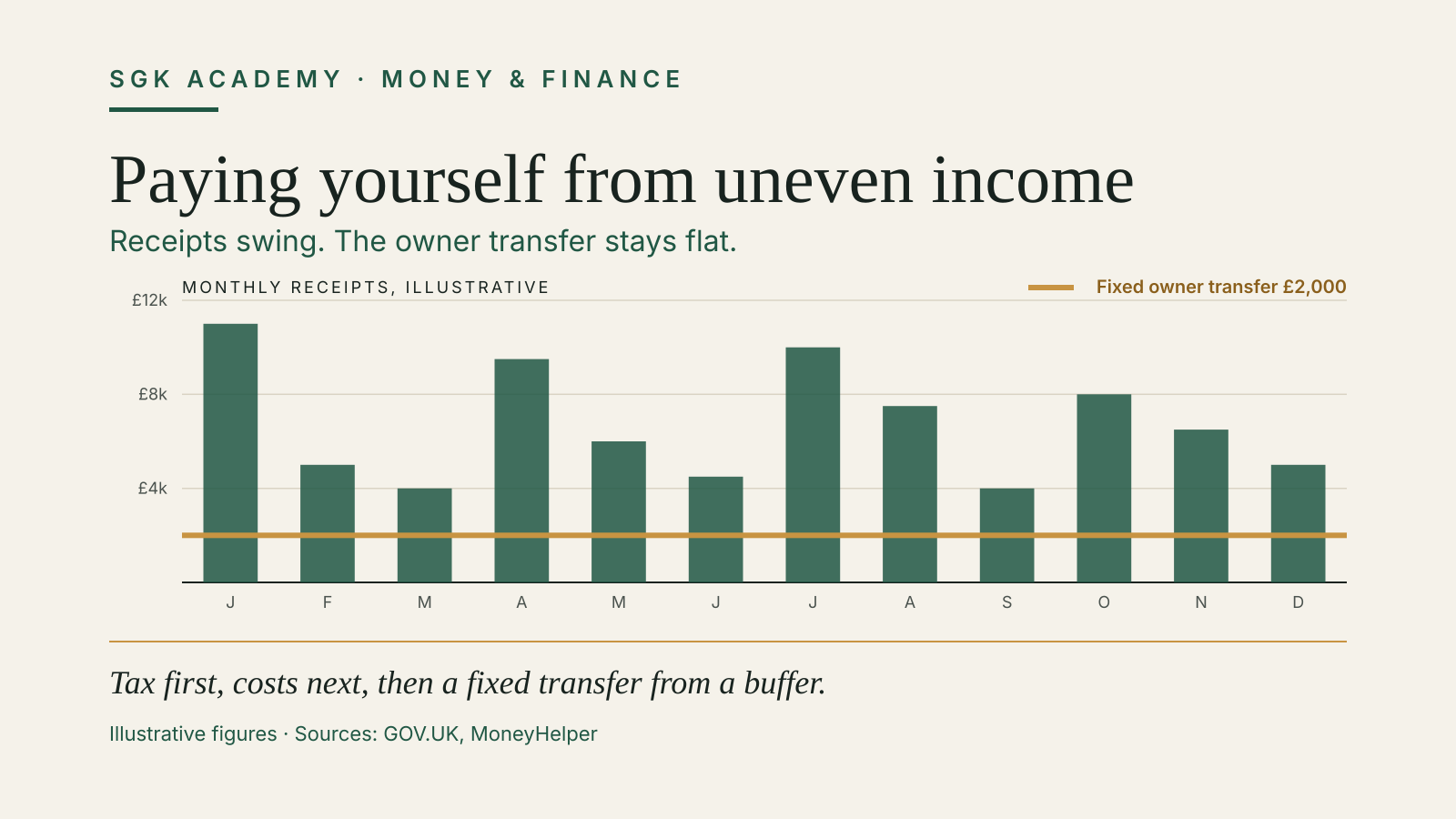
Pay yourself from irregular income by separating business cash from personal pay, setting a conservative fixed transfer and reviewing it on a schedule. The aim is not to make revenue look steady. It is to stop a strong month from becoming an unsustainable personal spending level.
This guide gives a practical method for sole traders and owner-managed companies. The legal route for taking money out still depends on your business structure and country.
Source review date: 28 October 2026. Tax rules and payment routes change; check current official guidance for your structure.
Start with three different numbers
Do not use “money in the account” as the pay figure. Track:
- Revenue received — customer cash that has cleared.
- Business cash available — revenue minus taxes, near-term bills and the operating buffer.
- Owner pay — the planned personal transfer.
Mixing those three numbers creates the familiar problem: a large invoice lands, the owner draws most of it, and the business cannot cover a tax payment or a quiet month.
Step 1: find the minimum viable personal pay
List the personal costs that must be funded each month: housing, food, utilities, transport, insurance, minimum debt payments and a modest allowance for variable essentials.
Use that total as a planning floor, not a promise from the business. MoneyHelper recommends budgeting around the lowest monthly income when income varies, then directing stronger months to savings or future costs. Its irregular-income budgeting guide also suggests a separate account for regular outgoings.
If the business cannot reliably support the personal floor, reduce the draw, improve the revenue plan or use a separate personal buffer. Do not hide the gap with optimistic forecasts.
Step 2: build the business cash floor
Before setting owner pay, calculate what the business must retain. Include:
- tax and social-contribution reserves;
- payroll and contractor commitments;
- rent, software and other recurring costs;
- annual bills divided into monthly amounts;
- debt payments;
- a working-capital buffer for late customers;
- approved spending needed to deliver current work.
A 13-week cash-flow forecast is useful because it puts receipts and payments in the weeks when cash actually moves. The lowest projected balance tells you whether the proposed owner transfer is affordable.
Step 3: choose a fixed transfer
A simple starting rule is to set a monthly transfer that the business could have supported across the previous six to twelve months after tax reserves and essential costs. The average month is the wrong anchor; the test is whether the transfer survives the weak stretches.
Take a consultant whose receipts swing between £4,000 and £11,000 a month. They reserve 25% of every receipt for tax and pay £3,000 a month in business costs. Whatever remains is the surplus available for owner pay. They start the year with £6,400 in an owner-pay buffer and want £3,200 a month.
The table below runs one illustrative year at two transfer levels. Figures are invented for the example.
| Month | Receipts | Surplus after tax reserve and costs | Buffer at £3,200 a month | Buffer at £2,000 a month |
|---|---|---|---|---|
| Jan | £11,000 | £5,250 | £8,450 | £9,650 |
| Feb | £5,000 | £750 | £6,000 | £8,400 |
| Mar | £4,000 | £0 | £2,800 | £6,400 |
| Apr | £9,500 | £4,125 | £3,725 | £8,525 |
| May | £6,000 | £1,500 | £2,025 | £8,025 |
| Jun | £4,500 | £375 | −£800 | £6,400 |
| Jul | £10,000 | £4,500 | £500 | £8,900 |
| Aug | £7,500 | £2,625 | −£75 | £9,525 |
| Sep | £4,000 | £0 | −£3,275 | £7,525 |
| Oct | £8,000 | £3,000 | −£3,475 | £8,525 |
| Nov | £6,500 | £1,875 | −£4,800 | £8,400 |
| Dec | £5,000 | £750 | −£7,250 | £7,150 |
Average receipts were £6,750 a month, which makes £3,200 look modest. But the average surplus was only £2,062.50, so a £3,200 transfer empties the buffer by June and leaves a £7,250 hole by December. At £2,000 the buffer never drops below its starting level and ends the year slightly higher.
The working method:
- Total the surplus for the last six to twelve months and divide by the number of months.
- Set the fixed transfer a little below that average, not above it.
- Check the lowest point the buffer would have reached. If it would have gone below zero, the transfer is too high or the starting buffer is too small.
If £2,000 does not cover the personal floor from Step 1, the answer is not a bigger transfer. It is more revenue, lower costs, or a larger personal emergency fund to bridge the gap. Our guide to an emergency fund on irregular income and the emergency fund calculator cover the personal side.
Step 4: use a buffer account
Route customer receipts into the business operating account. Move the tax amount to a dedicated reserve, then leave enough for near-term business costs. The remaining surplus can build an owner-pay buffer.
The monthly personal transfer comes from that buffer on a fixed date. This creates a one-month separation between volatile revenue and personal spending.
A useful target is one to three months of planned owner pay, adjusted for how concentrated or seasonal the business is. A freelancer with one large client usually needs more protection than a business with many small recurring customers.
Step 5: decide what happens in a strong month
Write the order before the money arrives. One possible order is:
- top up taxes;
- cover the next 13 weeks of committed business costs;
- restore the owner-pay buffer;
- fund overdue maintenance or approved investment;
- make an additional owner distribution only if the legal and tax route permits it.
This order prevents “bonus” withdrawals from competing with obligations that already exist.
Step 6: know the legal payment route
The cash-flow method does not turn every transfer into salary.
Sole trader
A sole trader’s withdrawals are generally drawings from the business, while tax is based on profit under the relevant local rules. In the UK, GOV.UK says a sole trader may need to pay Income Tax on profits and National Insurance contributions. It also requires business records to work out profit or loss; see the official sole-trader tax checklist.
Payments on account
Irregular income makes the UK Self Assessment timetable harder to fund. GOV.UK explains that payments on account are two advance payments towards the next bill, each usually half of the previous year’s tax, due by 31 January and 31 July. They include Class 4 National Insurance for the self-employed. You do not have to make them if last year’s bill was under £1,000, or if more than 80% of your tax was already collected outside Self Assessment.
A strong year therefore raises the following year’s advance payments too. In the first year you file, the January bill can include both the full year’s tax and the first payment on account for the next year, which is why a new sole trader can face a much larger January payment than expected. Fund the tax reserve before setting owner pay, and treat 31 January and 31 July as fixed outflows in the forecast.
Limited company
Company money belongs to the company. GOV.UK distinguishes salary, expenses and benefits, dividends and directors’ loans in its guide to taking money out of a limited company.
Salary requires payroll treatment. Dividends require available profits and records, including a declared dividend and voucher. A payment that is neither salary nor dividend may create a director’s-loan balance with separate rules; GOV.UK’s director’s loans guide explains that money taken that is not salary, dividend or an expense repayment must be recorded, and that tax can fall on both the director and the company.
For the tax year from 6 April 2026 to 5 April 2027, the GOV.UK dividends page lists a £500 dividend allowance, with dividends above it taxed at 10.75% in the basic band, 35.75% in the higher band and 39.35% in the additional band. Those rates matter for cash planning because dividend tax is usually paid later through Self Assessment, not at the time of the transfer.
That is the main trap for a company owner on irregular income: a regular monthly “dividend” only works if the company has enough distributable profit at each declaration. In a weak quarter the profit may not be there, and a transfer made anyway turns into a director’s loan. Our guides to salary versus dividends and the director’s loan account explain the mechanics. The practical fix is to declare dividends on a schedule after management accounts are updated, and keep the owner-pay buffer in the company until each declaration.
If you operate elsewhere, use the equivalent official guidance. The buffer method is portable; the legal labels are not.
Step 7: review quarterly, not emotionally
Set a recurring review every three months. Update:
- trailing six- and twelve-month receipts;
- the next 13 weeks of committed payments;
- tax estimates;
- customer concentration;
- the number of months in the owner-pay buffer;
- personal minimum costs.
The cash runway calculator gives a quick check of how many months the business could cover its costs and the planned transfer if receipts stopped.
Raise the fixed transfer only when the higher amount is supported by recurring evidence. Lower it early when the forecast breaks, rather than draining the buffer and cutting abruptly later.
A worked example
A consultant begins with £18,000 in business cash.
| Item | Amount |
|---|---|
| Tax reserve already required | £5,000 |
| Next 13 weeks of business costs | £6,000 |
| Minimum business cash floor | £2,000 |
| Cash available above the floor | £5,000 |
If planned owner pay is £2,000 a month, the available amount covers two and a half months. Paying £5,000 immediately would remove the entire cushion. A £2,000 scheduled transfer, followed by a monthly forecast update, is safer.
The calculation is a cash decision. It does not decide whether the transfer is salary, drawings, dividend or a loan.
Common mistakes
Paying a percentage of every invoice
A percentage rule can help fund tax, but it makes personal pay as volatile as revenue. Keep the owner transfer separate.
Ignoring annual costs
Insurance, licences and professional fees can make a profitable month misleading. Divide annual costs into monthly reserves.
Counting unpaid invoices
An invoice is not cash. Use the expected payment date in the forecast, then update it when the customer is late.
Treating the buffer as spare money
The buffer is doing a job: absorbing weak months. Record its target and do not spend it without a new forecast.
Copying another owner’s tax mix
Salary, dividends and drawings depend on legal structure and jurisdiction. Use current official guidance and professional advice where needed.
Monthly checklist
- Reconcile bank and payment accounts.
- Move the tax reserve.
- Update the 13-week forecast.
- Confirm the operating cash floor.
- Make the fixed transfer on the planned date.
- Record the payment under the correct legal route.
- Note whether the buffer rose or fell.
For tax-reserve mechanics, read how much to set aside for tax as a freelancer. For record retention, use how long to keep business records.
Questions people ask
Should owner pay change every month?
Usually no. A fixed transfer makes personal planning easier. Change it after a scheduled review when the business forecast supports a new level.
Is the owner-pay buffer the same as the tax reserve?
No. The tax reserve covers tax obligations. The owner-pay buffer smooths personal transfers. Keep them separate.
Can a limited-company owner call every transfer salary?
No. Salary, dividends, expenses and directors’ loans have different rules and records. Use the correct legal route for each payment.
What if one client provides most of the revenue?
Use a larger buffer and a lower fixed transfer because the loss or delay of that client would affect the whole forecast.
How big should the owner-pay buffer be at the start?
One to three months of the planned transfer is a common range. Run your own last twelve months through the table above: the lowest point the buffer would have reached tells you how much starting cushion you need.
Sources
- MoneyHelper: How to budget for an irregular income
- GOV.UK: Check what taxes may apply to a sole trader
- GOV.UK: Taking money out of a limited company
- GOV.UK: Payments on account
- GOV.UK: Tax on dividends
- GOV.UK: Director’s loans
This is a planning framework, not personal tax, legal or investment advice.



