An emergency fund for irregular income should cover the bills that continue when income stops, plus the gap before replacement income arrives. Start with a dated cash calendar and an initial, achievable reserve. A freelancer whose largest customer pays late needs a different target from an employee with predictable pay and a second household income.
The useful question at the start of the year is concrete: if the next expected payment did not arrive, which payments would become difficult, and on what dates? An annual income figure cannot answer that. This guide builds a reserve around those dates, using an illustrative household rather than a universal rule about how many months everyone should save.
Separate an emergency from a bill you can predict
Insurance renewals, annual software subscriptions and a known tax bill are irregular expenses, but they are not surprises. Put money aside for them separately. Otherwise the emergency fund can look healthy in January and disappear when an entirely predictable bill arrives in March.
The Consumer Financial Protection Bureau’s emergency-fund guide, last modified on 29 October 2025, describes emergency savings as a reserve for unplanned expenses or financial shocks. It also recognises that a useful target depends on a person’s circumstances. That leaves room to build something practical without treating a popular rule of thumb as an obligation.
Use three lines in your own records: money for ordinary bills, money for known future bills, and money for shocks. Separate accounts can help, but the accounting distinction matters more than the number of accounts. A tax reserve does not become spare cash simply because it shares an account with emergency savings.
If an expense happens repeatedly, move it into the ordinary or planned category. A car that needs repairs every few months is producing information about your transport budget. Repeatedly calling those repairs emergencies hides that information and makes the reserve difficult to rebuild.
Calculate the spending floor you could actually maintain
Begin with housing, basic food, utilities, essential transport, insurance and contractual minimum payments. Add the spending required to keep earning: perhaps internet access, childcare or a necessary professional subscription. Use actual recent statements rather than the amount you hope you spend.
There may be a normal budget and a temporary reduced budget. Keep both. An unrealistically severe reduced budget makes a target look easier to reach but will fail when used. A reserve should support a workable period of adjustment, not assume that every discretionary expense can disappear overnight.
Here is an illustrative monthly floor in euros. These are invented planning figures, not regional cost estimates or a recommended household budget.
| Essential expense | Monthly amount | Planning note |
|---|---|---|
| Housing | €1,000 | Contractual payment |
| Utilities and communications | €180 | Includes work internet |
| Food and household essentials | €350 | Based on recent spending |
| Transport | €120 | Required for work |
| Insurance and minimum debt payments | €250 | Check actual commitments |
| Total | €1,900 | Starting point for the reserve |
Annual bills are outside this table because this household funds them separately. If yours does not, include the next actual due amounts in the cash calendar. Do not divide an imminent large bill by twelve and assume that the money will somehow be available next week.
Model the delay, not just the average month
Suppose the household starts January with €3,000 of genuinely available cash. It expects €2,500 on 10 January and another €2,500 on 10 February. Essential spending is €1,900 each month, paid in several instalments. A monthly average suggests that income comfortably exceeds expenses.
Now delay the January payment by six weeks. The household still has enough for January’s €1,900, leaving €1,100 before February’s receipts. Whether that is sufficient depends on the dates of February’s bills and whether the February payment also depends on the same customer.
Make a weekly calendar for the next eight to twelve weeks. Enter opening cash, receipts that are already agreed, essential outgoings and closing cash. Mark uncertain receipts separately. The lowest closing balance is more informative than the average balance.
Run a second version with the largest receipt delayed and a third with it cancelled. These are scenarios, not forecasts. Their purpose is to reveal whether you need a small timing buffer, a larger income-replacement reserve, changes to invoicing, or some combination of the three.
A timing problem can sometimes be reduced without accumulating a very large fund. Ask whether invoice milestones can be smaller, deposits can be agreed, or bill dates can be aligned with receipts. A reserve remains useful, but it should not quietly subsidise avoidable payment delays forever.
Build a target in stages
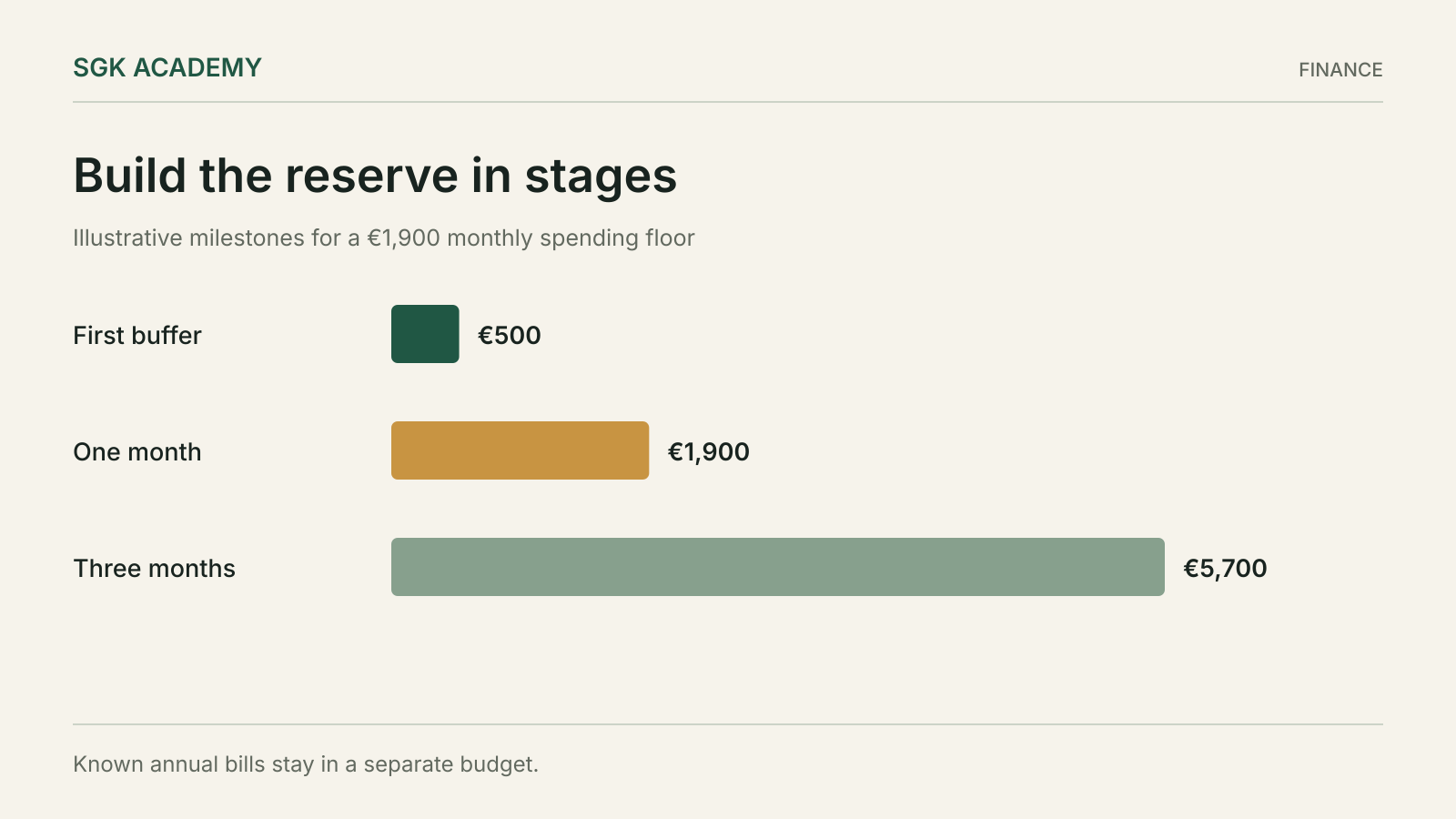
For the illustrative household, the first target could be €500 for a common immediate shock. The next could be one month of essential spending, €1,900. A later planning target might be three months, €5,700, if the household judges that period appropriate for replacing income.
Those amounts are milestones in this example, not advice that three months is enough for every reader. Dependants, health, insurance cover, visa conditions, access to family support and the time required to find work can all change the problem. Concentration in one customer also matters even when annual income is high.
Ask what each additional block of savings buys. The first €500 may prevent an overdraft. The next €1,400 may allow an invoice delay without missed bills. Further savings may buy time to replace a customer without accepting unsuitable work. Describing the function makes the target less abstract.
Avoid setting such a distant target that the first step feels pointless. A partial reserve is useful. The task is to improve your ability to absorb a shock while continuing to meet current commitments, including expensive debts whose costs should be assessed alongside saving.
Use a rule that follows receipts
A fixed transfer can work well with a salary. With uneven receipts, it can move money into savings immediately before an essential bill. The CFPB’s guide specifically cautions readers to watch balances when automating transfers.
One alternative is a receipt-based rule. When a payment clears, first allocate money for taxes and known obligations, then replenish the next period of essential spending, then transfer an agreed share of the remaining amount to the reserve. Define what “remaining” means so that the rule is repeatable.
For example, an illustrative €4,000 receipt might require €1,000 for a provisional tax allocation, €1,900 for essential spending and €300 for a known annual bill. That leaves €800 before other spending. Saving €400 is then a deliberate decision, not a percentage applied to money already committed elsewhere.
The tax allocation in this example is a planning placeholder, not a tax rate. Use a figure appropriate to your actual obligations. The broader lesson is that gross receipts, spendable income and capacity to save are three different numbers.
During a strong month, fund the next weak month before increasing recurring spending. A higher subscription or rent payment changes every future monthly floor. A one-off purchase has a different effect and should be assessed separately.
Keep access and account protection visible
Emergency money has a job: it must be available when the relevant bill becomes due. Compare access restrictions, transfer times, withdrawal penalties and the legal nature of the account before comparing the advertised return.
An investment that can fall in value just when income is lost may be unsuitable for the immediately needed part of a reserve. Likewise, a product described as cash-like may have dealing windows, settlement delays or a different protection framework from a bank deposit. Read the provider’s terms for your country and account type.
Record which account holds the money, how you would access it if your phone were lost, and whether another authorised household member needs access. Do not put passwords in the same spreadsheet as the budget. Keep recovery arrangements in the appropriate secure system.
A modest payment buffer in a second usable route may help during an account outage, but opening many accounts creates its own administrative burden. Choose arrangements you can keep current and understand. The reserve is not resilient if nobody knows which account contains it.
Write the withdrawal rule before the emergency
A short rule prevents two opposite mistakes: treating the reserve as spending money, or refusing to use it when it could prevent serious financial damage. Define the kinds of event it covers and what happens after a withdrawal.
For this household, the rule might cover necessary repairs, an unavoidable medical expense and essential bills during a loss of income. A holiday upgrade would remain outside it. A planned laptop replacement would belong in the business equipment budget unless an unexpected failure made replacement urgent.
Before withdrawing, estimate the amount and the date it is needed. Pay the actual expense rather than emptying the reserve into the everyday account. Afterwards, record the new balance and choose a realistic replenishment rule.
If the same event repeatedly drains the fund, review the budget or risk itself. Better insurance, a maintenance allowance, a different customer mix or a lower recurring commitment may be more useful than repeatedly raising a savings target.
Review the plan when the facts change
Set a short monthly check while building the reserve. Confirm the balance, the next large bills and the reliability of expected receipts. A longer review is useful after moving home, taking on dependants, changing contracts or losing a major customer.
Compare planned and actual saving without treating every shortfall as a failure of discipline. An unpaid invoice and an underestimated food budget need different responses. The record should help you find the cause.
Keep the worksheet small enough to maintain. The essential fields are available cash, protected money for known bills, monthly spending floor, largest income exposure, next milestone and the rule for replenishment. Add complexity only when it changes a decision.
A reserve becomes useful through repeated decisions: keeping committed money separate, transferring something during stronger periods, and using the fund for the purpose it was built to serve. Its value is the room it gives you to respond before a delayed payment becomes a much more expensive problem.
Questions
How large should an emergency fund be with irregular income?
Base it on essential spending and realistic income-replacement scenarios. There is no single month count that fits every household; start with a useful first milestone and revise it as circumstances change.
Should tax savings count as an emergency fund?
No. Money reserved for an expected tax bill is already committed and should be tracked separately.
Is a percentage of every invoice a good savings rule?
It can be, provided the percentage applies after appropriate allocations for taxes and essential commitments. Test it against weak months before automating it.
Should I invest emergency savings?
Consider the need for reliable value and timely access first. Market risk, withdrawal restrictions and settlement delays can conflict with the purpose of immediately needed emergency money.