
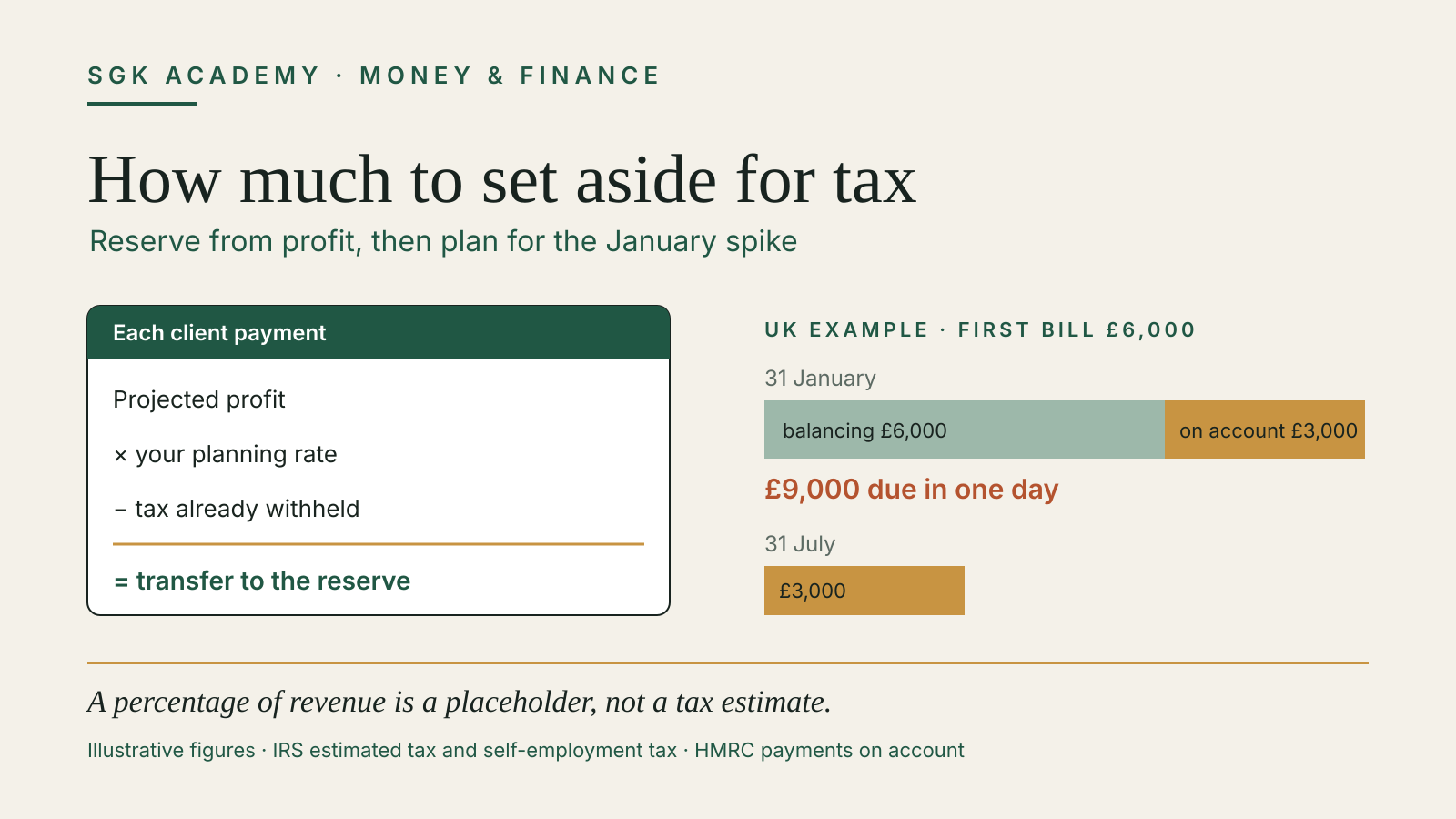
A freelancer tax reserve should be based on projected taxable profit and the rules that apply to you, not a percentage copied from somebody else. A practical system is to transfer a provisional amount whenever a client pays, then recalculate it against real profit and official payment rules every quarter.
Rules and source documents checked: 27 October 2026. This guide explains a cash-planning method, not personal tax advice.
Start with projected profit, not revenue
Putting aside a percentage of every invoice is convenient, but the tax calculation usually starts closer to profit than turnover. Begin with the cash you expect to receive, then subtract only costs that are genuinely deductible under your local rules. After that, estimate the taxes and mandatory contributions that apply, less withholding and credits you can reasonably document.
A useful reserve worksheet has six inputs:
- cash received from clients;
- eligible business expenses;
- projected taxable profit;
- the taxes and contributions that may apply;
- tax already withheld or prepaid; and
- the dates when payments are actually due.
If your work, costs or tax treatment changes, the reserve should change too. This is why a quarterly true-up is more reliable than setting one fixed percentage in January and forgetting it.
A simple reserve formula
Use this planning formula:
Tax reserve transfer = projected profit for the period × provisional planning rate − tax already withheld
The planning rate is an estimate built from your own jurisdiction, income range and tax position. It is not a published universal rate.
Here is an illustrative monthly example for a freelancer who receives €5,000, has €1,200 of eligible costs and uses a 28% planning rate supplied by their own forecast:
| Step | Amount |
|---|---|
| Cash received | €5,000 |
| Eligible business costs | −€1,200 |
| Projected profit | €3,800 |
| Illustrative planning rate | 28% |
| Transfer to tax reserve | €1,064 |
The 28% figure is only a worked assumption. It is not a recommended tax rate. A freelancer with withholding, social contributions, other income, a different legal form or a different country could need a very different amount.
What the reserve has to cover besides income tax
A reserve built only for income tax is usually too small, because self-employed people also pay social contributions on their profit. Those contributions are calculated on their own base and thresholds, so check them as a separate line in the worksheet.
In the United States, the IRS self-employment tax page sets the self-employment tax rate at 15.3%: 12.4% for Social Security and 2.9% for Medicare. You must file Schedule SE and pay it when net earnings from self-employment are $400 or more. The Social Security part stops at an annual earnings limit, while the Medicare part has no limit, and an additional 0.9% Medicare tax applies above $200,000 for a single filer ($250,000 married filing jointly, $125,000 married filing separately). You can deduct the employer-equivalent portion of self-employment tax when you work out adjusted gross income, but that deduction affects income tax only. Estimated tax payments cover self-employment tax as well as income tax.
In the UK, the self-employed pay Class 4 National Insurance through Self Assessment. For the 2026 to 2027 tax year, GOV.UK lists 6% on profits between £12,570 and £50,270 and 2% on profits above £50,270. Class 2 contributions are treated as paid when profits are £7,105 or more. HMRC’s payments-on-account guidance says those payments include Class 4 National Insurance, so the January and July instalments are bigger than an income-tax-only estimate would suggest.
In Spain, autónomos pay a monthly Social Security debit chosen from a band set by expected net returns, and the year is regularised once the tax data arrives. Our guide to autónomo social security contributions shows how to find the band and how much to hold back for that regularisation.
How to choose a provisional percentage
The best starting point is last year’s completed return adjusted for what has changed. Divide the total tax and mandatory contributions connected with the freelance activity by the relevant taxable profit. Then adjust for higher or lower expected profit, changed rates, expiring reliefs, withholding and any new income source.
If you do not have a prior return, use the official estimator or worksheet for your jurisdiction. Build a low, central and high case instead of pretending that one number is certain. Move cash using the central case, but keep enough headroom to survive the high case until a professional or the official calculation confirms the position.
Do not lower the reserve just because the business bank balance feels tight. Update the forecast first. If the business cannot cover both tax and operating commitments, the problem belongs in the cash plan rather than in an optimistic tax assumption. Our 13-week cash-flow forecast guide shows how to put upcoming tax payments into a rolling schedule.
United States: estimated tax is a pay-as-you-go system
The US Internal Revenue Service says individuals generally need estimated tax payments when they expect to owe at least $1,000 after withholding and refundable credits. The official process estimates adjusted gross income, taxable income, taxes, deductions and credits for the year. It is not simply a flat percentage of gross freelance receipts.
For 2026, the IRS Form 1040-ES instructions list four payment due dates: 15 April, 15 June, 15 September and 15 January 2027. The IRS also says taxpayers can refigure estimated tax during the year when income or deductions change.
The commonly used federal safe-harbor test generally compares payments with 90% of current-year tax or 100% of prior-year tax. The prior-year percentage is generally 110% when prior-year adjusted gross income exceeded $150,000, or $75,000 for married filing separately. The detailed conditions matter, so use the worksheet rather than turning those percentages into a blanket reserve rule.
You may transfer money to a separate reserve weekly or whenever a client pays, even though the statutory schedule is periodic. The IRS notes that taxpayers may pay weekly, biweekly or monthly as long as enough has been paid by the end of the relevant payment period. See the IRS estimated tax overview and our guide to estimated tax payments for self-employed people for the mechanics.
United Kingdom: plan for payments on account and the balancing payment
UK Self Assessment can create a cash-flow surprise because payments on account are normally based on the previous year’s bill. HMRC’s guidance says there are usually two payments, due on 31 January and 31 July, each equal to half of the previous year’s tax. Any remaining balancing payment is normally due on the following 31 January.
Payments on account are not required when the previous Self Assessment bill was under £1,000 or when more than 80% of the tax was collected outside Self Assessment, such as through PAYE. Those exceptions should be checked against the actual return, not assumed.
A first substantial Self Assessment bill can therefore combine the balancing payment for the year just ended with the first payment on account for the new year. In cash terms, the January amount can be around one and a half times the prior-year bill before considering any other adjustments. Reserving only for the old year’s balance can leave the next year’s advance unfunded.
Here is an illustrative case. A sole trader’s first Self Assessment bill, for the year just ended, is £6,000, and nothing was paid in advance. The 31 January bill is then the £6,000 balancing payment plus a first payment on account of £3,000 for the current year, so £9,000 leaves the account that day. A second £3,000 payment on account follows on 31 July. A reserve that only held £6,000 in January is £3,000 short, even though every figure follows the rules.
| Date | What is due | Illustrative amount |
|---|---|---|
| 31 January | Balancing payment for the year just ended | £6,000 |
| 31 January | First payment on account for the current year | £3,000 |
| 31 July | Second payment on account for the current year | £3,000 |
HMRC allows a claim to reduce payments on account when expected income is genuinely lower, using the online service or form SA303. It also warns that interest may be charged if the reduction is too large. If regular transfers help, HMRC provides a voluntary Budget Payment Plan for eligible taxpayers who are up to date; those payments reduce the amount still due at the deadline but do not change the deadline itself.
Separate the cash from operating money
A separate savings or tax-reserve account reduces the chance of spending money that is already economically committed. It does not change the legal ownership of the cash or create a tax deduction; it is simply a control.
Use a repeatable transfer rule:
- receive the client payment;
- record the related deductible costs;
- apply the current provisional rate to projected profit;
- subtract documented withholding;
- transfer the result to the reserve; and
- record the transfer in the forecast without treating it as an expense twice.
Automate the transfer only after you have checked that the banking rule matches how revenue actually arrives. If some clients withhold tax and others do not, one blanket automation can over- or under-reserve.
Reconcile every quarter
At the end of each quarter, compare actual profit with the forecast and rebuild the full-year estimate. Include invoices issued but not yet paid only if that matches the accounting basis you actually use. Then compare the revised liability with the reserve balance and amounts already paid.
If the reserve is short, divide the gap across the remaining payment cycles. If it is above the central estimate, keep the surplus until the return or official calculation is sufficiently certain. A strong month can be followed by refunds, chargebacks, equipment purchases or a weaker quarter, so do not distribute the apparent excess automatically.
Track the reserve next to other commitments in your cash runway calculator. The aim is to see both operating runway and tax cash without mixing them.
When the percentage method is not enough
Get jurisdiction-specific help when you have income in more than one country, move during the year, hire staff, incorporate, register for VAT or sales tax, receive equity or crypto compensation, sell major assets, or cannot identify which social contributions apply. A company owner taking salary and dividends should not copy a sole trader’s reserve method.
The same applies if prior returns are late or the records are incomplete. A percentage can make the bank account look organised while the underlying estimate remains wrong.
A monthly checklist
- Reconcile receipts and eligible costs.
- Confirm withholding with documents, not memory.
- Transfer the provisional reserve.
- Update the full-year profit forecast.
- Check the next statutory payment date.
- Recalculate at least quarterly.
- Keep a record of the assumptions and source date.



