Spain’s autónomo system links your contribution base to expected monthly net returns. For 2026, the Social Security table starts with a reduced band for returns up to €670 a month and rises through twelve general bands, with the top band covering returns above €6,000.
This guide explains how to read the official table, turn a band into an estimated monthly payment, and plan for the regularisation that follows once tax data is in.
Source review date: 28 October 2026. The figures below come from Spain’s Social Security administration. Check the live table before changing a base.
The short version
- Estimate your annual net returns under the income tax (IRPF) rules.
- Deduct the general-expense allowance of 7% (3% for some company directors and partners).
- Convert the result to a monthly figure.
- Find the matching 2026 returns band.
- Choose a contribution base between that band’s official minimum and maximum.
- Apply the 2026 contribution rates to estimate the monthly debit.
- Update the estimate if your year changes, and expect a regularisation later.
The table sets a contribution base range. The monthly payment is the chosen base multiplied by the contribution rates, not the base itself.
The 2026 bands
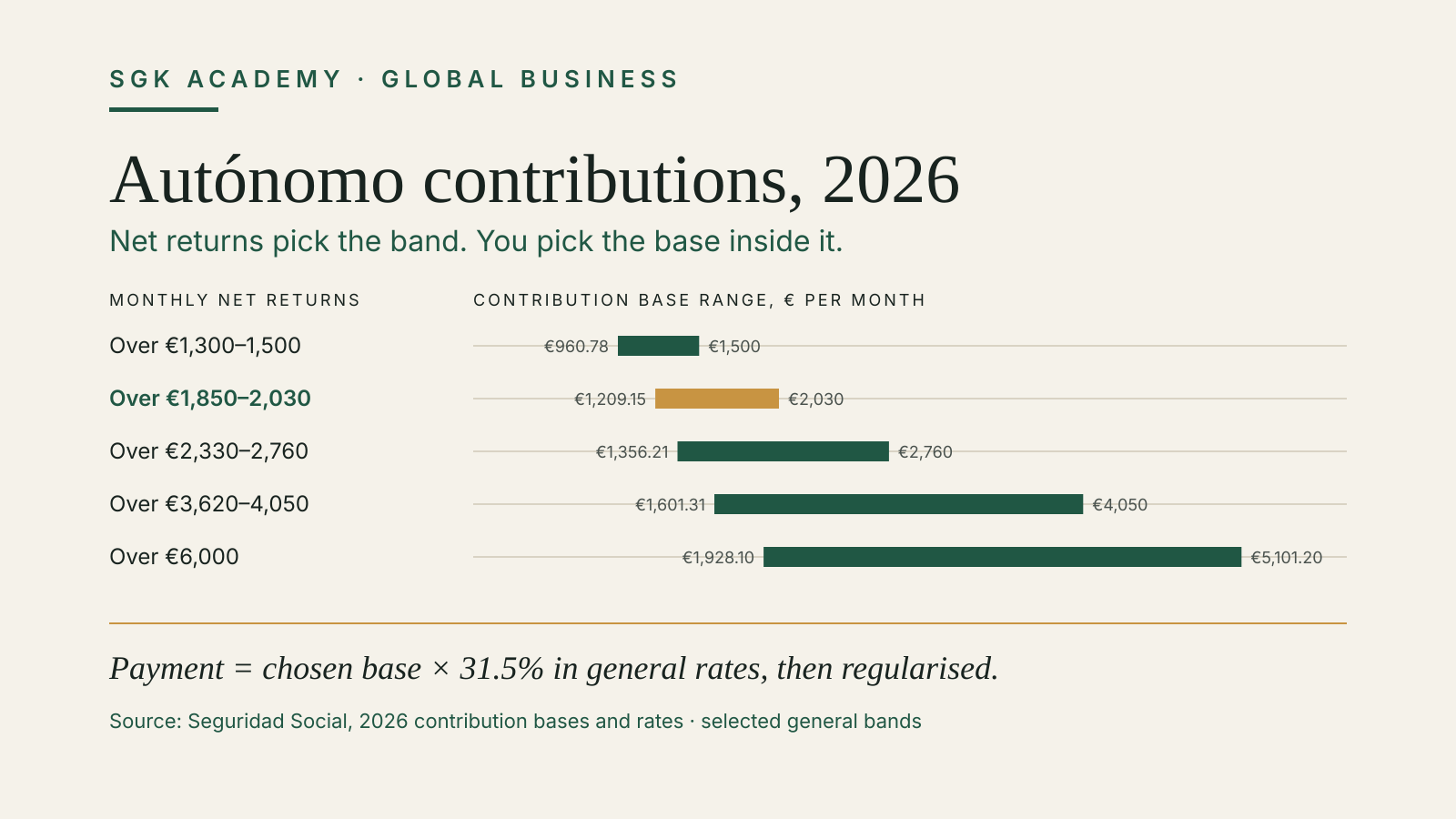
Spain’s Social Security page publishes three reduced bands followed by twelve general bands. The following table reproduces the official monthly net-return thresholds and contribution-base limits.
| Monthly net returns | Minimum base | Maximum base |
|---|---|---|
| Up to €670 | €653.59 | €718.94 |
| Over €670 to €900 | €718.95 | €900.00 |
| Over €900 to under €1,166.70 | €849.67 | €1,166.70 |
| €1,166.70 to €1,300 | €950.98 | €1,300.00 |
| Over €1,300 to €1,500 | €960.78 | €1,500.00 |
| Over €1,500 to €1,700 | €960.78 | €1,700.00 |
| Over €1,700 to €1,850 | €1,143.79 | €1,850.00 |
| Over €1,850 to €2,030 | €1,209.15 | €2,030.00 |
| Over €2,030 to €2,330 | €1,274.51 | €2,330.00 |
| Over €2,330 to €2,760 | €1,356.21 | €2,760.00 |
| Over €2,760 to €3,190 | €1,437.91 | €3,190.00 |
| Over €3,190 to €3,620 | €1,519.61 | €3,620.00 |
| Over €3,620 to €4,050 | €1,601.31 | €4,050.00 |
| Over €4,050 to €6,000 | €1,732.03 | €5,101.20 |
| Over €6,000 | €1,928.10 | €5,101.20 |
The official source is the Social Security contribution-base table. Thresholds use euros per month. The €5,101.20 maximum for the two top bands was set for 2026 by Royal Decree-law 3/2026 of 3 February, according to Social Security’s summary of the income-based system; the 2025 ceiling was €4,909.50.
Compared with 2025, the band thresholds and most minimum bases did not move. The change for 2026 sits at the top: the maximum base for the two highest bands rose. Anyone already paying the old €4,909.50 maximum on 1 January 2026 could ask, until 31 March 2026, for any base up to €5,101.20 with effect from 1 January.
Step one: work out net returns the way Social Security does
Social Security does not use turnover. It starts from the net returns of all your self-employed activities for the calendar year, calculated under the IRPF income tax rules, with some adjustments that depend on the group you belong to. Its guide to the income-based contribution system sets out the next step: deduct 7% for general expenses from that result.
The deduction falls to 3% for two groups, provided they spent at least ninety days in the regime during the year being regularised:
- directors of capital companies who hold 25% or more of the company;
- partners in a capital company with a holding of 33% or more.
The monthly average of what remains is the figure that selects your band. If you run more than one activity, every one of them counts towards the same total; you still hold one registration and pay one contribution.
Contribution base is not the same as net income
The band is selected from net returns, while the base is the amount to which the contribution rates are applied. A person with estimated net returns of €2,100 a month falls in the “over €2,030 to €2,330” band. They then select a base between €1,274.51 and €2,330, subject to the rules that apply to them.
That distinction matters. Copying the minimum-base column into a cash-flow plan as if it were the monthly fee will overstate the debit several times over. The payment depends on the base and the rates in force.
From base to monthly payment: the 2026 rates
The same Social Security page lists the general rates for 2026:
| Item | Rate on the chosen base |
|---|---|
| Common contingencies | 28.30% |
| Professional contingencies (work accidents and occupational illness) | 1.30% |
| Cessation of activity | 0.90% |
| Intergenerational equity mechanism (MEI) | 0.90% |
| Vocational training | 0.10% |
| Total | 31.50% |
Some people pay a slightly different mix. For example, someone already covered for temporary incapacity in another scheme who does not opt into it here gets a reduction on the common-contingency amount, and a person without cover for work accidents pays an extra 0.10% instead. Social Security’s public contribution simulator gives the figure for a specific case.
At the general 31.50%, a few bases from the table translate as follows (simple arithmetic, rounded to the cent):
| Base chosen | Approximate monthly payment |
|---|---|
| €1,209.15 (minimum of the “over €1,850 to €2,030” band) | €380.88 |
| €2,030.00 (maximum of the same band) | €639.45 |
| €1,274.51 (minimum of the “over €2,030 to €2,330” band) | €401.47 |
| €2,330.00 (maximum of the same band) | €733.95 |
The spread inside one band is wide. Choosing the maximum base costs more each month but raises the base on which benefits such as sick pay and the future pension are calculated. Choosing the minimum keeps more cash in the business now. Either way, regularisation compares the base with the band your actual returns support.
Example: variable consulting income
Suppose a consultant forecasts €42,000 of revenue and €16,200 of deductible costs for the year, giving €25,800 of net returns under the tax rules.
- Deduct 7% for general expenses: €25,800 × 0.93 = €23,994.
- Divide by twelve: €1,999.50 a month.
- That falls in the band for returns over €1,850 and up to €2,030.
- The 2026 table allows a base from €1,209.15 to €2,030.
- At the general rates, the monthly payment would run from about €380.88 to €639.45.
Skipping the 7% deduction would have put the same consultant at €2,150 a month, one band higher, with a minimum base of €1,274.51. Small adjustments matter near a threshold.
This is an illustration with invented figures, not a personal contribution calculation. Special statuses, reductions and the exact definition of net returns for your group can change the result.
When a base change takes effect
You can change your base up to six times a year if expected returns move. The request window decides the start date:
| Request made between | New base applies from |
|---|---|
| 1 January and the last day of February | 1 March |
| 1 March and 30 April | 1 May |
| 1 May and 30 June | 1 July |
| 1 July and 31 August | 1 September |
| 1 September and 31 October | 1 November |
| 1 November and 31 December | 1 January of the next year |
The timetable comes from the Social Security contribution-base page. Changes are requested through Import@ss, the Treasury’s online portal. In practice, a forecast review at the end of each two-month window lines up with the change dates; the 13-week cash-flow forecast is a convenient place to hold it.
What happens when the year changes
A provisional base should move with a material change in the business. Review the estimate when:
- a major client starts or ends;
- recurring expenses change;
- you take several months away from work;
- a one-off project shifts the annual result;
- actual profit has moved into another band.
Do not wait for December to notice that the year no longer resembles the original forecast. A two-monthly or quarterly true-up usually catches the change early enough to adjust cash reserves.
Starting out: the reduced flat fee
Social Security’s summary describes a reduced flat fee (tarifa plana) of €80 a month for the first twelve months for people registering for the first time during 2023–2025, or who had not been registered in the previous two years (three years if they had used the reduction before). It must be requested when registering. A further twelve months at a reduced fee is possible when expected annual net returns stay below the annual minimum wage.
The rules page states that the annual amount of the reduced fee is set in each year’s budget law. If you are registering now, confirm the current amount on the income-based system page before planning around it. One caution from the same page: if you claimed the second-year extension and your actual net returns reach the minimum wage, the unpaid contributions for that year are claimed back at regularisation.
Employed and self-employed at the same time
If you also work as an employee, you are in “pluriactividad”. Social Security refunds 50% of the amount by which your combined common-contingency contributions in both schemes exceed €17,323.68 in 2026, capped at 50% of the common-contingency contributions paid as an autónomo. The refund is due within four months of the regularisation, according to the 2026 rules.
Regularisation is the final check
The income-based system uses provisional contributions during the year. After the tax authorities pass on the actual income data, Social Security compares the chosen base with the band supported by actual returns and regularises the result: a refund if you paid too much, a charge if you paid too little.
That is why the monthly debit is not the final word. Keep the calculation, invoices, expenses and any base-change confirmations together. Our guide to how long to keep business records gives a practical filing structure.
If you chose a base below your actual band, the shortfall arrives as a single bill months after the year ends. Holding the difference between the minimum base you pay and the base your forecast supports in a separate reserve turns that bill into a transfer rather than a surprise.
Cash-flow checklist
Before changing a base:
- confirm that the source table says 2026;
- calculate net returns under the tax rules, not turnover;
- apply the 7% or 3% general-expense deduction;
- record the minimum and maximum base for the band;
- model the resulting debit at the current rates;
- keep a buffer for possible regularisation;
- save the filing confirmation;
- diarise the next change window.
If income is irregular, use a conservative owner-pay policy rather than drawing every high-income month. See how much to set aside for tax as a freelancer, how to pay yourself from irregular income and the cash runway calculator. Company-formation facts for Spain are in our Spain jurisdiction profile, and annual filing dates are in the deadlines tool.
Questions people ask
Can I simply choose the lowest base?
You can choose any base within the range for your band. A lower base costs less now, but benefits are calculated on it, and regularisation will charge the difference if your actual returns fall in a higher band.
Does the table show my tax bill?
No. It is a Social Security contribution-base table. Income tax is calculated separately.
What if my income crosses a band during the year?
Update the projection and request a new base in the next change window. The final regularisation uses actual information later.
Are the figures annual?
No. The table labels both net returns and contribution bases in euros per month.
How many times can I change my base?
Up to six times a year, with the new base starting on the first day of the next odd-numbered month after the request window (or 1 January after a November–December request).
Official sources
- Spanish Social Security: 2026 contribution bases, rates and base-change dates
- Spanish Social Security: income-based autónomo contribution system
- Spanish Social Security: public RETA contribution simulator
This guide explains the official framework for planning purposes. It is not individual tax or social-security advice.