If a chatbot on your website tells a customer something wrong, assume your business said it. In Moffatt v. Air Canada (2024), a Canadian tribunal called the airline’s argument that its chatbot was responsible for its own words “a remarkable submission” and ordered the airline to pay. UK consumer law gets there another way: what a trader says to a consumer about a service, including through a bot acting on its behalf, can become a term of the contract. A disclaimer helps less than most businesses expect.
This guide is for small businesses that put an AI assistant in front of customers: a support bot on the website, a booking assistant, a sales chat widget. It sets out what the decided case actually held, which UK and EU rules apply to a wrong answer, what a disclaimer can and cannot do, and the controls that keep the risk proportionate. It reflects the law as checked on 13 November 2026. It is general information, not legal advice for a particular dispute.
The case: what Air Canada’s chatbot cost
In November 2022, after a death in the family, Jake Moffatt asked the chatbot on Air Canada’s website about bereavement fares. The bot said the customer could book now and apply for the reduced rate retroactively within 90 days. Air Canada’s own bereavement page, linked from the bot’s answer, said the opposite: the policy did not apply after travel. When Mr. Moffatt applied, the airline refused, although a representative admitted in writing that the chatbot had used “misleading words”.
The British Columbia Civil Resolution Tribunal decided the claim on 14 February 2024 (Moffatt v. Air Canada, 2024 BCCRT 149). Three passages are the ones a business owner should read.
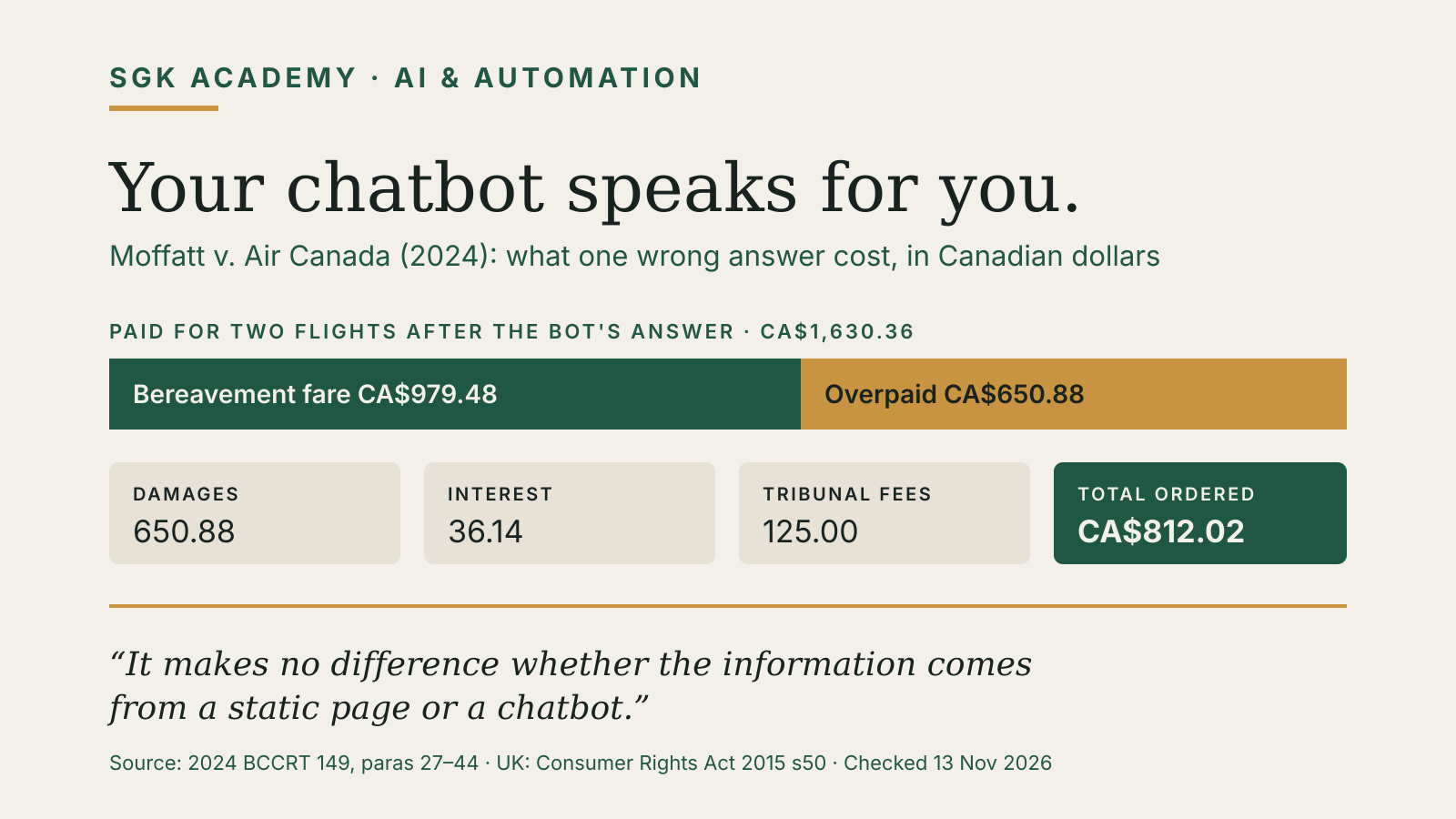
- The bot is part of the business. Air Canada argued it could not be held liable for information provided by its agents or representatives, including a chatbot. The tribunal answered that “while a chatbot has an interactive component, it is still just a part of Air Canada’s website”, and that “it makes no difference whether the information comes from a static page or a chatbot” (paragraph 27).
- “The right answer was elsewhere” is not a defence. The airline said the correct rule was on another page. The tribunal found no reason why customers “should have to double-check information found in one part of its website on another part of its website” (paragraph 28), and held that relying on the bot was reasonable (paragraph 29).
- Terms you do not produce do not help. Air Canada pointed to its tariff but did not file the relevant text, so it “has not proven a contractual defence” (paragraph 31).
The claim succeeded as negligent misrepresentation. The tribunal’s arithmetic is a useful reminder that the exposure is usually the gap between what the customer was told and what happened, plus costs:
| Item (Canadian dollars) | Amount |
|---|---|
| Paid for the two flights | 1,630.36 |
| Cost at the bereavement fare, with the same taxes and charges | 979.48 |
| Damages (the difference) | 650.88 |
| Pre-judgment interest | 36.14 |
| Tribunal fees | 125.00 |
| Total ordered | 812.02 |
Source: paragraphs 37 to 44 of the decision. The sum is small. What changed after the ruling is the argument: a business can no longer expect a tribunal to treat a bot’s answer as somebody else’s mistake.
Moffatt is a small-claims decision from one Canadian province, so it binds no UK or EU court. Its value is the reasoning, which lines up with rules that already exist in both places.
UK: three routes from a wrong answer to a claim
Consumer contracts: the answer can become a term
Section 50 of the Consumer Rights Act 2015 says every contract to supply a service to a consumer is treated as including “anything that is said or written to the consumer, by or on behalf of the trader, about the trader or the service”, if the consumer takes it into account when deciding to enter the contract or when making a later decision about the service.
A chatbot that answers on your website is speaking “on behalf of the trader”. If it tells a customer that a course can be cancelled for a full refund within 30 days, and the customer books because of that, the 30-day promise is a candidate term of the contract, whatever your standard terms say.
Two more provisions shape the outcome:
- Remedies. Where the trader breaks a term that section 50 reads in, section 54 gives the consumer repeat performance or a price reduction, and does not stop the consumer claiming damages, recovering money paid or treating the contract as at an end instead.
- Exclusion. Under section 57(2), a contract term is not binding on the consumer to the extent that it would exclude liability under section 50. A clause saying “our chatbot’s statements are not part of this contract” is therefore weak against a consumer.
For goods, section 11 treats the main characteristics the trader gives before the contract as terms, and any change is not effective unless expressly agreed.
Unfair commercial practices: the regulator’s route
Since 6 April 2025, Part 4 of the Digital Markets, Competition and Consumers Act 2024 has governed unfair commercial practices. Section 226 says a practice involves a misleading action if it involves “the provision of false or misleading information relating to a product, a trader or any other matter relevant to a transactional decision”, and adds that true information presented in a misleading way also counts.
A bot that repeatedly misstates prices, refund rights or delivery times is a commercial practice in its own right. The Competition and Markets Authority can now decide such cases itself: its guidance on direct consumer enforcement says a penalty “can be up to 10% of your business’ global turnover or £300,000 (whichever is greater)”. A single wrong answer is unlikely to bring a regulator; a systematic one is the risk.
Business customers: misrepresentation
When the customer is another business, the Consumer Rights Act does not apply, but the Misrepresentation Act 1967 does in England and Wales. Under section 2(1), a party induced into a contract by a misrepresentation can recover damages unless the party who made it proves it had reasonable grounds to believe, and did believe, that the facts represented were true. A business that let an unsupervised bot quote contract terms will find “we believed the bot” a hard case to prove.
Section 3 adds that a term excluding liability for pre-contract misrepresentation has no effect unless it satisfies the reasonableness test in section 11(1) of the Unfair Contract Terms Act 1977, and the business relying on the term must show that it does.
EU: what applies, and what does not
There is no EU-wide rule that makes a business liable for a chatbot’s words as such. The answer comes from national contract and tort law, consumer protection rules and a few AI-specific provisions.
Misleading practices. Article 6 of the Unfair Commercial Practices Directive treats a commercial practice as misleading if it contains false information, or deceives or is likely to deceive the average consumer, and causes or is likely to cause a decision the consumer would not otherwise have taken. National authorities enforce it, so a chatbot that misstates prices or rights to consumers sits within it.
Telling people they are talking to AI. Article 50(1) of the AI Act requires providers of AI systems that interact directly with people to design them so that people are informed they are dealing with an AI system, unless that is obvious. It has applied since 2 August 2026. Disclosure is about transparency; it does not move liability for wrong answers onto the customer. Our EU AI Act guide for small businesses sets out the deployer duties in full.
The new Product Liability Directive. Directive (EU) 2024/2853 treats software, including AI systems, as a product for no-fault liability. A corrigendum published on 7 May 2026 corrected Article 2(1): the Directive applies to products placed on the market or put into service after 8 December 2026, not after 9 December as first printed. Member states must transpose it by 9 December 2026 (Article 22).
It is easy to overread this for chatbots. Article 6(1) limits compensation to death or personal injury, damage to property, and destruction or corruption of data not used for professional purposes. Recital 24 says pure economic loss does not by itself trigger liability under the Directive, and recital 13 says information is not a product. A customer who paid too much because the bot quoted the wrong refund rule has an economic loss, so the claim runs through contract or consumer law, as in Moffatt, not through product liability.
The AI Liability Directive is gone. The Commission’s 2022 proposal for an AI Liability Directive, which would have eased the burden of proof in fault-based claims involving AI, was formally withdrawn on 6 October 2025. Fault-based claims stay with national law.
Which rule reaches which mistake
| What the chatbot got wrong | Customer | Main route to a claim | Can your terms exclude it? |
|---|---|---|---|
| Refund or cancellation rule | UK consumer | CRA 2015 s50 term, s54 remedies | Not against s50 (s57(2)) |
| Price or discount quoted before purchase | UK consumer | CRA 2015 s50; DMCC Act s226 if repeated | Not against s50 |
| Product specification | UK consumer, goods | CRA 2015 s11 | Change must be expressly agreed |
| Contract terms or service scope | UK business | Misrepresentation Act 1967 s2(1) | Only if reasonable (s3) |
| Any of the above, systematically | Consumers generally | CMA direct enforcement (UK); UCPD Article 6 (EU) | No |
| Advice that leads to injury or damaged personal property | Individual, EU, product placed on the market after 8 Dec 2026 | Product Liability Directive 2024/2853 | No (no-fault regime) |
Section numbers refer to the statutes linked above. The table shows where a claim would start, not whether it would succeed.
Do chatbot disclaimers work?
Partly, and less than the wording usually suggests.
What helps is a qualification given at the same time as the answer. Section 50(2) of the Consumer Rights Act makes what the consumer took into account “subject to anything that qualified it and was said or written to the consumer by the trader on the same occasion”. A bot that answers “Our standard terms allow a refund within 14 days; your booking confirmation is the binding version” has qualified its own statement. A footer link to terms that the customer never saw does much less.
What does not help:
- a general clause excluding liability for chatbot statements in a consumer contract (section 57(2));
- the argument that the correct answer was on another page, which the tribunal in Moffatt rejected (paragraph 28);
- a term you cannot produce when the dispute comes (paragraph 31).
For business customers, a clear entire-agreement and non-reliance clause in the signed contract is more useful than a banner on the chat window, but under section 3 of the Misrepresentation Act it still has to be reasonable.
Worked example (illustrative)
A UK training company sells a £600 online course to consumers. Its terms allow cancellation with a full refund within 14 days of purchase. On day 1 a customer asks the website assistant, “Can I get my money back if I change my mind next month?” The assistant answers: “Yes, you can cancel within 30 days for a full refund.” The customer buys. On day 25 the customer cancels and asks for the £600.
| Question | Answer under UK law |
|---|---|
| Was the statement made on behalf of the trader? | Yes: the assistant answers on the company’s site, for the company |
| Did the customer take it into account? | The chat log shows it was asked before purchase, so very likely |
| Was it qualified on the same occasion? | No: the answer gave no reference to the 14-day term |
| Does the 14-day clause in the terms save the company? | Not to the extent it would exclude the s50 term (s57(2)) |
| Likely exposure | Up to the £600 price through the section 54 remedies (a price reduction, or recovering money paid), plus staff time and goodwill |
Now change one thing. The assistant is configured so that refund questions get a fixed answer: “You can cancel within 14 days of purchase for a full refund. Your booking confirmation sets out the full terms.” The same customer asks the same question. The statement now matches the terms, and there is no gap to claim.
The cheapest control was not a disclaimer. It was deciding in advance which questions the bot may answer freely and which get a fixed, checked answer.
Controls for a small business
- List the answers that bind you. Prices, discounts, refunds, cancellation, delivery dates, warranties, eligibility and anything that sounds like a promise. For each, give the bot a fixed answer drawn from your current terms, or route the question to a person.
- Qualify in the answer itself. Where the bot summarises a rule, have it say in the same message where the binding version is.
- Keep the logs. The chat transcript is your evidence of what was said, and whether it was qualified. Set a retention period that covers your complaint and limitation windows, and record it in your data processing agreement for the AI tool.
- Test with real customer questions. Run the twenty questions your support inbox gets most often through the bot after every model, prompt or knowledge-base change, and compare the answers with your terms. Our guide to AI agent tests shows how to build a small test set.
- Watch what the bot reads. If the assistant draws on uploaded documents or web pages, an outdated PDF or a hostile instruction can change its answers. See prompt injection in business workflows.
- Check the vendor contract. Look for any cap on the vendor’s liability and what it is measured against. Moffatt was about the business that deployed the bot, not its supplier, so assume the loss lands with you unless the contract says otherwise. Our software supplier checks cover what to ask.
- Write it down for staff. Who may change the bot’s instructions, who reviews its answers and who handles complaints belong in your AI acceptable use policy.
- Honour the answer when it was clearly wrong. Refunding a small amount quickly costs less than a tribunal claim, and the chat log will usually decide the outcome anyway.