A small business does not need a fifty-page governance manual before staff use generative AI. It does need an AI acceptable use policy: a short, enforceable answer to four questions about which tasks are allowed, which data may enter a tool, who checks the output, and what happens when something goes wrong.
The NIST Generative AI Profile, published as NIST AI 600-1 on 26 July 2024, is a voluntary companion to the AI Risk Management Framework. It is cross-sector guidance rather than a ready-made company policy. The useful move for a small business is to turn its risk-management ideas into decisions that employees can follow during ordinary work.
What the NIST profile actually asks for
The profile does not leave the policy idea implicit. In its Govern section, suggested action GV-1.4-002 reads: “Establish transparent acceptable use policies for GAI that address illegal use or applications of GAI.” A second action, GV-3.2-003, asks organisations to define acceptable use policies for generative AI interfaces, modalities and human-AI configurations, including chatbots and decision-making tasks. Both are in the full NIST AI 600-1 PDF.
The same document lists twelve risks that are unique to generative AI or made worse by it. A small business will not need a rule for every one of them, but several map directly onto everyday office use:
| NIST risk | What it means in the profile | The policy rule it suggests |
|---|---|---|
| Confabulation | Confidently stated but erroneous or false content | Named human review before output is used externally |
| Data privacy | Leakage or unauthorised use of personal or sensitive data | Data classes that may and may not enter a tool |
| Information security | Lower barriers for attacks and a larger attack surface | Approved accounts only; no credentials in prompts |
| Intellectual property | Easier production or replication of protected content | Checks before publishing generated text or images |
| Human-AI configuration | Over-reliance, automation bias, anthropomorphising | Clear wording that output is a draft, not a decision |
| Value chain and component integration | Third-party components that are hard to trace | Supplier review before connecting a new tool |
The other six risks, such as CBRN information or obscene content, usually belong in the prohibited lane of the policy rather than in a separate control. For a business that publishes generated material, the AI-generated content copyright guide covers the intellectual-property side in more detail.
Start with an approved-use table
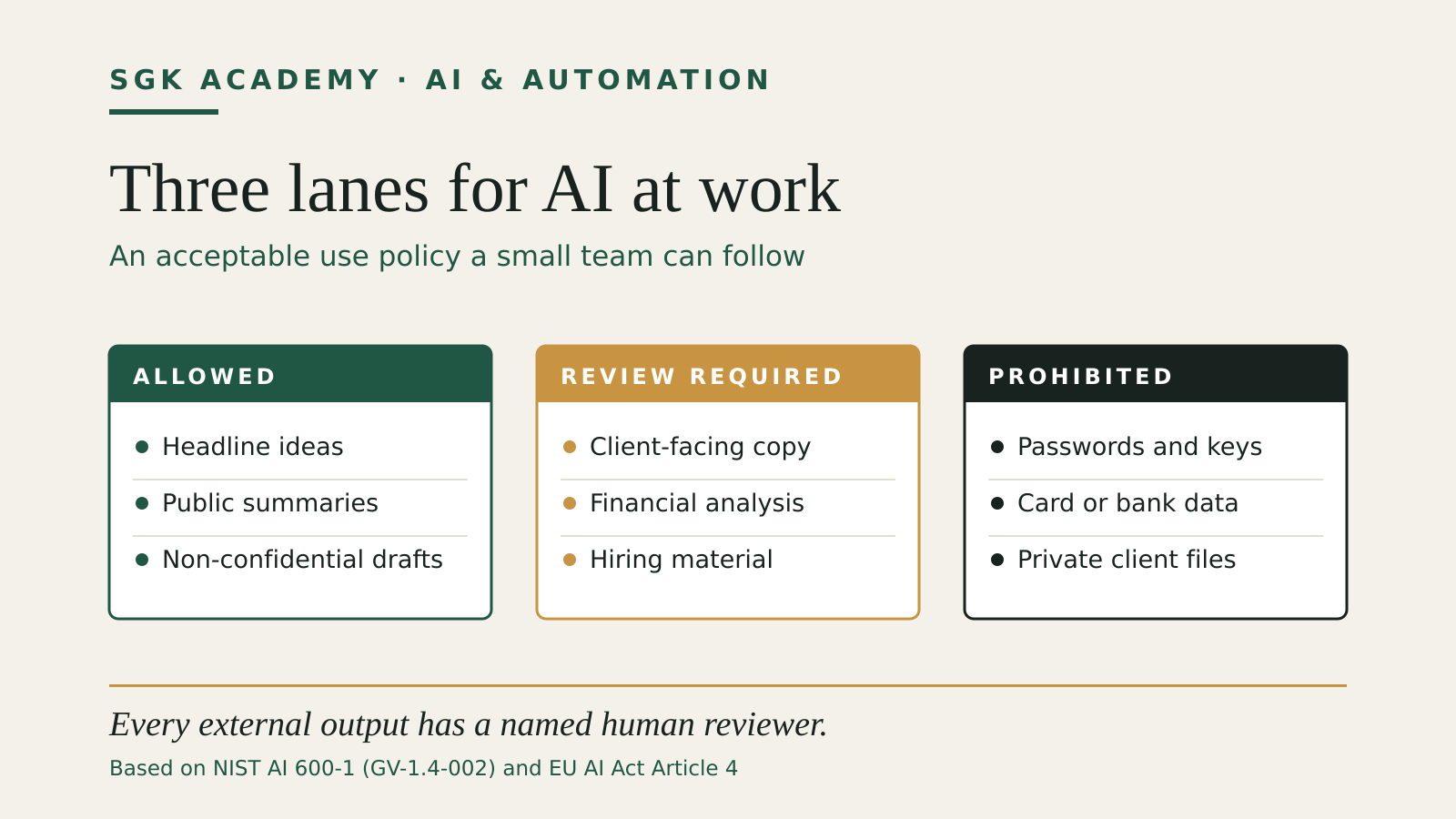
Do not begin with a blanket statement such as “use AI responsibly.” List common tasks and put each into one of three lanes:
| Lane | Typical examples | Rule |
|---|---|---|
| Allowed | brainstorming headings, summarising public material, rewriting a non-confidential draft | Staff may proceed within the data rules |
| Review required | customer-facing copy, financial analysis, hiring material, code changes | A named human checks before use |
| Prohibited | entering passwords, payment-card data, private client files or unapproved regulated data | Do not use the tool |
The table should name approved tools or accounts as well. A paid business account may have different retention and training terms from a free consumer account. The policy should require the employee to use the approved environment, not whichever chatbot happens to be open.
This is the practical “map” step in the NIST approach: understand the context, users, data and possible effects before deciding how the tool may be used. NIST’s AI RMF Core organises the work around Govern, Map, Measure and Manage, with governance running across the other functions.
Draw a hard line around data
The policy should say what employees may paste, upload or connect. Use categories that already make sense inside the company:
- public information;
- internal information approved for the tool;
- confidential business information;
- personal or customer data;
- credentials and security secrets;
- regulated data handled under a separate process.
A clear default is useful: if the employee cannot classify the information, they must not send it to the AI service until an owner approves it. This is easier to enforce than expecting every person to interpret a broad confidentiality clause.
The rule should also cover connected features. Uploading a spreadsheet, enabling a browser extension or linking a cloud drive can expose more than the prompt itself. The same approval and data limits should apply to files, connectors, plugins and automated workflows.
If vendors handle customer or employee data, pair this policy with the company’s data-processing agreement checklist. The acceptable-use policy controls employee behaviour; the supplier review controls what the service promises to do with the data. Where a new use involves personal data at scale or a decision about people, the DPIA guide for AI tools explains when a data protection impact assessment is needed before the tool goes live.
Assign a human decision owner
AI output is a draft or recommendation until a named person accepts it. The policy should identify who performs that check for each higher-risk use.
For customer communications, the reviewer checks accuracy, tone, promises and links. For finance work, they confirm calculations against the source records. For hiring or performance decisions, a responsible manager reviews the evidence and applicable rules rather than treating an AI score as a decision. For code, an authorised reviewer examines the change and runs the normal test and security process.
This review requirement should be tied to consequence. A typo in an internal brainstorm is not the same as a wrong invoice, unsafe instruction or rejected job applicant. NIST describes risk management as continuous and contextual, so the review level should reflect the people, data and decisions affected.
Decisions about people need extra care in the UK. Where a decision with legal or similarly significant effect is based solely on automated processing, the automated decision-making guide explains the safeguards that apply. A policy line that keeps a human in the decision is often the simplest way to stay outside that situation.
Teams with EU staff or customers: AI literacy
The EU AI Act adds one obligation that reaches ordinary business users, not only AI developers. Article 4, as amended by the Digital Omnibus on AI and shown on the European Commission’s AI Act Service Desk, says that providers and deployers of AI systems “shall take measures to support the development of AI literacy of their staff and other persons dealing with the operation and use of AI systems on their behalf”. The same paragraph now adds that the obligation does not require a business to guarantee any specific level of AI literacy for any individual. The Commission is to publish practical examples of compliance, with particular support for SMEs.
A business that uses an AI system in the course of its work is a deployer under the Act. An acceptable use policy is a natural home for the literacy measures: a short briefing when someone gets access, the approved-use table, examples of confabulated output, and a record of who received the briefing. The AI Act guide for small businesses sets out the rest of the Act’s timetable and which obligations apply when you only use AI tools.
Require traceability for consequential work
Small teams do not need to store every casual prompt. They should retain enough evidence for work that could affect money, access, customers or legal duties. A simple record can include:
- the task and business owner;
- the tool and account used;
- the source material supplied;
- the date and model or product version when visible;
- the reviewer and decision;
- any correction, complaint or incident.
The purpose is to reconstruct the decision, not to create paperwork for its own sake. When an output becomes part of a client deliverable or operational decision, the record should follow the business’s normal retention rules.
For tool access itself, use a defined joiner and leaver process. The cloud-access offboarding checklist is a useful companion because a policy is ineffective if former staff or unused integrations keep access. The software asset inventory guide shows how to keep approved AI services in the same register as the rest of the company’s software.
Add a short incident route
Tell staff what to do if sensitive data is entered into the wrong tool, an output causes harm, or a model produces a serious error. The first instruction should be concrete: stop the workflow, preserve the relevant record, notify the named owner and follow the existing security or privacy incident process.
Do not ask employees to quietly “fix the prompt” and continue. A recurring failure may require a tool setting change, a stronger review step or removal of the use case. That is the Manage part of the cycle: act on measured risk and adjust controls. If personal data was exposed, the data breach reporting guide covers the 72-hour assessment.
Illustrative example: a five-person design studio
The following scenario is illustrative, not a documented case. A studio uses one paid AI writing assistant and an image tool. Its policy fits on a page:
- Allowed: first drafts of blog posts from public sources, alternative headlines, meeting-note summaries without client names.
- Review required: anything sent to a client, any image used commercially, any quote or estimate. The account lead signs off.
- Prohibited: uploading unreleased client brand files to a tool not on the approved list; pasting invoices, bank details or passwords.
- Records: client deliverables that used AI carry a note in the project file naming the tool and the reviewer.
- Incident: a designer who uploads the wrong file tells the operations lead the same day; the lead checks the tool’s deletion options and the client contract.
Nothing in that list needs special software. It needs one owner, one approved-tool list and a habit of writing down who checked what.
A one-page policy structure
A usable policy can fit on one page before its appendices:
- Purpose and scope: who and which tools are covered.
- Approved, review and prohibited uses: the decision table.
- Data rules: what may enter tools and connectors.
- Human accountability: who reviews higher-impact outputs.
- Training: the briefing new users get and how it is recorded.
- Records: what evidence must be retained.
- Incidents: who to notify and what to preserve.
- Review date and owner: when the policy is reconsidered.
Have people from operations, security, privacy and the affected work review it. NIST’s guidance specifically values diverse perspectives in governance because risks look different to developers, managers, users and people affected by the system.
Review the policy when the workflow changes
Set a regular review date, but do not wait for it when the company adopts a new tool, connects a new data source, automates a decision or receives a material complaint. Record the policy version and the service terms or documentation date used for the review.
Guidance checked: NIST AI 600-1 (publication page and PDF), NIST AI RMF Core and Article 4 of the EU AI Act on the Commission’s AI Act Service Desk (consolidated text as at 27 July 2026), accessed 31 October 2026. This guide is operational guidance, not legal advice.
Questions to ask internally
- Which three AI uses are already happening without a written owner?
- What information would cause the most harm if it entered an unapproved tool?
- Which outputs need independent review before a customer or employee sees them?
- Can the team reconstruct a consequential AI-assisted decision six months later?