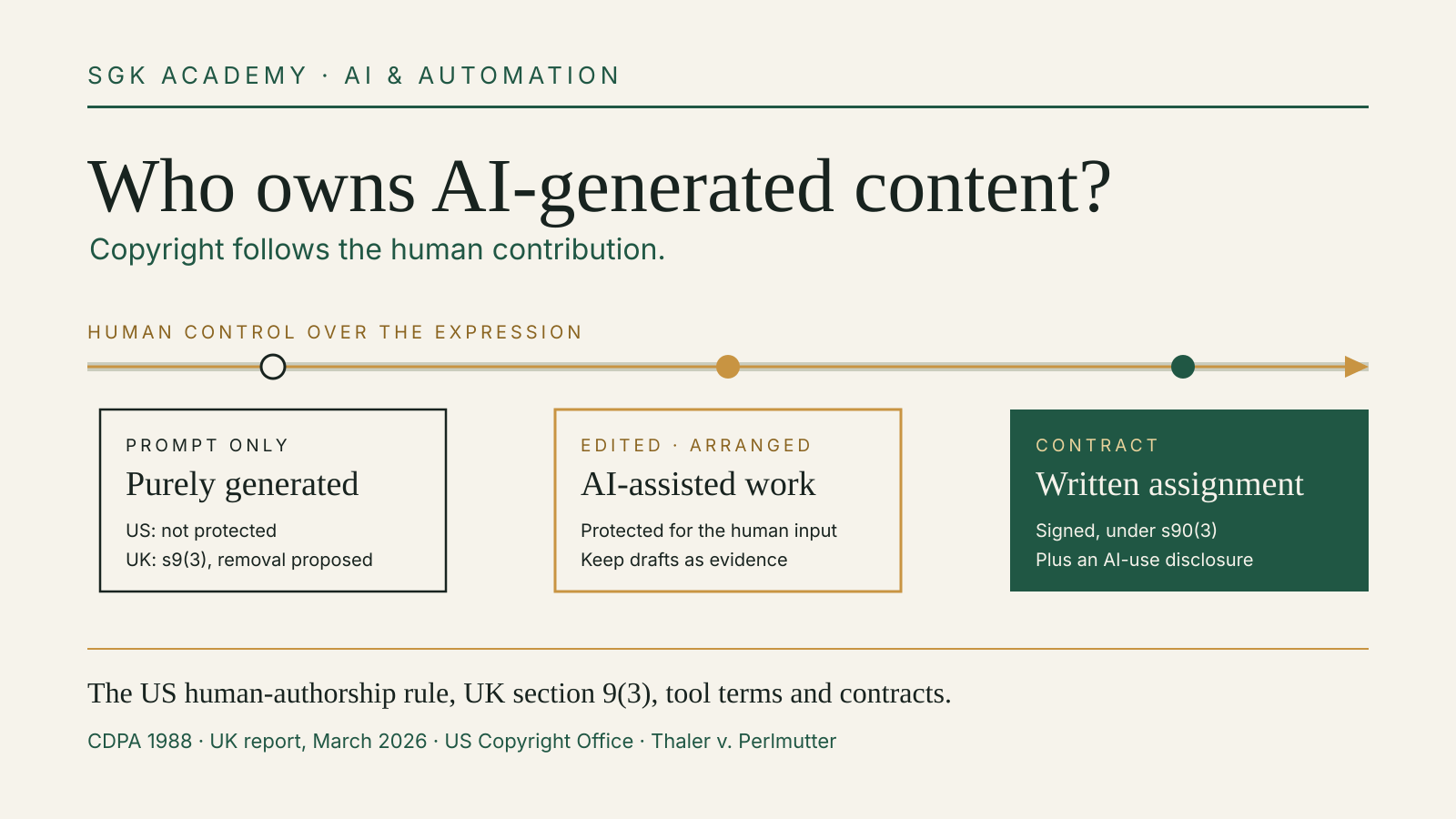
AI-generated content copyright is less settled than most tool terms suggest. In the US, material produced purely by an AI system is not protected, and a prompt alone does not make you its author. In the UK, the law still contains a special rule for “computer-generated” works, but the government said in March 2026 that it proposes to remove it. For a small business, the practical answers sit in three places: how much human work is in the output, what your contracts say, and what the AI provider’s terms assign.
Source and version check: reviewed 20 October 2026 against the Copyright, Designs and Patents Act 1988 (sections 9, 11, 12, 90 and 178) on legislation.gov.uk, the UK government’s Report on Copyright and Artificial Intelligence (18 March 2026), the US Copyright Office’s Copyright and Artificial Intelligence, Part 2: Copyrightability (January 2025), the D.C. Circuit’s decision in Thaler v. Perlmutter (18 March 2025), the US Supreme Court docket in case 25-449 and OpenAI’s Terms of Use effective 1 January 2026. This guide is general information on UK and US law, not legal advice.
Why ownership matters to a small business
Most firms meet this question in ordinary work rather than in a lawsuit. A founder drafts website copy with a chatbot. A designer uses an image generator for a campaign. An agency delivers a logo and mentions that AI helped. Each case raises the same practical questions:
- Can the business stop a competitor copying the material?
- Can it register the work or sell rights in it?
- Did the person who made it actually transfer whatever rights exist?
- Is there a risk that the output copies someone else’s work?
Copyright answers the first three only if the material is protected in the first place. That is where AI changes the analysis.
United States: human authorship is required
The Copyright Office’s position
The US Copyright Office published Part 2 of its report on copyright and AI on 29 January 2025. Its conclusions are the most useful starting point for a business using generative tools in the US:
- using AI tools to assist, rather than stand in for, human creativity does not affect the availability of copyright protection for the output;
- copyright protects the original expression in a work created by a human author, even if the work also includes AI-generated material;
- copyright does not extend to purely AI-generated material, or material where there is insufficient human control over the expressive elements;
- whether human contributions are enough must be decided case by case;
- based on current generally available technology, prompts alone do not provide sufficient control;
- human authors are entitled to copyright in their own expression that is perceptible in an AI output, and in the creative selection, coordination or arrangement of material in the output, or creative modifications of it.
The report explains its reasoning on prompts directly: they “essentially function as instructions that convey unprotectible ideas”, and while detailed prompts may describe what the user wants, they do not control how the system produces the result.
The courts
In Thaler v. Perlmutter, decided on 18 March 2025, the US Court of Appeals for the D.C. Circuit upheld the refusal to register an artwork that its owner said had been created autonomously by his AI system. The court held that the best reading of the Copyright Act is that human authorship is required for registration.
The US Supreme Court’s docket for case 25-449 records that the petition for review was denied on 2 March 2026. The D.C. Circuit’s ruling therefore stands.
Registering a work that includes AI material
The Copyright Office report describes its registration guidance: if a work contains more than a de minimis amount of AI-generated material, the applicant should disclose that and provide a brief statement describing the human author’s contribution. The report says the Office has registered hundreds of works incorporating AI-generated material, with the registration covering the human contribution.
The report gives an example the Office has accepted: a comic book combining human-written text with AI-generated images, where the selection and arrangement of the images with the text was protectable as a compilation, though the AI images alone were not.
United Kingdom: a special rule that may be removed
What the 1988 Act says
The UK’s Copyright, Designs and Patents Act 1988 is unusual. Section 178 defines a “computer-generated” work as one generated by computer in circumstances where there is no human author. For such literary, dramatic, musical or artistic works, section 9(3) says the author is taken to be “the person by whom the arrangements necessary for the creation of the work are undertaken”. Under section 12(7), copyright in a computer-generated work lasts 50 years from the end of the year in which it was made, rather than the life-plus-70-years term for ordinary works.
On the face of it, that suggests a UK business using AI could own copyright in wholly machine-made output. The government’s own analysis is more cautious.
The government’s 2026 report
The Report on Copyright and Artificial Intelligence, published on 18 March 2026 with an impact assessment, addresses computer-generated works directly. It makes three points a business should know:
- The rule may not work as written. The report says there “appears to be a legal contradiction within section 9(3)”. The provision applies only to original works, and the modern test of originality is an “author’s own intellectual creation” reflecting creative choices and a “personal touch” – a test associated with human qualities. Yet section 9(3) only applies to works without a human author. In the government’s view, a court is unlikely to conclude that the provision can never apply, but it is unclear how an original, wholly machine-authored work would be defined without case law.
- Most countries do not have it. The report notes that most jurisdictions, including the USA and China, provide no specific protection for computer-generated works.
- The government proposes removal. It says it will continue to monitor the use and impact of this protection but, “in the absence of evidence of its ongoing value”, proposes that the specific protection for wholly computer-generated works should be removed, while copyright continues to protect works created with AI assistance.
The report is a statement of policy, not a change in the law. At the time of this review, section 9(3) remains on legislation.gov.uk. Any removal would need legislation, and its timing and transitional rules are not yet known.
The same report notes that there are currently no UK obligations to label AI-generated content and that the government proposes to work with industry on best practice for labelling.
UK and US compared
| Question | United States | United Kingdom |
|---|---|---|
| Purely AI-generated output | Not protected (Copyright Office; Thaler) | Possibly protected under s9(3), with doubts about originality; removal proposed |
| AI-assisted work with human creative input | Protected for the human contribution | Protected as an ordinary work |
| Is a prompt enough for authorship? | No, under the Copyright Office’s current view | Not addressed by statute; the report’s originality analysis points to human creative choices |
| Term for a computer-generated work | Not applicable | 50 years from the end of the year made (s12(7)) |
| Registration | Disclose more than de minimis AI material | No copyright registration system |
What the AI provider’s terms add, and what they cannot
Tool terms often say that you own the output. OpenAI’s Terms of Use, effective 1 January 2026, are typical: as between the user and OpenAI, and to the extent permitted by applicable law, the user owns the output, and OpenAI assigns to the user “all our right, title, and interest, if any, in and to Output”. The same terms warn that output may not be unique and that other users may receive similar output, and the assignment does not extend to other users’ output. Those terms state that users in the European Economic Area, Switzerland and the UK are covered by a separate set of terms, and business products have their own.
Read that assignment carefully. It transfers whatever rights the provider has; the words “if any” acknowledge that there may be none. A contract between you and a tool provider cannot create copyright the law does not recognise, and it does not bind third parties. What it does is stop the provider from claiming the output against you.
Contracts with staff, freelancers and agencies
Ownership of human-created work still follows the ordinary rules, and those rules matter more when AI is in the workflow.
- Employees. Under section 11(2) of the 1988 Act, where a literary, dramatic, musical or artistic work is made by an employee in the course of employment, the employer is the first owner of any copyright, subject to any agreement to the contrary.
- Freelancers and agencies. A contractor is not an employee, so the creator is usually the first owner. Section 90(3) says an assignment of copyright is not effective unless it is in writing signed by or on behalf of the assignor. A paid invoice is not an assignment.
For commissioned creative work, add clauses that answer the AI questions explicitly:
- whether AI tools may be used, and for which parts of the job;
- a duty to disclose which deliverables contain AI-generated material, and which tools produced it;
- an assignment of all copyright in the deliverables that exists, signed in writing;
- a warranty that the contractor has the rights it is assigning, and that the deliverables are not knowingly copied from third-party works;
- delivery of working files, prompts and drafts where they show the human contribution.
The last point is practical rather than legal. If the business later needs to show which parts of a logo or text were human work, the drafts and editing history are the evidence.
A working policy for AI-assisted content
- Decide what must be protectable. A brand mark, product design or flagship content asset needs strong ownership. A one-off social post may not.
- Keep humans in the expressive decisions. Write, select, arrange and edit; use AI output as material, not as the finished work, where ownership matters.
- Record the process. Keep drafts, edit history and a short note of what the person changed.
- Do not rely on exclusivity for raw output. Provider terms themselves warn that similar output can be produced for others.
- Check for copying. Search for close matches before using generated images, text or code in public material.
- Register where available. For important US works, follow the Copyright Office’s disclosure rules for AI material.
- Align contracts. Make sure employment and contractor agreements cover AI use, disclosure and written assignment.
For the regulatory side of using AI tools in a business, see our guide to the EU AI Act for small businesses. For decisions an AI system makes about people, see automated decision-making under UK GDPR.
A worked example
The scenario below is illustrative.
A small UK company asks a freelance designer for a new logo. The designer generates thirty images from prompts, picks one and delivers it unchanged. The company pays the invoice and starts using the mark in the UK and the US.
- US: on the Copyright Office’s analysis, the unchanged image is purely AI-generated, so there is no copyright to protect it there.
- UK: the company might argue that the logo is a computer-generated work under section 9(3), but the government’s report questions whether such a work can be original, and the government proposes removing the protection. Even if copyright exists, the “arrangements necessary” may have been made by the designer, not the company, and there is no signed assignment.
Now change the process. The designer uses AI images as a starting point, redraws the mark by hand, chooses its proportions and lettering and delivers vector files with drafts. The contract includes a signed assignment and an AI-use disclosure. The human contribution is now protectable in both countries, ownership has passed to the company in writing, and the drafts show who did what.
Official sources
- Copyright, Designs and Patents Act 1988, section 9
- Copyright, Designs and Patents Act 1988, section 11
- Copyright, Designs and Patents Act 1988, section 12
- Copyright, Designs and Patents Act 1988, section 90
- Copyright, Designs and Patents Act 1988, section 178
- UK government: Report on Copyright and Artificial Intelligence (18 March 2026)
- US Copyright Office: Copyright and Artificial Intelligence, Part 2: Copyrightability
- US Copyright Office: Copyright and Artificial Intelligence hub
- US Court of Appeals for the D.C. Circuit: Thaler v. Perlmutter, No. 23-5233
- US Supreme Court docket 25-449
- OpenAI Terms of Use