Paying employees in crypto sounds like a payment choice. For tax purposes it is a payroll event first. In the UK, HMRC treats tokens such as bitcoin as earnings that normally go through PAYE at an estimated sterling value. In the US, the IRS treats them as wages subject to withholding, FICA and FUTA. The company also disposes of an asset when it hands the tokens over, so the same payment can create a gain or loss on the employer’s side.
Source and version check: reviewed 20 October 2026 against HMRC’s Cryptoassets Manual (CRYPTO21100, CRYPTO40100, CRYPTO41250, CRYPTO42050 to CRYPTO42300 and CRYPTO43000), HMRC’s Employment Income Manual (EIM11900 and EIM11956), the National Minimum Wage Regulations 2015 on legislation.gov.uk and the IRS page Frequently asked questions on virtual currency transactions (last reviewed or updated 30 June 2026). This guide covers UK and US federal rules only. It is not payroll or tax advice for a particular company.
What actually happens when salary is paid in tokens
Strip away the wallet and the exchange, and three separate things take place at the same moment:
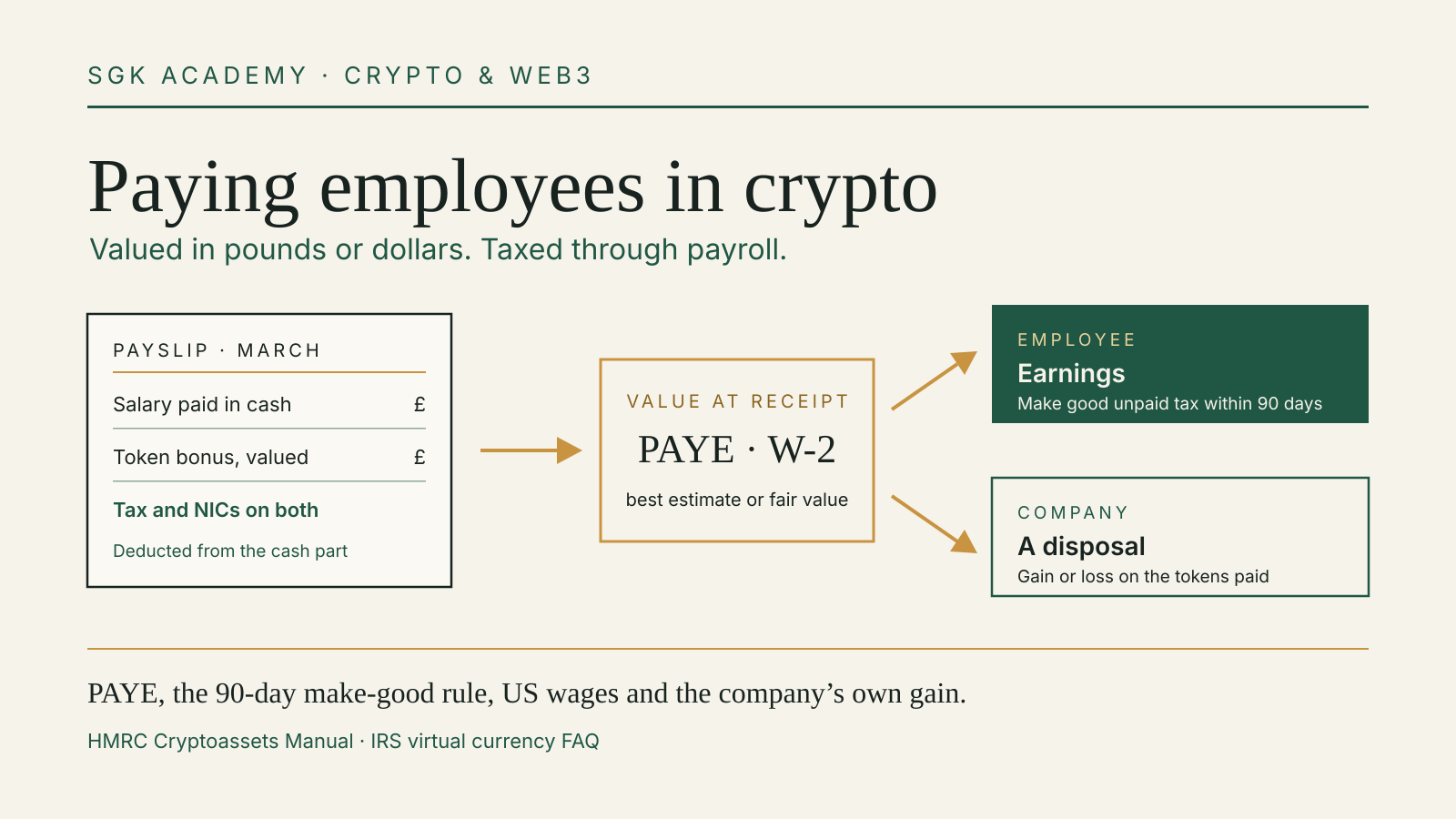
- The employee receives earnings. The value of the tokens on the day they are received is pay for the work.
- The employer has payroll duties on that value. Income tax and social security contributions are worked out on a currency figure, not on a number of tokens.
- The employer disposes of an asset. If the company held the tokens before paying them out, it has given them away in exchange for the employee’s services.
Most of the practical trouble comes from the fact that the first two happen in pounds or dollars, while the payment itself happens in something else. There is no cash in the payment from which to deduct tax, and the value can move between the time the payroll is calculated and the time the transfer lands.
For the opposite direction, when customers pay your business in crypto, see our guide to accepting crypto payments as a small business. The mechanics differ because a customer payment is income for the business, not pay for an employee.
UK: tokens are earnings, and usually go through PAYE
Earnings in money’s worth
HMRC’s Cryptoassets Manual at CRYPTO21100 states that cryptoassets received as employment income count as “money’s worth” and are subject to income tax and National Insurance contributions on the value of the asset. The employer-facing page, CRYPTO42050, repeats the point: HMRC considers exchange tokens to be employment income subject to income tax and NICs.
That settles the first question many founders ask. Paying in tokens does not move the payment outside payroll. It changes how payroll has to be operated.
Readily convertible assets
The way the tax is collected depends on whether the tokens are “readily convertible assets” (RCAs) under section 702 of the Income Tax (Earnings and Pensions) Act 2003. HMRC’s Employment Income Manual at EIM11900 lists the ways an asset can qualify; one of them is that trading arrangements exist, or are likely to come into existence, that let the asset be converted into money.
For exchange tokens, HMRC’s view is direct. CRYPTO42100 says that HMRC considers exchange tokens generally will be readily convertible assets, because they can be exchanged on token exchanges for money.
When the tokens are RCAs, the employer must:
- value the tokens using its best estimate;
- put that value through PAYE income tax and Class 1 National Insurance contributions;
- report and pay the amounts to HMRC under the normal Real Time Information process.
CRYPTO42200 confirms that HMRC treats RCA tokens as earnings for National Insurance purposes, so both primary (employee) and secondary (employer) Class 1 contributions are due through PAYE for the earnings period.
The cash problem and the 90-day make-good rule
PAYE normally works by deducting tax from the pay itself. A token transfer has nothing to deduct from. HMRC’s answer in CRYPTO42100 is that the employer generally recovers the tax and employee NICs from other payments of employment income made to the employee, such as the sterling part of the salary in the same period.
If the employer cannot recover the amount, it still has to account to HMRC for the full tax and NICs due. The employee must then “make good” the income tax and employee NICs the employer paid on their behalf. EIM11956, which explains section 222 of ITEPA 2003, sets the deadline for notional payments made after 5 April 2014: the end of the period of 90 days after the end of the tax year in which the payment was made.
Miss that deadline and the unpaid amount itself becomes further taxable employment income. CRYPTO42100 adds that both primary and secondary Class 1 contributions arise on it as well. EIM11956 also notes that the employer reports the amount for the employee on form P11D for the tax year concerned, and that repaying it late does not remove the charge.
In practice, this is the strongest argument for keeping at least part of each salary in sterling. It gives payroll something to deduct from.
When the tokens are not readily convertible
Some tokens have no exchange market. CRYPTO42250 covers that case:
- the employer does not apply PAYE income tax or Class 1 NIC deductions;
- the employee declares the value on the employment pages of their Self Assessment return and pays the income tax through Self Assessment;
- for National Insurance, the employer treats the payment as a benefit in kind and reports and pays any Class 1A contributions.
Whether a particular token is an RCA is a factual question. A token that is not listed today may become tradable later, and section 702 counts arrangements that are “likely to come into existence”. Record why you reached your conclusion at the time of each payment.
Tokens paid through someone else
If a third party, such as a token issuer or a group company, delivers the tokens, CRYPTO42300 says an income tax charge may arise under Part 7A of ITEPA 2003. The employer is still required to account for income tax through PAYE on the best estimate that can reasonably be made, while the Class 1A liability can in some circumstances fall on the third party.
UK: the parts of a pay package tokens cannot replace
Two rules limit how far tokens can stand in for money.
Pension contributions. CRYPTO43000 states that HMRC does not consider exchange tokens to be currency or money, so they do not count for the deduction provisions for employer contributions to registered pension schemes. Pension contributions should stay in money.
The minimum wage. Regulation 10 of the National Minimum Wage Regulations 2015 lists payments and benefits that do not count towards a worker’s pay for minimum wage purposes. Paragraph (f) covers “benefits in kind provided to the worker, whether or not a monetary value is attached to the benefit, other than living accommodation”, and paragraph (g) covers vouchers and similar documents exchangeable for money, goods or services. Neither the regulations nor HMRC’s manual says expressly how tokens are classified for minimum wage purposes. Given HMRC’s statement that tokens are not money, the cautious design is to pay at least the minimum wage for every pay reference period in sterling and treat any token element as an extra on top.
UK: the employer’s own tax on the tokens
When a company pays an employee with tokens it already holds, it disposes of them. CRYPTO41250 lists “using tokens to pay for goods or services” among the disposals that require the company to work out a chargeable gain or loss for corporation tax.
For a business that holds tokens as part of its trade, CRYPTO40350 says tokens given to suppliers or received from customers are accounted for within taxable trading profits instead.
Either way, the numbers must be in sterling. CRYPTO40100 requires conversion at an appropriate rate at the time of each transaction, using a consistent methodology, and says businesses must keep records of the valuation method.
US: crypto wages are ordinary wages
The IRS answers the employer question in its virtual currency FAQ.
- Q11: virtual currency paid by an employer as remuneration for services is wages for employment tax purposes. Its fair market value in US dollars at the date of receipt is subject to federal income tax withholding, FICA and FUTA, and must be reported on Form W-2. The IRS points employers to Publication 15 (Circular E) for withholding, deposit and reporting rules.
- Q12: income is the fair market value in US dollars when received; for an on-chain transfer, that is the date and time the transaction is recorded on the ledger.
- Q10: an independent contractor paid in virtual currency has self-employment income, measured at fair market value in US dollars on the date of receipt, and is subject to self-employment tax.
The payer has its own tax event too. Under Q14 and Q15, if you pay for a service using virtual currency held as a capital asset, you recognise a capital gain or loss: the difference between the fair market value of the services received and your adjusted basis in the currency.
The cash problem is the same as in the UK. Withholding and FICA must be deposited in dollars, and the token transfer contains none. That has to be solved in the payroll design, usually by withholding from a cash portion of pay.
UK and US side by side
| Question | UK (HMRC) | US (IRS) |
|---|---|---|
| Is crypto pay taxable as earnings? | Yes, money’s worth (CRYPTO21100) | Yes, wages (FAQ Q11) |
| Value used | Employer’s best estimate of value | Fair market value in USD at date of receipt |
| Collected through payroll? | Yes, PAYE and Class 1 NICs if tokens are RCAs | Yes, income tax withholding, FICA and FUTA |
| Tokens with no market | Self Assessment for income tax; Class 1A NICs | Same wage rules; valuation still required |
| Year-end reporting | Real Time Information returns | Form W-2 |
| Employer’s own tax | Disposal for corporation tax (CRYPTO41250) | Capital gain or loss on paying (FAQ Q14–Q15) |
| Contractors | Value enters the contractor’s own profits | Self-employment income (FAQ Q10) |
A worked example
The figures below are illustrative, not market prices.
A UK company pays an employee a monthly salary of £3,000 in sterling. In March it adds a one-off bonus of tokens it bought earlier for £1,000. On the day the tokens reach the employee’s wallet, the company’s documented valuation method gives a best estimate of £1,200.
- Payroll: the £1,200 is added to the employee’s taxable and NIC-able pay for March. The income tax and employee NICs on the total are deducted from the £3,000 cash salary, and employer NICs are due as usual. The bonus is reported through RTI.
- No shortfall: because the cash salary is large enough to absorb the deductions, nothing needs to be made good.
- Company gain: the company has disposed of tokens with an allowable cost of £1,000 at a value of £1,200. On these simple figures, the chargeable gain is £200, subject to the pooling rules in HMRC’s corporation tax guidance.
Now change one assumption. The employee asks for the whole £4,200 package in tokens. There is no sterling pay to deduct from, so the company must pay the full PAYE amount to HMRC from its own funds and collect it back from the employee within 90 days after the end of the tax year. If the employee does not repay, the unpaid tax becomes extra taxable pay, with more NICs on top.
A US version works the same way in dollars: the fair market value at receipt goes on the W-2, withholding and FICA are taken from the cash portion, and the employer recognises gain or loss against its basis in the tokens.
Design choices before the first crypto payroll
Pay in money and let the employee convert
The simplest structure keeps the payroll entirely in sterling or dollars. The employee then uses an exchange or a regulated service to buy tokens with their net pay. Payroll stays standard, the company never disposes of an asset, and the employee carries the market risk they asked for.
If staff want this, a voluntary arrangement where the employee directs part of their net pay to a provider of their choosing usually avoids every complication above. Check that the arrangement is genuinely the employee’s own choice of how to spend net pay.
Pay a fixed cash amount and a token supplement
If the business wants to deliver tokens itself, keep the contractual salary, minimum wage pay and pension contributions in money, and add the token element on top. This gives PAYE or withholding a cash base to deduct from.
Fix the valuation method in writing
Choose one price source, one time of day and one rounding rule. Apply it to every payment and keep the evidence. HMRC asks for a consistent methodology with records; the IRS asks for fair market value at the date and time of receipt. A screenshot of a price page is weaker evidence than an exported rate history from the source your policy names.
Decide who bears price movement
The valuation date for tax is the receipt date. If payroll is calculated on the 25th but the transfer happens on the 28th, the taxable value may differ from the payslip estimate. Write the employment contract and the payroll procedure so that the token amount, the valuation time and the treatment of any difference are clear before the first payment.
Remember the employee’s later tax
Once the employee holds the tokens, a later sale or exchange is their own disposal. HMRC’s CRYPTO21100 notes that a disposal of tokens received through employment may give rise to capital gains tax. The value taxed as earnings becomes the starting point for that calculation, so a clear payslip and receipt date help the employee as well.
Records to keep for each payment
- the employee, pay period and payroll reference;
- the token, network, number of tokens and wallet address used;
- the transaction hash and on-chain timestamp;
- the price source, the time used and the currency value;
- the RCA assessment for UK payments;
- the tax and NICs (or withholding and FICA) deducted and from which cash pay;
- any amount the employee must make good, and when it was repaid;
- the company’s allowable cost or basis in the tokens disposed of;
- the internal approval for the transfer.
These are the same records an auditor, a tax inspector or a new payroll provider will ask for. Keep them in the payroll file, not only in the wallet software.
If your company is also preparing for crypto exchange reporting, our guide to DAC8 crypto reporting explains what exchanges will ask a company to provide. For the wider question of how a director should take money out of a company, see salary vs dividends.
Official sources
- HMRC Cryptoassets Manual: CRYPTO21100, earnings from employment
- HMRC Cryptoassets Manual: CRYPTO42050, paying employees in cryptoassets
- HMRC Cryptoassets Manual: CRYPTO42100, readily convertible assets
- HMRC Cryptoassets Manual: CRYPTO42200, National Insurance contributions
- HMRC Cryptoassets Manual: CRYPTO42250, tokens that are not readily convertible
- HMRC Cryptoassets Manual: CRYPTO42300, employment income through third parties
- HMRC Cryptoassets Manual: CRYPTO43000, registered pension schemes
- HMRC Cryptoassets Manual: CRYPTO41250, what constitutes a disposal
- HMRC Cryptoassets Manual: CRYPTO40100, conversion to sterling
- HMRC Cryptoassets Manual: CRYPTO40350, business income paid in cryptoassets
- HMRC Employment Income Manual: EIM11900, readily convertible assets
- HMRC Employment Income Manual: EIM11956, employee’s requirement to make good PAYE
- National Minimum Wage Regulations 2015, regulation 10
- IRS: Frequently asked questions on virtual currency transactions