Accepting crypto payments as a small business looks like a payments decision: add a wallet address or a processor button and let customers pay. The tax and accounting rules treat it differently. A payment received in tokens is income measured in your own currency at the moment it arrives, and whatever you later do with those tokens is a second event with its own gain or loss.
This guide walks through both events under UK and US guidance, the VAT position, the accounting standards, and the records to keep from the first payment. It is written for freelancers and founders who invoice in pounds, dollars or euros and are asked whether a client can pay in bitcoin, ether or a stablecoin. The sources are HMRC’s Cryptoassets Manual, the IRS digital assets pages and the two main accounting standard setters. Other countries apply their own rules, and none of this decides the tax position of a particular business.
Two events, not one
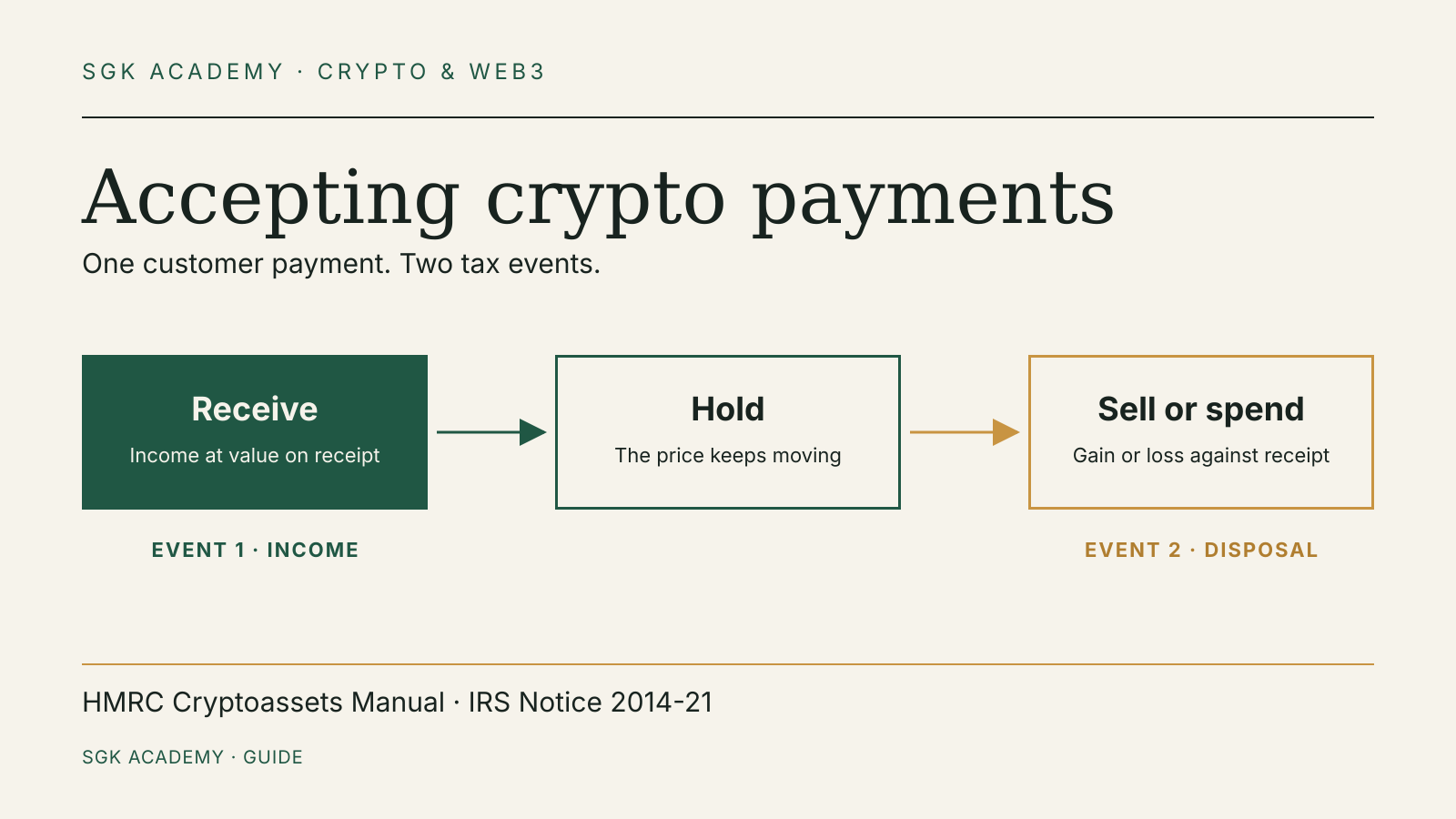
The single most useful idea is that a crypto payment creates two separate tax events.
- Receipt. You supply goods or services and receive tokens. That is ordinary business income, valued in your reporting currency at the time you receive it.
- Disposal. Later you sell the tokens for money, swap them for other tokens, or use them to pay someone else. That disposal produces a gain or a loss measured against the value you recorded at receipt.
If you convert the tokens to money within minutes, the second event is small. If you hold them for weeks, the second event can be larger than the profit on the sale itself. Every decision in the rest of this guide follows from keeping those two events apart in your records.
| Event | What happens | UK reference | US reference |
|---|---|---|---|
| Customer pays in tokens | Income at the value on receipt | HMRC CRYPTO40350 | IRS FAQ 57 and 58 |
| Value recorded | Becomes the starting value of the tokens you hold | HMRC CRYPTO40100 | IRS FAQ 59 (basis) |
| You sell, swap or spend the tokens | Gain or loss against that starting value | HMRC CRYPTO41250 | IRS FAQ 62 and 63 |
United Kingdom: income first, conversion second
The receipt is trading income
HMRC’s manual page on business income paid in cryptoassets is short and direct. If exchange tokens are held as part of an existing trade, profits of a revenue nature are included in trading profits. Its own example is a company that accepts exchange tokens as payment from customers, or uses them to pay suppliers: the tokens given or received are accounted for within taxable trading profits. HMRC says it taxes cryptoassets according to what the holder does with them, so a trading business pays Income Tax or Corporation Tax on its trading profits as usual.
Accepting tokens does not, by itself, make your business a crypto trader. HMRC’s page on trading in exchange tokens says it would expect buying and selling of tokens to amount to a financial trade in its own right only in exceptional circumstances. A design studio paid in bitcoin is still a design studio.
Convert to sterling at the time of each transaction
Taxable profits are calculated in pounds sterling. HMRC’s conversion and accountancy page says any profit or gain must be converted using the appropriate rate at the time of each transaction, that reasonable care is needed to arrive at an appropriate valuation using a consistent methodology, and that individuals and companies must keep records of that methodology. Where a token trades against another token rather than sterling, you need an appropriate exchange rate to reach a sterling value.
In practice that means choosing one price source before the first payment arrives, writing it down, and using it every time. Switching between sources to pick the most convenient figure is the kind of inconsistency the guidance warns against.
The same page notes that trading profits are generally calculated under generally accepted accounting practice (UK GAAP or international standards), subject to any adjustment tax law requires. A company can also elect a non-sterling functional currency, in which case transactions are converted into that currency and the return is completed in sterling at the end of the period.
Spending or selling the tokens is a disposal
For companies, HMRC’s page on what constitutes a disposal lists selling tokens for money, exchanging them for a different token, using them to pay for goods or services, and giving them away. Each one requires the company to work out its gain or loss. Paying a contractor in the same tokens a client sent you is therefore not a neutral pass-through: it is a disposal at the value on the day you pay.
Whether a particular gain or loss sits within trading profits or is calculated as a chargeable gain depends on how the tokens are held. CRYPTO40350 points to trading profits where tokens are held as part of the trade; CRYPTO41250 covers the chargeable gains route. If you plan to hold tokens rather than convert them, agree the treatment with your accountant before the first year end.
VAT: charge it on the sale as normal
HMRC’s VAT page for cryptoassets answers the question most UK sellers ask first. VAT is due in the normal way on goods or services sold in exchange for exchange tokens. The value of the supply on which VAT is due is the sterling value of the tokens at the point the transaction takes place. No VAT is due on the supply of the token itself when it is exchanged for goods or services.
HMRC describes these treatments as provisional, pending regulatory and EU VAT developments, so check the page again before relying on it for a large contract.
Within the EU, the Court of Justice ruled in Hedqvist (C-264/14) that exchanging traditional currency for bitcoin and back is a supply of services falling within the exemption in Article 135(1)(e) of the VAT Directive. That judgment concerns the exchange service, not the sale of your goods or services, which stays taxable under the normal rules. An EU VAT invoice also has its own currency rule; SGK Academy’s guide to VAT invoice requirements explains what the invoice must show.
United States: ordinary income at fair market value
The IRS treats convertible virtual currency as property. Notice 2014-21 states that a taxpayer who receives virtual currency as payment for goods or services must include its fair market value, measured in US dollars as of the date received, in gross income. The current IRS frequently asked questions on digital asset transactions carry the same rule into the 2025 framework:
- receiving digital assets for services is ordinary income (FAQ 57);
- the amount is the fair market value of the digital assets, measured in US dollars, when received (FAQ 58);
- your basis in the tokens is that same fair market value, provided you include it in income (FAQ 59);
- paying for services with digital assets is a disposal, with a capital gain or loss (FAQ 62), calculated as the difference between your adjusted basis and the amount realised (FAQ 63).
For an independent contractor, Notice 2014-21 also says the fair market value of virtual currency received for services is self-employment income subject to self-employment tax (Q&A 10). On valuation, the Notice asks for the dollar value at the exchange rate “in a reasonable manner that is consistently applied” (Q&A 5), which matches HMRC’s emphasis on a consistent method.
The IRS digital assets page adds two practical points. Federal returns ask every filer whether, during the year, they received a digital asset as payment for property or services, and receiving tokens as business payment means answering “Yes”. It also lists the records to keep: the type of asset, the date and time of each transaction, the number of units, the fair market value in US dollars at that time, and the basis of anything sold or disposed of.
How the tokens sit in your accounts
Tax rules start from the accounts in many cases, so the accounting standard matters.
IFRS. In June 2019 the IFRS Interpretations Committee published an agenda decision on holdings of cryptocurrencies. It considered tokens recorded on a distributed ledger, not issued by a jurisdictional authority or other party, and not giving rise to a contract between the holder and another party. It concluded that such a holding is not cash and not a financial asset. It is an intangible asset under IAS 38, unless it is held for sale in the ordinary course of business, in which case IAS 2 Inventories applies. A stablecoin with an issuer and redemption terms falls outside the subset the Committee described, so it needs its own analysis.
US GAAP. The FASB’s Accounting Standards Update 2023-08 requires crypto assets within its scope to be measured at fair value each reporting period, with changes recognised in net income. It applies to all entities for fiscal years beginning after 15 December 2024. One of its six scope criteria is that the asset does not give the holder enforceable rights to, or claims on, underlying goods, services or other assets. A token that carries a redemption claim on reserves does not meet that criterion and falls outside the update.
The practical effect for a small business on US GAAP: rises and falls in the value of in-scope tokens pass through net income every reporting period, so holding customer payments in tokens puts price movements into reported results. Under IFRS, ask your accountant which IAS 38 measurement model the business applies before the first year end.
Worked example: a UK agency paid in a stablecoin
The following scenario is illustrative, not a description of a real business, and it ignores processor and network fees.
A VAT-registered UK design agency invoices a client £2,000 plus £400 VAT, a total of £2,400 in sterling. The client asks to pay in USDC. The agency agrees, on the condition that the client sends enough USDC to equal £2,400 at the agency’s chosen price source when the payment is sent.
- On receipt. The agency records £2,000 of sales and £400 of output VAT, using the sterling value at the time of the transaction as CRYPTO45000 requires. It also records a holding of USDC with a starting value of £2,400, and saves the price, the source and the time.
- Three weeks later. Because the sterling and dollar exchange rate has moved, the same USDC converts to £2,350 on the agency’s exchange account. The agency records a £50 loss on disposal. The VAT due stays at £400, because it was fixed by the value at the time of the supply.
- The cash gap. The agency now has £2,350 in the bank against a £400 VAT liability and a sale booked at £2,000. Had it held a more volatile token, the gap could have run in either direction by far more than £50.
Two lessons follow. Pricing the invoice in sterling keeps the sale and the VAT stable while the customer carries the price risk until payment. Converting promptly limits the second event to small amounts. If you choose to hold tokens, model the worst plausible fall against your tax bills with the cash runway calculator before the next VAT quarter.
Practical decisions before you accept the first payment
Price in your own currency. An invoice in pounds, euros or dollars with a stated conversion rule gives you a fixed amount of income and VAT. An invoice in tokens moves the price risk onto you before you have even been paid.
Decide on conversion. Choose between converting each payment at once, converting on a schedule, or holding a set share. Write the policy down, because it determines how large the disposal side of your records becomes.
Choose how you receive. If a processor converts the payment and settles to your bank in your own currency, check when it converts and how its statements show the rate, because that is the value your records need. Receiving directly into a wallet leaves the valuation and record keeping to you. If you use a crypto exchange account for business payments, expect it to collect tax details about the company: the EU’s DAC8 reporting rules include a separate category for crypto payments for goods and services above USD 50,000.
Pick the token deliberately. Holding a dollar stablecoin is not the same as holding the issuer’s dollars, and redemption terms differ between issuers. SGK Academy’s comparison of USDT and USDC covers what each one gives the holder.
Fix one price source. HMRC and the IRS both look for a consistent, reasonable method. Name the source, the time you read it and the pair you use, and apply it to every receipt and disposal.
Records to keep for every payment
- the invoice number and the amount in your own currency;
- the token, the network and the number of units received;
- the date and time of receipt, and the transaction hash;
- the price source, the rate used and the value in your reporting currency;
- the date, time, units and proceeds of each later sale, swap or payment;
- the gain or loss on each disposal, matched to the value recorded at receipt;
- your written valuation method and conversion policy.
The list combines the IRS record list with HMRC’s requirement to keep the valuation methodology. A spreadsheet can hold it for a handful of payments a month; beyond that, use the exports from your processor or exchange and reconcile them to your ledger every month.
Sources and version
Checked 12 October 2026 against HMRC’s Cryptoassets Manual pages CRYPTO40100, CRYPTO40150, CRYPTO40350, CRYPTO41250 and CRYPTO45000; the Court of Justice judgment in Hedqvist (C-264/14); IRS Notice 2014-21, the IRS digital asset FAQs and the IRS digital assets page; the IFRS Interpretations Committee’s June 2019 agenda decision; and FASB ASU 2023-08. HMRC describes its VAT treatment as provisional. This guide explains published rules and does not determine any business’s tax position.