Payments on account are advance payments towards next year’s Self Assessment bill. HMRC asks for two of them, each normally half of the previous year’s bill, due on 31 January and 31 July. For a freelancer in a first or fast-growing year, they explain why the January bill can be far larger than the tax for the year just finished.
The rule comes from section 59A of the Taxes Management Act 1970 and is explained in HMRC’s guide to understanding your Self Assessment bill. This guide works through who has to pay them, how they are calculated, what a first-year bill looks like, when a reduction makes sense and what it costs if the estimate is wrong. Figures in the examples are illustrative; the rules were checked against HMRC guidance on 10 October 2026.
What payments on account are
HMRC describes them as “payments towards your next tax bill (including Class 4 National Insurance if you’re self-employed)”. They spread the cost of the coming year’s tax over two instalments:
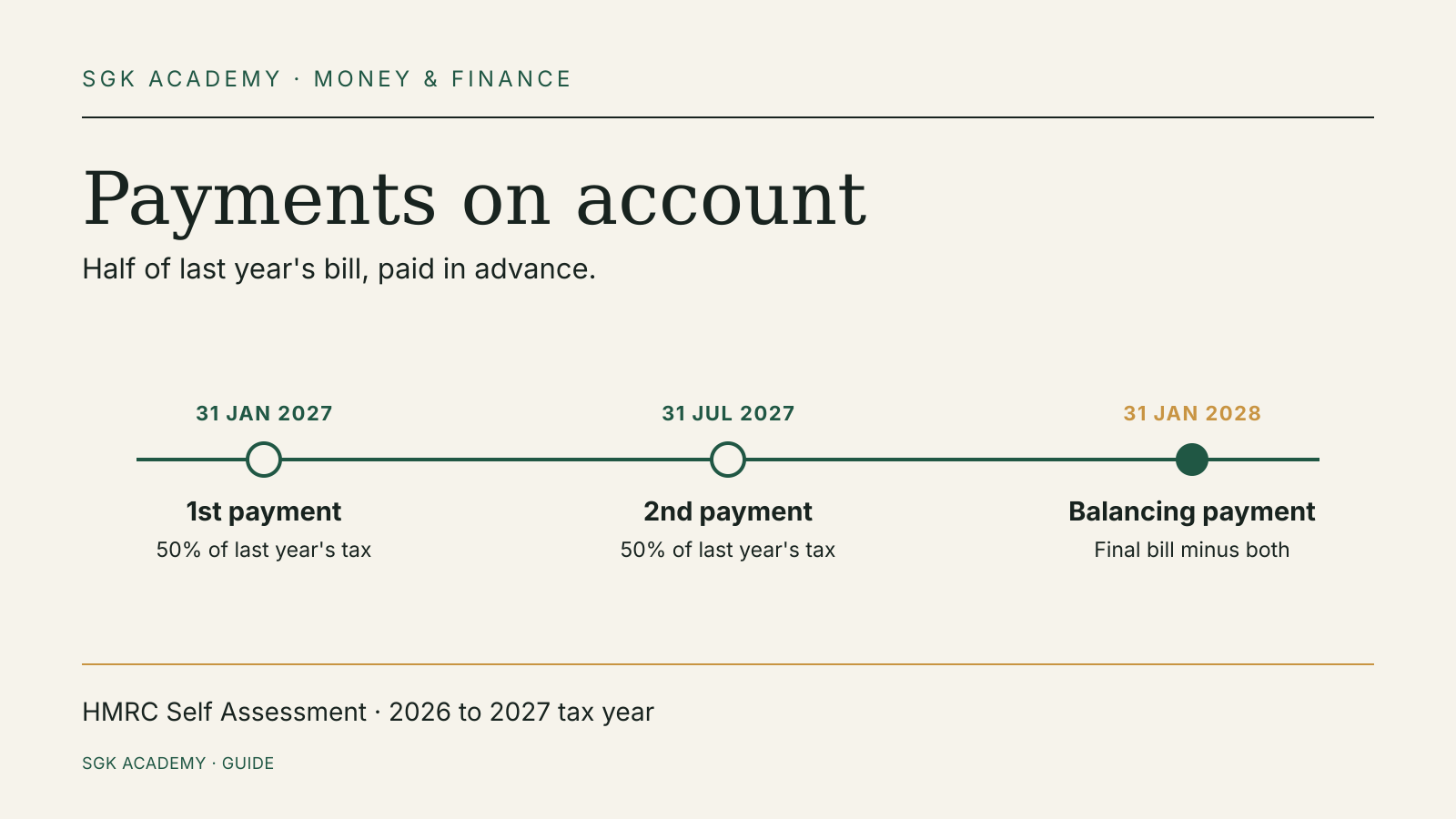
- the first payment on account is due by midnight on 31 January during the tax year;
- the second payment on account is due by midnight on 31 July after the tax year ends;
- a balancing payment for anything still owed is due on the following 31 January.
For the 2026 to 2027 tax year (6 April 2026 to 5 April 2027), that means payments on account on 31 January 2027 and 31 July 2027, and a balancing payment by 31 January 2028. Each 31 January therefore usually carries two items: the balance for the year just ended and the first instalment for the year in progress.
Payments on account cover Income Tax and Class 4 National Insurance. HMRC’s guidance says the balancing payment also includes anything owed for capital gains or student loans, so a large gain this year is paid with the balance rather than through the instalments.
Who has to make them
The HMRC guide says you must make the two payments unless either:
- the tax you owed last year was less than £1,000; or
- you paid more than 80% of last year’s tax outside Self Assessment, for example through your tax code or because tax was already deducted from savings interest.
“Tax owed” here means the Self Assessment amount after tax deducted at source. A person with a salary taxed through PAYE and a small side business will often fall under the 80% test. A full-time freelancer with no PAYE income will usually be in the scheme once the bill reaches £1,000.
Your Self Assessment statement or online account shows whether payments on account are due and how much. You do not calculate and register them separately.
How they are calculated
HMRC says each payment is “usually half of the tax you owed the previous year”. The calculation looks backwards, which is the whole difficulty: the instalments for this year are set by last year’s profit, not by what you are earning now.
When the year’s return is filed, HMRC compares the final figure with the two payments already made:
| Outcome | What happens |
|---|---|
| This year’s tax is higher than the two payments | The difference is a balancing payment due on the next 31 January |
| This year’s tax is lower than the two payments | The excess is credited or refunded |
| This year’s tax is about the same | Little or nothing is due beyond the next first payment on account |
HMRC’s own example: a £3,000 bill for 2023 to 2024, with payments on account of £900 each based on the year before, left a £1,200 balancing payment on 31 January 2025, due together with a £1,500 first payment on account for 2024 to 2025.
The first-year bill
The largest January payment usually arrives in the first year in which you owe £1,000 or more through Self Assessment. There were no payments on account the year before, so nothing has been paid towards the year just ended. HMRC’s guidance says you then pay “the full amount of your tax calculation” and “your first payment on account towards your next bill” on the same 31 January.
Take an illustrative designer who started freelancing in the 2025 to 2026 tax year and whose return shows Income Tax and Class 4 National Insurance of £8,000:
| Date | Payment | Amount |
|---|---|---|
| 31 January 2027 | Full 2025–26 bill | £8,000 |
| 31 January 2027 | First payment on account for 2026–27 (half of £8,000) | £4,000 |
| 31 July 2027 | Second payment on account for 2026–27 | £4,000 |
| 31 January 2028 | Balancing payment for 2026–27, plus first payment on account for 2027–28 | Depends on 2026–27 profit |
The January 2027 total is £12,000, or 150% of the year’s tax. Nothing has been overcharged: £4,000 is a prepayment of 2026 to 2027 tax. But if the money has not been set aside, it arrives as a cash-flow shock. Our emergency fund guide for irregular income and the cash runway calculator are built for planning around exactly this kind of lump.
Registration timing matters too. GOV.UK says you must tell HMRC by 5 October if you need to file a return for the previous tax year and have not filed one before. The filing and payment deadlines stay at 31 January.
When income falls: claiming a reduction
Because the instalments look backwards, a year with lower profit can leave you paying too much in advance. You can ask HMRC to reduce them with form SA303, online or by post. HMRC’s guidance on claiming a reduction lists three reasons:
- your business profits or other income go down;
- the tax relief you are entitled to goes up;
- tax deducted at source is more than in the previous year.
You must claim by 31 January after the end of the tax year concerned, and a reason must be given. Base the reduced figure on a reasonable estimate of the year’s Income Tax and Class 4 National Insurance after tax deducted at source; each payment is then half of that estimate.
A reduction is a forecast, not a discount. HMRC’s Self Assessment Manual (SAM1040) says HMRC does not agree the figures in a claim, that the taxpayer will be charged interest if the unpaid payments on account turn out to be due, and that penalties may be charged for fraudulent or negligent claims.
What a reduction that goes too far costs
HMRC’s legal framework manual (SALF305) explains the interest rule. Interest arises on the difference between what was paid and what should have been paid. What should have been paid is half of the final tax for the year, but never more than 50% of the previous year’s figure.
Continue the illustrative designer. The 2025–26 bill was £8,000, so each 2026–27 payment on account was set at £4,000. In autumn 2026 a major client leaves, and the designer forecasts 2026–27 tax of £5,000 and reduces each payment to £2,500. The final figure comes in at £6,000.
| Amount | |
|---|---|
| Each payment that should have been made (half of £6,000, capped at £4,000) | £3,000 |
| Each payment actually made | £2,500 |
| Shortfall on 31 January 2027 and on 31 July 2027 | £500 each |
Late payment interest runs on each £500 from its due date until it is paid, normally with the balancing payment. Had the final figure been £10,000, the cap would apply: each payment that “should have been made” would be £4,000, not £5,000, and interest would run on £1,500 per instalment.
The same manual makes a related point: there is no interest simply because this year’s tax turned out higher than last year’s. If you leave the payments at HMRC’s figure and profits grow, the extra is due with the balancing payment, without interest for the earlier instalments.
A practical way to use this: reduce only to the level your current bookkeeping supports, and revisit the figure if a strong quarter arrives. HMRC’s manual (SAM1001) notes that the online form can be used to reduce or increase payments on account, and paying an extra amount early stops further interest on it.
Interest and penalties for paying late
HMRC charges interest on late payments, including late payments on account. HMRC’s December 2025 announcement says late payment interest “is currently set at base rate plus 4%”, with the rate following Bank of England changes; the current figure is on HMRC’s interest rates page.
GOV.UK’s Self Assessment penalties page lists late payment penalties of 5% of the tax unpaid at 30 days, 6 months and 12 months, in addition to interest. HMRC’s Making Tax Digital guidance says people using MTD for Income Tax come under a newer late payment penalty system.
If you cannot pay, GOV.UK’s payment plan guidance explains Time to Pay arrangements for overdue tax. For a bill that is not yet overdue, HMRC offers a Budget Payment Plan to make weekly or monthly payments towards the next bill.
Making Tax Digital does not move the dates
From 6 April 2026, sole traders and landlords within scope of Making Tax Digital for Income Tax send quarterly updates through software. HMRC’s MTD guidance on submitting your return says it “will not change the way you pay tax or the dates that payments are due”. Quarterly updates are summaries, not tax returns; the return and the payment are still due by 31 January.
They can help with payments on account. HMRC’s introduction to MTD for Income Tax says the software shows a predicted tax bill after each update, which is useful evidence when you decide whether an SA303 reduction is justified or too optimistic.
Companies use a different system
Payments on account belong to Self Assessment for individuals, partners and trustees. A limited company does not make them. Most small companies pay Corporation Tax in one sum after the accounting period ends.
Larger companies pay in instalments instead. GOV.UK’s guidance on paying Corporation Tax as a large company says a company whose profits are at an annual rate above £1.5 million normally pays by instalments, with that threshold divided among associated companies and exceptions for small liabilities and companies that were not large in the previous 12 months. A director who takes salary or dividends may still have personal payments on account through their own Self Assessment.
A cash plan for payments on account
- When you file each return, note three numbers: the balancing payment, and the two payments on account for the year in progress.
- Set aside a share of every invoice in a separate account; our cash vs accrual guide explains why profit for tax and cash in the bank can differ.
- In your first Self Assessment year, plan for the January bill to include the first payment on account as well as the full bill.
- Review profit in the autumn. If the year is clearly lower, consider an SA303 claim at a level your records support.
- If profit rises, expect a larger balancing payment and a larger next payment on account in the same January.
- Add 31 January and 31 July to your calendar, and use the filing deadlines tool for company filing dates if you also run a company.