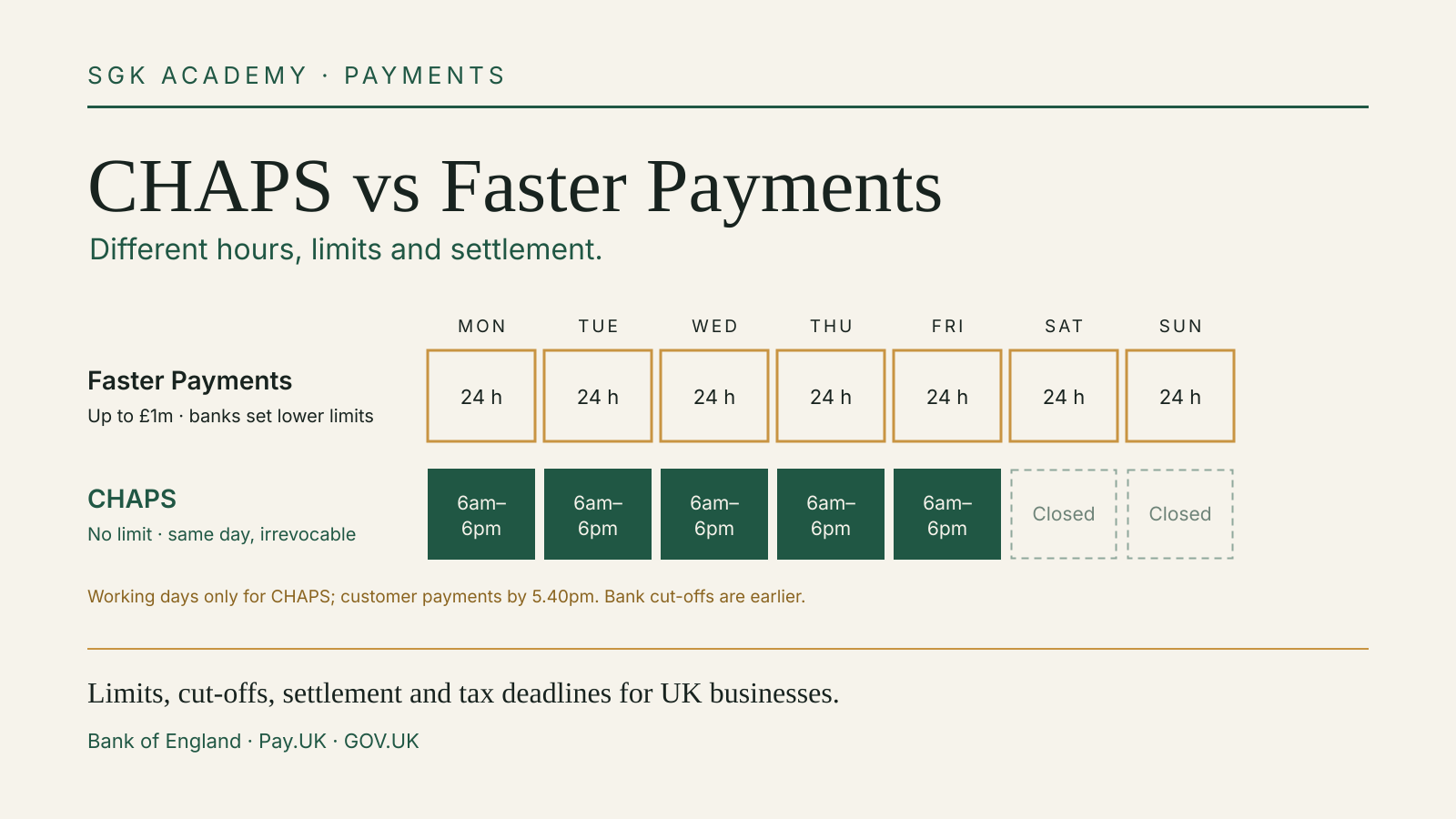
CHAPS vs Faster Payments is a choice between two UK payment systems built for different jobs. Faster Payments runs day and night, every day of the year, and moves most business transfers almost instantly up to a scheme ceiling of £1 million. CHAPS settles each payment individually across Bank of England accounts on working days only, with no scheme minimum or maximum. For a founder, the right choice depends on the amount, the deadline, the recipient’s bank and what your own bank’s tariff says.
Source and version check: reviewed 20 October 2026 against the Bank of England’s CHAPS page, the Bank’s 2026 consultation paper on extending RTGS and CHAPS settlement hours, Pay.UK’s Faster Payment System pages and GOV.UK’s guidance on paying Corporation Tax. Individual bank limits, cut-off times and fees are set by each bank and are not covered by the system operators’ pages.
The short answer
| Question | Faster Payments | CHAPS |
|---|---|---|
| Who runs it | Pay.UK | Bank of England |
| When it runs | Day and night, 365 days a year | Usually 6am to 6pm, Monday to Friday, excluding bank and public holidays in England and Wales |
| Scheme limit per payment | Up to £1 million (banks may set lower limits) | No minimum or maximum |
| Typical arrival | Usually almost immediately; can take up to two hours | Same day, if submitted before the cut-off |
| How it settles | Through the Faster Payment System, with a response to the sending bank within 15 seconds | Each payment settled individually and gross in the Bank of England’s RTGS system; irrevocable between direct participants |
| Common business use | Supplier invoices, payroll top-ups, tax payments, refunds | Property completions, very large or time-critical supplier payments, money market and FX settlement |
Everything else in this guide explains the edges: when the £1 million ceiling is really much lower, why “same day” can still miss a deadline, and what to check before you press send.
How Faster Payments works
Pay.UK describes the Faster Payment System as available day and night, 365 days a year, since 2008. It facilitates real-time payments of up to £1 million, started mainly through online, mobile or telephone banking. Pay.UK reports that in 2025 the system processed 5.55 billion transactions worth £4.84 trillion.
Its page on types of Faster Payment transactions sets out what a sender can expect from a single immediate payment:
- it can be initiated online, by mobile, by phone or in a branch, 24 hours a day, seven days a week, subject to the bank’s own service;
- up to £1 million can be sent per transaction, although individual banks may impose lower limits;
- the money is usually available almost immediately, although it can sometimes take up to two hours;
- the central infrastructure gives the sending bank a response within 15 seconds confirming whether the receiving bank accepted or rejected the payment, with a reason for a rejection.
The same page explains that the receiving bank is sometimes unable to apply the payment immediately, for example because of an operational issue or an account that does not allow immediate posting. The customer should then be told when to expect the funds.
Faster Payments also carries forward-dated one-off payments and standing orders, which is why rent, regular supplier payments and many payroll top-ups run on it without anyone choosing the system consciously.
The limit that matters is your bank’s
The £1 million figure is the scheme’s ceiling. Pay.UK’s pages say banks may set lower limits, and in practice the binding number is your bank’s limit for your account type and channel. Business accounts often have different limits for online banking, mobile apps and multi-user approval workflows.
Check three numbers before a large payment:
- the per-payment limit for Faster Payments on your account;
- any daily limit across all outgoing payments;
- any lower limit for a payment to a new payee.
If the amount is above any of them, the bank will not send it as a Faster Payment, and you need CHAPS or another route. Do not split a single invoice into several transfers to get under a limit without agreeing that with the recipient; it complicates their reconciliation and may trigger your bank’s fraud checks.
How CHAPS works
The Bank of England’s CHAPS page describes CHAPS as a sterling same-day system used to settle high-value wholesale payments as well as time-critical, lower-value payments such as buying a property or paying a deposit on one.
Three features follow from its design:
- Gross, individual settlement. Payment obligations between direct participants are settled individually on a gross basis in the Bank’s real-time gross settlement (RTGS) system on the day they are submitted, and the transfer of funds between direct participants is irrevocable.
- No limit. The Bank states there is no minimum or maximum payment limit.
- Working-day hours. The system is usually open from 6am to 6pm, Monday to Friday, excluding bank and public holidays in England and Wales. CHAPS closes at 6pm for bank-to-bank payments, and customer payments must be submitted by 5.40pm.
That 5.40pm figure is the system’s customer deadline, not your bank’s. Banks set their own, earlier internal cut-offs so their payment teams can process the instruction, and many require a CHAPS request to be submitted or approved by a specific time. Your bank’s cut-off is the one that decides whether the payment goes today.
The Bank lists more than 35 direct participants. Thousands of other institutions send CHAPS payments through one of them, so your bank or payment provider may access CHAPS indirectly.
Who uses CHAPS
The Bank names the main uses: financial institutions and the largest businesses settling money market and foreign exchange transactions; companies making high-value and time-sensitive payments to suppliers or paying taxes; solicitors and conveyancers completing property transactions; and individuals buying high-value items such as a car or a house deposit.
For a small business, the most common CHAPS moment is a property or business purchase completed through solicitors, or a supplier who requires a CHAPS payment for a large order.
CHAPS hours are changing
In its 2026 consultation paper, Extending RTGS and CHAPS settlement hours: next steps, the Bank confirms that from September 2027 it will open CHAPS settlement at 01:30 instead of 06:00, Monday to Friday. It also proposes an additional settlement day at the weekend, most likely Sunday, plus certain bank holidays, but not before 2029, and longer weekday settlement windows not before 2031. Those later steps are proposals under consultation, not confirmed changes.
Until then, a CHAPS payment requested on a Friday evening or over a bank holiday weekend will not settle until the next working day.
Choosing between them
Use Faster Payments when
- the amount is within your bank’s limit;
- the payment must arrive outside working hours or on a weekend;
- you are paying an ordinary supplier invoice, a refund or a tax bill;
- you want a quick acceptance or rejection from the receiving bank.
Use CHAPS when
- the amount is above your bank’s Faster Payments limit;
- a solicitor, conveyancer or supplier requires CHAPS for completion;
- the payment must be final and settled in central bank money the same working day;
- the transaction is part of a process with a fixed completion time on a weekday.
Check before either
- Recipient details. Use the account name, sort code and account number from a trusted source. Our guide to verification of payee explains how a name check before a transfer works and what it cannot prove.
- Cost. Neither the Bank of England nor Pay.UK sets your customer price. Your bank’s business tariff does, so check the CHAPS fee and the Faster Payments charge, if any, before choosing.
- Approval workflow. If two people must approve payments, a CHAPS request at 5pm may already be too late once the second approver is found.
- Fraud controls. The Payment Systems Regulator’s APP scams policy covers payments made via Faster Payments or CHAPS from one UK account to another, and the Bank of England, as CHAPS operator, has published CHAPS reimbursement rules. Eligibility and limits are set out in those rules; verify the recipient before paying rather than relying on reimbursement afterwards.
A worked example: paying a tax bill on time
GOV.UK’s guidance on paying Corporation Tax groups payment methods by how long they take to reach HMRC:
- same or next day: approving a payment through your online bank account, online or telephone banking by Faster Payments or CHAPS, and card payments;
- 3 working days: Direct Debit (if one has been set up before) and Bacs;
- 5 working days: a first Direct Debit.
It adds a rule that turns the choice of system into a deadline question: if the deadline falls on a weekend or bank holiday, the payment must reach HMRC on the last working day before it, unless you are paying by Faster Payments using online or telephone banking.
Take an illustrative case. A company’s payment deadline falls on a Saturday. Its bank’s online Faster Payments limit is above the bill.
- Paying by Faster Payments on the Saturday meets the GOV.UK exception.
- A CHAPS payment cannot settle on the Saturday, because CHAPS is closed; it would have to be sent on Friday, within the bank’s cut-off.
- A Bacs payment would need to be started three working days before the last working day.
Now assume the bill is larger than the bank’s Faster Payments limit. The company must use CHAPS, or another method, and plan for Friday’s cut-off. The difference between the two systems has become a difference between meeting and missing the deadline. For your company’s own filing and payment dates, use the company filing deadlines calculator.
HMRC’s bank details and the 17-character Corporation Tax payment reference are on GOV.UK’s bank details page. The payment reference changes with each accounting period, and a saved payee in your banking app may still hold last year’s reference.
Common mistakes
Treating “instant” as guaranteed. Pay.UK says a Faster Payment usually arrives almost immediately but can take up to two hours, and some receiving accounts cannot post it immediately. Leave a margin for a contractual deadline.
Ignoring the bank’s cut-off. The Bank of England’s 5.40pm deadline for customer payments is the outer limit. Your bank’s CHAPS cut-off is earlier, and the approval step inside your business may be earlier still.
Assuming CHAPS works on bank holidays. CHAPS follows bank and public holidays in England and Wales. A completion booked for the day after a bank holiday needs the funds sent on the last working day before it.
Forgetting about Bacs. Payroll and Direct Debit collections usually run on Bacs, a different, scheduled system. Our guide to Direct Debit for small business explains its three-day cycle.
Paying from abroad. CHAPS and Faster Payments are UK domestic sterling systems. A payment from an overseas account arrives through the sending bank’s international route and may reach the UK on a different day. GOV.UK asks overseas payers of Corporation Tax to pay in sterling and gives separate IBAN and BIC details for that purpose.
Checklist before a large business payment
- Confirm the amount, the deadline and whether the recipient requires a specific system.
- Check your bank’s Faster Payments per-payment and daily limits for the channel you will use.
- If CHAPS is needed, check your bank’s CHAPS cut-off and fee.
- Verify the payee details independently and run the name check.
- Arrange approvals early enough for the cut-off.
- Keep the payment confirmation, reference and time.
- Ask the recipient to confirm receipt, especially for property or business completions.