Direct Debit for small business means collecting your customers’ payments from their UK bank accounts on a date you control, under the Bacs Direct Debit scheme. You need a bank to sponsor you, a bureau or a facilities management provider to submit the files, and a signed or paperless instruction from each customer. In return, the customer keeps the Direct Debit Guarantee, including an immediate refund from their own bank if a payment is taken in error.
This guide follows the scheme’s own published material on the Bacs website and the wording of the Guarantee. The worked example later on uses invented figures for an illustrative business; the dates and notice periods in it follow the Bacs rules described here.
What Direct Debit changes for a business that invoices
Most small firms get paid by sending an invoice and waiting for the customer to push a bank transfer. The customer decides when the money moves. Direct Debit reverses that. Bacs describes a Direct Debit as an instruction from a customer to their payment service provider (PSP) authorising an organisation to collect varying amounts from their account, as long as the customer has been given advance notice of the amounts and dates.
Bacs lists what a collecting business gets from this on its collecting page: you control the date of receipt into your account, you get cleared funds on a known date, you can collect variable amounts on regular or irregular dates, and you are told only about errors and non-payments, so reconciliation can be done by exception.
That makes Direct Debit a natural fit for retainers, subscriptions, monthly service fees, instalment plans and any arrangement where the same customer pays you again and again. It is a poor fit for one-off sales to strangers, where the set-up work outweighs a single payment.
| Question | Invoice paid by bank transfer | Direct Debit |
|---|---|---|
| Who starts the payment? | The customer | You, under the customer’s instruction |
| Who chooses the date? | The customer, within your payment terms | You, after advance notice |
| Can the amount vary? | Yes, invoice by invoice | Yes, with advance notice of each change |
| What if the customer disputes it? | Depends on your contract | The customer’s bank refunds errors under the Guarantee and reclaims from you |
If you mainly need customers to pay invoices on time, start with clear invoice payment terms. Direct Debit is the next step when the same customers pay you every month.
Three ways to offer Direct Debit
Bacs describes three routes in its guide to becoming a user. Which one suits you depends mostly on how many payments you collect and how much of the process you want to run yourself.
1. Direct submitter. Your business is sponsored by a Bacs participant PSP, receives its own service user number (SUN) and sends payment files straight to the Bacs Payment System through Bacstel-IP, the scheme’s secure submission channel. Bacs says direct access may be faster and cheaper where you process a high volume of payments. All new service users that submit directly must use AUDDIS, the electronic service for lodging instructions.
2. Indirect submitter through a bureau. You still need a sponsoring PSP and your own SUN, but a Bacs Approved Bureau submits the files for you. Bacs calls indirect access “often the most suitable method for smaller organisations or those with a limited number of payments”. The split of tasks between you and the bureau is set by your contract, and Bacs is explicit that your organisation remains ultimately responsible for its own actions and those of the bureau it appoints.
3. Facilities management (FM) provider. An FM provider acts as the service user on your behalf and forwards the collected money to you. Bacs says this lets a business use Direct Debit without being sponsored by a PSP. Bacs accredits commercial FM providers, but the contract, including when you receive the money and how failed payments and refund claims are handled, sits outside the scheme rules.
| Route | Own SUN and bank sponsorship? | Who submits files | Typical fit (per Bacs) |
|---|---|---|---|
| Direct submitter | Yes | You, via Bacstel-IP | High volumes |
| Bureau | Yes | The bureau | Smaller organisations, fewer payments |
| FM provider | No | The FM provider, as service user | Businesses without their own SUN |
What the bank checks before sponsoring you
For the first two routes, the Bacs getting-started page says the first step is to consult your bank, and that acceptance depends on checks of integrity, financial standing and administrative capability. The becoming-a-user guide adds that a sponsoring PSP will run a credit check, because there are risks and liabilities attached to collecting by Direct Debit. The reason becomes clear in the section on refunds below: when a customer is refunded, the money comes back out of your account.
A young company with little trading history may find sponsorship harder to obtain. That is one practical reason small firms use an FM provider first.
Setting up the customer’s instruction
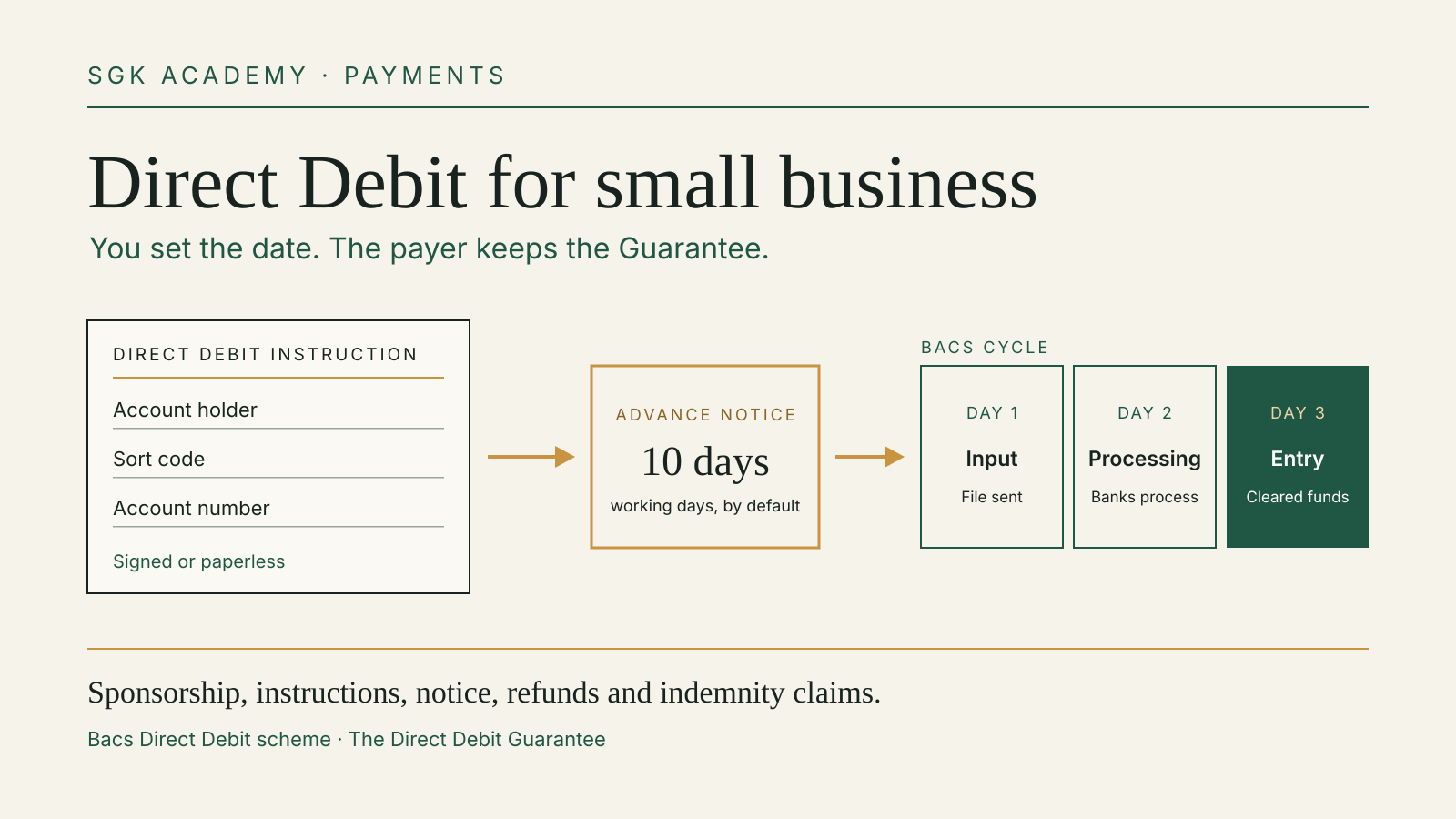
Every collection rests on a Direct Debit Instruction (DDI). Bacs’ short guide to Direct Debit lists the details needed from the customer:
- the name or names of the account holders;
- the name and address of the customer’s PSP;
- the customer’s account number and sort code.
You can take the instruction on paper or use Paperless Direct Debit. According to the Bacs Paperless Direct Debit page, paperless set-up lets customers sign up by telephone, on your website or face to face without signing a form. It is only available to organisations that use AUDDIS and meet additional criteria, and the Bacs FAQs add that your PSP must approve every telephone script and internet screen used to set up an instruction.
Paperless set-up carries two timing rules from the Bacs pages:
- You must send the customer confirmation within three working days of their instruction. Alternatively, if the first collection is within a month of set-up, the confirmation can be combined with the advance notice, as long as it reaches the customer within the advance notice period before the first collection.
- Instructions should reach the customer’s PSP within 10 working days of the customer signing, even if the first payment is some time away.
The FAQs also warn that an accepted instruction is not a promise of payment. The customer or their bank may cancel it before the first collection, and the account may not hold enough money on the day.
Advance notice: the rule that shapes your calendar
Advance notice is the part of Direct Debit most businesses underestimate. The Direct Debit Guarantee tells customers that if there are any changes to the amount, date or frequency of a Direct Debit, the organisation will notify them, normally 10 working days in advance of their account being debited, or as otherwise agreed. The Bacs FAQs put the default the other way round: in the absence of any other agreement, the notice period is a minimum of 10 working days plus postal time.
Bacs’ short guide says you must give notice every time the amount or the collection date changes, and that the method (letter, email or a line on the bill) and the notice period are set out when the Direct Debit is set up. If you want a shorter period than the default, it has to be agreed at that stage.
For a business with variable monthly bills, this means the bill and the collection date are linked: the customer must have the bill, or at least the amount and date, in time. A late invoice delays the collection.
The three-day Bacs cycle
Collections run on a fixed processing cycle. The Bacs getting-started page sets it out:
| Day | Name | What happens |
|---|---|---|
| Day 1 | Input | The latest day you or your bureau can submit the payment file. Files must reach Bacs between 07:00 and 22:30. |
| Day 2 | Processing | Files are delivered to the customers’ banks, which process each payment. |
| Day 3 | Entry | The customer’s account is debited and yours is credited at the same time. |
You can submit instructions up to 30 days before the payment date, and you can recall payments after submission if your bank is told before its cut-off time. The days are working days, so a collection due on a Monday is input the previous Thursday.
A worked example: changing a monthly retainer
The figures below are invented to show how the rules combine. Suppose a small bookkeeping practice collects a monthly retainer from 40 business clients by Direct Debit on the first working day of each month. It used the default notice period when it set up the instructions. It decides to raise the fee from £250 to £275 from the December 2026 collection.
The collection date. 1 December 2026 is a Tuesday. Working back through the Bacs cycle, Monday 30 November is the processing day and Friday 27 November is the input day, so the bureau must submit the file by 22:30 on 27 November.
The notice deadline. Ten working days before Tuesday 1 December takes you back to Tuesday 17 November (there are no bank holidays in between). Because the default is 10 working days plus postal time, a notice sent by email should reach clients by 17 November, and a letter needs to be posted earlier still.
The cash. If every collection succeeds, 40 × £275 = £11,000 lands as cleared funds on 1 December. The practice can plan its own outgoings around that date, which is the main gain over waiting for 40 separate transfers. To see how a known receipt date changes your buffer, run the figures through the cash runway calculator.
The miss. If the practice notices on 20 November that it forgot to send the notice, it cannot collect the new amount on 1 December under the default notice period. It can collect the old £250 as already notified, or move the date and send fresh notice.
When the money comes back: refunds and indemnity claims
The Guarantee is what makes customers willing to sign up, and it is also the scheme’s main risk for you. Its wording, which appears on Direct Debit Instructions, says:
- the Guarantee is offered by all banks and building societies that accept instructions to pay Direct Debits;
- if an error is made in the payment of a Direct Debit, by the organisation or by the customer’s bank or building society, the customer is entitled to a full and immediate refund of the amount paid from their bank or building society;
- if the customer receives a refund they are not entitled to, they must pay it back when the organisation asks;
- the customer can cancel a Direct Debit at any time by contacting their bank or building society.
The Bacs FAQs explain what happens behind a refund. The customer’s bank must refund the customer immediately and then reclaims the amount from you through an indemnity claim. Where a customer says they never gave an instruction, their bank asks you for a copy. If you cannot supply it within 7 working days, which the FAQs say is likely for paperless service users, you must refund the bank and then deal with the customer directly. The FAQs add that there may be circumstances in which you can challenge an indemnity claim.
Two practical consequences follow. First, keep a retrievable record of every instruction and every notice you send, because your evidence in a dispute is your own records. Second, treat an indemnity claim as a debt question, not a payment question: the Guarantee returns the money to the customer, but it does not cancel what they owe you for services they received.
Cancellations
When a customer cancels through their bank, the bank tells you by an ADDACS advice (the Automated Direct Debit Amendment and Cancellation Service). Bacs’ short guide says you must act on that advice immediately or you may be liable for errors. It also says that if the customer keeps accepting your goods or services after cancelling, they must arrange with you to pay by another method. Put that obligation in your terms of service so the conversation starts from an agreed position.
Direct Debit or card on file?
Many subscription businesses choose between Direct Debit and charging a saved card. The decision usually turns on cost, failure handling and who your customers are.
- Cost structure. Card payments carry interchange, scheme and acquirer fees; our guide to card processing fees explains each part. Direct Debit costs depend on your route: bank tariffs, bureau fees or an FM provider’s price. Ask each provider for a full price, including charges for failed collections and indemnity claims.
- Timing control. Direct Debit lets you fix the collection date after notice. A card charge happens when you take it, but settlement to your account follows your acquirer’s terms.
- Customer base. Direct Debit under Bacs collects from accounts identified by UK sort codes and account numbers. If many customers bank outside the UK, it will not cover them on its own.
- Disputes. Both systems let customers recover money in defined cases. Under Direct Debit, the refund comes from the customer’s bank first and is reclaimed from you.
A set-up checklist
- Decide which payments qualify. Recurring amounts from the same UK customers are the best candidates.
- Choose your route. Ask your bank about sponsorship, compare Bacs Approved Bureaux, or price an FM provider if you do not want your own SUN.
- Set your notice terms at sign-up. Use the default 10 working days plus postal time unless you agree a different period in writing when the instruction is set up.
- Get scripts and screens approved. For paperless set-up, your PSP must approve them before you use them.
- Build the calendar backwards. For each collection date, record the input day (two working days earlier) and the notice deadline (10 working days earlier, plus postal time).
- Keep the evidence. Store instructions, confirmations and notices so you can answer an indemnity claim within 7 working days.
- Process reports daily. Act on ADDACS cancellations and failed-payment advices at once.
- Write the fallback. State in your terms how a customer who cancels must pay for services already provided.
A collection plan also needs a cash plan. If you are moving customers from invoices to Direct Debit, our guide to profit versus cash flow shows why the timing of receipts matters as much as the amount.
Sources and document dates
Checked 13 October 2026. Bacs, Getting started with Direct Debit (three steps, access methods and the three-day processing cycle); Bacs, Collecting by Direct Debit; Bacs, The little Bacs guide to becoming a user of Direct Debit (PDF); Bacs, The little Bacs guide to Direct Debit (PDF); Bacs, Paperless Direct Debit; Bacs, FAQs (AUDDIS, advance notice default, indemnity claims, paperless confirmations); Direct Debit, The Direct Debit Guarantee. The full Service User’s Guide and Rules to the Direct Debit Scheme is available to registered users on the Bacs website and was not used for this guide.