A VAT credit note adjusts the VAT on a supply after the price has genuinely changed: a discount agreed after the invoice, goods returned, an overcharge corrected, or a contract price renegotiated downward. It is not a tool for writing off an invoice a customer simply refuses to pay, and it is not the route for fixing VAT that was calculated wrongly on an unchanged price — both of those are handled differently, and mixing them up is the most common mistake.
What a credit note actually does
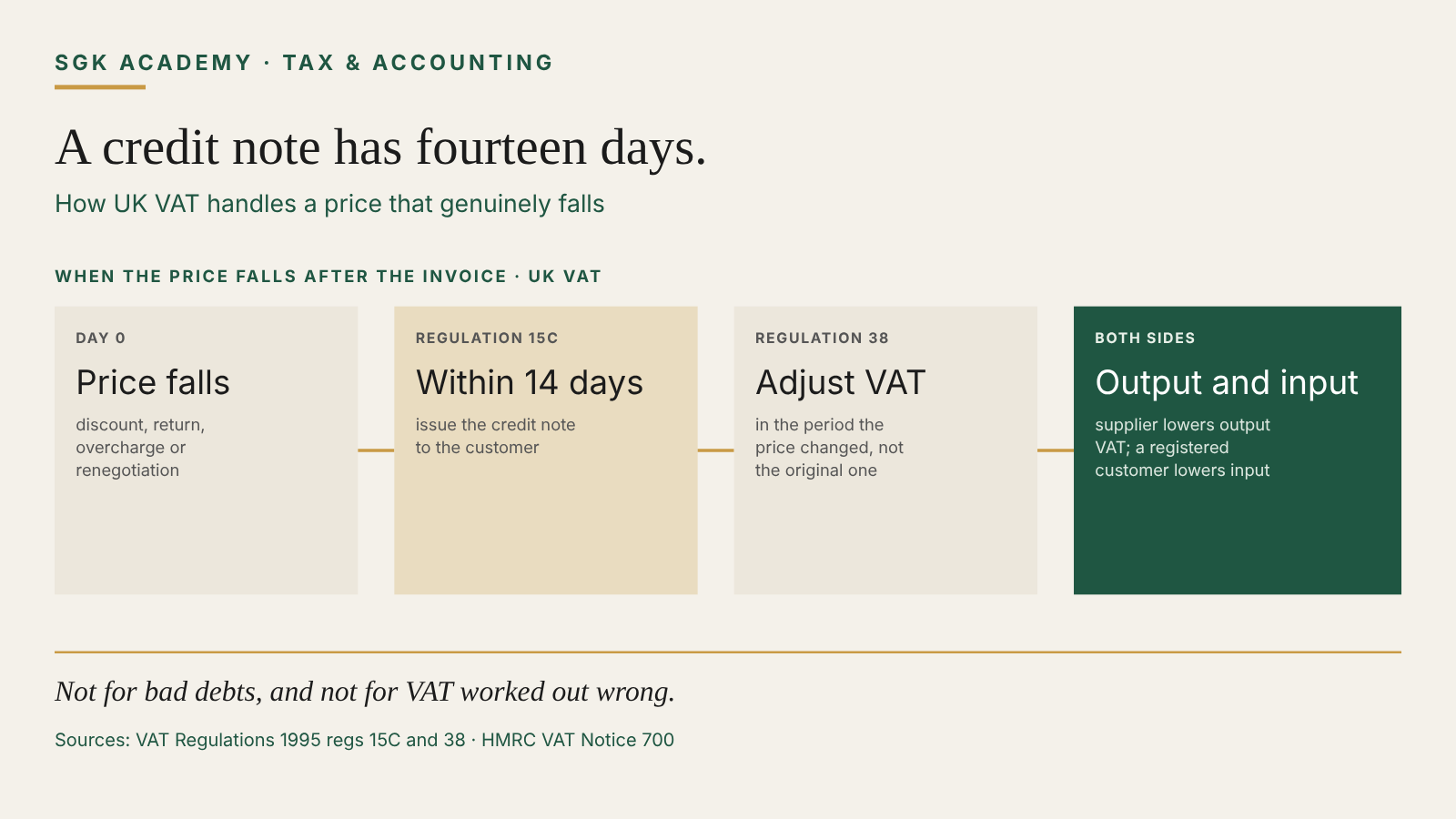
When the amount a customer owes for a supply falls after the original VAT invoice was issued, the supplier has to reduce the output VAT already declared, and a VAT-registered customer has to reduce the input VAT it claimed. The adjustment itself is made under regulation 38 of the VAT Regulations 1995, in the VAT period in which the increase or decrease in consideration actually happens, not by going back and amending the return for the period of the original supply. The same regulation covers price increases, where a debit note does the opposite job.
The requirement to issue the credit note sits in a different rule: regulation 15C, introduced from 1 September 2019 by the Value Added Tax (Amendment) Regulations 2019. Where consideration for a supply is reduced, the supplier must issue a credit note within 14 days of the decrease, showing an identifying number and the amount of VAT credited, among the other particulars HMRC’s manual sets out (VATREC13040). Before that 2019 change, the credit note rules sat in the old regulation 15 under slightly different wording; the 14-day timing and the move to a dedicated regulation are the main practical changes.
Conditions for a valid credit note
| Requirement | Detail |
|---|---|
| Genuine reduction in consideration | The price actually has to fall — a discount taken up, goods returned and accepted, an agreed reduction, or correcting an overcharge |
| Timing | Issued within 14 days of the reduction (regulation 15C(5)) |
| Content | An identifying number, a reference to the original invoice, and the amount of VAT credited, along with the supplier and customer details a VAT document normally carries |
| Period of adjustment | The output and input tax adjustment falls in the VAT period the reduction happens in, under regulation 38 |
| Record keeping | Both sides keep the credit note as evidence of the adjustment, alongside the original invoice |
When you can skip the VAT adjustment
If both the supplier and a fully taxable, VAT-registered customer agree not to adjust the VAT on a price reduction — because the customer can recover all the VAT anyway, so there is no net effect on HMRC’s revenue — HMRC accepts that no formal VAT credit note needs to be issued. In that case, any document recording the price change should say clearly that it is not a credit note for VAT purposes, so nobody later treats it as one by mistake. This agreement only works where the customer is fully taxable; if the customer is partly exempt or not VAT-registered, the normal credit note and regulation 38 adjustment still apply, because skipping it would understate the VAT actually due.
Credit note vs correcting a VAT error
A credit note adjusts VAT because the price changed. It is the wrong tool when the price never changed but the VAT was calculated or recorded incorrectly from the start — wrong rate applied, arithmetic error, VAT left off entirely. That is a VAT error, corrected under VAT Notice 700/45, not a change in consideration under regulation 38.
The practical difference matters because the correction routes are not interchangeable:
- A net error of £10,000 or less can usually be adjusted directly on the next VAT return.
- An error between £10,000 and £50,000 can still go on the next return, but only if it does not exceed 1% of the box 6 (net outputs) figure for the period the error is found.
- Anything larger, or any deliberate error regardless of size, has to be disclosed to HMRC separately on form VAT652, rather than folded into the next return.
If you are dealing with VAT that was simply left off an invoice rather than a price reduction, our guide to VAT-only invoices covers how that correction is usually raised and cross-referenced instead.
Credit note vs bad debt relief
A credit note and bad debt relief both end with the supplier getting VAT back, but they apply to different problems. A credit note is for a genuine change in what is owed — the price itself is lower. Bad debt relief is for a debt that stays the same amount but simply never gets paid; HMRC does not allow a credit note to be used to write off an unpaid invoice, because doing so understates sales rather than correctly reflecting a reduced price. If a customer has stopped paying but the original price was correct, the relevant process is the one described in our guide to bad debt relief VAT, which has its own six-month wait and separate claim mechanics.
A worked example
A wholesaler sells goods for £10,000 plus £2,000 VAT (20%), invoiced on 5 May. On 20 May, after a quality complaint, the wholesaler agrees to a 15% price reduction on the whole order.
| Step | Figure | Rule |
|---|---|---|
| Original invoice | £10,000 + £2,000 VAT | 5 May |
| Price reduction agreed | 15% of £10,000 = £1,500 net, £300 VAT | 20 May |
| Credit note deadline | By 3 June | 14 days from the 20 May reduction (regulation 15C(5)) |
| Output VAT adjustment | −£300 | Regulation 38, in the VAT period that includes 20 May |
| Customer’s input VAT adjustment | −£300 | Customer reduces its own claim in the same period |
If both sides are fully taxable and agree not to bother with a formal credit note, the price-reduction document should say plainly that it is not a credit note for VAT, and the £300 adjustment should still be made in both sets of VAT records for the period — the informal agreement changes the paperwork, not the figures.
Before you issue one: a short checklist
- Confirm it is a genuine price change. A discount, return or agreed reduction — not an unpaid invoice and not a miscalculated VAT amount on an unchanged price.
- Issue it within 14 days of the price actually falling, not 14 days from when you get round to it.
- Reference the original invoice by number and date, and show the VAT credited separately from the net reduction.
- Adjust the VAT account in the current period. Regulation 38 puts the adjustment in the period the reduction happens in, not the period of the original supply.
- Decide whether you actually need a formal credit note. Only skip it, with the “not a credit note for VAT” wording, if the customer is fully taxable and you have both agreed not to adjust.
- If the VAT itself was wrong rather than the price, use the error correction route in VAT Notice 700/45 instead.