The UK statutory residence test (SRT) is not a day count. It is three questions asked in a fixed order, and the days you spend in the UK only decide the third one. Someone with 48 days in the UK can be resident, and someone with 100 days can be non-resident, depending on which tests they meet first and how many UK ties they have.
This guide walks the order, defines each tie as the statute does, gives the days-and-ties table for people who are leaving and people who are arriving, and runs four worked examples, including the deeming rule that adds days to people who only visit.
Checked on 21 November 2026 against Schedule 45 to the Finance Act 2013 and HMRC’s guidance, both linked below. HMRC’s RDR3 note was last updated on 11 June 2026 and the RFIG20720 manual page on 13 November 2026. This is a general guide to how the test works, not advice on anyone’s residence.
The order of the tests
Schedule 45 to the Finance Act 2013 makes you UK resident for a tax year if the automatic residence test or the sufficient ties test is met. The automatic residence test is met if you meet at least one automatic UK test and none of the automatic overseas tests. The sufficient ties test is reached only when you meet none of the automatic tests of either kind.
So the order is:
- Check the automatic overseas tests. Meet any one and you are non-resident, and nothing else is looked at.
- Check the automatic UK tests. Meet any one (and no overseas test) and you are resident.
- If neither side decides it, count your UK ties against your UK days.
The UK tax year runs from 6 April to 5 April, so 2026/27 started on 6 April 2026. HMRC’s RDR3 guidance note sets out all the tests below.
Step 1: the automatic overseas tests
| Test | Who it is for | You are non-resident if |
|---|---|---|
| First | UK resident in at least one of the previous three tax years | You spend fewer than 16 days in the UK in the tax year |
| Second | UK resident in none of the previous three tax years | You spend fewer than 46 days in the UK in the tax year |
| Third | Anyone working abroad | You work full-time overseas for the year, spend fewer than 91 days in the UK, work more than 3 hours on fewer than 31 days in the UK, and have no significant break from overseas work |
A significant break is a run of at least 31 days with no day on which you work more than 3 hours overseas, apart from leave. The statute words the third test as working “sufficient hours overseas”; HMRC’s guidance calls it full-time overseas work.
The first two tests settle most short visits. A founder who left the UK years ago and returns for a 10-day trip is non-resident whatever they own in the UK, because the 16-day test is met and the ties are never counted.
Step 2: the automatic UK tests
| Test | You are resident if |
|---|---|
| First | You spend 183 days or more in the UK in the tax year |
| Second (home) | You have a UK home for a period of at least 91 consecutive days, at least 30 of those days fall in the tax year, you were present in that home on at least 30 days in the year, and you had no overseas home or were in it for fewer than 30 days |
| Third (work) | You work full-time in the UK for a 365-day period that falls in the tax year, more than 75% of the days on which you work more than 3 hours are UK days, and at least one such day is in both the period and the tax year |
An automatic UK test only makes you resident if no automatic overseas test is met. A founder with a UK flat who spends 80 days in the UK, and who also meets the third overseas test, is non-resident whatever the home test says.
What counts as a day
A day counts as a UK day if you are in the UK at the end of it, at midnight. Two rules in the same schedule change that count:
- Transit. A day does not count if you arrive only as a passenger, leave the next day and do nothing substantially unrelated to passing through.
- Exceptional circumstances. Days you stayed because of circumstances beyond your control can be left out, up to 60 days in the tax year. Days beyond the cap count. HMRC’s guidance on what qualifies is in its Residence and FIG Regime Manual.
A third rule goes the other way. The deeming rule adds days to the count of someone who was UK resident recently. HMRC’s RFIG20720 says it applies only if all three conditions hold:
- you were UK resident in at least one of the three previous tax years;
- you have at least three UK ties for the year; and
- you were in the UK on more than 30 days without being there at midnight (HMRC calls these qualifying days).
When it applies, every qualifying day after the first 30 is treated as a day spent in the UK. The rule does not apply to the day limit in the third automatic overseas test, and it is not used when checking for the 90-day tie.
Step 3: the five UK ties
These definitions come from paragraphs 31 to 38 of Schedule 45.
| Tie | You have it if |
|---|---|
| Family | Your spouse, civil partner or cohabiting partner is UK resident for the year, or you have a child under 18 who is UK resident. A child gives you the tie only if you see them in the UK on at least 61 days in the year |
| Accommodation | You have a place to live in the UK that is available for a continuous period of at least 91 days, and you spend at least one night there in the year. Gaps of fewer than 16 days do not break the 91 days. If it is a close relative’s home, you need at least 16 nights in total |
| Work | You work in the UK for at least 40 days in the year, continuous or not. A day counts if you work more than 3 hours in the UK |
| 90-day | You spent more than 90 days in the UK in the previous tax year, in the year before that, or in each of them |
| Country | The UK is the country where you spend the most midnights in the year. Only people who were UK resident in one of the previous three years can have this tie |
That last point is why the two groups have different maximums: a person who was not resident in any of the previous three years can have four ties, and a person who was can have five.
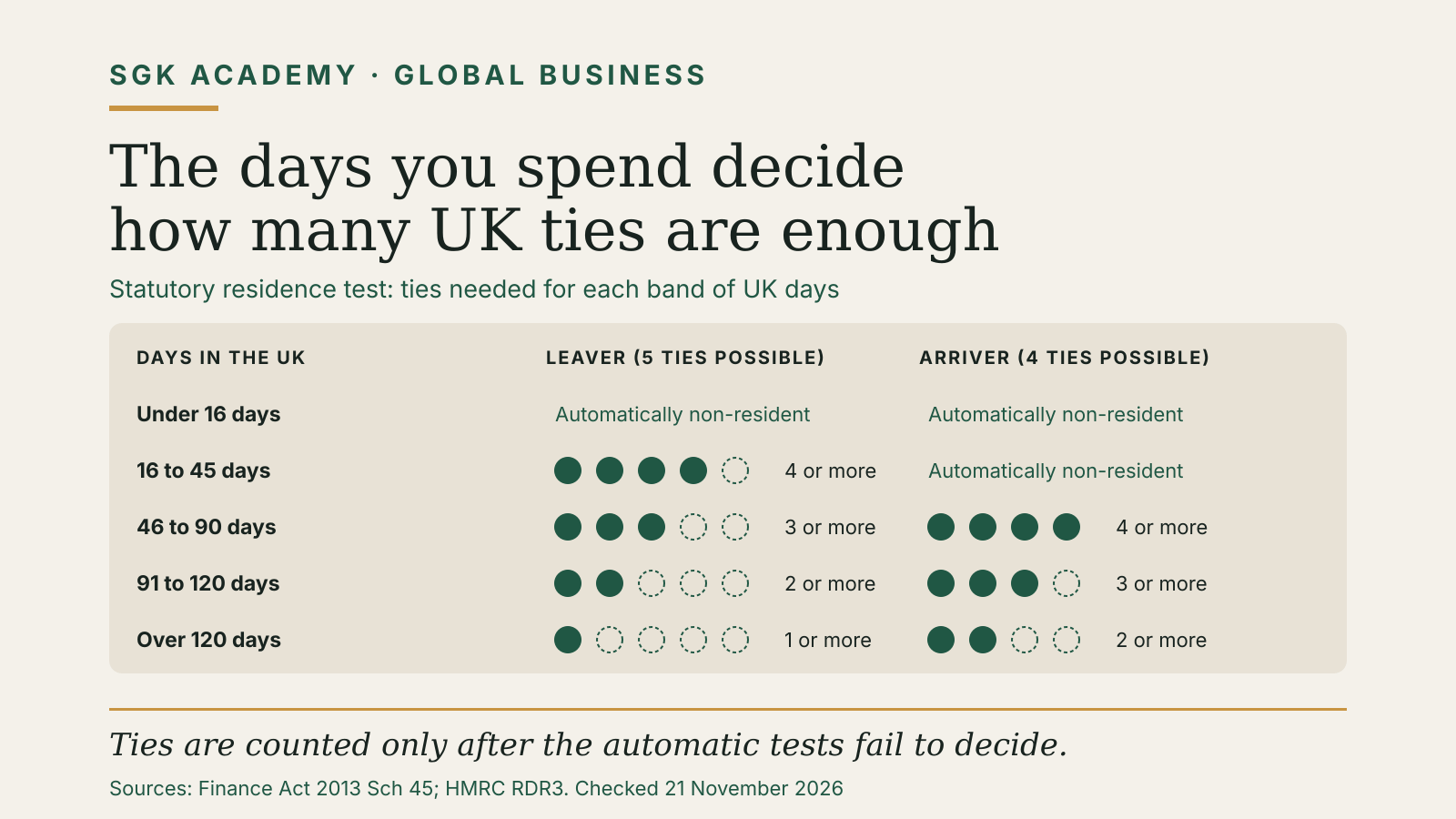
How many ties for how many days
| Days in the UK | Resident in one or more of the previous three years (leaver) | Resident in none of the previous three years (arriver) |
|---|---|---|
| Fewer than 16 | Non-resident (automatic test) | Non-resident (automatic test) |
| 16 to 45 | At least 4 ties | Non-resident (automatic test) |
| 46 to 90 | At least 3 ties | All 4 ties |
| 91 to 120 | At least 2 ties | At least 3 ties |
| More than 120 | At least 1 tie | At least 2 ties |
Read the table with the right column for you. The common trap is reading the leaver column as if it were the arriver column: at 100 days, a leaver with two ties is resident and an arriver with two ties is not.
Four worked examples
All people and figures below are invented for illustration. In each, assume no automatic overseas test and no automatic UK test is met, so the ties decide.
A leaver who keeps a flat and takes on UK work
Nadia was UK resident in 2025/26 and spent 120 days in the UK that year. In 2026/27 she lives in Portugal and spends 62 nights in the UK. She kept a UK flat that is available all year and she sleeps there on her visits. Her partner and children live in Portugal, and the UK is not the country where she spends the most midnights.
| Tie | Met? |
|---|---|
| Family | No |
| Accommodation | Yes, the flat |
| Work | No, 20 UK working days |
| 90-day | Yes, 120 days in the previous year |
| Country | No, Portugal has more midnights |
Two ties at 62 days. A leaver needs 3 ties at 46 to 90 days, so Nadia is non-resident. If she takes UK client work and reaches 40 UK working days, the work tie is met, she has three ties, and she is resident for the year with no change in the nights she sleeps in the UK. The work tie counts any day of more than 3 hours of work in the UK, including day trips with no overnight stay.
An arriver with 100 days
Tom has not been UK resident in any of the last three tax years. In 2026/27 he spends 100 nights in the UK, renting a flat for six months and working in the UK on 45 days. His partner lives abroad. He spent 30 days in the UK in the previous year, so he has no 90-day tie.
His ties are accommodation and work: two. An arriver needs 3 ties at 91 to 120 days, so Tom is non-resident. If his partner moves to the UK and is UK resident for the year, the family tie is met, he has three ties and he is resident. In the leaver column, two ties at 100 days would already have been enough, which is why the history matters.
The deeming rule at work
Priya was UK resident last year and has three UK ties this year (family, accommodation and 90-day). She sleeps in the UK on 40 nights and is in the UK at some point on another 38 days without being there at midnight, for example day trips and late departures.
- Without the rule: 40 days. A leaver needs 4 ties at 16 to 45 days, so she would be non-resident with three.
- With the rule: she has three ties, was resident in a previous year and has more than 30 qualifying days, so 38 minus 30 gives 8 extra days. Her count is 48.
At 46 to 90 days a leaver needs 3 ties. Priya has 3, so she is resident. HMRC’s own examples at RFIG20720 use the same arithmetic; one has 35 midnight days and 57 other days, which becomes 62.
Why 14 days beats a UK home
Marcus left the UK two years ago and was UK resident in 2024/25. He still owns a house in the UK, where his family lives, and he visits for 14 nights in 2026/27. He has the family tie, the accommodation tie and perhaps others, but none of that is counted: he spends fewer than 16 days in the UK, so he meets the first automatic overseas test and is non-resident. With 16 to 45 days he would need four ties, and the same house and family would no longer settle it on their own.
After you have the answer
- Self Assessment. HMRC’s SA109 residence pages and notes say to complete the residence pages if you are not UK resident, became resident during the year, or are due split year treatment. The days box holds days in the UK at midnight plus any deemed days, and HMRC asks you to note in box 54 how many deemed days are included. The 2025/26 notes describe those boxes.
- Split year. Split year treatment applies only to someone who is UK resident for the year. The notes list eight cases: three for leaving and five for arriving. Meeting one divides the year into a UK part and an overseas part.
- Filing dates. Company filing rules are in our filing deadlines calculator. For your own Self Assessment return, use HMRC’s dates.
What the test does not decide
- Your company’s residence. A company is resident where it is incorporated or centrally managed, a separate question covered in company tax residence. Your own residence and your company’s residence can differ.
- Other countries’ tests. The UK’s number is not the number elsewhere. The 183-day rule guide compares the UK test with Spain, Germany, France, the US, Canada and the treaty salary test.
- Treaty residence. If two countries both treat you as resident, a tax treaty tie-breaker decides which one counts for treaty purposes. The certificate of tax residence guide covers the paperwork.
- Business presence abroad. Working from another country can create a taxable presence for your company; see permanent establishment and remote work.
- UK company facts. For company tax and registration figures, use the United Kingdom entry in our jurisdictions catalog.
A day log that stands up
The count is yours to prove, so keep it as you go:
- one row per day with where you were at midnight, and a separate column for days in the UK that did not include midnight (they feed the deeming rule);
- a column for any day on which you worked more than 3 hours in the UK, for the work tie and the 40-day limit;
- the dates the UK accommodation was available, and any night you slept there;
- for the 90-day tie, the previous two years’ midnight totals;
- boarding passes, tickets and bookings for every crossing, and a note on any transit day or exceptional-circumstances day.