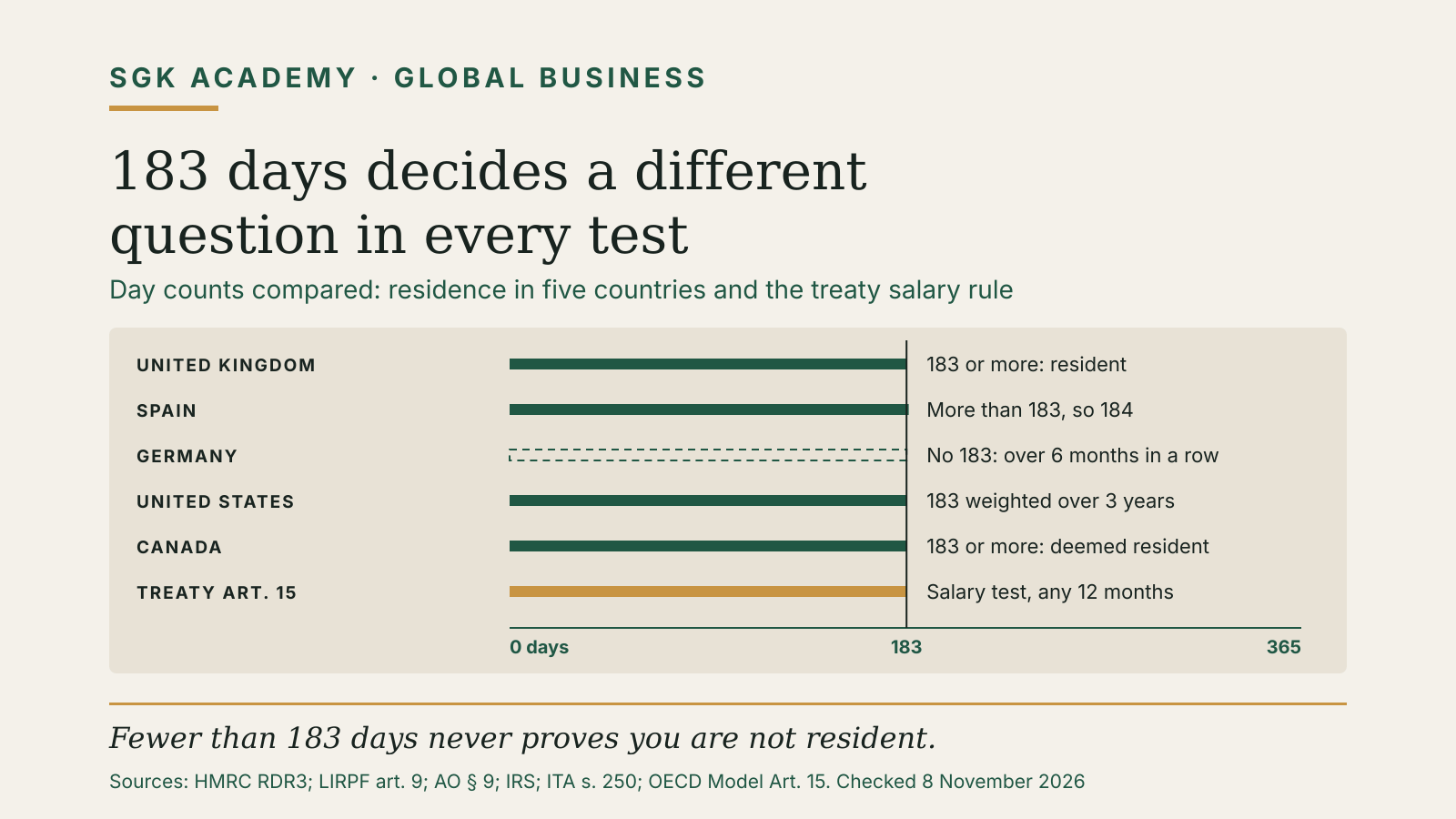
The 183-day rule is not one rule. It is a number that turns up in several unrelated tests, and each test counts days differently, over a different period, and decides a different question. In some countries 183 days of presence makes you tax resident. In tax treaties, staying at or under 183 days keeps an employee’s salary taxable only at home, and only if two other conditions hold. In Germany and France the statute does not use the number at all.
So “I stayed under 183 days” answers nothing until you know which test you are under. Staying under it never proves you are not resident somewhere, because every country below can make you resident on other grounds.
Checked on 8 November 2026 against the statutes and tax authority pages linked in each section. This is a general guide to how the tests work, not advice on anyone’s residence.
Six countries and the treaty test side by side
| Test | The day threshold | Period counted | How a day counts | Resident without the days? |
|---|---|---|---|---|
| UK statutory residence test | 183 days or more makes you resident automatically | UK tax year | Present at the end of the day (midnight) | Yes: UK home test, full-time UK work test, or the sufficient ties test from 16 days |
| Spain (IRPF art. 9) | More than 183 days, so 184 | Calendar year | Any day of certified presence counts in full; sporadic absences are added back | Yes: centre of economic interests in Spain; spouse and minor children living in Spain create a presumption |
| Germany (AO §§ 8, 9) | No 183-day figure. A continuous stay of more than six months is a habitual abode | Any continuous six-month stay, even across two years | Short interruptions are ignored | Yes: keeping and using a home in Germany (Wohnsitz) is enough from the first day |
| France (CGI art. 4 B) | No day count in the statute | Not applicable | Not applicable | Yes: home or principal stay, main professional activity, or centre of economic interests in France |
| United States (substantial presence) | 183 weighted days over three years, with at least 31 in the current year | Current and two previous calendar years | Any part of a day | This table covers the day test only; the closer connection exception can take you out even when it is met |
| Canada (ITA s. 250(1)(a)) | Sojourning 183 days or more makes you a deemed resident for the whole year | Calendar year | Any part of a day | Yes: factual residence through significant residential ties |
| Tax treaty, OECD Article 15(2) | Employment income stays taxable only at home if presence does not exceed 183 days, and two other conditions are met | Any 12-month period starting or ending in the fiscal year | Any part of a day; transit days excluded | Not a residence test |
The rest of this guide takes each line in turn, then runs the same travel diary through several of them.
United Kingdom: 183 days is the automatic UK test
HMRC’s RDR3 guidance on the statutory residence test puts it plainly: if you spend 183 or more days in the UK in the tax year, you are UK resident and no other test needs checking. Below 183 days, you work through the automatic overseas tests first, then the other automatic UK tests, then the sufficient ties test.
The ties test is why many people become UK resident on far fewer days. Someone who was UK resident in any of the previous three tax years needs only one UK tie once they spend more than 120 days in the UK, and four ties at 16 to 45 days. Someone who was not UK resident in any of those three years needs two ties above 120 days and all four ties at 46 to 90 days.
A UK day is a day on which you are in the UK at the end of the day. HMRC’s manual at RFIG20720 adds a deeming rule for people who leave: if you were UK resident in one of the last three tax years, have at least three UK ties and are in the UK on more than 30 days without being there at midnight, every such day after the first 30 counts as a UK day.
Spain: more than 183 days, with absences added back
Article 9 of the IRPF law makes you resident in Spain if you stay there more than 183 days in the calendar year. The Agencia Tributaria’s 2025 IRPF manual states the threshold as 184 days and explains how the tax courts build the count from three parts:
- certified presence: any day for which there is evidence that you were in Spain counts in full, with no minimum number of hours;
- presumed days: a reasonable run of days between two certified days can be counted, unless you prove you were elsewhere;
- sporadic absences: time abroad is added back to the Spanish total unless you prove tax residence in another country with a certificate.
The last point catches people who spend four months travelling and assume those months are “not Spain”. Without a certificate of residence elsewhere, Spain can count them. Our guide to the certificate of tax residence covers how those certificates are issued.
Days are not the only route. You are also resident if your main centre of activities or economic interests is in Spain, and the law presumes residence when your spouse (not legally separated) and dependent minor children live there habitually.
Germany: six months, not 183 days
German law has no 183-day residence rule. Section 9 of the Fiscal Code treats a continuous stay of more than six months as a habitual abode from the first day, and short interruptions do not break it. Stays purely for visits, holidays, cures or similar private purposes are excluded if they last no more than a year.
The six months can run across two calendar years. A stay from 1 October to 15 April is more than six months even though neither year holds more than 105 days of it.
The stronger trigger is often section 8: you have a domicile in Germany if you keep a dwelling there in circumstances showing you will keep and use it. A founder who rents a flat in Berlin and lives in it can be resident from the day of moving in.
France: no day count in the law
Article 4 B of the Code général des impôts lists three criteria, any one of which makes you tax domiciled in France: your home (foyer) or principal place of stay is in France; you carry on a professional activity there that is not merely ancillary; or the centre of your economic interests is in France. The article contains no number of days.
Counting days can still be evidence of where your principal stay was, but a person who keeps their family home in France can be domiciled there while spending most of the year abroad. The same article says a treaty that treats you as resident elsewhere overrides these criteria.
United States: 183 weighted days over three years
The IRS substantial presence test is met if you are physically present in the US on at least 31 days in the current year and the weighted total reaches 183:
- every day in the current year,
- one third of the days in the previous year, and
- one sixth of the days in the year before that.
Any part of a day counts. Days in transit for less than 24 hours between two places outside the US, regular commuting days from Canada or Mexico, and days as an exempt individual (certain students, teachers, trainees and foreign government-related visa holders) do not.
Worked example with the IRS formula: 150 days in 2024, 120 days in 2025, 130 days in 2026.
| Year | Days present | Weight | Counted days |
|---|---|---|---|
| 2026 | 130 | all | 130 |
| 2025 | 120 | 1/3 | 40 |
| 2024 | 150 | 1/6 | 25 |
| Total | 195 |
195 is 183 or more, so the test is met for 2026, even though no single year reached 183 days. The IRS’s closer connection exception can still treat this person as non-resident if they qualify: it is available to someone present on fewer than 183 days in the current year who kept a tax home in one foreign country all year, had a closer connection to it than to the US, and had not applied for a green card.
Canada: 183 days makes you resident for the whole year
Under section 250(1)(a) of the Income Tax Act, a person who sojourns in Canada for 183 days or more in a year is deemed resident throughout that year. The CRA’s Income Tax Folio S5-F1-C1 explains two consequences people miss.
First, any part of a day counts, but only days on which you are sojourning, meaning staying temporarily in Canada. A commuter who works in Canada and goes home across the border each night is not sojourning.
Second, a deemed resident is taxed on worldwide income for the entire year, not only from the date of arrival. The CRA’s deemed residents page adds that the rule does not apply if a tax treaty makes you resident of the other country.
The deeming rule only matters if you are not already a factual resident. Someone who moves to Canada with a home, a spouse and a bank account there is resident because of those ties, whatever the day count.
The treaty 183-day test is about salary, not residence
This is the 183-day rule most employers mean. Article 15(2) of the OECD Model Tax Convention says salary for work done in the other country stays taxable only in the employee’s country of residence if all three conditions are met:
- the employee is present in the other country for no more than 183 days in total in any twelve-month period starting or ending in the fiscal year concerned;
- the pay comes from an employer that is not resident in the other country; and
- the pay is not borne by a permanent establishment the employer has there.
Fail any one of them and the country where the work is done may tax the salary for those workdays from the first day. A founder employed by their own company, which is resident in the country where they are working, fails condition 2 however short the stay.
The Commentary on Article 15 (paragraph 5) says the only method consistent with the wording is counting days of physical presence: part of a day, the day of arrival, the day of departure, weekends, holidays and sick days spent in the country all count. Days in transit between two points outside the country do not. Paragraph 4 of the same Commentary notes that the 1963 and 1977 versions of the model counted 183 days “in the fiscal year concerned”, and that every possible twelve-month period must be checked under the current wording. Older bilateral treaties can still carry the earlier formula, so read the treaty that actually applies.
The article covers employees. Business profits of the self-employed and of companies fall under different articles, where the question is whether there is a permanent establishment, which no day count settles on its own. Our guide to permanent establishment and remote work covers that.
Worked example: a rolling window across two calendar years
An employee resident in Country A, paid by an employer in Country A, works in Country B from 1 September 2026 to 15 March 2027. Assume the treaty follows the OECD wording and both countries use calendar tax years.
| Period | Days present in Country B |
|---|---|
| 1 September to 31 December 2026 | 122 |
| 1 January to 15 March 2027 | 74 |
| Twelve months from 1 September 2026 | 196 |
Each calendar year on its own stays under 183 days. The twelve-month period from 1 September 2026 to 31 August 2027 starts in fiscal year 2026 and holds 196 days, so condition 1 fails for both years. Country B may tax the salary for the workdays spent there, and Country A then gives relief under the treaty’s double taxation article.
One diary, counted four ways
The same travel pattern produces different totals depending on the test. Take a founder based outside the country in question who, in one year, spends 140 nights there, makes 20 day trips in and out without staying overnight, and changes planes there 4 times on the way between two other countries without leaving the airport.
| Test | Days counted | Why |
|---|---|---|
| UK statutory residence test | 140 | Only days present at midnight count, and overnight transit days are excluded (RFIG20730). The 20 day trips and 4 plane changes stay out unless the deeming rule applies, which needs more than 30 such days |
| Treaty Article 15 (OECD Commentary) | 160 | Part days count; transit days are excluded |
| US substantial presence (current-year days) | 160 | Part days count; transit of less than 24 hours between two foreign points is excluded |
| Spain | At least 160 | Certified days count in full, presumed days between them can be added, and absences are added back without a foreign residence certificate |
None of these totals crosses 183, yet the founder could still be resident in the UK under the ties test, in Spain through the centre of economic interests, or in Germany through a kept home. Under the US test, 160 current-year days plus weighted days from the two earlier years can reach 183.
When two countries both say you are resident
Each country applies its own law, so two countries can both treat you as resident in the same year. A treaty between them settles it with the tie-breaker in Article 4(2) of the OECD model, applied in this order:
- where you have a permanent home available to you;
- if you have one in both countries, where your personal and economic relations are closer (centre of vital interests);
- if that cannot be decided, or you have no permanent home in either, where you have a habitual abode;
- then nationality;
- and if that does not decide it, the two tax authorities settle it by mutual agreement.
Day counts only enter at step 3, as evidence of habitual abode. A permanent home comes first.
What the 183-day rule does not decide
- Social security. Which country’s contributions you pay inside the EU, EEA and Switzerland follows the coordination regulations and is evidenced by an A1 certificate, not by income tax day counts.
- Your company’s tax residence. A company’s residence turns on where it is incorporated and where it is managed, covered in company tax residence.
- Special regimes. Regimes for new arrivals have their own entry tests; our IFICI Portugal guide sets out one of them.
- Immigration. A residence permit and tax residence are separate. The Agencia Tributaria notes that a person can hold a residence permit in a country without being tax resident there.
A day log that will stand up
Every test above depends on evidence of where you were. Keep it as you go rather than rebuilding it from a passport later:
- one row per day, with the country where you were at midnight and any other country you were in during the day;
- flight confirmations, boarding passes and hotel or rental invoices for each border crossing;
- a note of transit days, with the through ticket;
- for Spain and any country that adds absences back, a current certificate of tax residence from the country you claim;
- the treaty that applies between each pair of countries and whether its employment article uses a rolling twelve months or a fiscal year.